
Khóa học
IELTS Online
IELTS Online
Giảm đến 18%
Đăng ký ngay
Mục lục [Ẩn]
IELTS Reading luôn là nỗi “ám ảnh” với nhiều thí sinh bởi lượng từ vựng học thuật lớn và các chủ đề đa dạng, lặp lại theo chu kỳ qua nhiều năm. Việc luyện tập các bài đọc hay, sát đề thi thật theo những chủ đề thường gặp nhất sẽ giúp người học làm quen với dạng câu hỏi, cải thiện tốc độ đọc hiểu và ghi nhớ từ vựng hiệu quả hơn. Bài viết dưới đây sẽ tổng hợp những bài đọc IELTS Reading tiêu biểu theo từng chủ đề quen thuộc, kèm định hướng ôn luyện giúp bạn nâng band một cách có chiến lược.
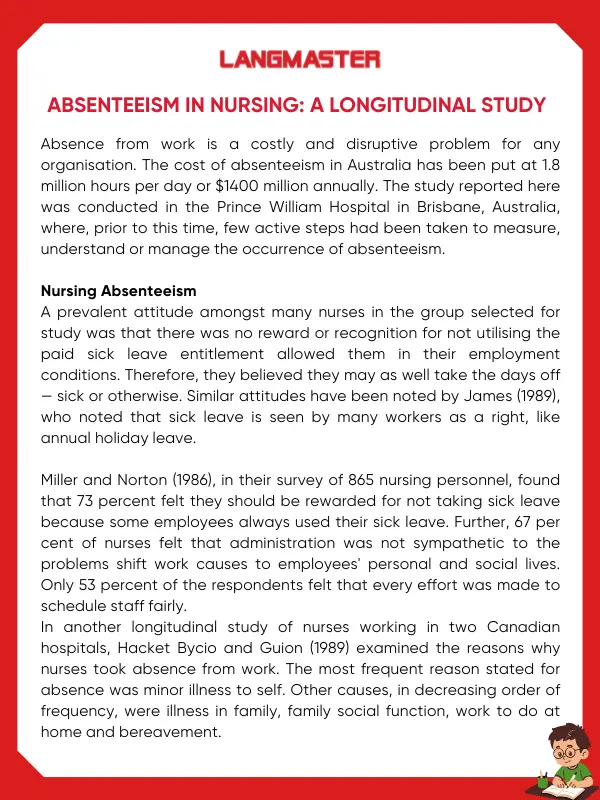
Absence from work is a costly and disruptive problem for any organisation. The cost of absenteeism in Australia has been put at 1.8 million hours per day or $1400 million annually. The study reported here was conducted in the Prince William Hospital in Brisbane, Australia, where, prior to this time, few active steps had been taken to measure, understand or manage the occurrence of absenteeism.
Nursing Absenteeism
A prevalent attitude amongst many nurses in the group selected for study was that there was no reward or recognition for not utilising the paid sick leave entitlement allowed them in their employment conditions. Therefore, they believed they may as well take the days off — sick or otherwise. Similar attitudes have been noted by James (1989), who noted that sick leave is seen by many workers as a right, like annual holiday leave.
Miller and Norton (1986), in their survey of 865 nursing personnel, found that 73 percent felt they should be rewarded for not taking sick leave because some employees always used their sick leave. Further, 67 per cent of nurses felt that administration was not sympathetic to the problems shift work causes to employees' personal and social lives. Only 53 percent of the respondents felt that every effort was made to schedule staff fairly.
In another longitudinal study of nurses working in two Canadian hospitals, Hacket Bycio and Guion (1989) examined the reasons why nurses took absence from work. The most frequent reason stated for absence was minor illness to self. Other causes, in decreasing order of frequency, were illness in family, family social function, work to do at home and bereavement.
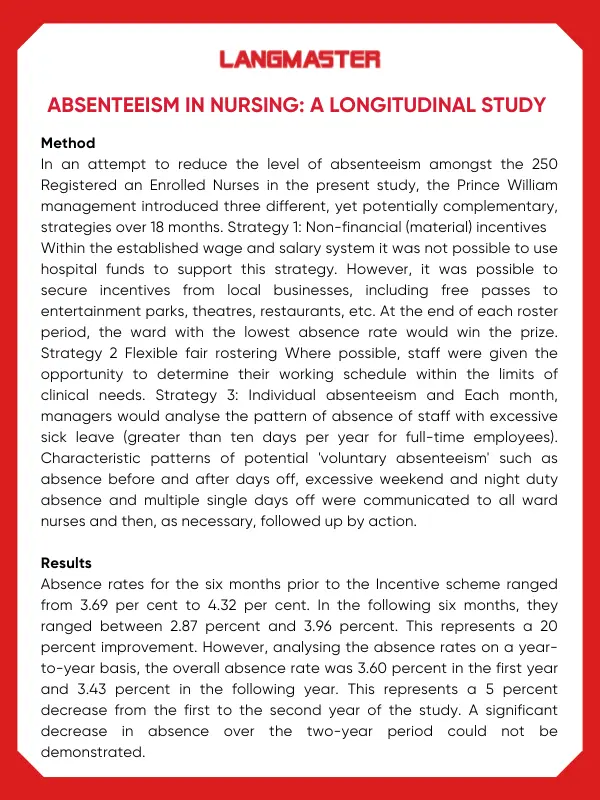
Method
In an attempt to reduce the level of absenteeism amongst the 250 Registered an Enrolled Nurses in the present study, the Prince William management introduced three different, yet potentially complementary, strategies over 18 months. Strategy 1: Non-financial (material) incentives
Within the established wage and salary system it was not possible to use hospital funds to support this strategy. However, it was possible to secure incentives from local businesses, including free passes to entertainment parks, theatres, restaurants, etc. At the end of each roster period, the ward with the lowest absence rate would win the prize. Strategy 2 Flexible fair rostering
Where possible, staff were given the opportunity to determine their working schedule within the limits of clinical needs. Strategy 3: Individual absenteeism and
Each month, managers would analyse the pattern of absence of staff with excessive sick leave (greater than ten days per year for full-time employees). Characteristic patterns of potential 'voluntary absenteeism' such as absence before and after days off, excessive weekend and night duty absence and multiple single days off were communicated to all ward nurses and then, as necessary, followed up by action.
Results
Absence rates for the six months prior to the Incentive scheme ranged from 3.69 per cent to 4.32 per cent. In the following six months, they ranged between 2.87 percent and 3.96 percent. This represents a 20 percent improvement. However, analysing the absence rates on a year-to-year basis, the overall absence rate was 3.60 percent in the first year and 3.43 percent in the following year. This represents a 5 percent decrease from the first to the second year of the study. A significant decrease in absence over the two-year period could not be demonstrated.
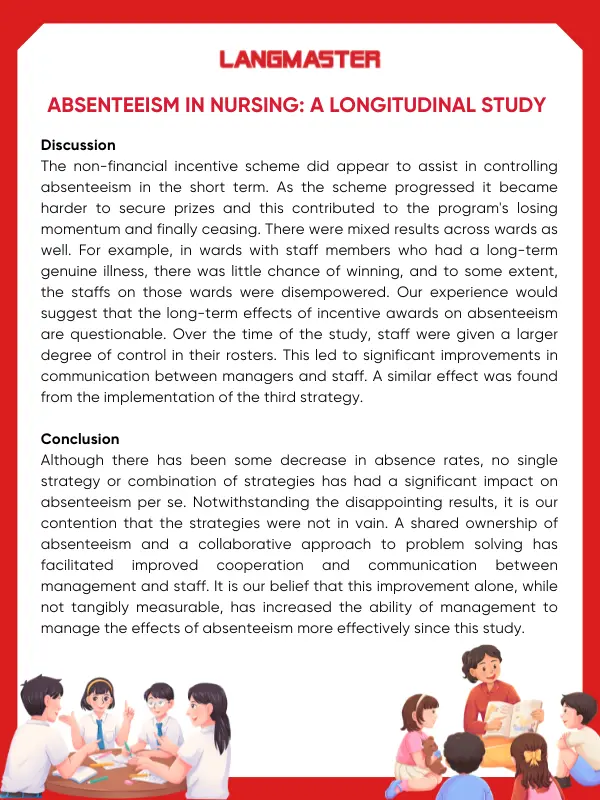
Discussion
The non-financial incentive scheme did appear to assist in controlling absenteeism in the short term. As the scheme progressed it became harder to secure prizes and this contributed to the program's losing momentum and finally ceasing. There were mixed results across wards as well. For example, in wards with staff members who had a long-term genuine illness, there was little chance of winning, and to some extent, the staffs on those wards were disempowered. Our experience would suggest that the long-term effects of incentive awards on absenteeism are questionable.
Over the time of the study, staff were given a larger degree of control in their rosters. This led to significant improvements in communication between managers and staff. A similar effect was found from the implementation of the third strategy. Many of the nurses had not realised the impact their behaviour was having on the organisation and their colleagues but there were also staff members who felt that talking to them about their absenteeism was 'picking' on them and this usually had a negative effect on management—employee relationships.
Conclusion
Although there has been some decrease in absence rates, no single strategy or combination of strategies has had a significant impact on absenteeism per se. Notwithstanding the disappointing results, it is our contention that the strategies were not in vain. A shared ownership of absenteeism and a collaborative approach to problem solving has facilitated improved cooperation and communication between management and staff. It is our belief that this improvement alone, while not tangibly measurable, has increased the ability of management to manage the effects of absenteeism more effectively since this study.
["This article has been adapted and condensed from the article by G. William and K. Slater (1996), 'Absenteeism in nursing: A longitudinal study', Asia Pacific Journal of Human Resources, 34(1): 111-21. Names and other details have been changed and report findings may have been given a different emphasis from the original. We are grateful to the authors and Asia Pacific Journal of Human Resources for allowing us to use the material in this way. " ]
>> Xem thêm: Đề thi IELTS Reading có đáp án mới nhất [Cập nhật liên tục]
Questions 1-7
Do the following statements agree with the information given in Reading Passage 1. In boxes 1-7 on your answer sheet write:
YES if the statement agrees with the information
NO if the statement contradicts the information
NOT GIVEN if there is no information on this in the passage
1. The Prince William Hospital has been trying to reduce absenteeism amongst nurses for many years.
2. Nurses in the Prince William Hospital study believed that there were benefits in taking as little sick leave as possible.
3. Just over half the nurses in the 1986 study believed that management understood the effects that shift work had on them.
4. The Canadian study found that 'illness in the family' was a greater cause of absenteeism than 'work to do at home'.
5. In relation to management attitude to absenteeism the study at the Prince William Hospital found similar results to the two 1989 studies.
6. The study at the Prince William Hospital aimed to find out the causes of absenteeism amongst 250 nurses.
7. The study at the Prince William Hospital involved changes in management practices.
Questions 8-13
Complete the notes below. Choose ONE OR TWO WORDS from the passage, for each answer. Write your answers in boxes 8-13 on your answer sheet.
In the first strategy, wards with the lowest absenteeism in different periods would win prizes donated by ....... (8) .......
In the second strategy, staff were given more control over their ......(9 )........
In the third strategy, nurses who appeared to be taking ...... (10)...... sick leave or ...... (11) ...... were identified and counselled.
Initially, there was a ...... (12)...... per cent decrease in absenteeism.
The first strategy was considered ineffective and stopped.
The second and third strategies generally resulted in better ...... (13) ...... among staff.
ĐÁP ÁN:
|
Câu 1. NO |
Câu 7. (local) businesses |
|
Câu 2. NO |
Câu 8. (work/working) schedule//rostering//roster(s) |
|
Câu 3. NO |
Câu 10. excessive |
|
Câu 4. YES |
Câu 11. voluntary absence/absenteeism |
|
Câu 5. NOT GIVEN |
Câu 12. twenty// 20 |
|
Câu 6. NO |
Câu 13. communication |
|
Câu 7. YES |
>> Xem thêm: Đáp án the development of the London underground railway - Cam 17, Test 1
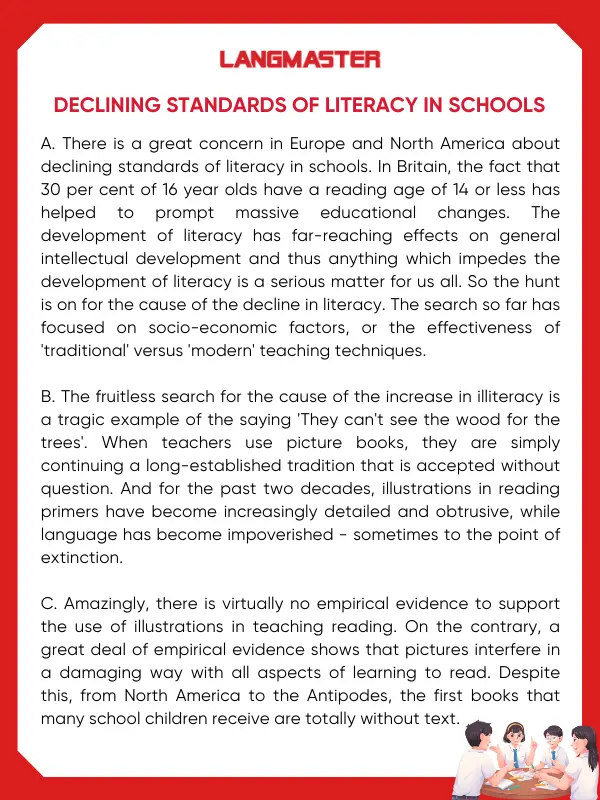
A. There is a great concern in Europe and North America about declining standards of literacy in schools. In Britain, the fact that 30 per cent of 16 year olds have a reading age of 14 or less has helped to prompt massive educational changes. The development of literacy has far-reaching effects on general intellectual development and thus anything which impedes the development of literacy is a serious matter for us all. So the hunt is on for the cause of the decline in literacy. The search so far has focused on socio-economic factors, or the effectiveness of 'traditional' versus 'modern' teaching techniques.
B. The fruitless search for the cause of the increase in illiteracy is a tragic example of the saying 'They can't see the wood for the trees'. When teachers use picture books, they are simply continuing a long-established tradition that is accepted without question. And for the past two decades, illustrations in reading primers have become increasingly detailed and obtrusive, while language has become impoverished - sometimes to the point of extinction.
C. Amazingly, there is virtually no empirical evidence to support the use of illustrations in teaching reading. On the contrary, a great deal of empirical evidence shows that pictures interfere in a damaging way with all aspects of learning to read. Despite this, from North America to the Antipodes, the first books that many school children receive are totally without text.
D. A teacher's main concern is to help young beginner readers to develop not only the ability to recognise words, but the skills necessary to understand what these words mean. Even if a child is able to read aloud fluently, he or she may not be able to understand much of it: this is called 'barking at text'. The teacher's task of improving comprehension is made harder by influences outside the classroom. But the adverse effects of such things as television, video games, or limited language experiences at home, can be offset by experiencing 'rich' language at school.
E. Instead, it is not unusual for a book of 30 or more pages to have only one sentence full of repetitive phrases. The artwork is often marvellous, but the pictures make the language redundant, and the children have no need to imagine anything when they read such books. Looking at a picture actively prevents children younger than nine from creating a mental image, and can make it difficult for older children. In order to learn how to comprehend, they need to practise making their own meaning in response to text. They need to have their innate powers of imagination trained.
F. As they grow older, many children turn aside from books without pictures, and it is a situation made more serious as our culture becomes more visual. It is hard to wean children off picture books when pictures have played a major part throughout their formative reading experiences, and when there is competition for their attention from so many other sources of entertainment. The least intelligent are most vulnerable, but tests show that even intelligent children are being affected. The response of educators has been to extend the use of pictures in books and to simplify the language, even at senior levels. The Universities of Oxford and Cambridge recently held joint conferences to discuss the noticeably rapid decline in literacy among their undergraduates.
G. Pictures are also used to help motivate children to read because they are beautiful and eye-catching. But motivation to read should be provided by listening to stories well read, where children imagine in response to the story. Then, as they start to read, they have this experience to help them understand the language. If we present pictures to save children the trouble of developing these creative skills, then I think we are making a great mistake.
H. Academic journals ranging from educational research, psychology, language learning, psycholinguistics, and so on cite experiments which demonstrate how detrimental pictures are for beginner readers. Here is a brief selection:
I. The research results of the Canadian educationalist Dale Willows were clear and consistent: pictures affected speed and accuracy and the closer the pictures were to the words, the slower and more inaccurate the child's reading became. She claims that when children come to a word they already know, then the pictures are unnecessary and distracting. If they do not know a word and look to the picture for a clue to its meaning, they may well be misled by aspects of the pictures which are not closely related to the meaning of the word they are trying to understand.
J. Jay Samuels, an American psychologist, found that poor readers given no pictures learnt significantly more words than those learning to read with books with pictures. He examined the work of other researchers who had reported problems with the use of pictures and who found that a word without a picture was superior to a word plus a picture. When children were given words and pictures, those who seemed to ignore the pictures and pointed at the words learnt more words than the children who pointed at the pictures, but they still learnt fewer words than the children who had no illustrated stimuli at all.
>> Xem thêm: Giải đề Back to the future of skyscraper design [Cam IELTS 14, Test 2]
Questions 14-17
Choose the appropriate letters A-D and write them in boxes 14-17 on your answer sheet.
14. Readers are said to 'bark' at a text when ...
A. they read too loudly.
B. there are too many repetitive words.
C. they are discouraged from using their imagination.
D. they have difficulty assessing its meaning.
15. The text suggests that...
A. pictures in books should be less detailed.
B. pictures can slow down reading progress.
C. picture books are best used with younger readers.
D. pictures make modern books too expensive
16. University academics are concerned because ...
A. young people are showing less interest in higher education.
B. students cannot understand modern academic texts.
C. academic books are too childish for their undergraduates.
D. there has been a significant change in student literacy.
17. The youngest readers will quickly develop good reading skills if they ...
A. learn to associate the words in a text with pictures.
B. are exposed to modern teaching techniques.
C. are encouraged to ignore pictures in the text.
D. learn the art of telling stories.
Questions 18-21
Do the following statements agree with the information given in Reading Passage 2? In boxes 18-21 on your answer sheet, write:
YES if the statement agrees with the information
NO if the statement contradicts the information
NOT GIVEN if there is no information about this in the passage
18. It is traditionally accepted that children's books should contain few pictures.
19. Teachers aim to teach both word recognition and word meaning.
20. Older readers are having difficulty in adjusting to texts without pictures.
21. Literacy has improved as a result of recent academic conferences.
Questions 22-25
Reading Passage 2 has ten paragraphs, A-J. Which paragraphs state the following information? Write the appropriate letters A-J in boxes 22-25 on your answer sheet.
NB There are more paragraphs than summaries, so you will not use them all.
22. The decline of literacy is seen in groups of differing ages and abilities.
23. Reading methods currently in use go against research findings.
24. Readers able to ignore pictures are claimed to make greater progress.
25. Illustrations in books can give misleading information about word meaning.
Question 26
From the list below choose the most suitable title for the whole of Reading Passage 2. Write the appropriate letter A-E in box 26 on your answer sheet.
A. The global decline in reading levels
B. Concern about recent educational developments
C. The harm that picture books can cause
D. Research carried out on children's literature
E. An examination of modern reading style
ĐÁP ÁN:
|
Câu 14. D |
Câu 20. YES |
|
Câu 15. B |
Câu 21. NOT GIVEN |
|
Câu 16. D |
Câu 22. F |
|
Câu 17. C |
Câu 23. C |
|
Câu 18. NO |
Câu 24. J |
|
Câu 19. YES |
Câu 25. I |
|
Câu 26. C |
>> Xem thêm: Why companies should welcome disorder [Cam 14, Test 2, Passage 3]
Johnson's Dictionary
For the century before Johnson's Dictionary was published in 1775, there had been concern about the state of the English language.There was no standard way of speaking or writing and no agreement as to the best way of bringing some order to the chaos' of English spelling. Dr Johnson provided the solution.
There had, of course, been dictionaries in the past, the first of these being a little book of some 120 pages, compiled by a certain Robert Cawdray, published in 1604 under the title A Table Alphabetical! ‘of hard usual English wordes'. Like the various dictionaries that came after it during the seventeenth century, Cawdray's tended to concentrate on 'scholarly' words; one function of the dictionary was to enable its student to convey an impression of fine learning.
Beyond the practical need to make order out of chaos, the rise of dictionaries is associated with the rise of the English middle class, who were anxious to define and circumscribe the various worlds to conquer - lexical as well as social and commercial. It is highly appropriate that Dr Samuel Johnson, the very model of an eighteenth-century literary man, as famous in his own time as in ours, should have published his dictionary at the very beginning of the heyday of the middle class.
Johnson was a poet and critic who raised common sense to the heights of genius. His approach to the problems that had worried writers throughout the late seventeenth and early eighteenth centuries was intensely practical. Up until his time, the task of producing a dictionary on such a large scale had seemed impossible without the establishment of an academy to make decisions about right and wrong usage Johnson decided he did not need an academy to settle arguments about language; he would write a dictionary himself; and he would do it single-handed. Johnson signed the contract for the Dictionary with the bookseller Robert Dosley at a breakfast held at the Golden Anchor Inn near Holbom Bar on 18 June 1764. He was to be paid £ 1.575 in instalments, and from this he took money to rent 17 Gough Square, in which he set up his 'dictionary workshop'.
James Boswell, his biographer described the garret where Johnson worked as ‘fitted up like a counting house' with a long desk running down the middle at which the copying clerks would work standing up. Johnson himself was stationed on a rickety chair at an 'old crazy deal table' surrounded by a chaos of borrowed books. He was also helped by six assistants, two of whom died whilst the Dictionary was still in preparation.
The work was immense; filling about eighty large notebooks (and without a library to hand). Johnson wrote the definitions of over 40,000 words, and illustrated their many meanings with some I 14.000 quotations drawn from English writing on every subject, from the Elizabethans to his own time. He did not expect to achieve complete originality. Working to a deadline, he had to draw on the best of all previous dictionaries, and to make his work one of heroic synthesis. In fact it was very much more. Unlike his predecessors. Johnson treated English very practically, as a living language, with many different shades of meaning. He adopted his definitions on the principle of English common law - according to precedent. After its publication, his Dictionary was not seriously rivalled for over a century.
After many vicissitudes the Dictionary was finally published on 15 April 1775. It was instantly recognised as a landmark throughout Europe. This very noble work.’ wrote the leading Italian lexicographer; ‘will be a perpetual monument of Fame to the Author, an Honour to his own Country in particular, and a general Benefit to the republic of Letters throughout Europe.' The fact that Johnson had taken on the Academies of Europe and matched them (everyone knew that forty French academics had taken forty years to produce the first French national dictionary) was cause for much English celebration.
Johnson had worked for nine years.‘with little assistance of the learned, and without any patronage of the great; not in the soft obscurities of retirement, or under the shelter of academic bowers, but amidst inconvenience and distraction, in sickness and in sorrow'. For all its faults and eccentricities his two-volume work is a masterpiece and a landmark, in his own words, 'setting the orthography, displaying the analogy, regulating the structures, and ascertaining the significations of English words’. It is the corner-stone of Standard English, an achievement which, in James Boswell’s words,‘conferred stability on the language of his country'.
The Dictionary, together with his other writing, made Johnson famous and so well esteemed that his friends were able to prevail upon King George III to offer him a pension. From then on, he was to become the Johnson of folklore.
>> Xem thêm: Giải IELTS Reading Cam 16, Test 2: The white horse of uffington
Questions 1-3
Choose THREE letters A-H. Write your answers in boxes 1-3 on your answer sheet.
NB Your answers may be given in any order.
Which THREE of the following statements are true of Johnson’s Dictionary?
A. It avoided all scholarly words.
B. It was the only English dictionary in general use for 200 years.
C. It was famous because of the large number of people involved.
D. It focused mainly on language from contemporary texts.
E. There was a time limit for its completion.
F. It ignored work done by previous dictionary writers.
G. It took into account subtleties of meaning.
H. Its definitions were famous for their originality.
Questions 4-7
Complete the summary. Choose NO MORE THAN TWO WORDS from the passage for each answer. Write your answers in boxes 4-7 on your answer sheet.
In 1764 Dr Johnson accepted the contract to produce a dictionary. Having rented a garret, he took on a number of 4 ............. who stood at a long central desk. Johnson did not have a 5 .................... available to him, but eventually produced definitions of in excess of 40,000 words written down in 80 large notebooks. On publication, the Dictionary was immediately hailed in many European countries as a landmark. According to his biographer, James Boswell, Johnson’s principal achievement was to bring 6 ................. to the English language. As a reward for his hard work, he was granted a 7 ..................... by the king.
Questions 8-13
Do the following statements agree with the information given in Reading Passage? In boxes 8-13 on your answer sheet, write:
TRUE if the statement agrees with the information
FALSE if the statement contradicts the information
NOT GIVEN if there is no information on this
8. The growing importance of the middle classes led to an increased demand for dictionaries.
9. Johnson has become more well known since his death.
10. Johnson had been planning to write a dictionary for several years.
11. Johnson set up an academy to help with the writing of his Dictionary.
12. Johnson only received payment for his Dictionary on its completion.
13. Not all of the assistants survived to see the publication of the Dictionary.
ĐÁP ÁN:
|
Câu 1. D, E, G IN ANY ORDER |
Câu 7. pension |
|
Câu 2. D, E, G IN ANY ORDER |
Câu 8. TRUE |
|
Câu 3. D, E, G IN ANY ORDER |
Câu 9. FALSE |
|
Câu 4. clerks / copying clerks |
Câu 10. NOT GIVEN |
|
Câu 5. library |
Câu 11. FALSE |
|
Câu 6. stability |
Câu 12. FALSE |
|
Câu 13. TRUE |
>> Xem thêm: Motivational factors and the hospitality industry [Giải đề Cam IELTS 14, Test 1]
A spark, a flint: How fire leapt to life
The control of fire was the first and perhaps greatest of humanity’s steps towards a life-enhancing technology.
To early man, fire was a divine gift randomly delivered in the form of lightning, forest fire or burning lava. Unable to make flame for themselves, the earliest peoples probably stored fire by keeping slow burning logs alight or by carrying charcoal in pots.
How and where man learnt how to produce flame at will is unknown. It was probably a secondary invention, accidentally made during tool-making operations with wood or stone. Studies of primitive societies suggest that the earliest method of making fire was through friction. European peasants would insert a wooden drill in a round hole and rotate it briskly between their palms. This process could be speeded up by wrapping a cord around the drill and pulling on each end.
The Ancient Greeks used lenses or concave mirrors to concentrate the sun’s rays and burning glasses were also used by Mexican Aztecs and the Chinese.
Percussion methods of fire-lighting date back to Paleolithic times, when some Stone Age toolmakers discovered that chipping flints produced sparks. The technique became more efficient after the discovery of iron, about 5000 years ago In Arctic North America, the Eskimos produced a slow-burning spark by striking quartz against iron pyrites, a compound that contains sulphur. The Chinese lit their fires by striking porcelain with bamboo. In Europe, the combination of steel, flint and tinder remained the main method of fire lighting until the mid 19th century.
Fire-lighting was revolutionized by the discovery of phosphorus, isolated in 1669 by a German alchemist trying to transmute silver into gold. Impressed by the element’s combustibility, several 17th century chemists used it to manufacture fire-lighting devices, but the results were dangerously inflammable. With phosphorus costing the equivalent of several hundred pounds per ounce, the first matches were expensive.
The quest for a practical match really began after 1781 when a group of French chemists came up with the Phosphoric Candle or Ethereal Match, a sealed glass tube containing a twist of paper tipped with phosphorus. When the tube was broken, air rushed in, causing the phosphorus self-combust. An even more hazardous device, popular in America, was the Instantaneous Light Box — a bottle filled with sulphuric acid into which splints treated with chemicals were dipped.
The first matches resembling those used today were made in 1827 by John Walker, an English pharmacist who borrowed the formula from a military rocket-maker called Congreve. Costing a shilling a box, Congreves were splints coated with sulphur and tipped with potassium chlorate. To light them, the user drew them quickly through folded glass paper.
Walker never patented his invention, and three years later it was copied by a Samuel Jones, who marketed his product as Lucifers. About the same time, a French chemistry student called Charles Sauria produced the first “strike-anywhere” match by substituting white phosphorus for the potassium chlorate in the Walker formula. However, since white phosphorus is a deadly poison, from 1845 match-makers exposed to its fumes succumbed to necrosis, a disease that eats away jaw-bones. It wasn’t until 1906 that the substance was eventually banned.
That was 62 years after a Swedish chemist called Pasch had discovered non-toxic red or amorphous phosphorus, a development exploited commercially by Pasch’s compatriot J E Lundstrom in 1885. Lundstrom’s safety matches were safe because the red phosphorus was non-toxic; it was painted on to the striking surface instead of the match tip, which contained potassium chlorate with a relatively high ignition temperature of 182 degrees centigrade.
America lagged behind Europe in match technology and safety standards. It wasn’t until 1900 that the Diamond Match Company bought a French patent for safety matches — but the formula did not work properly in the different climatic conditions prevailing in America and it was another 11 years before scientists finally adapted the French patent for the US.
The Americans, however, can claim several “firsts” in match technology and marketing. In 1892 the Diamond Match Company pioneered book matches. The innovation didn’t catch on until after 1896, when a brewery had the novel idea of advertising its product in match books. Today book matches are the most widely used type in the US, with 90 percent handed out free by hotels, restaurants and others.
Other American innovations include an anti-after-glow solution to prevent the match from smoldering after it has been blown out; and the waterproof match, which lights after eight hours in water.
Questions 1-8
Complete the summary below. Choose your answers from the box at the bottom of the page and write them in boxes 1-8 on your answer sheet.
NB There are more words than spaces so you will not use them all You may use any of the words more than once.
EARLY FIRE-LIGHTING METHODS
Primitive Societies saw fire as a ….….(Example)…..… gift. Answer: heavenly
They tried to ...... (1) ...... burning logs or charcoal ...... (2) ...... that they could create fire themselves. It is suspected that the first man-made flames were produced by ...... (3) ......
The very first fire-lighting methods involved the creation of ...... (4) ...... by, for example, rapidly ...... (5) ...... a wooden stick in a round hole. The use of ...... (6) ...... or persistent chipping was also widespread in Europe and among other peoples such as the Chinese and ...... (7) ........ European practice of this method continued until the 1850s ....... (8) ....... the discovery of phosphorus some years earlier.
List of Words
|
Mexicans |
random |
rotating |
despite |
preserve |
realising |
|
sunlight |
lacking |
heavenly |
percussion |
Chance |
friction |
|
unaware |
without |
make |
heating |
Eskimos |
surprised |
|
until |
smoke |
Questions 9-15
Look at the following notes that have been made about the matches described in Reading Passage 32. Decide which type of match (A-H) corresponds with each description and write your answers in boxes 9-15 on your answer sheet.
NB There are more matches than descriptions so you will not use them all. You may use any match more than once.
Example: could be lit after soaking in water. Answer: H
NOTES
9. made using a less poisonous type of phosphorus
10. identical to a previous type of match
11. caused a deadly illness
12. first to look like modern matches
13. first matches used for advertising
14. relied on an airtight glass container
15. made with the help of an army design
Types of Matches
A. the Ethereal Match
B. the Instantaneous Light box
C. Congreves
D. Lucifers
E. the first strike-anywhere match
F. Lundstrom safety match
G. book matches
H. waterproof matches
>> Xem thêm: Giải đề IELTS Reading Cam 16, Test 2: I Contain Multitudes
ĐÁP ÁN:
|
Câu 1. preserve |
Câu 9. F |
|
Câu 2. unaware |
Câu 10. D |
|
Câu 3. chance |
Câu 11. E |
|
Câu 4. friction |
Câu 12. C |
|
Câu 5. rotating |
Câu 13. G |
|
Câu 6. percussion |
Câu 14. A |
|
Câu 7. Eskimos |
Câu 15. C |
|
Câu 8. despite |
|
Spoken Corpus Comes To Life
A. The compiling of dictionaries has been historically the provenance of studious professorial types - usually bespectacled - who love to pore over weighty tomes and make pronouncements on the finer nuances of meaning. They were probably good at crosswords and definitely knew a lot of words, but the image was always rather dry and dusty. The latest technology, and simple technology at that, is revolutionising the content of dictionaries and the way they are put together.
B. For the first time, dictionary publishers are incorporating real, spoken English into their data. It gives lexicographers (people who write dictionaries) access to a more vibrant, up-to-date vernacular language which has never really been studied before. In one project, 150 volunteers each agreed to discreetly tie a Walkman recorder to their waist and leave it running for anything up to two weeks. Every conversation they had was recorded. When the data was collected, the length of tapes was 35 times the depth of the Atlantic Ocean. Teams of audio typists transcribed the tapes to produce a computerised database of ten million words.
C. This has been the basis - along with an existing written corpus - for the Language Activator dictionary, described by lexicographer Professor Randolph Quirk as “the book the world has been waiting for”. It shows advanced foreign learners of English how the language is really used. In the dictionary, keywords such as “eat” are followed by related phrases such as “wolf down” or “be a picky eater”, allowing the student to choose the appropriate phrase.
D. “This kind of research would be impossible without computers,” said Delia Summers, a director of dictionaries. “It has transformed the way lexicographers work. If you look at the word “like”, you may intuitively think that the first and most frequent meaning is the verb, as in “I like swimming”. It is not. It is the preposition, as in: “she walked like a duck”. Just because a word or phrase is used doesn’t mean it ends up in a dictionary. The sifting out process is as vital as ever. But the database does allow lexicographers to search for a word and find out how frequently it is used - something that could only be guessed at intuitively before.
E. Researchers have found that written English works in a very different way to spoken English. The phrase “say what you like” literally means “feel free to say anything you want”, but in reality it is used, evidence shows, by someone to prevent the other person voicing disagreement. The phrase “it”s a question of crops up on the database over and over again. It has nothing to do with enquiry, but it’s one of the most frequent English phrases which has never been in a language learner’s dictionary before: it is now.
F. The Spoken Corpus computer shows how inventive and humorous people are when they are using language by twisting familiar phrases for effect. It also reveals the power of the pauses and noises we use to play for time, convey emotion, doubt and irony.
G. For the moment, those benefiting most from the Spoken Corpus are foreign learners. “Computers allow lexicographers to search quickly through more examples of real English,” said Professor Geoffrey Leech of Lancaster University. “They allow dictionaries to be more accurate and give a feel for how language is being used.” The Spoken Corpus is part of the larger British National Corpus, an initiative carried out by several groups involved in the production of language learning materials: publishers, universities and the British Library.
>> Xem thêm: Giải IELTS Reading Cam 16, Test 4, Passage 2: Changes in reading habits
Questions 1-6
Reading Passage 1 has seven paragraphs (A-G). Choose the most suitable heading for each paragraph from the list of headings below. Write the appropriate numbers (i-xi) in boxes 1-6 on your answer sheet. Paragraph C has been done for you as an example.
NB There are more headings than paragraphs so you will not use all of them. You may use any heading more than once.
List of Headings
i. Grammar is corrected
ii. New method of research
iii. Technology learns from dictionaries
iv. Non-verbal content
v. The first study of spoken language
vi. Traditional lexicographical methods
vii. Written English tells the truth
viii. New phrases enter dictionary
ix. A cooperative research project
x. Accurate word frequency counts
xi. Alternative expressions provided
1 Paragraph A
2 Paragraph B
Example Answer:
Paragraph C xi
3. Paragraph D
4. Paragraph E
5. Paragraph F
6. Paragraph G
Questions 7-11
The diagram below illustrates the information provided in paragraphs B-F of Reading Passage 127. Complete the labels on the diagram with an appropriate word or words Use NO MORE THAN THREE WORDS for each space. Write your answers in boxes 7-11 on your answer sheet.
Question 12
Choose the appropriate letter A-D and write it in box 12 on your answer sheet.
12. Why was this article written?
A. To give an example of a current dictionary.
B. To announce a new approach to dictionary writing.
C. To show how dictionaries have progressed over the years.
D. To compare the content of different dictionaries
ĐÁP ÁN
|
Câu hỏi |
Đáp án |
|
1 |
vi |
|
2 |
ii |
|
3 |
x |
|
4 |
viii |
|
5 |
iv |
|
6 |
ix |
|
7 |
existing |
>> Xem thêm: Giải đề thi View of intelligence across cultures IELTS Reading [FULL ANSWER]
Giải đề IELTS Reading Robots [FULL ANSWERS]
Giải đề: Living with artificial intelligence [IELTS Reading Cambridge 18 – Test 2 – Passage 2]
A whale surprises researchers with her journey. A lone humpback whale travelled more than 9,800 kilometres from breeding areas in Brazil to those in Madagascar, setting a record for the longest mammal migration ever documented.
Humpback whales (Megaptera novaeangliae) are known to have some of the longest migration distances of all mammals, and this huge journey is about 400 kilometres farther than the previous humpback record. The finding was made by Peter Stevick, a biologist at the College of the Atlantic in Bar Harbor, Maine.
The whale’s journey was unusual not only for its length, but also because it travelled across almost 90 degrees of longitude from west to east. Typically, humpbacks move in a north-south direction between cold feeding areas and warm breeding grounds - and the longest journeys which have been recorded until now have been between breeding and feeding sites.
The whale, a female, was first spotted off the coast of Brazil, where researchers photographed its tail fluke and took skin samples for chromosome testing to determine the animal's sex. Two years later, a tourist on a whale-watching boat snapped a photo of the humpback near Madagascar.
To match the two sightings, Stevick’s team used an extensive international catalogue of photographs of the undersides of tail flukes, which have distinctive markings. Researchers routinely compare the markings in each new photograph to those in the archive.
The scientists then estimated the animal’s shortest possible route: an arc skirting the southern tip of South Africa and heading north-east towards Madagascar. The minimum distance is 9,800 kilometres, says Stevick, but this is likely to be an underestimate, because the whale probably took a detour to feed on krill in the Southern Ocean near Antarctica before reaching its destination.
Most humpback-whale researchers focus their efforts on the Northern Hemisphere because the Southern Ocean near the Antarctic is a hostile environment and it is hard to get to, explains Rochelle Constantine, who studies the ecology of humpback whales at the University of Auckland in New Zealand. But, for whales, oceans in the Southern Hemisphere are wider and easier to travel across, says Constantine. Scientists will probably observe more long-distance migrations in the Southern Hemisphere as satellite tracking becomes increasingly common, she adds.
Daniel Palacios, an oceanographer at the University of Hawaii at Manoa, says that the record-breaking journey could indicate that migration patterns are shifting as populations begin to recover from near-extinction and the population increases. But the reasons why the whale did not follow the usual migration routes remain a mystery. She could have been exploring new habitats, or simply have lost her way. 'We generally think of humpback whales as very well studied, but then they surprise us with things like this,’ Palacios says. ‘Undoubtedly there are a lot of things we still don’t know about whale migration.’
>> Xem thêm: Giải đề thi European Heat Wave IELTS Reading [FULL ANSWER]
Questions 1-2
What TWO aspects of the whale’s journey surprised researchers?
A. the destination
B. the direction
C. the distance
D. the reason
E. the season
Questions 3-4
The passage mentions reasons why whales generally migrate.
What TWO reasons are given?
A. to avoid humans
B. to be safe
C. to eat
D. to keep warm
E. to produce young
Questions 5-6
What TWO methods did researchers use to record the identity of the whale near Brazil?
A. They analysed part of the whale’s body.
B. They marked its tail.
C. They made notes of its behaviour.
D. They recorded the sounds it made.
E. They took a picture.
Questions 7-8
The passage mentions places the whale may have passed close to on its journey.
Which TWO places may the whale have passed?
A. Antarctica
B. Hawaii
C. Maine
D. New Zealand
E. South Africa
Questions 9-10
The passage says that more research is done in the Northern Hemisphere.
Which TWO reasons are given for this?
A. It contains more whales.
B. It has friendlier surroundings.
C. There are more samples available.
D. It is easier to reach.
E. It contains smaller whales.
Questions 11-12
The passage suggests why the whale made a different journey from usual.
Which TWO reasons does it suggest?
A. She did not know where she was going.
B. She did not want to breed.
C. She wanted to escape danger.
D. She was looking for a new place to live.
E. She was recovering from an illness.
Questions 13-14
Which TWO methods of finding out where whales migrate are mentioned in the passage?
A. attaching radio transmitters
B. comparing pictures taken in different place
C. following them in boats
D. placing cameras in key positions
E. following their movements from space.
>> Xem thêm: Giải đề IELTS Reading Holidays with a difference
ĐÁP ÁN:
|
Câu 1 - 2 |
B, C |
|
Câu 3 - 4 |
C, E |
|
Câu 5 - 6 |
A OR E |
|
Câu 7 - 8 |
A OR E |
|
Câu 9 - 10 |
B OR D |
|
Câu 11 - 12 |
A OR D |
|
Câu 13 - 14 |
B OR E |
On the trail of the honey badger
Researchers learn more about this fearless African predator
On a recent field trip to the Kalahari Desert, a team of researchers learnt a lot more about honey badgers. They were rewarded with a detailed insight into how these fascinating creatures live and hunt.
The team employed a local wildlife expert, Kitso Khama, to help them locate and follow the badgers across the desert. Their main aim was to study the badgers' movements and behaviour as discreetly as possible, without frightening them away or causing them to change their natural behaviour. They also planned to trap a few and study them close up before releasing them. In view of the animal's reputation, this was something that even Khama was reluctant to do.
'The problem with honey badgers is they are naturally curious animals, especially when they see something new,' he says. 'That, combined with their unpredictable nature, can be a dangerous mixture. If they sense you have food, for example, they won't be shy about coming right up to you for something to eat. They're actually quite sociable creatures around humans, but as soon as they feel they might be in danger, they can become extremely vicious. Fortunately this is rare, but it does happen.'
The research confirmed many things that were already known. As expected, honey badgers ate any creatures they could catch and kill. Even poisonous snakes, feared and avoided by most other animals,, were not safe from them. The researchers were surprised, however, by the animal's fondness for local melons, probably because of their high water content. Previously researchers thought that the animal got all of its liquid requirements from its prey. The team also learnt that, contrary to previous research findings, the badgers occasionally formed loose family groups. They were also able to confirm certain results from previous research, including the fact that female badgers never socialised with each other.
Following some of the male badgers was a challenge, since they can cover large distances in a short space of time. Some hunting territories cover more than 500 square kilometres. Although they seem happy to share these territories with other males, there are occasional fights over an important food source, and male badgers can be as aggressive towards each other as they are towards other species.
As the badgers became accustomed to the presence of people, it gave the team the chance to get up close to them without being the subject of the animals' curiosity - or their sudden aggression. The badgers' eating patterns, which had been disrupted, returned to normal. It also allowed the team to observe more closely some of the other creatures that form working associations with the honey badger, as these seemed to adopt the badgers' relaxed attitude when near humans.
>> Xem thêm: IELTS Reading Answers University of Western Sydney Macarthur
Read the rest of the passage and choose TWO letters, A–E, for Questions 1–5
Question 1: Why did the wildlife experts visit the Kalahari desert?
A To find where honey badgers live.
B To observe how honey badgers behave.
C To try to change the way honey badgers behave.
D To temporarily catch some honey badgers.
E To find out why honey badgers have such a bad reputation.
Question 2: What two things does Kitso Khama say about honey badgers?
A. They show interest in things they are not familiar with.
B. It's hard to tell how they will behave.
C. They are always looking for food.
D. They do not enjoy human company.
E. It is common for them to attack people.
Question 3: What two things did the team find out about honey badgers?
A. There are some creatures they will not eat.
B. They were afraid of poisonous creatures.
C. They may get some of the water they need from fruit.
D. They do not always live alone.
E. Female badgers do not mix with male badgers.
Question 4: According to the passage, which of these two features are typical of male badgers?
A. They don't run very quickly.
B. They hunt over a very large area.
C. They defend their territory from other badgers.
D. They sometimes fight each other.
E. They are more aggressive than females.
Question 5: What two things happened when the honey badgers got used to humans being around them?
A. The badgers lost interest in people.
B. The badgers became less aggressive towards other creatures.
C. The badgers started eating more.
D. Other animals started working with the badgers.
E. Other animals near them became more relaxed.
>> Xem thêm: Giải đề Learning to Work IELTS Reading with Location [FULL ANSWER]
ĐÁP ÁN:
|
Câu 1: B-D |
|
Câu 2: A-B |
|
Câu 3: C-D |
|
Câu 4: B-D |
|
Câu 5: C-E |
Otters
A
Otters have long, thin bodies and short legs – ideal for pushing through dense undergrowth or hunting in tunnels. An adult male may be up to 4 feet long and 30lbs. Females are smaller typically. The Eurasian otter’s nose is about the smallest among the otter species and has a characteristic shape described as a shallow ‘W’. An otters tail (or rudder, or stern) is stout at the base and tapers towards the tip where it flattens. This forms part of the propulsion unit when swimming fast underwater. Otter fur consists of two types of hair: stout guard hairs which form a waterproof outer covering, and under-fur which is dense and fine, equivalent to an otter’s thermal underwear. The fur must be kept in good condition by grooming. Seawater reduces the waterproofing and insulating qualities of otter fur when saltwater in the fur. This is why freshwater pools are important to otters living on the coast. After swimming, they wash the salts off in pools and the squirm on the ground to rub dry against vegetation.
B
The scent is used for hunting on land, for communication and for detecting danger. Otterine sense of smell is likely to be similar in sensitivity to dogs. Otters have small eyes and are probably short-sighted on land. But they do have the ability to modify the shape of the lens in the eye to make it more spherical, and hence overcome the refraction of water. In clear water and good light, otters can hunt fish by sight. The otter’s eyes and nostrils are placed high on its head so that it can see and breathe even when the rest of the body is submerged. Underwater, the cotter holds its legs against the body, except for steering, and the hind end of the body is flexed in a series of vertical undulations. River otters have webbing which extends for much of the length of each digit, though not to the very end. Giant otters and sea otters have even more prominent webs, while the Asian short-clawed otter has no webbing – they hunt for shrimps in ditches and paddy fields so they don’t need the swimming speed. Otter’s ears are tiny for streamlining, but they still have very sensitive hearing and are protected by valves which close them against water pressure.
C
A number of constraints and preferences limit suitable habitats of otters. Water is a must and the rivers must be large enough to support a healthy population of fish. Being such shy and wary creatures, they will prefer territories where man’s activities do not impinge greatly. Of course, there must also be no other otter already in residence – this has only become significant again recently as populations start to recover. Coastal otters have a much more abundant food supply and range for males and females may be just a few kilometres of coastline. Because male range overlaps with two or three females – not bad! Otters will eat anything that they can get hold of – there are records of sparrows and snakes and slugs being gobbled. Apart from fish, the most common prey are crayfish, crabs and water birds. Small mammals are occasionally taken, most commonly rabbits but sometimes even moles.
D
Eurasian otters will breed any time where food is readily available. In places where the condition is more severe, Sweden for example where the lakes are frozen for much of winter, cubs are born in spring. This ensures that they are well grown before severe weather returns. In the Shetlands, cubs are born in summer when fish is more abundant. Though otters can breed every year, some do not. Again, this depends on food availability. Other factors such as food range and quality of the female may have an effect. Gestation for Eurasian otter is 63 days, with the exception of Lutra canadensis whose embryos may undergo delayed implantation. Otters normally give birth in more secure dens to avoid disturbances. Nests are lined with bedding to keep the cub’s warm mummy is away feeding.
E
Otters normally give birth in more secure dens to avoid disturbances. Nests are lined with bedding (reeds, waterside plants, grass) to keep the cub’s warm while is away feeding. Litter Size varies between 1 and 5. For some unknown reason, coastal otters tend to produce smaller litters. At five weeks they open their eyes – a tiny cub of 700g. At seven weeks they’re weaned onto solid food. At ten weeks they leave the nest, blinking into daylight for the first time. After three months they finally meet the water and learn to swim. After eight months they are hunting, though the mother still provides a lot of food herself. Finally, after nine months she can chase them all away with a clear conscience, and relax – until the next fella shows up.
F
The plight of the British otter was recognised in the early 60s, but it wasn’t until the late 70s that the chief cause was discovered. Pesticides, such as dieldrin and aldrin, were first used in1955 in agriculture and other industries – these chemicals are very persistent and had already been recognised as the cause of huge declines in the population of peregrine falcons, sparrow hawks and other predators. The pesticides entered the river systems and the food chain – micro-organisms, fish and finally otters, with every step increasing the concentration of the chemicals. From 1962 the chemicals were phased out, but while some species recovered quickly, otter numbers did not – and continued to fall into the 80s. This was probably due mainly to habitat destruction and road deaths. Acting on populations fragmented by the sudden decimation in the 50s and 60s, the loss of just a handful of otters in one area can make an entire population unviable and spell the end.
G
Otter numbers are recovering all around Britain – populations are growing again in the few areas where they had remained and have expanded from those areas into the rest of the country. This is almost entirely due to legislation, conservation efforts, slowing down and reversing the destruction of suitable otter habitat and reintroductions from captive breeding programs. Releasing captive-bred otters is seen by many as a last resort. The argument runs that where there is no suitable habitat for them they will not survive after release and where there is suitable habitat, natural populations should be able to expand into the area. However, reintroducing animals into a fragmented and fragile population may add just enough impetus for it to stabilise and expand, rather than die out. This is what the Otter Trust accomplished in Norfolk, where the otter population may have been as low as twenty animals at the beginning of the 1980s. The Otter Trust has now finished its captive breeding program entirely, great news because it means it is no longer needed.
Questions 1-9
The reading Passage has seven paragraphs A-G
Which paragraph contains the following information?
Write the correct letter A-G, in boxes 1-9 on your answer sheet.
NB You may use any letter more than once.
1. A description of how otters regulate vision underwater
2. The fit-for-purpose characteristics of otter’s body shape
3. A reference to an underdeveloped sense
4. An explanation of why agriculture failed in otter conservation efforts
5. A description of some of the otter’s social characteristics
6. A description of how baby otters grow
7. The conflicting opinions on how to preserve
8. A reference to the legislative act
9. An explanation of how otters compensate for heat loss
Questions 10-13
Answer the questions below.
Choose NO MORE THAN THREE WORDS AND/OR A NUMBER from the passage for each answer
10. What affects the outer fur of otters?
11. What skill is not necessary for Asian short-clawed otters?
12. Which type of otters has the shortest range?
13. Which type of animals do otters hunt occasionally?
ĐÁP ÁN:
|
Câu 1: B |
Câu 7: G |
|
Câu 2: A |
Câu 8: G |
|
Câu 3: B |
Câu 9: A |
|
Câu 4: F |
Câu 10: Sea water/Salt water/Salt |
|
Câu 5: C |
Câu 11: swimming speed |
|
Câu 6: E |
Câu 12: Coastal otters |
|
Câu 13: Small mammals |
>> Xem thêm: Giải đề Violins and very cold weather a hypothesis IELTS Reading Answers
Giải đề IELTS Reading Cam 16 Test 1: Why we need to protect polar bears
Zoo conservation programmes
One of London Zoo’s recent advertisements caused me some irritation, so patently did it distort reality. Headlined “Without zoos, you might as well tell these animals to get stuffed”, it was bordered with illustrations of several endangered species and went on to extol the myth that without zoos like London Zoo these animals “will almost certainly disappear forever”. With the zoo world’s rather mediocre record on conservation, one might be forgiven for being slightly sceptical about such an advertisement.
Zoos were originally created as places of entertainment, and their suggested involvement with conservation didn’t seriously arise until about 30 years ago, when the Zoological Society of London held the first formal international meeting on the subject. Eight years later, a series of world conferences took place, entitled “The Breeding of Endangered Species”, and from this point onwards conservation became the zoo community’s buzzword. This commitment has now been clear defined in The World Zoo Conservation Strategy (WZCS, September 1993), which although an important and welcome document does seem to be based on an unrealistic optimism about the nature of the zoo industry.
The WZCS estimates that there are about 10,000 zoos in the world, of which around 1,000 represent a core of quality collections capable of participating in coordinated conservation programmes. This is probably the document’s first failing, as I believe that 10,000 is a serious underestimate of the total number of places masquerading as zoological establishments. Of course, it is difficult to get accurate data but, to put the issue into perspective, I have found that, in a year of working in Eastern Europe, I discover fresh zoos on almost a weekly basis.
The second flaw in the reasoning of the WZCS document is the naive faith it places in its 1,000 core zoos. One would assume that the calibre of these institutions would have been carefully examined, but it appears that the criterion for inclusion on this select list might merely be that the zoo is a member of a zoo federation or association. This might be a good starting point, working on the premise that members must meet certain standards, but again the facts don’t support the theory. The greatly respected American Association of Zoological Parks and Aquariums (AAZPA) has had extremely dubious members, and in the UK the Federation of Zoological Gardens of Great Britain and Ireland has
Occasionally had members that have been roundly censured in the national press. These include Robin Hill Adventure Park on the Isle of Wight, which many considered the most notorious collection of animals in the country. This establishment, which for years was protected by the Isle’s local council (which viewed it as a tourist amenity), was finally closed down following a damning report by a veterinary inspector appointed under the terms of the Zoo
Licensing Act 1981. As it was always a collection of dubious repute, one is obliged to reflect upon the standards that the Zoo Federation sets when granting membership. The situation is even worse in developing countries where little money is available for redevelopment and it is hard to see a way of incorporating collections into the overall scheme of the WZCS.
Even assuming that the WZCS’s 1,000 core zoos are all of a high standard complete with scientific staff and research facilities, trained and dedicated keepers, accommodation that permits normal or natural behaviour, and a policy of co-operating fully with one another what might be the potential for conservation? Colin Tudge, author of Last Animals at the Zoo (Oxford University Press, 1992), argues that “if the world”s zoos worked together in co-operative breeding programmes, then even without further expansion they could save around 2,000 species of endangered land vertebrates’. This seems an extremely optimistic proposition from a man who must be aware of the failings and weaknesses of the zoo industry the man who, when a member of the council of London Zoo, had to persuade the zoo to devote more of its activities to conservation. Moreover, where are the facts to support such optimism?
Today approximately 16 species might be said to have been “saved” by captive breeding programmes, although a number of these can hardly be looked upon as resounding successes. Beyond that, about a further 20 species are being seriously considered for zoo conservation programmes. Given that the international conference at London Zoo was held 30 years ago, this is pretty slow progress, and a long way off Tudge’s target of 2,000.
>> Xem thêm: Giải đề Does Education fuel economic growth IELTS Reading
Questions 16 - 22
Do the following statements agree with the views of the writer in Reading Passage 3? In boxes 16-22, write:
Y if the statement agrees with the writer
N if the statement contradicts the writer
NG if it is impossible to say what the writer thinks about this
Example: London Zoos advertisements are poorly presented. NOT GIVEN
16. London Zoo’s advertisements are dishonest.
17. Zoos made an insignificant contribution to conservation up until 30 years ago.
18. The WZCS document is not known in Eastern Europe.
19. Zoos in the WZCS select list were carefully inspected.
20. No-one knew how the animals were being treated at Robin Hill Adventure Park.
21. Colin Tudge was dissatisfied with the treatment of animals at London Zoo.
22. The number of successful zoo conservation programmes is unsatisfactory.
Questions 23-25
Choose the appropriate letters A-D and write them in boxes 23-25 on your answer sheet.
23. What were the objectives of the WZCS document?
A. to improve the calibre of zoos worldwide
B. to identify zoos suitable for conservation practice
C. to provide funds for zoos in underdeveloped countries
D. to list the endangered species of the world
24. Why does the writer refer to Robin Hill Adventure Park?
A. to support the Isle of Wight local council
B. to criticise the 1981 Zoo Licensing Act
C. to illustrate a weakness in the WZCS document
D. to exemplify the standards in AAZPA zoos
25. What word best describes the writer’s response to Colin Tudges’ prediction on captive breeding programmes?
A. disbelieving
B. impartial
C. prejudiced
D. accepting
Questions 26-28
The writer mentions a number of factors which lead him to doubt the value of the WZCS document Which THREE of the following factors are mentioned? Write your answers (A-F) in boxes 26-28 on your answer sheet.
List of Factors
A. the number of unregistered zoos in the world
B. the lack of money in developing countries
C. the actions of the Isle of Wight local council
D. the failure of the WZCS to examine the standards of the “core zoos”
E. the unrealistic aim of the WZCS in view of the number of species “saved” to date
F. the policies of WZCS zoo managers
ĐÁP ÁN
|
1. YES |
8. B |
|
2. YES |
9. C |
|
3. NOT GIVEN |
10. A |
|
4. NO |
11. A/D/E |
|
5. NO |
12. A/D/E |
|
6. NOT GIVEN |
13. A/D/E |
|
7. YES |
>> Xem thêm: Giải đề IELTS Reading: How deserts are formed [Full answers] v
Population viability analysis
Part A
To make political decisions about the extent and type of forestry in a region it is important to understand the consequences of those decisions. One tool for assessing the impact of forestry on the ecosystem is population viability analysis (PVA). This is a tool for predicting the probability that a species will become extinct in a particular region over a specific period. It has been successfully used in the United States to provide input into resource exploitation decisions and assist wildlife managers and there is now an enormous potential for using population viability to assist wildlife management in Australia’s forests. A species becomes extinct when the last individual dies. This observation is a useful starting point for any discussion of extinction as it highlights the role of luck and chance in the extinction process. To make a prediction about extinction we need to understand the processes that can contribute to it and these fall into four broad categories which are discussed below.
Part B
A) Early attempts to predict population viability were based on demographic uncertainty whether an individual survives from one year to the next will largely be a matter of chance. Some pairs may produce several young in a single year while others may produce none in that same year. Small populations will fluctuate enormously because of the random nature of birth and death and these chance fluctuations can cause species extinctions even if, on average, the population size should increase. Taking only this uncertainty of ability to reproduce into account, extinction is unlikely if the number of individuals in a population is above about 50 and the population is growing.
B) Small populations cannot avoid a certain amount of inbreeding. This is particularly true if there is a very small number of one sex. For example, if there are only 20 individuals of a species and only one is a male, all future individuals in the species must be descended from that one male. For most animal species such individuals are less likely to survive and reproduce. Inbreeding increases the chance of extinction.
C) Variation within a species is the raw material upon which natural selection acts. Without genetic variability, a species lacks the capacity to evolve and cannot adapt to changes in its environment or to new predators and new diseases. The loss of genetic diversity associated with reductions in population size will contribute to the likelihood of extinction.
D) Recent research has shown that other factors need to be considered. Australia’s environment fluctuates enormously from year to year. These fluctuations add yet another degree of uncertainty to the survival of many species. Catastrophes such as fire, flood, drought or epidemic may reduce population sizes to a small fraction of their average level. When allowance is made for these two additional elements of uncertainty the population size necessary to be confident of persistence for a few hundred years may increase to several thousand.
Part C
Besides these processes, we need to bear in mind the distribution of a population. A species that occurs in five isolated places each containing 20 individuals will not have the same probability of extinction as a species with a single population of 100 individuals in a single locality. Where logging occurs (that is, the cutting down of forests for timber) forest-dependent creatures in that area will be forced to leave. Ground-dwelling herbivores may return within a decade. However, arboreal marsupials (that is animals which live in trees) may not recover to pre-logging densities for over a century. As more forests are logged, animal population sizes will be reduced further. Regardless of the theory or model that we choose, a reduction in population size decreases the genetic diversity of a population and increases the probability of extinction because of any or all of the processes listed above. It is, therefore, a scientific fact that increasing the area that is loaded in any region will increase the probability that forest-dependent animals will become extinct.
>> Xem thêm: Roman shipbuilding and navigation [IELTS Reading Cambridge 16 – Test 3]
Questions 28-31
Do the following statements agree with the views of the writer in Part A of Reading Passage 3? In boxes 28-31 on your answer sheet, write:
YES if the statement agrees with the writer
NO if the statement contradicts the writer
NOT GIVEN if it is impossible to say what the writer thinks about this
Example: A link exists between the consequences of decisions and the decision-making process itself. Answer: YES.
28. Scientists are interested in the effect of forestry on native animals.
29. PVA has been used in Australia for many years.
30. A species is said to be extinct when only one individual exists.
31. Extinction is a naturally occurring phenomenon.
Questions 32-35
These questions are based on Part B of Reading Passage 3.
In paragraphs A to D the author describes four processes which may contribute to the extinction of a species. Match the list of processes (i-vi) to the paragraphs. Write the appropriate number (i-vi) in boxes 32-35 on your answer sheet.
NB. There are more processes than paragraphs so you will not use all of them.
Paragraphs
32. Paragraph A
33. Paragraph B
34. Paragraph C
35. Paragraph D
Processes
i. Loss of ability to adapt
ii. Natural disasters
iii. An imbalance of the sexes
iv. Human disasters
v. Evolution
vi. The haphazard nature of reproduction
Questions 36-38
Based on your reading of Part C, complete the sentences below with words taken from the passage. Use NO MORE THAN THREE WORDS for each answer. Write your answers in boxes 36-38 on your answer sheet.
While the population of a species may be on the increase, there is always a chance that small isolated groups .......... 36 .......... Survival of a species depends on a balance between the size of a population and its .......... 37 ......... The likelihood that animals which live in forests will become extinct is increased when .......... 38 ...........
Question 39
Choose the appropriate letter A-D and write it in box 39 on your answer sheet.
39. An alternative heading for the passage could be:
A. The protection of native flora and fauna
B. Influential factors in assessing survival probability
C. An economic rationale for the logging of forests
D. Preventive measures for the extinction of a species
ĐÁP ÁN:
|
Câu 1. YES |
Câu 7. i |
|
Câu 2. NO |
Câu 8. ii |
|
Câu 3. NO |
Câu 9. will/may not survive//will/may/could become extinct |
|
Câu 4. NOT GIVEN |
Câu 10. locality//distribution |
|
Câu 5. vi |
Câu 11. logging takes place/occurs |
|
Câu 6. iii |
Câu 12. B |
>> Xem thêm: Giải đề Nature or Nurture IELTS Reading Practice test [FULL ANSWER]
Giải đề IELTS Reading: Deforestation and Desertification
Giải đề IELTS Reading: Rags bones and Recycling bins
You should spend about 20 minutes on Questions 14–26, which are based on Reading Passage 2 on pages 6 and 7.
Preserving Antarctic History
Protecting early buildings in Antarctica
Few people coming up to the most comfortable dwelling place imaginable are likely to picture wooden huts on an island off the coldest continent on Earth. But that's where the Antarctic explorer Robert Falcon Scott described the hut at Cape Evans on Ross Island that he used for his 1910–13 expedition. The hut is nestled below the cliffs on a flat, long stretch of sand. In 2011, a bottle of MacKinlay’s whisky, the only one, was to be seen in front of the newly restored structure and sun reflects off the cliffs of the nearby glacier.
The New Zealand Antarctic Heritage Trust (NZHAT) and its accompanying workers recently announced the completion of 10 years of intensive work to save the historic buildings on Ross Island as well as the hut at Cape Evans, the hut at Cape Royds on Discovery Hut from Scott’s 1901–04 expedition at Hut Point, and the hut at Cape Royds, built for Ernest Shackleton’s 1907–09 expedition. When work began, many of the artefacts were temporarily removed while carpenters from the team of conservation workers repaired walls, floors and roof. In Scott’s ‘command hut’ was the table where team member Edward Wilson had once incubated his moulds and parasites. Of particular interest is the small wooden racks of sample tubes, sample jars and Bunsen burners standing on the biologist Edward Nelson, by its shape through a dusty window. This was where the young scientist preserved Antarctic specimens as part of his search for new species and an understanding of the Antarctic food chain.
The NZHAT executive director Nigel Watson describes the three restored huts as fantastic remnants of humans’ first contact with the continent. The idea for the birth of the conservation project, he says, was the fact that we were in great danger of losing them. ‘When the site work began in 2004, snow and ice were building up around, under and sometimes inside the huts, damaging the structures and threatening their contents. Now we have three buildings that are structurally sound and watertight with a very different feel – they are drier and lighter and the humidity is reduced. It’s a much better environment for the collection.’
As well as heritage carpenters, the NZHAT team on Ross Island has included experts in textile, paper and metal conservation: in total, 62 experts from 11 countries have visited Antarctica to work on the project, often spending a whole summer on-site, sleeping in tents around 25km back to Scott Base for the occasional shower. The team is now known as the most exciting conservation project in the world,’ says Watson. ‘So it attracted top heritage conservation talent.’ Some of the most exciting discoveries were the intact cases of MacKinlay’s Rare Old Highland Malt Whisky found encased in ice beneath Shackleton’s hut, a paper notebook that belonged to surgeon, zoologist and photographer George Murray Levick found buried in dirt at Cape Evans and a small box of 22 cellulose nitrate negatives waiting to be developed into photographs found in Herbert Ponting’s darkroom. But most of the 18,202 items catalogued and conserved are more mundane: food, tools, clothing and other personal items that the crews found no purpose to take home on the return voyages.
The NZHAT team’s conservation treatments involved thorough cleaning, followed by meticulous treatment to help slow or, even reverse, the deterioration. Metal items would go through a chemical process, followed by a chemical stabilization treatment, then repackaged and preserved in airtight containers for future conservation. Treatment of paper items often involved washing to remove harmful acids and to repair the fractured parts so that in some cases the paper was even stronger than before.
As a result of the project, the NZHAT has become the world leader in cold-climate heritage conservation and its members have been interviewed for numerous television documentaries and radio reports. ‘The Ross Island huts are the jewels in the crown,’ says Watson, but there are other historic buildings needing attention. With logistics support from Antarctica New Zealand, programme managers Al Fastier and Lizzie Meek will be part of a small team heading to Cape Adare, an exposed site more than 700km north of Scott Base. The two Cape Adare huts, remnants of an 1898–1900 British expedition, are not only the first buildings on the continent,’ says Watson, but also the only example of humanity’s first buildings on any continent on Earth.
The three-year restoration effort will involve construction repairs and the removal, conservation and return of about 11,000 objects. Compared with the huts on Ross Island, which are relatively sheltered, Cape Adare is a ‘very remote and challenging place to work in’, says Watson. It’s set among the world’s biggest colony of Adélie penguins on an exposed spit of land, and it is important that they don’t interrupt the functioning of the colony in any way while they are there. Lizzie Meek looks forward to the challenge. But I’m also looking forward to going back to the Ross Island huts and seeing them with fresh eyes. After so many years of working on them, to be able to step inside and look around to see what we have accomplished will be amazing.
If you can find your way to Antarctica, you’ll need a permit to visit any of these huts, which each are in an Antarctic Specially Protected Area. But there’s an easier way to see them without making the long journey: the trust has partnered with Google to offer Street View walkthroughs of each of the dwellings, available via Google Earth or through the NZHAT’s website.
Questions 14–19
Reading Passage 2 has nine paragraphs A–H.
Which paragraph contains the following information?
Write the correct letter, A–H, in boxes 14–19 on your answer sheet.
14 a reason the early explorers left some objects behind
15 an explanation of how to see the huts without traveling to Antarctica
16 reference to the fact that Robert Falcon Scott enjoyed the time he spent living in the hut
17 reference to how the Ross Island project has received attention from the media
18 the reason the decision to begin conservation work at Ross Island was made
19 a description of the process for preserving paper
Questions 20 and 21
Choose TWO letters, A–E.
Write the correct letters in boxes 20 and 21 on your answer sheet.
Which TWO research activities were carried out by Scott’s expedition team?
A. collecting samples of sea life monitoring penguin behaviour
B. studying the effects of cold on the human body
C. keeping a record of Antarctic weather patterns
D. drawing pictures of plants and animals
Questions 22 and 23
Choose TWO letters, A–E.
Write the correct letters in boxes 22 and 23 on your answer sheet.
Which TWO statements are true about the conservation workers on Ross Island?
A. They lived in Scott’s huts while carrying out the work.
B. They were in Antarctica for months at a time.
C. They had previously worked together in New Zealand.
D. They restored the contents as well as the buildings themselves.
E. They had no access to showers at all.
Complete the summary below.
Questions 24 and 26
Choose ONE WORD ONLY from the passage for each answer.
Write your answers in boxes 24–26 on your answer sheet.
Cape Adare
Adare is located several hundred kilometres north of Scott’s hut. The huts on Cape are not as 24 ______ as those on Ross Island and the workers have to be careful disturb the group of 25 ______ living nearby. Visitors to Antarctica must have a to see the restored huts.
ĐÁP ÁN:
|
Câu 14 D |
Câu 20 - 21 A + D |
|
Câu 15 H |
Câu 22 - 23 B + D |
|
Câu 16 A |
Câu 24 sheltered |
|
Câu 17 F |
Câu 25 penguins |
|
Câu 18 C |
Câu 26 permit |
|
Câu 19 E |
>> Xem thêm: Nature's Useful Designs IELTS READING - Giải đề thi thật [Full answers]
You should spend about 20 minutes on Questions 1-13, which are based on Reading Passage 1 on pages 2 and 3.
A Brief History of Humans and Food
During the journey from our hunter-gatherer ancestors to the present day, there have been three seismic changes that have impacted the food we eat: the discovery of cooking, the emergence of agriculture, and the invention of methods of preserving food.
The 19th-century scientist Charles Darwin thought that cooking, after language, was the greatest discovery made by man. All of us eat some raw food, such as fruit and vegetables, but the great majority of food we consume is cooked. Cooking can turn plants that are inedible into edible food by destroying toxic chemicals that plants often manufacture to protect themselves against attack by insects or other herbivorous animals. These toxic chemicals are referred to as "plant secondary compounds" because they are not directly involved in the plant's normal growth, development, and reproduction, and are produced purely as chemical defenses. They give many of the plants we consume, such as coffee or Brussels sprouts, their bitter taste.
Cooked food is often more digestible because heat breaks down tough cellulose cell walls in plants or tough connective tissue in animals. Chewing raw turnip, a plate of uncooked rice, or a raw leg of lamb is much harder work than eating the cooked equivalent. The energy expended in chewing to break down the tough material is replaced by energy from the fuel used in cooking the food, so the ratio of energy gained to energy expended by the body is greater when food is cooked.
Until the development of agriculture, hunter-gatherers spent up to seven hours a day gathering food. This all began to change around 10,500 years ago with the advent of farming, which led to dramatic changes in human societies. People began to create a variety of new tools to aid survival, and in turn, populations increased in size. These changes led to the possibility of specialization of different tasks within society. Around this time, writing became more sophisticated and allowed people to maintain records of the harvest and taxes. Eventually, formalized structures of government were established as people settled in one area.
The arrival of agriculture meant that, for the first time, our ancestors had more food than they could eat immediately. This, combined with the seasonality of production, led them to discover methods of preserving food: smoking, drying, adding acid by fermentation, or adding salt. These four methods all share one feature in common - they make the food a more hostile environment for bacteria that can cause it to spoil. They also tend to slow down natural chemical reactions in the food that would cause decay.
Although foods today are still preserved in these ancient ways, two more recent methods of preserving food have become more common: canning and freezing. Canning was invented by a Frenchman, Nicholas Appert, in the early 19th century. He sealed food in bottles fabricated from glass and then heated them in boiling water to cook the contents. Appert's method had great advantages over older methods of food preservation: it could be applied to a wide range of foods, and the flavor and texture were similar to freshly cooked products. His idea was soon copied by an Englishman, Peter Durand. Until this point, containers had been too heavy to be widely used, but Durand produced the first ones which were lightweight and resistant to damage. Two years later, in 1812, two Englishmen, Bryan Donkin and John Hall, started the commercial canning of food, although the real rise in popularity of canning had to wait until the invention of the can opener in 1855. Until then, cans were opened with a chisel and hammer. Canning is an extremely effective way of preserving food: one can containing meat, dating back to 1824, was opened in 1939, and the contents were still in good condition.
In the 21st century, the dominance of canning as a method of food preservation has been overtaken by freezing. Chilling food to keep it fresh is an old idea. The earliest mentions of icehouses, thick-walled buildings, half underground, date back to 1700 BC in northwest Iran. In early 16th-century Italy, water was mixed with chemicals to lower its freezing point to -18 degrees Celsius. Several centuries later, frozen fish and other goods were transported by ship from Australia to England. However, the modern frozen food industry was started in the 1920s by an American, Clarence Birdseye. While on a fishing trip with the Inuit in the Canadian Arctic, Birdseye observed that rapid freezing creates smaller ice crystals and therefore causes less damage to food - a discovery he had not expected. Nevertheless, the major growth in demand for frozen food came with the arrival of freezers in ordinary people’s homes. The advantages of frozen over canned food include the fact that the flavor and consistency are often identical to the fresh product, and freezing can be used to preserve a wide variety of foods.
Questions 1-5:
Do the following statements agree with the information given in Reading Passage 1?
In boxes 1-5 on your answer sheet, write:
TRUE if the statement agrees with the information
FALSE if the statement contradicts the information
NOT GIVEN if there is no information on this
1 According to Darwin, cooking was the most significant development in human history.
2 The process of cooking gets rid of some plant poisons.
3 Eating cooked food is more energy efficient than eating raw food.
4 Clarence Birdseye had previously worked in the Australian food industry.
5 Birdseye’s trip with the Inuit confirmed what he already believed about rapid freezing.
Questions 6-13:
Complete the notes below.
Choose ONE WORD ONLY from the passage for each answer.
Write your answers in boxes 6-13 on your answer sheet.
The development of agriculture and food preservation
The changes agriculture brought about were:
The development of equipment and larger 6. _______
The ability to keep 7. _______ as writing developed
The setting up of organized government
Food Preservation
Early methods of food preservation included:
Smoking
Acid or 8. _______
Adding salt
Canning
Nicholas Appert put food into containers
Appert's method resulted in preserved food with the same taste and 9. _______ as fresh food
Peter Durand introduced cans that were lightweight and 10. _______
In 1855, the metal can opener replaced the 11. _______ and hammer used to open cans
Some food was still edible after more than 100 years, e.g., an old can of 12. _______
Freezing
Rapid freezing prevents the formation of large ice crystals and causes less 13. _______
ĐÁP ÁN:
|
Câu 1 |
False |
|
Câu 2 |
True |
|
Câu 3 |
True |
|
Câu 4 |
Not given |
|
Câu 5 |
False |
|
Câu 6 |
populations |
|
Câu 7 |
records |
|
Câu 8 |
salt |
|
Câu 9 |
texture |
|
Câu 10 |
resistant |
|
Câu 11 |
chisel |
|
Câu 12 |
meat |
|
Câu 13 |
damage |
>> Xem thêm: Crossing the Threshold IELTS READING - Giải đề thi thật [Full answers]
Roman tunnels
The Romans, who once controlled areas of Europe, North Africa and Asia Minor, adopted the construction techniques of other civilizations to build tunnels in their territories
The Persians, who lived in present-day Iran, were one of the first civilizations to build tunnels that provided a reliable supply of water to human settlements in dry areas. In the early first millennium BCE, they introduced the qanat method of tunnel construction, which consisted of placing posts over a hill in a straight line, to ensure that the tunnel kept to its route, and then digging vertical shafts down into the ground at regular intervals. Underground, workers removed the earth from between the ends of the shafts, creating a tunnel. The excavated soil was taken up to the surface using the shafts, which also provided ventilation during the work. Once the tunnel was completed, it allowed water to flow from the top of a hillside down towards a canal, which supplied water for human use. Remarkably, some qanats built by the Persians 2,700 years ago are still in use today.
They later passed on their knowledge to the Romans, who also used the qanat method to construct water-supply tunnels for agriculture. Roman qanat tunnels were constructed with vertical shafts dug at intervals of between 30 and 60 meters. The shafts were equipped with handholds and footholds to help those climbing in and out of them and were covered with a wooden or stone lid. To ensure that the shafts were vertical, Romans hung a plumb line from a rod placed across the top of each shaft and made sure that the weight at the end of it hung in the center of the shaft. Plumb lines were also used to measure the depth of the shaft and to determine the slope of the tunnel. The 5.6-kilometer-long Claudius tunnel, built in 41 CE to drain the Fucine Lake in central Italy, had shafts that were up to 122 meters deep, took 11 years to build and involved approximately 30,000 workers.
By the 6th century BCE, a second method of tunnel construction appeared called the counter excavation method, in which the tunnel was constructed from both ends. It was used to cut through high mountains when the qanat method was not a practical alternative. This method required greater planning and advanced knowledge of surveying, mathematics and geometry as both ends of a tunnel had to meet correctly at the center of the mountain. Adjustments to the direction of the tunnel also had to be made whenever builders encountered geological problems or when it deviated from its set path. They constantly checked the tunnel’s advancing direction, for example, by looking back at the light that penetrated through the tunnel mouth, and made corrections whenever necessary. Large deviations could happen, and they could result in one end of the tunnel not being usable. An inscription written on the side of a 428-meter tunnel, built by the Romans as part of the Saldae aqueduct system in modern-day Algeria, describes how the two teams of builders missed each other in the mountain and how the later construction of a lateral link between both corridors corrected the initial error.
The Romans dug tunnels for their roads using the counter-excavation method, whenever they encountered obstacles such as hills or mountains that were too high for roads to pass over. An example is the 37-meter-long, 6-meter-high, Furlo Pass Tunnel built in Italy in 69-79 CE. Remarkably, a modern road still uses this tunnel today. Tunnels were also built for mineral extraction. Miners would locate a mineral vein and then pursue it with shafts and tunnels underground. Traces of such tunnels used to mine gold can still be found at the Dolaucothi mines in Wales. When the sole purpose of a tunnel was mineral extraction, construction required less planning, as the tunnel route was determined by the mineral vein.
Roman tunnel projects were carefully planned and carried out. The length of time it took to construct a tunnel depended on the method being used and the type of rock being excavated. The qanat construction method was usually faster than the counter-excavation method as it was more straightforward. This was because the mountain could be excavated not only from the tunnel mouths but also from shafts. The type of rock could also influence construction times. When the rock was hard, the Romans employed a technique called fire quenching which consisted of heating the rock with fire, and then suddenly cooling it with cold water so that it would crack. Progress through hard rock could be very slow, and it was not uncommon for tunnels to take years, if not decades, to be built. Construction marks left on a Roman tunnel in Bologna show that the rate of advance through solid rock was 30 centimeters per day. In contrast, the rate of advance of the Claudius tunnel can be calculated at 1.4 meters per day. Most tunnels had inscriptions showing the names of patrons who ordered construction and sometimes the name of the architect. For example, the 1.4-kilometer Cevlik tunnel in Turkey, built to divert the floodwater threatening the harbor of the ancient city of Seleucia Pieria, had inscriptions on the entrance, still visible today, that also indicate that the tunnel was started in 69 CE and was completed in 81 CE.
Questions 1-6
Label the diagrams below.
Choose ONE WORD ONLY from the passage for each answer.
Write your answers in boxes 1-6 on your answer sheet.
Questions 7-10
Do the following statements agree with the information given in Reading Passage 1?
In boxes 7-10 on your answer sheet, write:
TRUE if the statement agrees with the information
FALSE if the statement contradicts the information
NOT GIVEN if there is no information on this
7. The counter-excavation method completely replaced the qanat method in the 6th century BCE.
8. Only experienced builders were employed to construct a tunnel using the counterexcavation method.
9. The information about a problem that occurred during the construction of the Saldae aqueduct system was found in an ancient book.
10. The mistake made by the builders of the Saldae aqueduct system was that the two parts of the tunnel failed to meet.
Questions 11-13
Answer the questions below.
Choose NO MORE THAN TWO WORDS from the passage for each answer.
Write your answers in boxes 11-13 on your answer sheet.
11. What type of mineral were the Dolaucothi mines in Wales built to extract?
12. In addition to the patron, whose name might be carved onto a tunnel?
13. What part of Seleuceia Pieria was the Qevlik tunnel built to protect?
ĐÁP ÁN:
|
Câu 1: posts |
Câu 5: weight |
Câu 9: False |
|
Câu 2: canal |
Câu 6: climbing |
Câu 10: True |
|
Câu 3: ventilation |
Câu 7: False |
Câu 11: gold |
|
Câu 4: lid |
Câu 8: Not given |
Câu 12: (the) architect |
|
Câu 13: (the) harbor |
>> Xem thêm: Giải đề IELTS Reading: The importance of law [Full answers]
Questions 14-18
Reading passage 8 has six paragraphs B-F from the list of headings below. Choose the most suitable headings for paragraphs B-F from the list of headings below. Write the appropriate numbers (i-ix) in boxes 14-18 on your answer sheet.
NB There are more headings than paragraphs, so you will not use them all.
List of Headings
i) Ottawa International Conference on Health Promotion
ii) Holistic approach to health
iii) The primary importance of environmental factors
iv) Healthy lifestyles approach to health
v) Changes in concepts of health in Western society
vi) Prevention of diseases and illness
vii) Ottawa Charter for Health Promotion
viii) Definition of health in medical terms
ix) Socio-ecological view of health
14. Paragraph B
15. Paragraph C
16. Paragraph D
17. Paragraph E
18. Paragraph F
Changing Our Understanding of Health
A. The concept of health holds different meanings for different people and groups. These meanings of health have also changed over time. This change is no more evident than in Western society today, when notions of health and health promotion are being challenged and expanded in new ways.
B. For much of recent Western history, health has been viewed in the physical sense only. That is, good health has been connected to the smooth mechanical operation of the body, while ill health has been attributed to a breakdown in this machine. Health in this sense has been defined as the absence of disease or illness and is seen in medical terms. According to this view, creating health for people means providing medical care to treat or prevent disease and illness. During this period, there was an emphasis on providing clean water, improved sanitation and housing.
C. In the late 1940s the World Health Organisation challenged this physically and medically oriented view of health. They stated that ‘health is a complete state of physical, mental and social well-being and is not merely the absence of disease’ (WHO, 1946). Health and the person were seen more holistically (mind/body/spirit) and not just in physical terms.
D. The 1970s was a time of focusing on the prevention of disease and illness by emphasising the importance of the lifestyle and behaviour of the individual. Specific behaviours which were seen to increase the risk of diseases, such as smoking, lack of fitness and unhealthy eating habits, were targeted. Creating health meant providing not only medical health care, but health promotion programs and policies which would help people maintain healthy behaviours and lifestyles. While this individualistic healthy lifestyle approach to health worked for some (the wealthy members of society), people experiencing poverty, unemployment, underemployment or little control over the conditions of their daily lives benefited little from this approach. This was largely because both the healthy lifestyles approach and the medical approach to health largely ignored the social and environmental conditions affecting the health of people.
E. During 1980s and 1990s there has been a growing swing away from seeing lifestyle risks as the root cause of poor health. While lifestyle factors still remain important, health is being viewed also in terms of the social, economic and environmental contexts in which people live. This broad approach to health is called the socio-ecological view of health. The broad socio-ecological view of health was endorsed at the first International Conference of Health Promotion held in 1986, Ottawa, Canada, where people from 38 countries agreed and declared that:
The fundamental conditions and resources for health are peace, shelter, education, food, a viable income, a stable eco-system, sustainable resources, social justice and equity. Improvement in health requires a secure foundation in these basic requirements. (WHO, 1986)
It is clear from this statement that the creation of health is about much more than encouraging healthy individual behaviours and lifestyles and providing appropriate medical care. Therefore, the creation of health must include addressing issues such as poverty, pollution, urbanisation, natural resource depletion, social alienation and poor working conditions. The social, economic and environmental contexts which contribute to the creation of health do not operate separately or independently of each other. Rather, they are interacting and interdependent, and it is the complex interrelationships between them which determine the conditions that promote health. A broad socio-ecological view of health suggests that the promotion of health must include a strong social, economic and environmental focus.
F. At the Ottawa Conference in 1986, a charter was developed which outlined new directions for health promotion based on the socio-ecological view of health. This charter, known as the Ottawa Charter for Health Promotion, remains as the backbone of health action today. In exploring the scope of health promotion it states that:
Good health is a major resource for social, economic and personal development and an important dimension of quality of life. Political, economic, social, cultural, environmental, behavioural and biological factors can all favour health or be harmful to it. (WHO, 1986)
The Ottawa Charter brings practical meaning and action to this broad notion of health promotion. It presents fundamental strategies and approaches in achieving health for all. The overall philosophy of health promotion which guides these fundamental strategies and approaches is one of ‘enabling people to increase control over and to improve their health’ (WHO, 1986).
Questions 19-22
Using NO MORE THAN THREE WORDS from the passage, answer the following questions. Write your answers in boxes 19-22 on your answer sheet.
19. In which year did the World Health Organization define health in terms of mental, physical and social well-being?
20. Which members of society benefited most from the healthy lifestyles approach to health?
21. Name the three broad areas which relate to people’s health, according to the socio-ecological view of health.
22. During which decade were lifestyle risks seen as the major contributors to poor health?
Questions 23-27
Do the following statements agree with the information in Reading Passage 8?
In boxes 23-27 on your answer sheet write
YES if the statement agrees with the information.
NO if the statement contradicts the information.
NOT GIVEN if there is no information on this in the passage.
23. Doctors have been instrumental in improving living standards in Western society.
24. The approach to health during the 1970s included the introduction of health awareness programs.
25. The socio-ecological view of health recognises that lifestyle habits and the provision of adequate health care are critical factors governing health.
26. The principles of the Ottawa Charter are considered to be out of date in the 1990s.
27. In recent years a number of additional countries have subscribed to the Ottawa Charter.
ĐÁP ÁN:
|
Câu 1. viii |
Câu 8. social, economic, environmental |
|
Câu 2. ii |
Câu 9. (the) 1970s |
|
Câu 3. iv |
Câu 10. NOT GIVEN |
|
Câu 4. ix |
Câu 11. YES |
|
Câu 5. vii |
Câu 12. NO |
|
Câu 6. 1946 |
Câu 13. NO |
|
Câu 7. (the) wealthy (members) (of) (society) |
Câu 14. NOT GIVEN |
>> Xem thêm: Giải đề IELTS Reading: Katherine Mansfield [Full answers]
Questions 1 – 6
The reading passage has seven paragraphs, A-G.
Choose the correct heading for paragraphs B-G from the list of headings below.
Example: Paragraph A: viii
1 Paragraph B ……………….
2 Paragraph C ……………….
3 Paragraph D ……………….
4 Paragraph E ……………….
5 Paragraph F ……………….
6 Paragraph G ……………….
List of Headings
i. Research into whether organic food is better for us
ii. Adding up the cost of organic food
iii. The factors that can affect food quality
iv. The rich and poor see things differently
v. A description of organic farming
vi. Testing the taste of organic food
viI. Fear of science has created the organic trend
viii. The main reason for the popularity of organic food
ix. The need to remove hidden dangers from food
Questions 7 – 8
Choose TWO letters, A-E Questions 7-8.
Which TWO of the following points does the writer mention in connection with organic farming?
A. the occasional use of pesticides
B. using the same field for different crops
C. testing soil quality
D. reducing the number of farm workers
E. the production of greenhouse gases
Questions 9 – 10
According to the writer, which TWO factors affect the nutritional content of food?
A. who prepares the food
B. the weather conditions during growth
C. where the food has been stored
D. when the plants were removed from the earth
E. the type of farm the food was grown on
Questions 11-12
Which TWO negative aspects of organic farming does the writer mention?
A. Consumers complain about the extra cost.
B. Organic food may make people ill.
C. Farm workers have to be specially trained.
D. It requires too much technological expertise.
E. It is not possible in some countries.
ĐÁP ÁN:
|
1. v |
7 - 8. B or E in either order |
|
2. i |
9 - 10. B or D in either order |
|
3. iii |
11 - 12. B or E in either order |
|
4. ix |
|
|
5. vii |
|
|
6. iv |
>> Xem thêm: GIẢI ĐỀ IELTS READING: CONFORMITY [FULL ANSWERS]
How much higher? How much faster?
— Limits to human sporting performance are not yet in sight —
Since the early years of the twentieth century, when the International Athletic Federation began keeping records, there has been a steady improvement in how fast athletes run, how high they jump and how far they are bale to hurl massive objects, themselves included, through space. For the so-called power events –that require a relatively brief, explosive release of energy, like the 100-metre sprint and the long jump-times and distances have improved ten to twenty percent. In the endurance events the results have been more dramatic. At the 1908 Olympics, John Hayes of the U.S. team ran to marathon in a time of 2:55:18. In 1999, Morocco’s Khalid Khannouchi set a new world record of 2:05:42, almost thirty percent faster.
No one theory can explain improvements in performance, but the most important factor has been genetics. ‘The athlete must choose his parents carefully,’ says Jesus Dapena, a sports scientist at Indiana University, invoking an oftcited adage. Over the past century, the composition of the human gene pool has not changed appreciably, but with increasing global participation in athletics-and greater rewards to tempt athletes-it is more likely that individuals possessing the unique complement of genes for athletic performance can be identified early. ‘Was there someone like [sprinter] Michael Johnson in the 1920s?’ Dapena asks. ‘I’m sure there was, but his talent was probably never realized.’
Identifying genetically talented individuals is only the first step. Michael Yessis, an emeritus professor of Sports Science at California State University at Fullerton, maintains that ‘genetics only determines about one third of what an athlete can do. But with the right training we can go much further with that one third than we’ve been going.’ Yesis believes that U.S. runners, despite their impressive achievements, are ‘running on their genetics’. By applying more scientific methods, ‘they’re going to go much faster’. These methods include strength training that duplicates what they are doing in their running events as well as plyometrics, a technique pioneered in the former Soviet Union.
Whereas most exercises are designed to build up strength or endurance, plyometrics focuses on increasing power-the rate at which an athlete can expend energy. When a sprinter runs, Yesis explains, her foot stays in contact with the ground for just under a tenth of a second, half of which is devoted to landing and the other half to pushing off. Plyometric exercises help athletes make the best use of this brief interval.
Nutrition is another area that sports trainers have failed to address adequately. ‘Many athletes are not getting the best nutrition, even through supplements,’ Yessis insists. Each activity has its own nutritional needs. Few coaches, for instance, understand how deficiencies in trace minerals can lead to injuries.
Focused training will also play a role in enabling records to be broken. ‘If we applied the Russian training model to some of the outstanding runners we have in this country,’ Yessis asserts, ‘they would be breaking records left and right.’ He will not predict by how much, however: ‘Exactly what the limits are it’s hard to say, but there will be increases even if only by hundredths of a second, as long as our training continues to improve.’
One of the most important new methodologies is biomechanics, the study of the body in motion. A biomechanic films an athlete in action and then digitizes her performance, recording the motion of every joint and limb in three dimensions. By applying Newton’s law to these motions, ‘we can say that this athlete’s run is not fast enough; that this one is not using his arms strongly enough during take-off,’ says Dapena, who uses these methods to help high jumpers. To date, however, biomechanics has made only a small difference to athletic performance.
Revolutionary ideas still come from the athletes themselves. For example, during the 1968 Olympics in Mexico City, a relatively unknown high jumper named Dick Fosbury won the gold by going over the bar backwards, in complete contradiction of all the received high-jumping wisdom, a move instantly dubbed the Fosbury flop. Fosbury himself did not know what he was doing. That understanding took the later analysis of biomechanics specialists. who put their minds to comprehending something that was too complex and unorthodox ever to have been invented through their own mathematical simulations. Fosbury also required another element that lies behind many improvements in athletic performance: an innovation in athletic equipment. In Fosbury’s case, it was the cushions that jumpers land on. Traditionally, high jumpers would land in pits filled with sawdust. But by Fosbury’s time, sawdust pits had been replaced by soft foam cushions, ideal for flopping.
In the end, most people who examine human performance are humbled by the resourcefulness of athletes and the powers of the human body. ‘Once you study athletics, you learn that it’s a vexingly complex issue,’ says John S.Raglin, a sports psychologist at Indiana University. ‘Core performance is not a simple or mundane thing of higher, faster, longer. So many variables enter into the equation, and our understanding in many cases is fundamental. We’re got a long way to go.’ For the foreseeable future, records will be made to be broken.
Questions 1-6
Do the following statements agree with the information given in Reading Passage? In boxes 1-6 on your answer sheet write:
TRUE if the statement agrees with the information
FALSE if the statement contradicts the information
NOT GIVEN if there is no information on this
1. Modern official athletic records date from about 1900.
2. There was little improvement in athletic performance before the twentieth century.
3. Performance has improved most greatly in events requiring an intensive burst of energy.
4. Improvements in athletic performance can be fully explained by genetics.
5. The parents of top athletes have often been successful athletes themselves.
6. The growing international importance of athletics means that gifted athletes can be recognised at a younger age.
Questions 7-10
Complete the sentences below with words taken from Reading Passage. Use ONE WORD for each answer. Write your answers in boxes 7-10 on your answer sheet.
7. According to Professor Yessis, American runners are relying for their current success on
8. Yessis describes a training approach from the former Soviet Union that aims to develop an athlete’s
9. Yessis links an inadequate diet to
10. Yessis claims that the key to setting new records is better
Questions 11-13
Choose the correct letter, A, B, C or D. Write your answers in boxes 11-13 on your answer sheet.
11. Biomechanics films are proving particularly useful because they enable trainers to
A. highlight areas for improvement in athletes.
B. assess the fitness levels of athletes.
C. select top athletes.
D. predict the success of athletes.
12. Biomechanics specialists used theoretical models to
A. soften the Fosbury flop.
B. create the Fosbury flop.
C. correct the Fosbury flop.
D. explain the Fosbury flop.
13. John S. Raglin believes our current knowledge of athletics is
A. mistaken.
B. basic.
C. diverse.
D. theoretical.
ĐÁP ÁN:
|
Câu 1. TRUE |
Câu 8. power |
|
Câu 2. NOT GIVEN |
Câu 9. injuries |
|
Câu 3. FALSE |
Câu 10. training |
|
Câu 4. FALSE |
Câu 11. A |
|
Câu 5. NOT GIVEN |
Câu 12. D |
|
Câu 6. TRUE |
Câu 13. B |
|
Câu 7. genetics |
>> Xem thêm: Giải đề IELTS Reading: Mind music [Full answers]
Mỗi bài đọc IELTS thường có các chủ đề quen thuộc như môi trường, giáo dục, công nghệ, sức khỏe, xã hội… Việc học từ vựng theo các chủ đề này sẽ giúp bạn dễ dàng nhận diện từ mới và hiểu được bài đọc nhanh hơn. Khi bạn làm bài theo chủ đề, hãy ghi chú lại các từ vựng, thuật ngữ chuyên ngành mà bạn gặp phải, và tìm cách sử dụng chúng trong câu để ghi nhớ lâu.
Cách làm:
Chọn một chủ đề cụ thể (ví dụ: "environment" hoặc "health") và tìm các bài đọc IELTS liên quan đến chủ đề đó.
Lập danh sách từ vựng và cố gắng học từ vựng này qua nhiều lần tiếp xúc (đọc bài, nghe video, làm bài tập).
Thực hành lại từ vựng trong ngữ cảnh của các bài đọc IELTS để hiểu cách sử dụng từ trong bài thi.
Mỗi chủ đề trong IELTS Reading có những đặc điểm riêng và cũng có những dạng câu hỏi xuất hiện thường xuyên. Ví dụ, bài đọc về công nghệ có thể sẽ tập trung vào các giải pháp mới, trong khi bài về sức khỏe có thể yêu cầu bạn hiểu về các nghiên cứu hoặc xu hướng y tế. Bằng cách luyện tập với các bài đọc theo từng chủ đề, bạn sẽ hiểu được cấu trúc và cách làm bài cho mỗi loại chủ đề.
Cách làm:
Chọn bài đọc IELTS theo chủ đề bạn muốn luyện (ví dụ: "technology" hoặc "education").
Làm các bài tập câu hỏi như True/False/Not Given, Matching Headings hoặc Sentence Completion để luyện cách xử lý câu hỏi liên quan đến thông tin trong bài đọc.
Sau khi làm bài, hãy kiểm tra kỹ đáp án và tìm hiểu lý do vì sao bạn sai để tránh mắc lỗi trong tương lai.
Vì các bài đọc IELTS thường dài và thông tin phong phú, bạn cần học cách đọc nhanh để tìm kiếm thông tin chính xác trong thời gian giới hạn. Kỹ thuật skimming giúp bạn tìm ý chính của bài đọc, trong khi scanning giúp bạn tìm kiếm thông tin chi tiết cụ thể để trả lời câu hỏi.
Cách làm:
Khi bạn đọc bài về môi trường (environment), hãy sử dụng kỹ thuật skimming để nhanh chóng nắm được các ý chính trong từng đoạn.
Sau khi đã xác định được các điểm chính, sử dụng scanning để tìm kiếm các con số, tên riêng hoặc những từ khóa trong câu hỏi, rồi quay lại với bài đọc để tìm thông tin chi tiết.
Khi bạn làm bài theo chủ đề, hãy luyện tập làm bài dưới thời gian giới hạn như trong kỳ thi thật. Điều này không chỉ giúp bạn quen với áp lực thời gian mà còn giúp bạn cải thiện khả năng xử lý thông tin hiệu quả hơn. Sau khi làm bài, đừng quên phân tích kỹ các câu trả lời sai để học hỏi từ những lỗi mình mắc phải.
Cách làm:
Tìm các bài kiểm tra IELTS Reading theo chủ đề (ví dụ: một test chỉ về "science" hoặc "global issues") và làm trong thời gian giới hạn (60 phút).
Sau khi hoàn thành bài, hãy phân tích các câu sai, xác định lý do bạn chọn sai (có thể do hiểu sai câu hỏi, bỏ qua từ khóa, hoặc do không hiểu rõ đoạn văn).
Ghi chú lại những lỗi này và cố gắng không tái phạm khi làm bài lần sau.

Để đạt được band điểm IELTS cao và cải thiện kỹ năng Reading, ngoài lựa chọn những tài liệu luyện thi “gối đầu”, luyện tập qua những bài đọc theo chủ đề, người học cần một lộ trình luyện thi rõ ràng, môi trường giao tiếp thực tế và sự hướng dẫn từ giảng viên có chuyên môn cao. Trong số nhiều lựa chọn hiện nay, Langmaster được đánh giá là trung tâm luyện thi IELTS online uy tín tốt nhất dành cho người mất gốc cũng như người mới bắt đầu.
Khóa học IELTS Online tại Langmaster được thiết kế dựa trên giáo trình chuẩn đề thi thật, kết hợp học cá nhân hóa và phản hồi 1-1 từ giảng viên 7.5+ IELTS, giúp học viên phát triển toàn diện cả 4 kỹ năng: Listening, Speaking, Reading, và Writing.

Ưu điểm nổi bật của khóa học IELTS Online Langmaster:
Lớp học quy mô nhỏ (7–10 học viên): Tại Langmaster, các lớp IELTS online chỉ 7–10 học viên, tạo môi trường học tập tập trung và tương tác cao. Nhờ vậy, giảng viên có thể theo sát, góp ý và chỉnh sửa chi tiết cho từng học viên – điều mà lớp học đông khó đáp ứng.
Lộ trình cá nhân hóa: Langmaster xây dựng lộ trình học cá nhân hóa dựa trên kết quả kiểm tra đầu vào, tập trung vào kỹ năng còn yếu và nội dung theo band điểm mục tiêu. Nhờ vậy, học viên được học đúng trình độ, rút ngắn thời gian và đạt hiệu quả tối ưu.
Giảng viên 7.5+ IELTS – chuyên gia luyện thi uy tín: Tại Langmaster, 100% giảng viên sở hữu IELTS từ 7.5 trở lên, có chứng chỉ sư phạm quốc tế CELTA và nhiều năm kinh nghiệm luyện thi. Đặc biệt, giáo viên luôn chấm và phản hồi bài trong vòng 24h, giúp học viên tiến bộ nhanh và duy trì hiệu quả học tập liên tục.
Các buổi coaching 1-1 với chuyên gia – Tăng tốc hiệu quả: Trong suốt khóa học, học viên được kèm cặp qua các buổi coaching 1-1 với chuyên gia IELTS, tập trung ôn luyện chuyên sâu, khắc phục điểm yếu và củng cố kiến thức. Đây là yếu tố quan trọng giúp cải thiện điểm số nhanh chóng và bứt phá hiệu quả.
Thi thử định kỳ chuẩn đề thật: Học viên được tham gia thi thử định kỳ mô phỏng phòng thi thật, giúp rèn luyện tâm lý và kỹ năng làm bài thi hiệu quả. Sau mỗi lần thi, bạn sẽ nhận được bản đánh giá chi tiết về điểm mạnh – điểm yếu, cùng với định hướng cải thiện rõ ràng cho từng kỹ năng.
Cam kết đầu ra – học lại miễn phí: Langmaster là một trong số ít đơn vị cam kết band điểm đầu ra bằng văn bản. Trong trường hợp học viên không đạt band điểm mục tiêu dù đã hoàn thành đầy đủ yêu cầu khóa học, sẽ được học lại hoàn toàn miễn phí.
Học trực tuyến linh hoạt: Lịch học online linh hoạt, tiết kiệm thời gian di chuyển và dễ dàng ghi lại buổi học để ôn tập.Giáo viên theo sát và gọi tên từng học viên, kết hợp bài tập thực hành ngay trong buổi học. Không lo sao nhãng, không lo mất động lực học.
Hãy đăng ký khóa IELTS online tại Langmaster ngay hôm nay để nhận được buổi HỌC THỬ MIỄN PHÍ trước khi chính thức tham gia khóa học.
KẾT LUẬN: Như vậy, việc luyện tập với các bài đọc IELTS Reading theo chủ đề không chỉ giúp bạn cải thiện kỹ năng đọc hiểu mà còn giúp bạn làm quen với những dạng câu hỏi phổ biến trong kỳ thi. Hãy kiên trì áp dụng các tips học hiệu quả như xây dựng từ vựng theo chủ đề, luyện tập với các bài đọc đa dạng, và sử dụng kỹ thuật đọc nhanh để tối ưu hóa kết quả luyện thi của mình. Chúc bạn có một quá trình ôn luyện hiệu quả và đạt được kết quả cao trong kỳ thi IELTS!




![Giải đề thi European Heat Wave IELTS Reading [FULL ANSWER]](https://langmaster.edu.vn/storage/uploads/original/2025/11/20/european-heat-wave-ielts-reading-answers.png)
Tổng hợp đề thi European Heat Wave IELTS Reading Answers kèm phân tích chi tiết, từ vựng và đáp án giúp bạn tối ưu điểm Reading nhanh chóng.
![Đề thi IELTS Reading có đáp án mới nhất 2025-2026 [Cập nhật liên tục]](https://langmaster.edu.vn/storage/uploads/original/2025/12/25/de-thi-ielts-reading.png)
Đề thi IELTS Reading có đáp án mới nhất 2025/2026, cập nhật liên tục đề thi thật và Cambridge, kèm lời giải chi tiết giúp nâng band hiệu quả.

Bài viết tổng hợp chi tiết đề thi IELTS Reading Holidays with a difference, đáp án kèm giải thích chi tiết, từ vựng cần lưu ý khi làm bài giúp bạn luyện thi hiệu quả và nâng cao band điểm.

Bài viết tổng hợp chi tiết đề thi IELTS Reading on the trail of the honey badger, đáp án kèm giải thích chi tiết, từ vựng cần lưu ý khi làm bài giúp bạn luyện thi hiệu quả và nâng cao band điểm.
![Giải đề IELTS Reading Growing more for less [FULL ANSWER]](https://langmaster.edu.vn/storage/uploads/original/2025/10/22/growing-more-for-less-ielts-reading-answers.png)
Khám phá bài đọc Growing more for less IELTS Reading: Tổng hợp đáp án, từ vựng quan trọng và phân tích chi tiết giúp bạn hiểu cách công nghệ vệ tinh hỗ trợ nông nghiệp hiện đại




Hơn 16 năm kinh nghiệm, đào tạo thành công hàng trăm nghìn học viên
Phương pháp giảng dạy hiện đại, học viên tiến bộ rõ rệt
Lộ trình học chuẩn quốc tế, phù hợp với nhu cầu thực tiễn
Giáo viên đạt chuẩn Quốc tế với chất lượng top đầu thị trường, giàu kinh nghiệm
Học online linh hoạt, cam kết đầu ra bằng văn bản


![Giải đề thi View of intelligence across cultures IELTS Reading [FULL ANSWER]](https://langmaster.edu.vn/storage/uploads/original/2025/11/25/views-of-intelligence-across-cultures-ielts-reading.png)
.png)


![Giải IELTS Reading Cam 18, Test 1: Urban farming [FULL ANSWERS]](https://langmaster.edu.vn/storage/uploads/original/2025/12/04/urban-farming-ielts-reading-answers.png)