Khóa học
IELTS Online
IELTS Online
Giảm đến 18%
Đăng ký ngay
Mục lục [Ẩn]
Bài đọc Robots là một trong những bài kiểm tra toàn diện nhất về kỹ năng Reading IELTS, mang tính học thuật cao. Bài viết này sẽ cung cấp hướng dẫn giải chi tiết từng câu, từ những câu hỏi True/False/Not Given hóc búa đến các dạng Matching phức tạp, giúp bạn ôn luyện Skill Reading hiệu quả và nâng cao band điểm của mình.
| Bạn đang ở band IELTS bao nhiêu? Làm bài test miễn phí và nhận ngay lộ trình học cá nhân hóa. 👉 Đăng ký test IELTS miễn phí ngay |
Since the dawn of human ingenuity, people have devised ever more cunning tools to cope with work that is dangerous, boring, onerous, or just plain nasty. That compulsion has culminated in robotics - the science of conferring various human capabilities on machines.
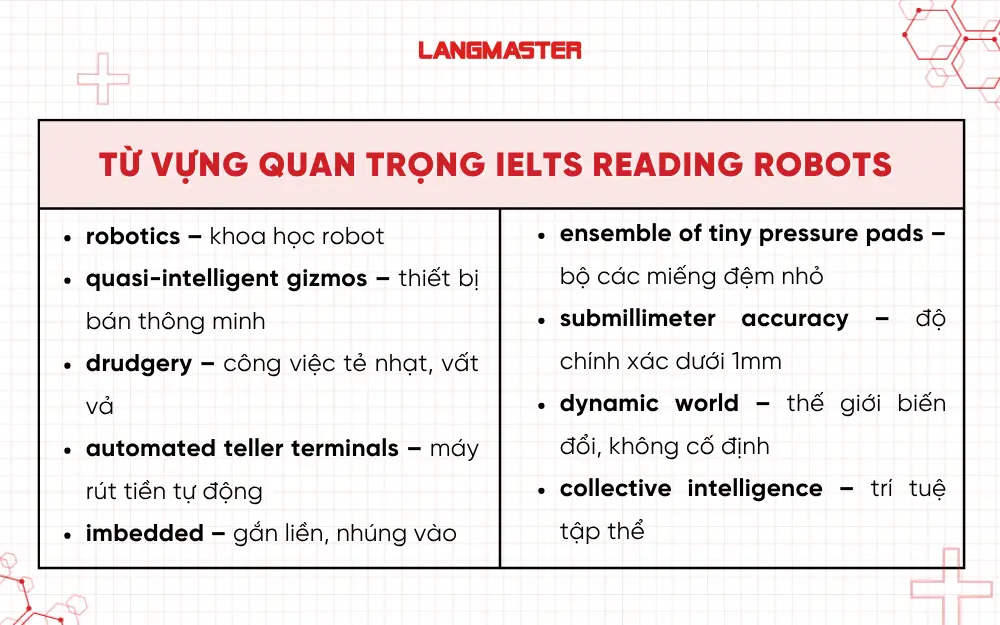
A The modern world is increasingly populated by quasi-intelligent gizmos whose presence we barely notice but whose creeping ubiquity has removed much human drudgery. Our factories hum to the rhythm of robot assembly arms. Our banking is done at automated teller terminals that thank us with rote politeness for the transaction. Our subway trains are controlled by tireless robo- drivers. Our mine shafts are dug by automated moles, and our nuclear accidents - such as those at Three Mile Island and Chernobyl - are cleaned up by robotic muckers fit to withstand radiation.
Such is the scope of uses envisioned by Karel Capek, the Czech playwright who coined the term ‘robot’ in 1920 (the word ‘robota’ means ‘forced labor’ in Czech). As progress accelerates, the experimental becomes the exploitable at record pace.
B Other innovations promise to extend the abilities of human operators. Thanks to the incessant miniaturisation of electronics and micromechanics, there are already robot systems that can perform some kinds of brain and bone surgery with submillimeter accuracy - far greater precision than highly skilled physicians can achieve with their hands alone. At the same time, techniques of long-distance control will keep people even farther from hazard. In 1994 a ten- foot-tall NASA robotic explorer called Dante, with video-camera eyes and with spiderlike legs, scrambled over the menacing rim of an Alaskan volcano while technicians 2,000 miles away in California watched the scene by satellite and controlled Dante’s descent.
C But if robots are to reach the next stage of labour-saving utility, they will have to operate with less human supervision and be able to make at least a few decisions for themselves - goals that pose a formidable challenge. ‘While we know how to tell a robot to handle a specific error,’ says one expert, ‘we can’t yet give a robot enough common sense to reliably interact with a dynamic world.’ Indeed the quest for true artificial intelligence (Al) has produced very mixed results. Despite a spasm of initial optimism in the 1960s and 1970s, when it appeared that transistor circuits and microprocessors might be able to perform in the same way as the human brain by the 21st century, researchers lately have extended their forecasts by decades if not centuries.
D What they found, in attempting to model thought, is that the human brain’s roughly one hundred billion neurons are much more talented - and human perception far more complicated - than previously imagined. They have built robots that can recognise the misalignment of a machine panel by a fraction of a millimeter in a controlled factory environment. But the human mind can glimpse a rapidly changing scene and immediately disregard the 98 per cent that is irrelevant, instantaneously focusing on the woodchuck at the side of a winding forest road or the single suspicious face in a tumultuous crowd. The most advanced computer systems on Earth can’t approach that kind of ability, and neuroscientists still don’t know quite how we do it.
E Nonetheless, as information theorists, neuroscientists, and computer experts pool their talents, they are finding ways to get some lifelike intelligence from robots. One method renounces the linear, logical structure of conventional electronic circuits in favour of the messy, ad hoc arrangement of a real brain’s neurons. These ‘neural networks’ do not have to be programmed. They can ‘teach’ themselves by a system of feedback signals that reinforce electrical pathways that produced correct responses and, conversely, wipe out connections that produced errors. Eventually the net wires itself into a system that can pronounce certain words or distinguish certain shapes.
F In other areas researchers are struggling to fashion a more natural relationship between people and robots in the expectation that some day machines will take on some tasks now done by humans in, say, nursing homes. This is particularly important in Japan, where the percentage of elderly citizens is rapidly increasing. So experiments at the Science University of Tokyo have created a ‘face robot’ - a life-size, soft plastic model of a female head with a video camera imbedded in the left eye - as a prototype. The researchers’ goal is to create robots that people feel comfortable around. They are concentrating on the face because they believe facial expressions are the most important way to transfer emotional messages. We read those messages by interpreting expressions to decide whether a person is happy, frightened, angry, or nervous. Thus the Japanese robot is designed to detect emotions in the person it is ‘looking at’ by sensing changes in the spatial arrangement of the person’s eyes, nose, eyebrows, and mouth. It compares those configurations with a database of standard facial expressions and guesses the emotion. The robot then uses an ensemble of tiny pressure pads to adjust its plastic face into an appropriate emotional response.
G Other labs are taking a different approach, one that doesn’t try to mimic human intelligence or emotions. Just as computer design has moved away from one central mainframe in favour of myriad individual workstations - and single processors have been replaced by arrays of smaller units that break a big problem into parts that are solved simultaneously - many experts are now investigating whether swarms of semi-smart robots can generate a collective intelligence that is greater than the sum of its parts. That’s what beehives and ant colonies do, and several teams are betting that legions of mini-critters working together like an ant colony could be sent to explore the climate of planets or to inspect pipes in dangerous industrial situations.
Questions 1-6
Reading Passage 2 has seven paragraphs A-G.
From the list of headings below choose the most suitable heading for each paragraph.
Write the appropriate numbers (i-x) in boxes 1-6 on your answer sheet.
List of headings
|
i |
Some success has resulted from observing how the brain functions. |
|
ii |
Are we expecting too much from one robot? |
|
iii |
Scientists are examining the humanistic possibilities. |
|
iv |
There are judgements that robots cannot make. |
|
v |
Has the power of robots become too great? |
|
vi |
Human skills have been heightened with the help of robotics. |
|
vii |
There are some things we prefer the brain to control. |
|
viii |
Robots have quietly infiltrated our lives. |
|
iix |
Original predictions have been revised. |
|
x |
Another approach meets the same result. |
Questions 7-11
Do the following statements agree with the information given in Reading Passage 2? In boxes 7-11 on your answer sheet write
YES if the statement agrees with the information
NO if the statement contradicts the information
NOT GIVEN if there is no information on this in the passage
7 Karel Capek successfully predicted our current uses for robots.
8 Lives were saved by the NASA robot, Dante.
9 Robots are able to make fine visual judgements.
10 The internal workings of the brain can be replicated by robots.
11 The Japanese have the most advanced robot systems.
Questions 12-14
Complete the summary below with words taken from paragraph F.
Use NO MORE THAN THREE WORDS for each answer.
Write your answers in boxes 12-14 on your answer sheet.
The prototype of the Japanese ‘face robot’ observes humans through a 12…. which is planted in its head. It then refers to a 13…. of typical ‘looks’ that the human face can have, to decide what emotion the person is feeling. To respond to this expression, the robot alters it’s own expression using a number of 14….
>>> Xem thêm: Những sai lầm khi luyện IELTS Reading cần tránh và cách khắc phục
|
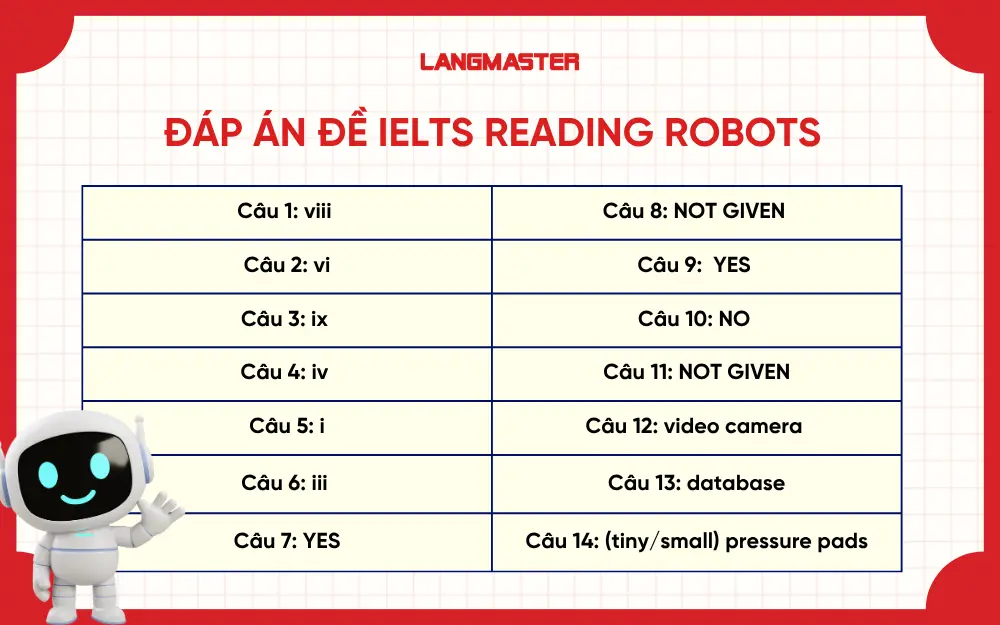
Câu 1: viii |
Câu 8: NOT GIVEN |
|
Câu 2: vi |
Câu 9: YES |
|
Câu 3: ix |
Câu 10: NO |
|
Câu 4: iv |
Câu 11: NOT GIVEN |
|
Câu 5: i |
Câu 12: video camera |
|
Câu 6: iii |
Câu 13: database |
|
Câu 7: YES |
Câu 14: (tiny/small) pressure pads |
Giải thích chi tiết:
Câu 1 - Đáp án viii
Thông tin trong bài: “Our factories hum to the rhythm of robot assembly arms. Our banking is done at automated teller terminals…Our subway trains are controlled by tireless robo-drivers…our nuclear accidents…are cleaned up by robotic muckers.”
Dịch: Các nhà máy hoạt động nhờ cánh tay robot, giao dịch ngân hàng tự động, tàu điện ngầm do robot lái, robot xử lý tai nạn hạt nhân.
Giải thích: Robot xuất hiện trong nhiều lĩnh vực đời sống mà chúng ta ít để ý.
-->Đáp án: viii
Câu 2 – Đáp án vii
Thông tin trong bài: “Thanks to the incessant miniaturisation of electronics…there are already robot systems that can perform some kinds of brain and bone surgery with submillimeter accuracy…Dante…scrambled over the menacing rim of an Alaskan volcano while technicians 2,000 miles away in California watched the scene by satellite and controlled Dante’s descent.”
Dịch: Robot giúp phẫu thuật chính xác hơn con người và kiểm soát từ xa để tránh nguy hiểm.
Giải thích: Robot nâng cao khả năng con người và giảm rủi ro.
--> Đáp án: vi
Câu 3 - Đáp án ix
Thông tin trong bài: “While we know how to tell a robot to handle a specific error, we can’t yet give a robot enough common sense to reliably interact with a dynamic world…researchers lately have extended their forecasts by decades if not centuries.”
Dịch: Robot chưa có common sense, dự đoán ban đầu về AI bị kéo dài.
Giải thích: Những dự đoán ban đầu về AI cần được điều chỉnh.
--> Đáp án: ix
Câu 4 - Đáp án iv
Thông tin trong bài: “They have built robots that can recognise the misalignment of a machine panel…But the human mind can glimpse a rapidly changing scene and immediately disregard the 98 per cent that is irrelevant…”
Dịch: Robot nhận biết sai lệch nhỏ nhưng con người lọc thông tin nhanh và hiệu quả hơn.
Giải thích: Có những phán đoán mà robot chưa thể thực hiện.
--> Đáp án: iv
Câu 5 - Đáp án i
Thông tin trong bài: “These ‘neural networks’ do not have to be programmed. They can ‘teach’ themselves by a system of feedback signals…Eventually the net wires itself into a system that can pronounce certain words or distinguish certain shapes.”
Dịch: Neural networks học giống như não người, tự điều chỉnh để làm đúng.
Giải thích: Một số thành công nhờ quan sát hoạt động của não.
--> Đáp án: i
Câu 6 - Đáp án iii
Thông tin trong bài: “Experiments at the Science University of Tokyo have created a ‘face robot’…The researchers’ goal is to create robots that people feel comfortable around…detect emotions in the person it is ‘looking at’ by sensing changes in the spatial arrangement of the person’s eyes, nose, eyebrows, and mouth.”
Dịch: Robot gương mặt Nhật phát hiện cảm xúc con người và tạo cảm giác thoải mái.
Giải thích: Nghiên cứu các khía cạnh nhân văn của robot.
--> Đáp án: iii
Câu 7 - Đáp án YES
Thông tin trong bài: “Such is the scope of uses envisioned by Karel Capek, the Czech playwright who coined the term ‘robot’ in 1920.”
Dịch: Karel Capek đưa ra khái niệm “robot” và phạm vi ứng dụng tưởng tượng của nó.
Giải thích: Bài chỉ nói ông đề xuất ý tưởng, không khẳng định dự đoán chính xác các ứng dụng hiện nay.
--> Đáp án: YES
Câu 8 - Đáp án NOT GIVEN
Thông tin trong bài: “In 1994 a ten-foot-tall NASA robotic explorer called Dante…scrambled over the menacing rim of an Alaskan volcano while technicians 2,000 miles away…controlled Dante’s descent.”
Dịch: Dante điều khiển núi lửa từ xa, kỹ thuật viên quan sát và điều khiển.
Giải thích: Không nói Dante cứu mạng người cụ thể.
--> Đáp án: NOT GIVEN
Câu 9 - Đáp án YES
Thông tin trong bài: “They have built robots that can recognise the misalignment of a machine panel by a fraction of a millimeter in a controlled factory environment.”
Dịch: Robot nhận biết sai lệch rất nhỏ trong môi trường nhà máy.
Giải thích: Robot có khả năng phán đoán thị giác chi tiết.
--> Đáp án: YES
Câu 10 - Đáp án NO
Thông tin trong bài: “What they found, in attempting to model thought, is that the human brain’s roughly one hundred billion neurons are much more talented…The most advanced computer systems on Earth can’t approach that kind of ability.”
Dịch: Não người phức tạp hơn nhiều, robot không thể sao chép hoàn toàn.
Giải thích: Không thể tái tạo bộ não con người hoàn toàn.
--> Đáp án: NO
Câu 11 – Đáp án B NOT GIVEN
Thông tin trong bài: “Experiments at the Science University of Tokyo have created a ‘face robot’…”
Dịch: Nhật Bản nghiên cứu robot gương mặt.
Giải thích: Không so sánh với các nước khác.
--> Đáp án: NOT GIVEN
Câu 12 – Đáp án video camera
Thông tin trong bài: “…with a video camera imbedded in the left eye…”
Dịch: Camera video được gắn trong mắt trái.
Giải thích: Robot quan sát con người qua camera.
--> Đáp án: video camera
Câu 13 - Đáp án database
Thông tin trong bài: “…It compares those configurations with a database of standard facial expressions…”
Dịch: So sánh với cơ sở dữ liệu biểu cảm tiêu chuẩn.
Giải thích: Robot dùng dữ liệu chuẩn để xác định cảm xúc.
--> Đáp án: database
Câu 14 - Đáp án (tiny/small) pressure pads
Thông tin trong bài: “…The robot then uses an ensemble of tiny pressure pads to adjust its plastic face into an appropriate emotional response.”
Dịch: Robot sử dụng các miếng đệm nhỏ để điều chỉnh biểu cảm.
Giải thích: Công cụ vật lý để phản ứng biểu cảm.
--> Đáp án: tiny pressure pads
| Học mãi mà IELTS không lên band? Học thử IELTS miễn phí cùng giáo viên 7.5+, chấm chữa lỗi sai ngay lập tức. 👉 Đăng ký học thử miễn phí ngay |
>> Xem thêm:
>> Xem thêm: Thời gian làm Reading IELTS: Chiến lược phân bổ và mẹo làm bài hiệu quả
Để đạt điểm cao trong IELTS Reading, điều quan trọng là học theo một lộ trình khoa học, có sự kèm cặp của giảng viên và nhận được phản hồi cụ thể cho từng bài làm. Đây cũng chính là lý do nhiều bạn tin tưởng lựa chọn khóa học IELTS online tại Langmaster – trung tâm luyện thi IELTS online uy tín tốt nhất dành cho người mất gốc cũng như người mới bắt đầu.
Ưu đãi đặc biệt – HỌC THỬ MIỄN PHÍ: Giúp bạn trải nghiệm phương pháp giảng dạy và cảm nhận sự khác biệt ngay từ buổi học đầu tiên.
KẾT LUẬN: Như vậy, chúng ta đã vừa cùng nhau phân tích và giải chi tiết đề IELTS Reading Robots. Bài viết đã làm rõ các kỹ năng cần thiết để tìm thông tin, nhận biết từ khóa và áp dụng chiến lược đọc hiểu hiệu quả. Hy vọng hướng dẫn này sẽ giúp bạn tự tin hơn khi làm bài và cải thiện điểm số Reading IELTS. Chúc bạn học tập hiệu quả và đạt kết quả cao trong kỳ thi IELTS sắp tới!



![Giải đề thi European Heat Wave IELTS Reading [FULL ANSWER]](https://langmaster.edu.vn/storage/uploads/original/2025/11/20/european-heat-wave-ielts-reading-answers.png)
Tổng hợp đề thi European Heat Wave IELTS Reading Answers kèm phân tích chi tiết, từ vựng và đáp án giúp bạn tối ưu điểm Reading nhanh chóng.
![Đề thi IELTS Reading có đáp án mới nhất 2025-2026 [Cập nhật liên tục]](https://langmaster.edu.vn/storage/uploads/original/2025/12/25/de-thi-ielts-reading.png)
Đề thi IELTS Reading có đáp án mới nhất 2025/2026, cập nhật liên tục đề thi thật và Cambridge, kèm lời giải chi tiết giúp nâng band hiệu quả.

Bài viết tổng hợp chi tiết đề thi IELTS Reading Holidays with a difference, đáp án kèm giải thích chi tiết, từ vựng cần lưu ý khi làm bài giúp bạn luyện thi hiệu quả và nâng cao band điểm.

Bài viết tổng hợp chi tiết đề thi IELTS Reading on the trail of the honey badger, đáp án kèm giải thích chi tiết, từ vựng cần lưu ý khi làm bài giúp bạn luyện thi hiệu quả và nâng cao band điểm.
![Giải đề IELTS Reading Growing more for less [FULL ANSWER]](https://langmaster.edu.vn/storage/uploads/original/2025/10/22/growing-more-for-less-ielts-reading-answers.png)
Khám phá bài đọc Growing more for less IELTS Reading: Tổng hợp đáp án, từ vựng quan trọng và phân tích chi tiết giúp bạn hiểu cách công nghệ vệ tinh hỗ trợ nông nghiệp hiện đại




Hơn 16 năm kinh nghiệm, đào tạo thành công hàng trăm nghìn học viên
Phương pháp giảng dạy hiện đại, học viên tiến bộ rõ rệt
Lộ trình học chuẩn quốc tế, phù hợp với nhu cầu thực tiễn
Giáo viên đạt chuẩn Quốc tế với chất lượng top đầu thị trường, giàu kinh nghiệm
Học online linh hoạt, cam kết đầu ra bằng văn bản


![Giải đề Nature or Nurture IELTS Reading Practice test [FULL ANSWER]](https://langmaster.edu.vn/storage/uploads/original/2025/10/22/nature-or-nurture-ielts-reading.png)