
Khóa học
IELTS Online
IELTS Online
Giảm đến 18%
Đăng ký ngay
Mục lục [Ẩn]
Bạn đang tìm lời giải chi tiết cho bài European Heat Wave – IELTS Reading Answers nhưng vẫn bối rối trước lượng thông tin học thuật dày đặc? Đừng lo — bài viết này sẽ giúp bạn hiểu rõ bối cảnh đoạn văn, nắm chắc từ vựng trọng tâm và biết cách định vị đáp án nhanh chóng nhất.
| Bạn đang ở band IELTS bao nhiêu? Làm bài test miễn phí và nhận ngay lộ trình học cá nhân hóa. 👉 Đăng ký test IELTS miễn phí ngay |
You should spend about 20 minutes on Questions 14-27 which are based on Reading Passage 2 below.
The 2003 Heatwave
It was the summer, scientists now realise, when felt. We knew that summer 2003 was remarkable; global warming, at last, made itself unmistakably Britain experienced its record high temperature and continental Europe saw forest fires raging out of control, great rivers drying of a trickle and thousands of heat-related deaths. But just how remarkable is only now becoming clean.
The three months of June, July and August were the warmest ever recorded in western and central Europe, with record national highs in Portugal, Germany and Switzerland as well as Britain. And they were the warmest by a very long way Over a great rectangular block of the earth stretching from west of Paris to northern Italy, taking in Switzerland and southern Germany, the average temperature for the summer months was 3.78°C above the long-term norm, said the Climatic Research Unit (CRU) of the University of East Anglia in Norwich, which is one of the world’s leading institutions for the monitoring and analysis of temperature records.
That excess might not seem a lot until you are aware of the context – but then you realise it is enormous. There is nothing like this in previous data, anywhere. It is considered so exceptional that Professor Phil Jones, the CRU’s director, is prepared to say openly – in a way few scientists have done before – that the 2003 extreme may be directly attributed, not to natural climate variability, but to global warming caused by human actions.
Meteorologists have hitherto contented themselves with the formula that recent high temperatures are consistent with predictions of climate. For the great block of the map – that stretching between 35-50N and 0-20E – the CRU has reliable temperature records dating back to 1781. Using as a baseline the average summer temperature recorded between 1961 and 1990, departures from the temperature norm, or ‘anomalies’: over the area as a whole can easily be plotted.
As the graph shows, such as the variability of our climate that over the past 200 years, there have been at least half a dozen anomalies, in terms of excess temperature – the peaks on the graph denoting very hot years – approaching, or even exceeding, 20°C. But there has been nothing remotely like 2003 when the anomaly is nearly four degrees.
“This is quite remarkable,” Professor Jones told The Independent. “It’s very unusual in a statistical sense. If this series had a normal statistical distribution, you wouldn’t get this number. There turn period “how often it could be expected to recur” would be something like one in a thou-sand years.
If we look at an excess above the average of nearly four degrees, then perhaps nearly three degrees of that is natural variability, because we’ve seen that in past summers. But the final degree of it is likely to be due to global warming, caused by human actions.
The summer of 2003 has, in a sense, been one that climate scientists have long been expecting. Until now, the warming has been manifesting itself mainly in winters that have been less cold than in summers that have been much hotter. Last week, the United Nations predicted that winters were warming so quickly that winter sports would die out in Europe’s lower-level ski resorts. But sooner or later, the unprecedented hot summer was bound to come, and this year it did.
One of the most dramatic features of the summer was the hot nights, especially in the first half of August. In Paris, the temperature never dropped below 23°C (73.4°F) at all between 7 and 14 August, and the city recorded its warmest-ever night on 11-12 August, when the mercury did not drop below 25.5°C (77.9°F). Germany recorded its warmest-ever night at Weinbiet in the Rhine Valley with the lowest figure of 27.6°C (80.6°F) on 13 August, and similar record-breaking nighttime temperatures were recorded in Switzerland and Italy.
The 15,000 excess deaths in France during August, compared with previous years, have been related to the high night-time temperatures. The number gradually increased during the first 12 days of the month, peaking at about 2,000 per day on the night of 12-13 August, then fell off dramatically after 14 August when the minimum temperatures fell by about 5°C. The elderly were most affected, with a 70 per cent increase in mortality rate in those aged 75-94.
For Britain, the year as a whole is likely to be the warmest ever recorded, but despite the high temperature record on 10 August, the summer itself - defined as the June, July and August period - still comes behind 1976 and 1995, when there were longer periods of intense heat. “At the moment, the year is on course to be the third hottest ever in the global temperature record, which goes back to 1856, behind 1998 and 2002, but when all the records for October, November and December are collated, it might move into second place' Professor Jones said. The ten hottest years in the record have all now occurred since 1990. Professor Jones is in no doubt about the astonishing nature of European summer of 2003. “The temperatures recorded were out of all proportion to the previous record," he said.
“It was the warmest summer in the past 500 years and probably way beyond that. It was enormously exceptional."
His colleagues at the University of East Anglia's Tyndall Centre for Climate Change Research are now planning a special study of it. “It was a summer that has not been experienced before, either in terms of the temperature extremes that were reached, or the range and diversity of the impacts of the extreme heat," said the centre's executive director, Professor Mike Hulme. “It will certainly have left its mark on a number of countries, as to how they think and plan for climate change in the future, much as the 2000 floods have revolutionised the way the Government is thinking about flooding in the UK. The 2003 heatwave will have similar repercussions across Europe."

Questions 14-19
Do the following statements agree with the information given in Reading Passage 2?
In boxes 14-19 on your answer sheet write:
YES if the statement agrees with the information
NO if the statement contradicts the information
NOT GIVEN if there is no information on this
Questions 20-21
Answer the questions below using NO MORE THAN TWO WORDS from the passage for each answer.
Write your answers in boxes 20-21 on your answer sheet.
Questions 22-25
Complete the summary below using NO MORE THAN THREE WORDS from the passage for each answer.
Write your answers in boxes 22-25 on your answer sheet.
Question 26
Choose the correct letter A, B, C or D.
Write your answer in box 26 on your answer sheet.
26. Which one of the following can be best used as the title of this passage?
| Học mãi mà IELTS không lên band? Học thử IELTS miễn phí cùng giáo viên 7.5+, chấm chữa lỗi sai ngay lập tức. 👉 Đăng ký học thử miễn phí ngay |
>> Xem thêm: Giải đề thi Endless Harvest IELTS Reading [FULL ANSWER]
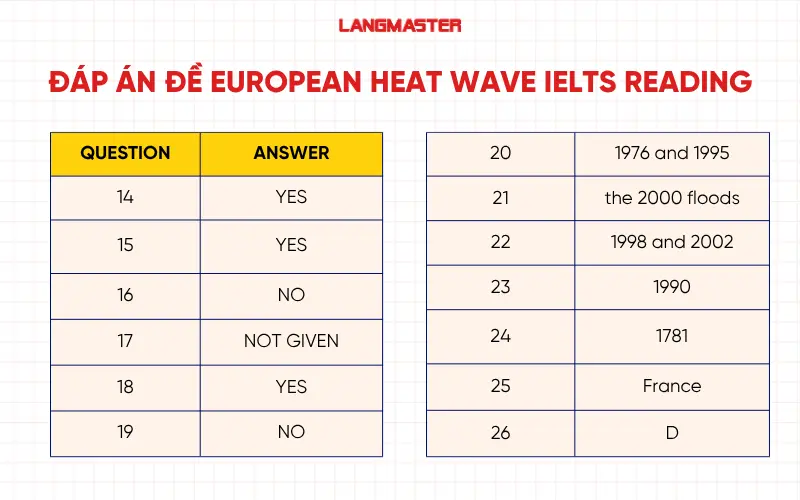
14. Đáp án: YES
Thông tin: “The average temperature for the summer months was 3.78°C above the long-term norm…”
Giải thích: Bài nói rõ mức tăng là 3.78°C — gần 4 độ. Do đó, câu khẳng định là đúng với thông tin trong bài.
15. Đáp án: YES
Thông tin: “…may be directly attributed… to global warming caused by human actions.”
Giải thích: Bài nêu rất rõ rằng sự nóng lên toàn cầu được quy cho hành động của con người, vì vậy câu này đồng ý với bài.
16. Đáp án: NO
Thông tin: “It’s very unusual in a statistical sense… you wouldn’t get this number… the return period… would be something like one in a thousand years.”
Giải thích: Jones nói nhiệt độ năm 2003 là cực kỳ bất thường, không nằm trong biến động bình thường. Vì vậy câu nói Jones cho rằng nó “bình thường” là trái với nội dung bài.
17. Đáp án: NOT GIVEN
Thông tin: Bài chỉ đề cập đến nhiệt độ ban đêm, chỉ số thấp nhất trong ngày, và các kỷ lục nhiệt độ — nhưng không đề cập việc đo nhiệt độ hai lần mỗi ngày hay quy trình đo trong các thành phố.
Giải thích: Không có thông tin về tần suất đo nhiệt độ → NOT GIVEN.
18. Đáp án: YES
Thông tin: “Until now, the warming has been manifesting itself mainly in winters that have been less cold than in summers that have been much hotter.”
Giải thích: Bài nói rõ: trước 2003, sự nóng lên toàn cầu thể hiện chủ yếu ở mùa đông ấm hơn, không phải ở mùa hè quá nóng. Do đó câu này là YES.
19. Đáp án: NO
Thông tin: “…the United Nations predicted that winters were warming so quickly that winter sports would die out in Europe’s lower-level ski resorts.”
Giải thích: Bài chỉ đề cập đến việc thể thao mùa đông có thể biến mất ở các khu trượt tuyết thấp — không hề nói chính phủ đang xây thêm khu trượt tuyết mới ở độ cao lớn. Câu nói chính phủ đang xây resort mới là trái với thông tin bài → NO.
20. Đáp án: 1976 and 1995
Thông tin: “…the summer itself… still comes behind 1976 and 1995, when there were longer periods of intense heat.”
21. Đáp án: the 2000 floods
Thông tin: “…much as the 2000 floods have revolutionised the way the Government is thinking about flooding…”
22. Đáp án: 1998 and 2002
Thông tin: “…the third hottest ever… behind 1998 and 2002…”
23. Đáp án: 1990
Thông tin: “The ten hottest years… have all now occurred since 1990.”
24. Đáp án: 1781
Thông tin: “…the CRU has reliable temperature records dating back to 1781.”
25. Đáp án: France
Thông tin: “The 15,000 excess deaths in France during August…”
26. Đáp án: D
Giải thích:
>> Xem thêm:
Để hiểu trọn vẹn bài đọc European Heat Wave, người học cần nắm vững nhiều thuật ngữ học thuật xoay quanh khí hậu, thống kê và môi trường. Những từ này không chỉ xuất hiện dày đặc trong đoạn văn mà còn là vốn từ quen thuộc trong các chủ đề Weather, Environment và Global Issues của IELTS Reading. Dưới đây là những từ vựng cốt lõi giúp bạn đọc nhanh hơn và dễ dàng suy luận đáp án chính xác.
Qua bài viết này, bạn đã được tìm hiểu toàn diện về nội dung, ý chính, từ vựng quan trọng và cách giải từng dạng câu hỏi trong chủ đề “European Heat Wave IELTS Reading Answers.” Từ việc phân tích cấu trúc bài đọc, nhận diện manh mối trong câu hỏi đến cách suy luận logic, Langmaster mong rằng bạn đã trang bị thêm nhiều kỹ năng làm bài Reading hiệu quả hơn.
Tuy nhiên, để đạt band điểm cao và phát triển đồng đều cả 4 kỹ năng, việc tự học vẫn chưa đủ. Bạn cần có lộ trình học rõ ràng, sự hướng dẫn từ chuyên gia, và môi trường luyện thi chuyên nghiệp – đó chính là những gì Langmaster mang đến cho bạn.
Langmaster – trung tâm luyện thi IELTS online uy tín hàng đầu tại Việt Nam – là lựa chọn tốt nhất dành cho bạn. Với hơn 16 năm kinh nghiệm đào tạo, Langmaster cam kết mang đến trải nghiệm học tập hiệu quả, giúp bạn đạt được mục tiêu điểm số IELTS thực tế.

Langmaster triển khai hai hình thức học tiếng Anh linh hoạt ONLINE và OFFLINE. Các lớp OFFLINE đang được tổ chức tại 3 cơ sở dành cho học viên khu vực Hà Nội.
169 Xuân Thủy (Cầu Giấy)
179 Trường Chinh (Thanh Xuân)
N03-T7 Ngoại giao đoàn (Bắc Từ Liêm)
Trước khi bắt đầu, bạn có thể tham gia đăng ký nhận tư vấn lộ trình cá nhân hóa và trải nghiệm phương pháp giảng dạy hiện đại. Đây là cơ hội tuyệt vời để bạn cảm nhận vì sao Langmaster được đánh giá là trung tâm luyện thi IELTS online uy tín tại Việt Nam.




![Giải đề thi European Heat Wave IELTS Reading [FULL ANSWER]](https://langmaster.edu.vn/storage/uploads/original/2025/11/20/european-heat-wave-ielts-reading-answers.png)
Tổng hợp đề thi European Heat Wave IELTS Reading Answers kèm phân tích chi tiết, từ vựng và đáp án giúp bạn tối ưu điểm Reading nhanh chóng.
![Đề thi IELTS Reading có đáp án mới nhất 2025-2026 [Cập nhật liên tục]](https://langmaster.edu.vn/storage/uploads/original/2025/12/25/de-thi-ielts-reading.png)
Đề thi IELTS Reading có đáp án mới nhất 2025/2026, cập nhật liên tục đề thi thật và Cambridge, kèm lời giải chi tiết giúp nâng band hiệu quả.

Bài viết tổng hợp chi tiết đề thi IELTS Reading Holidays with a difference, đáp án kèm giải thích chi tiết, từ vựng cần lưu ý khi làm bài giúp bạn luyện thi hiệu quả và nâng cao band điểm.

Bài viết tổng hợp chi tiết đề thi IELTS Reading on the trail of the honey badger, đáp án kèm giải thích chi tiết, từ vựng cần lưu ý khi làm bài giúp bạn luyện thi hiệu quả và nâng cao band điểm.
![Giải đề IELTS Reading Growing more for less [FULL ANSWER]](https://langmaster.edu.vn/storage/uploads/original/2025/10/22/growing-more-for-less-ielts-reading-answers.png)
Khám phá bài đọc Growing more for less IELTS Reading: Tổng hợp đáp án, từ vựng quan trọng và phân tích chi tiết giúp bạn hiểu cách công nghệ vệ tinh hỗ trợ nông nghiệp hiện đại




Hơn 16 năm kinh nghiệm, đào tạo thành công hàng trăm nghìn học viên
Phương pháp giảng dạy hiện đại, học viên tiến bộ rõ rệt
Lộ trình học chuẩn quốc tế, phù hợp với nhu cầu thực tiễn
Giáo viên đạt chuẩn Quốc tế với chất lượng top đầu thị trường, giàu kinh nghiệm
Học online linh hoạt, cam kết đầu ra bằng văn bản





![Giải đề thi Endless Harvest IELTS Reading [FULL ANSWER]](https://langmaster.edu.vn/storage/uploads/original/2025/11/12/endless-harvest-ielts-reading-answers.png)
![Roman shipbuilding and navigation [IELTS Reading Cambridge 16 – Test 3]](https://langmaster.edu.vn/storage/uploads/original/2025/10/23/roman-shipbuilding-and-navigation.png)