
Khóa học
IELTS Online
IELTS Online
Giảm đến 18%
Đăng ký ngay
Mục lục [Ẩn]
Khi ôn tập IELTS Reading, việc luyện kĩ năng giải đề qua các đề thi thật là một cách hiệu quả giúp bạn tăng band điểm nhanh. Bài viết này sẽ giúp bạn giải trọn vẹn đề thi IELTS Reading Cambridge 17, Test 1, Reading Passage 1 - The development of the London underground railway với đầy đủ đề bài, câu hỏi, đáp án chi tiết kèm giải thích rõ ràng. Đây sẽ là tài liệu hữu ích để bạn ôn luyện và nâng cao kỹ năng Reading, sẵn sàng chinh phục band điểm mục tiêu trong kỳ thi IELTS.
The development of the London underground railway
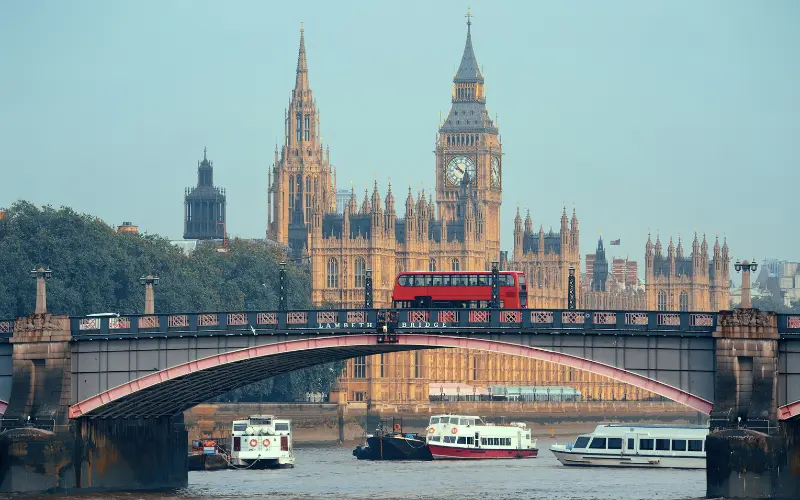
In the first half of the 1800s, London’s population grew at an astonishing rate, and the central area became increasingly congested. In addition, the expansion of the overground railway network resulted in more and more passengers arriving in the capital. However, in 1846, a Royal Commission decided that the railways should not be allowed to enter the City, the capital’s historic and business centre. The result was that the overground railway stations formed a ring around the City. The area within consisted of poorly built, overcrowded slums and the streets were full of horse-drawn traffic. Crossing the City became a nightmare. It could take an hour and a half to travel 8 km by horse-drawn carriage or bus. Numerous schemes were proposed to resolve these problems, but few succeeded.
Amongst the most vocal advocates for a solution to London’s traffic problems was Charles Pearson, who worked as a solicitor for the City of London. He saw both social and economic advantages in building an underground railway that would link the overground railway stations together and clear London slums at the same time. His idea was to relocate the poor workers who lived in the inner-city slums to newly constructed suburbs, and to provide cheap rail travel for them to get to work. Pearson’s ideas gained support amongst some businessmen and in 1851 he submitted a plan to Parliament. It was rejected, but coincided with a proposal from another group for an underground connecting line, which Parliament passed.
The two groups merged and established the Metropolitan Railway Company in August 1854. The company’s plan was to construct an underground railway line from the Great Western Railway’s (GWR) station at Paddington to the edge of the City at Farringdon Street – a distance of almost 5 km. The organisation had difficulty in raising the funding for such a radical and expensive scheme, not least because of the critical articles printed by the press. Objectors argued that the tunnels would collapse under the weight of traffic overhead, buildings would be shaken and passengers would be poisoned by the emissions from the train engines. However, Pearson and his partners persisted.
The GWR, aware that the new line would finally enable them to run trains into the heart of the City, invested almost £250,000 in the scheme. Eventually, over a five-year period, £1m was raised. The chosen route ran beneath existing main roads to minimise the expense of demolishing buildings. Originally scheduled to be completed in 21 months, the construction of the underground line took three years. It was built just below street level using a technique known as ‘cut and cover’. A trench about ten metres wide and six metres deep was dug, and the sides temporarily held up with timber beams. Brick walls were then constructed, and finally a brick arch was added to create a tunnel. A two-metre-deep layer of soil was laid on top of the tunnel and the road above rebuilt.
The Metropolitan line, which opened on 10 January 1863, was the world’s first underground railway. On its first day, almost 40,000 passengers were carried between Paddington and Farringdon, the journey taking about 18 minutes. By the end of the Metropolitan’s first year of operation, 9.5 million journeys had been made.
Even as the Metropolitan began operation, the first extensions to the line were being authorised; these were built over the next five years, reaching Moorgate in the east of London and Hammersmith in the west. The original plan was to pull the trains with steam locomotives, using firebricks in the boilers to provide steam, but these engines were never introduced. Instead, the line used specially designed locomotives that were fitted with water tanks in which steam could be condensed. However, smoke and fumes remained a problem, even though ventilation shafts were added to the tunnels.
Despite the extension of the underground railway, by the 1880s, congestion on London’s streets had become worse. The problem was partly that the existing underground lines formed a circuit around the centre of London and extended to the suburbs, but did not cross the capital’s centre. The ‘cut and cover’ method of construction was not an option in this part of the capital. The only alternative was to tunnel deep underground.
Although the technology to create these tunnels existed, steam locomotives could not be used in such a confined space. It wasn’t until the development of a reliable electric motor, and a means of transferring power from the generator to a moving train, that the world’s first deep-level electric railway, the City & South London, became possible. The line opened in 1890, and ran from the City to Stockwell, south of the River Thames. The trains were made up of three carriages and driven by electric engines. The carriages were narrow and had tiny windows just below the roof because it was thought that passengers would not want to look out at the tunnel walls. The line was not without its problems, mainly caused by an unreliable power supply. Although the City & South London Railway was a great technical achievement, it did not make a profit. Then, in 1900, the Central London Railway, known as the ‘Tuppenny Tube’, began operation using new electric locomotives. It was very popular and soon afterwards new railways and extensions were added to the growing tube network. By 1907, the heart of today’s Underground system was in place.
Questions 1-6
Complete the notes below.
Choose ONE WORD ONLY from the passage for each answer.
Write your answers in boxes 1-6 on your answer sheet
The London Underground Railway
The problem
The 1 _______ of London increased rapidly between 1800 and 1850
The streets were full of horse-drawn vehicles
The proposed solution
Charles Pearson, a solicitor, suggested building an underground railway
Building the railway would make it possible to move people to better housing in the 2_______
A number of 3 _______ agreed with Pearson’s idea
The company initially had problems getting the 4_______ needed for the project
Negative articles about the project appeared in the 5 _______
The construction
The chosen route did not require many buildings to be pulled down
The ‘cut and cover’ method was used to construct the tunnels
With the completion of the brick arch, the tunnel was covered with 6 _______
Questions 7-13
Do the following statements agree with the information given in Reading Passage 1?
In boxes 7-13 on your answer sheet, write
TRUE – if the statement agrees with the information
FALSE – if the statement contradicts the information
NOT GIVEN – if there is no information on this
7. Other countries had built underground railways before the Metropolitan line opened.
8. More people than predicted travelled on the Metropolitan line on the first day.
9. The use of ventilation shafts failed to prevent pollution in the tunnels
10. A different approach from the ‘cut and cover’ technique was required in London’s central area.
11. The windows on City & South London trains were at eye level.
12. The City & South London Railway was a financial success.
13. Trains on the ‘Tuppenny Tube’ nearly always ran on time.
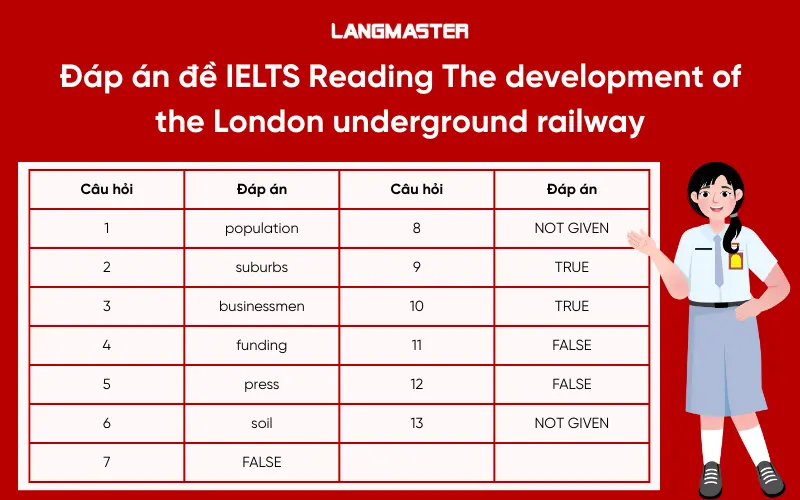
Dưới đây là bảng đáp án để bạn đối chiếu:
|
Question |
Đáp án |
|
1 |
population |
|
2 |
suburbs |
|
3 |
businessmen |
|
4 |
funding |
|
5 |
press |
|
6 |
soil |
|
7 |
FALSE |
|
8 |
NOT GIVEN |
|
9 |
TRUE |
|
10 |
TRUE |
|
11 |
FALSE |
|
12 |
FALSE |
|
13 |
NOT GIVEN |
1. population
Trích đoạn: “In the first half of the 1800s, London’s population grew at an astonishing rate…”
Dịch: Trong nửa đầu những năm 1800, dân số của London tăng với tốc độ đáng kinh ngạc.
Giải thích
Câu hỏi: “The 1 ______ of London increased rapidly between 1800 and 1850.”
Cụm “population grew at an astonishing rate” trực tiếp tương ứng với “increased rapidly”. Danh từ cần điền là “population”, đúng yêu cầu ONE WORD ONLY.
Đáp án đúng: population
2. suburbs
Trích đoạn: “His idea was to relocate the poor workers who lived in the inner-city slums to newly constructed suburbs…”
Dịch: Ý tưởng của ông là di dời những công nhân nghèo sống trong các khu ổ chuột nội thành đến những khu ngoại ô mới được xây dựng.
Giải thích
Câu hỏi: “Building the railway would make it possible to move people to better housing in the 2 ______.”
“Better housing” được diễn đạt trong bài bằng “newly constructed suburbs”. Từ khóa “suburbs” xuất hiện nguyên văn.
Đáp án đúng: suburbs
3. businessmen
Trích đoạn: “Pearson’s ideas gained support amongst some businessmen…”
Dịch: Những ý tưởng của Pearson đã nhận được sự ủng hộ từ một số doanh nhân.
Giải thích
Câu hỏi: “A number of 3 ______ agreed with Pearson’s idea.”
“A number of” đi với danh từ số nhiều. Trong bài, nhóm người ủng hộ Pearson được nêu rõ là “businessmen”.
Đáp án đúng: businessmen
4. funding
Trích đoạn: “The organisation had difficulty in raising the funding for such a radical and expensive scheme…”
Dịch: Tổ chức này gặp khó khăn trong việc huy động nguồn vốn cho một kế hoạch mang tính đột phá và tốn kém như vậy.
Giải thích
Câu hỏi: “The company initially had problems getting the 4 ______ needed for the project.”
“Raising the funding” tương đương với “getting the funding needed”. Đây là từ khóa chính xác, đúng ngữ cảnh tài chính.
Đáp án đúng: funding
5. press
Trích đoạn: “…not least because of the critical articles printed by the press.”
Dịch: … đặc biệt là do những bài viết chỉ trích được đăng tải trên báo chí.
Giải thích
Câu hỏi: “Negative articles about the project appeared in the 5 ______.”
Cụm “printed by the press” cho biết nơi xuất hiện các bài viết tiêu cực là báo chí. Không có từ đồng nghĩa nào khác trong bài.
Đáp án đúng: press
6. soil
Trích đoạn: “A two-metre-deep layer of soil was laid on top of the tunnel and the road above rebuilt.”
Dịch: Một lớp đất dày hai mét được phủ lên trên đường hầm và con đường phía trên được xây dựng lại.
Giải thích
Câu hỏi: “With the completion of the brick arch, the tunnel was covered with 6 ______.”
Sau khi vòm gạch hoàn thành, lớp phủ lên trên được mô tả chính xác là “soil”. ONE WORD ONLY nên không thể dùng “layer of soil”.
Đáp án đúng: soil
7. FALSE
Trích đoạn: “The Metropolitan line, which opened on 10 January 1863, was the world’s first underground railway.”
Dịch: Tuyến Metropolitan, khai trương ngày 10 tháng 1 năm 1863, là tuyến đường sắt ngầm đầu tiên trên thế giới.
Giải thích
Câu hỏi: “Other countries had built underground railways before the Metropolitan line opened.”
Bài khẳng định Metropolitan là tuyến đầu tiên trên thế giới, nên không thể có quốc gia nào xây trước đó.
Đáp án đúng: FALSE
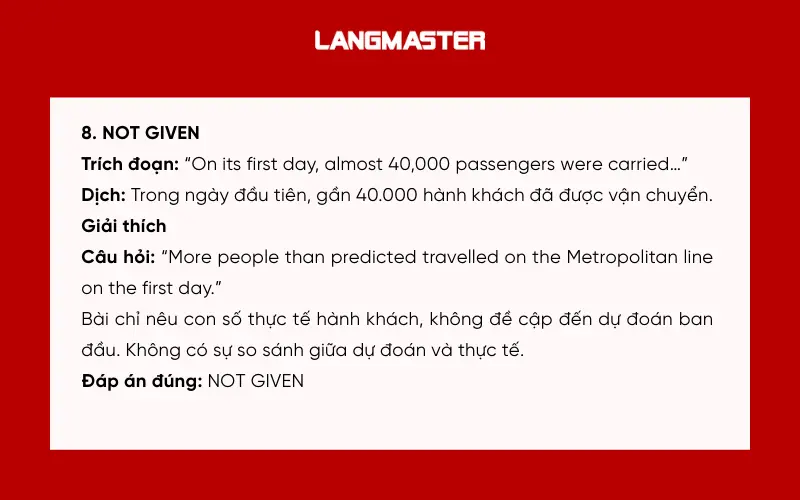
8. NOT GIVEN
Trích đoạn: “On its first day, almost 40,000 passengers were carried…”
Dịch: Trong ngày đầu tiên, gần 40.000 hành khách đã được vận chuyển.
Giải thích
Câu hỏi: “More people than predicted travelled on the Metropolitan line on the first day.”
Bài chỉ nêu con số thực tế hành khách, không đề cập đến dự đoán ban đầu. Không có sự so sánh giữa dự đoán và thực tế.
Đáp án đúng: NOT GIVEN
9. TRUE
Trích đoạn: “However, smoke and fumes remained a problem, even though ventilation shafts were added to the tunnels.”
Dịch: Tuy nhiên, khói và khí thải vẫn là một vấn đề, mặc dù các trục thông gió đã được bổ sung vào đường hầm.
Giải thích
Câu hỏi: “The use of ventilation shafts failed to prevent pollution in the tunnels.”
“Smoke and fumes remained a problem” cho thấy ô nhiễm vẫn tồn tại dù đã có thông gió. Điều này khớp hoàn toàn với câu hỏi.
Đáp án đúng: TRUE
10. TRUE
Trích đoạn: “The ‘cut and cover’ method of construction was not an option in this part of the capital. The only alternative was to tunnel deep underground.”
Dịch: Phương pháp ‘cut and cover’ không phải là một lựa chọn ở khu vực này của thủ đô. Giải pháp duy nhất là đào hầm sâu dưới lòng đất.
Giải thích
Câu hỏi: “A different approach from the ‘cut and cover’ technique was required in London’s central area.”
Bài nói rõ phương pháp cũ không dùng được, nên cần cách tiếp cận khác.
Đáp án đúng: TRUE
11. FALSE
Trích đoạn: “The carriages were narrow and had tiny windows just below the roof…”
Dịch: Các toa tàu hẹp và có những cửa sổ rất nhỏ, nằm ngay dưới mái.
Giải thích
Câu hỏi: “The windows on City & South London trains were at eye level.”
“Just below the roof” hoàn toàn không phải “at eye level”. Thông tin này mâu thuẫn trực tiếp với bài.
Đáp án đúng: FALSE
12. FALSE
Trích đoạn: “Although the City & South London Railway was a great technical achievement, it did not make a profit.”
Dịch: Mặc dù là một thành tựu kỹ thuật lớn, tuyến City & South London Railway không mang lại lợi nhuận.
Giải thích
Câu hỏi: “The City & South London Railway was a financial success.”
“Did not make a profit” trái nghĩa với “financial success”.
Đáp án đúng: FALSE
13. NOT GIVEN
Trích đoạn: “Then, in 1900, the Central London Railway, known as the ‘Tuppenny Tube’, began operation… It was very popular…”
Dịch: Sau đó, vào năm 1900, tuyến Central London Railway, được gọi là ‘Tuppenny Tube’, bắt đầu hoạt động… Nó rất được ưa chuộng.
Giải thích
Câu hỏi: “Trains on the ‘Tuppenny Tube’ nearly always ran on time.”
Bài chỉ nói tuyến này “very popular”, không đề cập đến độ đúng giờ hay lịch trình vận hành.
Đáp án đúng: NOT GIVEN

>>> XEM THÊM:
Trong quá trình ôn luyện IELTS Reading, việc phát triển vốn từ vựng học thuật theo một lộ trình rõ ràng đóng vai trò quan trọng trong việc cải thiện khả năng đọc hiểu và gia tăng band score. Thay vì học từ rời rạc, học viên nên tiếp cận từ vựng thông qua các bài IELTS Reading chuẩn cấu trúc đề thi, bởi việc luyện tập với đề thi thật và bài đọc mẫu giúp ghi nhớ từ mới sâu hơn và sử dụng chính xác trong từng ngữ cảnh học thuật.
Dựa trên định hướng đó, nội dung dưới đây tổng hợp những từ và cụm từ tiêu biểu được chọn lọc từ bài IELTS Reading “The development of the London underground railway”, hỗ trợ người học mở rộng vốn từ vựng, nắm vững cách dùng từ trong bài đọc và tối ưu hiệu quả luyện đề IELTS một cách hệ thống.
|
Từ |
Nghĩa |
Ví dụ trong bài |
|
population |
dân số |
“In the first half of the 1800s, London’s population grew at an astonishing rate.” (Trong nửa đầu thế kỷ 19, dân số London tăng với tốc độ đáng kinh ngạc.) |
|
congested |
ùn tắc, chật chội |
“the central area became increasingly congested.” (Khu vực trung tâm ngày càng trở nên ùn tắc.) |
|
expansion |
sự mở rộng |
“the expansion of the overground railway network resulted in more and more passengers arriving in the capital.” (Sự mở rộng của mạng lưới đường sắt trên mặt đất dẫn đến ngày càng nhiều hành khách đến thủ đô.) |
|
overcrowded |
quá đông đúc |
“The area within consisted of poorly built, overcrowded slums.” (Khu vực bên trong gồm những khu ổ chuột xây dựng kém và quá đông đúc.) |
|
nightmare |
cơn ác mộng |
“Crossing the City became a nightmare.” (Việc băng qua thành phố trở thành một cơn ác mộng.) |
|
schemes |
kế hoạch |
“Numerous schemes were proposed to resolve these problems, but few succeeded.” (Nhiều kế hoạch được đề xuất để giải quyết các vấn đề này, nhưng rất ít thành công.) |
|
advocates |
người ủng hộ mạnh mẽ |
“Amongst the most vocal advocates for a solution to London’s traffic problems was Charles Pearson.” (Trong số những người ủng hộ mạnh mẽ nhất cho giải pháp giao thông London có Charles Pearson.) |
|
relocate |
di dời |
“His idea was to relocate the poor workers who lived in the inner-city slums to newly constructed suburbs.” (Ý tưởng của ông là di dời những công nhân nghèo sống trong khu ổ chuột nội thành ra các khu ngoại ô mới xây.) |
|
suburbs |
ngoại ô |
“to newly constructed suburbs, and to provide cheap rail travel for them to get to work.” (Đến các khu ngoại ô mới xây và cung cấp phương tiện đi lại bằng tàu giá rẻ cho họ đi làm.) |
|
businessmen |
doanh nhân |
“Pearson’s ideas gained support amongst some businessmen.” (Ý tưởng của Pearson nhận được sự ủng hộ từ một số doanh nhân.) |
|
funding |
nguồn vốn |
“The organisation had difficulty in raising the funding for such a radical and expensive scheme.” (Tổ chức gặp khó khăn trong việc huy động vốn cho một kế hoạch táo bạo và tốn kém như vậy.) |
|
press |
báo chí |
“because of the critical articles printed by the press.” (Do các bài báo chỉ trích được đăng tải trên báo chí.) |
|
persisted |
kiên trì |
“However, Pearson and his partners persisted.” (Tuy nhiên, Pearson và các cộng sự vẫn kiên trì.) |
|
minimise |
giảm thiểu |
“The chosen route ran beneath existing main roads to minimise the expense of demolishing buildings.” (Tuyến đường được chọn chạy dưới các con đường chính hiện có để giảm thiểu chi phí phá dỡ công trình.) |
|
trench |
rãnh, hào |
“A trench about ten metres wide and six metres deep was dug.” (Một rãnh rộng khoảng mười mét và sâu sáu mét được đào.) |
|
soil |
đất |
“A two-metre-deep layer of soil was laid on top of the tunnel and the road above rebuilt.” (Một lớp đất dày hai mét được phủ lên trên đường hầm và con đường phía trên được xây lại.) |
|
ventilation shafts |
trục thông gió |
“smoke and fumes remained a problem, even though ventilation shafts were added to the tunnels.” (Khói và khí thải vẫn là vấn đề, dù các trục thông gió đã được bổ sung.) |
|
confined |
chật hẹp |
“steam locomotives could not be used in such a confined space.” (Đầu máy hơi nước không thể được sử dụng trong không gian chật hẹp như vậy.) |
|
reliable |
đáng tin cậy |
“the development of a reliable electric motor made the railway possible.” (Sự phát triển của một động cơ điện đáng tin cậy đã khiến tuyến đường sắt trở nên khả thi.) |
|
achievement |
thành tựu |
“the City & South London Railway was a great technical achievement.” (Tuyến City & South London là một thành tựu kỹ thuật to lớn.) |
|
profit |
lợi nhuận |
“Although the City & South London Railway was a great technical achievement, it did not make a profit.” (Mặc dù là một thành tựu kỹ thuật lớn, tuyến đường này không tạo ra lợi nhuận.) |
>>> XEM THÊM:
Khi luyện đề IELTS Reading “The development of the London underground railway”, nhiều học viên thường gặp khó khăn trong việc xác định dạng câu hỏi và áp dụng từ vựng học thuật một cách chính xác. Để đạt hiệu quả cao, cần có một kế hoạch ôn tập logic, kết hợp với chiến lược làm bài rõ ràng và sự hỗ trợ từ giáo viên nhiều kinh nghiệm. Để đáp ứng nhu cầu, Langmaster xây dựng các khóa học IELTS online với lộ trình cá nhân hóa. Học viên sẽ được giảng viên theo sát, chỉ ra lỗi sai ngay lập tức trong vòng 24 giờ và hướng dẫn phương pháp học tập tối ưu để tiến bộ nhanh chóng hơn.

Tại Langmaster học viên được:
Coaching 1 - 1 với chuyên gia: Học viên được kèm riêng để khắc phục điểm yếu, phân bổ thời gian thi chi tiết, tập trung rèn kỹ năng chưa vững và rút ngắn lộ trình nâng band.
Sĩ số lớp nhỏ, 7 - 10 học viên: Giáo viên theo sát từng bạn, nhiều cơ hội trao đổi và nhận phản hồi chi tiết.
Hệ sinh thái học tập toàn diện: Tài liệu chuẩn, bài tập online, cộng đồng học viên và cố vấn luôn đồng hành.
Lộ trình học cá nhân hóa: Thiết kế dựa trên trình độ đầu vào và mục tiêu điểm số, kèm báo cáo tiến bộ hàng tháng.
Giáo viên 7.5+ IELTS: Chấm chữa bài trong 24 giờ, giúp bạn cải thiện nhanh chóng và rõ rệt.
Thi thử định kỳ: Mô phỏng áp lực thi thật, phân tích điểm mạnh - yếu để điều chỉnh chiến lược học.
Cam kết đầu ra, học lại miễn phí: Đảm bảo kết quả, giảm thiểu rủi ro “học xong vẫn chưa đạt mục tiêu”.
Học online tiện lợi, chất lượng như offline: Có bản ghi để xem lại, linh hoạt, tiết kiệm thời gian, chi phí.
Đăng ký học thử IELTS Online miễn phí ngay hôm nay để trải nghiệm lớp học thực tế, kiểm tra trình độ và nhận lộ trình học tập hiệu quả, giúp bạn thành thạo kỹ năng IELTS Reading và chinh phục mục tiêu IELTS!
Khi ôn luyện đề IELTS Reading “The development of the London underground railway”, học viên không chỉ nắm vững đáp án đúng mà còn phát triển khả năng phân tích theo từng dạng câu hỏi một cách logic. Việc kết hợp từ vựng học thuật trong ngữ cảnh thực tế giúp ghi nhớ hiệu quả, đồng thời mở rộng vốn từ cần thiết cho kỹ năng đọc học thuật.




![Giải đề thi European Heat Wave IELTS Reading [FULL ANSWER]](https://langmaster.edu.vn/storage/uploads/original/2025/11/20/european-heat-wave-ielts-reading-answers.png)
Tổng hợp đề thi European Heat Wave IELTS Reading Answers kèm phân tích chi tiết, từ vựng và đáp án giúp bạn tối ưu điểm Reading nhanh chóng.
![Đề thi IELTS Reading có đáp án mới nhất 2025-2026 [Cập nhật liên tục]](https://langmaster.edu.vn/storage/uploads/original/2025/12/25/de-thi-ielts-reading.png)
Đề thi IELTS Reading có đáp án mới nhất 2025/2026, cập nhật liên tục đề thi thật và Cambridge, kèm lời giải chi tiết giúp nâng band hiệu quả.

Bài viết tổng hợp chi tiết đề thi IELTS Reading Holidays with a difference, đáp án kèm giải thích chi tiết, từ vựng cần lưu ý khi làm bài giúp bạn luyện thi hiệu quả và nâng cao band điểm.

Bài viết tổng hợp chi tiết đề thi IELTS Reading on the trail of the honey badger, đáp án kèm giải thích chi tiết, từ vựng cần lưu ý khi làm bài giúp bạn luyện thi hiệu quả và nâng cao band điểm.
![Giải đề IELTS Reading Growing more for less [FULL ANSWER]](https://langmaster.edu.vn/storage/uploads/original/2025/10/22/growing-more-for-less-ielts-reading-answers.png)
Khám phá bài đọc Growing more for less IELTS Reading: Tổng hợp đáp án, từ vựng quan trọng và phân tích chi tiết giúp bạn hiểu cách công nghệ vệ tinh hỗ trợ nông nghiệp hiện đại




Hơn 16 năm kinh nghiệm, đào tạo thành công hàng trăm nghìn học viên
Phương pháp giảng dạy hiện đại, học viên tiến bộ rõ rệt
Lộ trình học chuẩn quốc tế, phù hợp với nhu cầu thực tiễn
Giáo viên đạt chuẩn Quốc tế với chất lượng top đầu thị trường, giàu kinh nghiệm
Học online linh hoạt, cam kết đầu ra bằng văn bản