Khóa học
IELTS Online
IELTS Online
Giảm đến 18%
Đăng ký ngay
Mục lục [Ẩn]
IELTS Reading The Global Importance of Wetlands là đọc xoay quanh vai trò của các vùng đất ngập nước đối với con người, môi trường và biến đổi khí hậu, đồng thời đề cập đến những tác động của khai thác tài nguyên, nông nghiệp và phát triển kinh tế. Bài đọc gồm ba dạng câu hỏi chính: Matching Information, Note Completion và Matching Features. Dưới đây là đề bài, đáp án và giải thích chi tiết từng câu để bạn dễ dàng kiểm tra và rút kinh nghiệm khi luyện IELTS Reading.
| Bạn đang ở band IELTS bao nhiêu? Làm bài test miễn phí và nhận ngay lộ trình học cá nhân hóa. 👉 Đăng ký test IELTS miễn phí ngay |
|
The Global Importance of Wetlands A Wetlands are areas where water covers the soil, or is present either at or near the surface of the soil, for all or part of the year. These are complex ecosystems, rich in unique plant and animal life. But according to the World Wide Fund for Nature (WWFN), half of the world’s wetlands have disappeared since 1990 – converted or destroyed for commercial development, drainage schemes and the extraction of minerals and peat. Many of those that remain have been damaged by agricultural pesticides and fertilizers, industrial pollutants, and construction works. B Throughout history, humans have gathered around wetlands, and their fertile ecosystems have played an important part in human development. Consequently, they are of considerable religious, historical and archaeological value to many communities around the world. ‘Wetlands directly support the livelihoods and well-being of millions of people,’ says Dr Matthew McCartney, principal researcher and hydrologist at the International Water Management Institute (IWMI). ‘In many developing countries, large numbers of people are dependent on wetland agriculture for their livelihoods.’ C They also serve a crucial environmental purpose. ‘Wetlands are one of the key tools in mitigating climate change across the planet,’ says Pieter van Eijk, head of Climate Adaptation at Wetlands International (WI), pointing to their use as buffers that protect coastal areas from sea-level rise and extreme weather events such as hurricanes and flooding. Wetland coastal forests provide food and water, as well as shelter from storms, and WI and other agencies are working to restore those forests which have been lost. ‘It can be as simple as planting a few trees per hectare to create shade and substantially change a microclimate,’ he says. ‘Implementing climate change projects isn’t so much about money.’ D The world’s wetlands are, unfortunately, rich sources for in-demand commodities, such as palm oil and pulpwood. Peatlands – wetlands with a waterlogged organic soil layer – are particularly targeted. When peatlands are drained for cultivation, they become net carbon emitters instead of active carbon stores, and, according to Marcel Silvius, head of Climate-smart Land-use at WI, this practice causes six per cent of all global carbon emissions. The clearance of peatlands for planting also increases the risk of forest fires, which release huge amounts of CO₂. ‘We’re seeing huge peatland forests with extremely high biodiversity value being lost for a few decades of oil palm revenues,’ says Silvius. E The damage starts when logging companies arrive to clear the trees. They dig ditches to enter the peat swamps by boat and then float the logs out the same way. These are then used to drain water out of the peatlands to allow for the planting of corn, oil palms or pulpwood trees. Once the water has drained away, bacteria and fungi then break down the carbon in the peat and turn it into CO₂ and methane. Meanwhile, the remainder of the solid matter in the peat starts to move downwards, in a process known as subsidence. Peat comprises 90 per cent water, so this is one of the most alarming consequences of peatland clearances. ‘In the tropics, peat subsides at about four centimetres a year, so within half a century, very large landscapes on Sumatra and Borneo will become flooded as the peat drops below water level,’ says Silvius. ‘It’s a huge catastrophe that’s in preparation. Some provinces will lose 40 per cent of their landmass.’ F And while these industries affect wetlands in ways that can easily be documented, Dr Dave Tickner of the WWFN believes that more subtle impacts can be even more devastating. ‘Sediment run-off and fertilizers can be pretty invisible,’ says Tickner. ‘Over-extraction of water is equally invisible. You do get shock stories about rivers running red, or even catching fire, but there’s seldom one big impact that really hurts a wetland.’ Tickner does not blame anyone for deliberate damage, however. ‘I’ve worked on wetland issues for 20 years and have never met anybody who wanted to damage a wetland,’ he says. ‘It isn’t something that people generally set out to do. Quite often, the effects simply come from people trying to make a living.’ G Silvius also acknowledges the importance of income generation. ‘It’s not that we just want to restore the biodiversity of wetlands – which we do – but we recognise there’s a need to provide an income for local people.’ This approach is supported by IWMI. ‘The idea is that people in a developing country will only protect wetlands if they value and profit from them,’ says McCartney. ‘For sustainability, it’s essential that local people are involved in wetland planning and decision making and have clear rights to use wetlands.’ H The fortunes of wetlands would be improved, Silvius suggests, if more governments recognized their long-term value. ‘Different governments have different attitudes,’ he says, and goes on to explain that some countries place a high priority on restoring wetlands, while others still deny the issue. McCartney is cautiously optimistic, however. ‘Awareness of the importance of wetlands is growing,’ he says. ‘It’s true that wetland degradation still continues at a rapid pace, but my impression is that things are slowly changing.’ |
Questions 14–17
Reading Passage 2 has eight paragraphs, A–H.
Which paragraph contains the following information?
Write the correct letter, A–H, in boxes 14–17 on your answer sheet.
14. Reference to the need to ensure that inhabitants of wetland regions continue to benefit from them.
15. The proportion of wetlands which have already been lost.
16. Reference to the idea that people are beginning to appreciate the value of wetlands.
17. Mention of the cultural significance of wetlands.
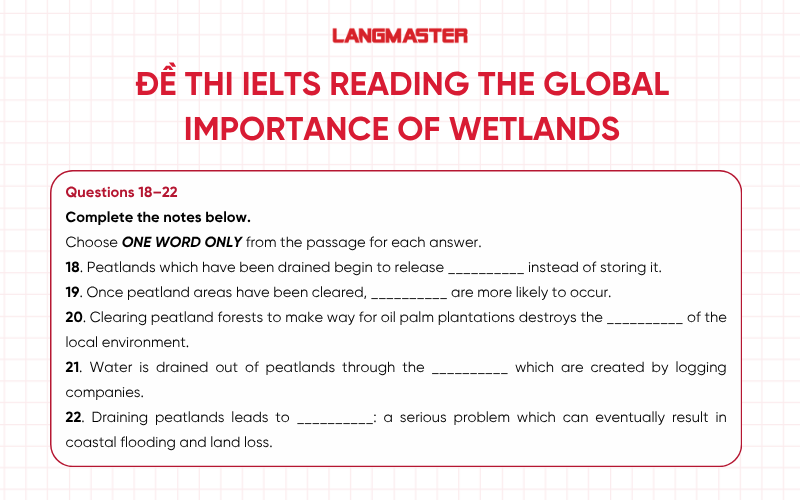
Questions 18–22
Complete the notes below.
Choose ONE WORD ONLY from the passage for each answer.
18. Peatlands which have been drained begin to release __________ instead of storing it.
19. Once peatland areas have been cleared, __________ are more likely to occur.
20. Clearing peatland forests to make way for oil palm plantations destroys the __________ of the local environment.
21. Water is drained out of peatlands through the __________ which are created by logging companies.
22. Draining peatlands leads to __________: a serious problem which can eventually result in coastal flooding and land loss.
Questions 23–26
Look at the following statements and the list of experts below.
Match each statement with the correct expert, A–D.
23. Communities living in wetland regions must be included in discussions about the future of these areas.
24. Official policies towards wetlands vary from one nation to the next.
25. People cause harm to wetlands without having any intention to do so.
26. Initiatives to reverse environmental damage need not be complex.
List of Experts
A. Matthew McCartney
B. Pieter van Eijk
C. Marcel Silvius
D. Dave Tickner
>> Xem thêm: Telepathy IELTS Reading: Đáp án & Giải thích chi tiết
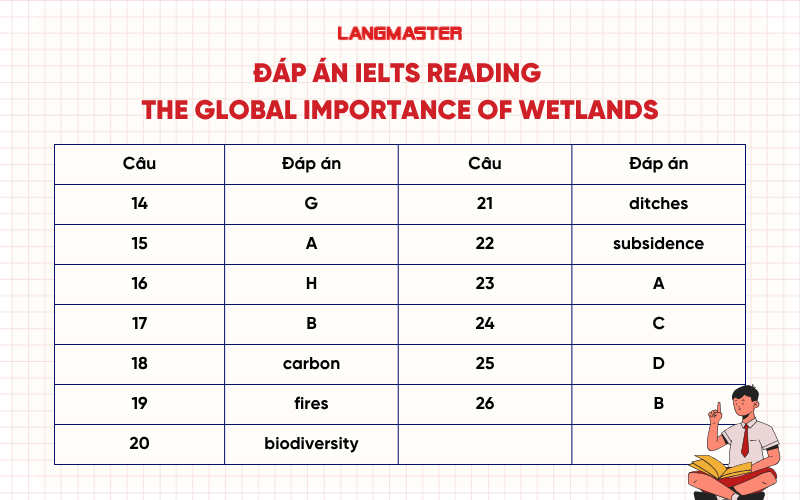
Dưới đây là bảng đáp án IELTS Reading The Global Importance of Wetlands để bạn kiểm tra nhanh trước khi xem phần giải thích chi tiết:
|
Câu |
Đáp án |
Câu |
Đáp án |
|
14 |
G |
21 |
ditches |
|
15 |
A |
22 |
subsidence |
|
16 |
H |
23 |
A |
|
17 |
B |
24 |
C |
|
18 |
carbon |
25 |
D |
|
19 |
fires |
26 |
B |
|
20 |
biodiversity |
Câu 14 – G
Vị trí thông tin: Đoạn G
Từ khóa: inhabitants of wetland regions, continue to benefit, local people, provide an income, profit from them
Bài đọc có câu:
“We recognise there’s a need to provide an income for local people.”
“People in a developing country will only protect wetlands if they value and profit from them.”
Giải thích: Cụm inhabitants of wetland regions continue to benefit from them trong câu hỏi được paraphrase bằng provide an income for local people và profit from them. Ý chính là người dân địa phương cần tiếp tục nhận được lợi ích kinh tế từ vùng đất ngập nước. Vì vậy, đáp án là G.
Câu 15 – A
Vị trí thông tin: Đoạn A
Từ khóa: proportion of wetlands, already been lost, half, disappeared
Bài đọc có câu: “Half of the world’s wetlands have disappeared since 1990.”
Giải thích: Half tương đương 50%, chính là tỷ lệ các vùng đất ngập nước đã bị mất. Cụm have already been lost trong câu hỏi được paraphrase bằng have disappeared. Vì vậy, đáp án là A.
Câu 16 – H
Vị trí thông tin: Đoạn H
Từ khóa: people are beginning to appreciate, value of wetlands, awareness, importance
Bài đọc có câu: “Awareness of the importance of wetlands is growing.”
Giải thích: Cụm people are beginning to appreciate the value of wetlands được paraphrase bằng awareness of the importance of wetlands is growing, nghĩa là ngày càng nhiều người nhận thức được giá trị và tầm quan trọng của wetlands. Vì vậy, đáp án là H.
Câu 17 – B
Vị trí thông tin: Đoạn B
Từ khóa: cultural significance, religious, historical, archaeological value
Bài đọc có câu: “They are of considerable religious, historical and archaeological value to many communities around the world.”
Giải thích: Cultural significance trong câu hỏi được thể hiện qua các giá trị religious, historical and archaeological. Đây đều là những khía cạnh thuộc giá trị văn hóa của wetlands đối với cộng đồng. Vì vậy, đáp án là B.
>> Xem thêm: Bring Back the Big Cats IELTS Reading: Dịch đề & Giải đề chi tiết
Câu 18 – carbon
Vị trí thông tin: Đoạn D
Từ khóa: peatlands, drained, release, instead of storing
Bài đọc có câu: “When peatlands are drained for cultivation, they become net carbon emitters instead of active carbon stores.”
Giải thích: Emitters tương ứng với release, trong khi stores tương ứng với storing. Sau khi peatlands bị rút nước, chúng bắt đầu phát thải carbon thay vì lưu trữ carbon như trước.
→ Đáp án: carbon
Câu 19 – fires
Vị trí thông tin: Đoạn D
Từ khóa: peatland areas cleared, more likely to occur, risk, forest fires
Bài đọc có câu: “The clearance of peatlands for planting also increases the risk of forest fires.”
Giải thích: Cụm more likely to occur trong câu hỏi được paraphrase bằng increases the risk of. Khi peatlands bị phát quang để trồng trọt, nguy cơ xảy ra forest fires tăng lên. Do đề yêu cầu ONE WORD ONLY, đáp án cần điền là fires.
→ Đáp án: fires
Câu 20 – biodiversity
Vị trí thông tin: Đoạn D
Từ khóa: oil palm plantations, destroys, local environment, biodiversity, being lost
Bài đọc có câu: “We’re seeing huge peatland forests with extremely high biodiversity value being lost for a few decades of oil palm revenues.”
Giải thích: Câu hỏi đề cập đến việc phát quang rừng peatland để trồng oil palm và hỏi yếu tố nào của môi trường bị phá hủy. Bài đọc cho biết những khu rừng này có giá trị biodiversity rất cao và đang bị mất đi. Vì vậy, đáp án là biodiversity.
→ Đáp án: biodiversity
Câu 21 – ditches
Vị trí thông tin: Đoạn E
Từ khóa: water is drained, logging companies, dig ditches
Bài đọc có câu:
“They dig ditches to enter the peat swamps by boat.”
“These are then used to drain water out of the peatlands.”
Giải thích: Đại từ These trong câu thứ hai quay lại chỉ ditches ở câu trước. Như vậy, nước được dẫn ra khỏi peatlands thông qua những con ditches do các công ty khai thác gỗ đào.
→ Đáp án: ditches
Câu 22 – subsidence
Vị trí thông tin: Đoạn E
Từ khóa: draining peatlands, flooding, land loss, move downwards
Bài đọc có câu: “The remainder of the solid matter in the peat starts to move downwards, in a process known as subsidence.”
Giải thích: Sau khi nước bị rút khỏi peatlands, phần đất than bùn bắt đầu sụt xuống. Quá trình này được gọi là subsidence. Bài đọc sau đó cho biết hiện tượng này có thể khiến đất thấp hơn mực nước, dẫn đến ngập lụt và mất diện tích đất.
→ Đáp án: subsidence
>> Xem thêm: Jumping Spiders IELTS Reading: Dịch đề & Giải đề chi tiết
Câu 23 – A. Matthew McCartney
Vị trí thông tin: Đoạn G
Từ khóa: communities living in wetland regions, included in discussions, planning and decision making
Bài đọc có câu: “For sustainability, it’s essential that local people are involved in wetland planning and decision making.”
Giải thích: Cụm must be included in discussions about the future of these areas trong câu hỏi được paraphrase bằng be involved in wetland planning and decision making. Người đưa ra quan điểm này là Matthew McCartney.
→ Đáp án: A
Câu 24 – C. Marcel Silvius
Vị trí thông tin: Đoạn H
Từ khóa: official policies, vary, one nation to the next, different governments, different attitudes
Bài đọc có câu: “Different governments have different attitudes.”
Giải thích: Cụm vary from one nation to the next được paraphrase trực tiếp bằng different governments have different attitudes. Người đưa ra nhận xét này là Marcel Silvius.
→ Đáp án: C
Câu 25 – D. Dave Tickner
Vị trí thông tin: Đoạn F
Từ khóa: cause harm, without intention, wanted to damage, set out to do
Bài đọc có câu:
“I’ve never met anybody who wanted to damage a wetland.”
“It isn’t something that people generally set out to do.”
Giải thích: Cụm without having any intention to do so trong câu hỏi tương ứng với việc con người không chủ ý gây tổn hại đến wetlands. Dave Tickner nhấn mạnh rằng những tác động tiêu cực thường xảy ra ngoài ý muốn. Vì vậy, đáp án là D.
→ Đáp án: D
Câu 26 – B. Pieter van Eijk
Vị trí thông tin: Đoạn C
Từ khóa: initiatives, reverse environmental damage, need not be complex, simple
Bài đọc có câu: “It can be as simple as planting a few trees per hectare to create shade and substantially change a microclimate.”
Giải thích: Câu hỏi nói rằng các sáng kiến nhằm khắc phục thiệt hại môi trường không nhất thiết phải phức tạp. Ý này được thể hiện trực tiếp qua cụm as simple as planting a few trees. Quan điểm này thuộc về Pieter van Eijk.
→ Đáp án: B
>> Xem thêm: The Falkirk Wheel IELTS Reading: Dịch đề & Giải đề chi tiết
| Học mãi mà IELTS không lên band? Học thử IELTS miễn phí cùng giáo viên 7.5+, chấm chữa lỗi sai ngay lập tức. 👉 Đăng ký học thử miễn phí ngay |
Dưới đây là một số từ và cụm từ quan trọng xuất hiện trong bài đọc. Ngoài việc ghi nhớ nghĩa, bạn nên chú ý những cách paraphrase vì đây chính là yếu tố thường được sử dụng để tạo bẫy trong IELTS Reading.
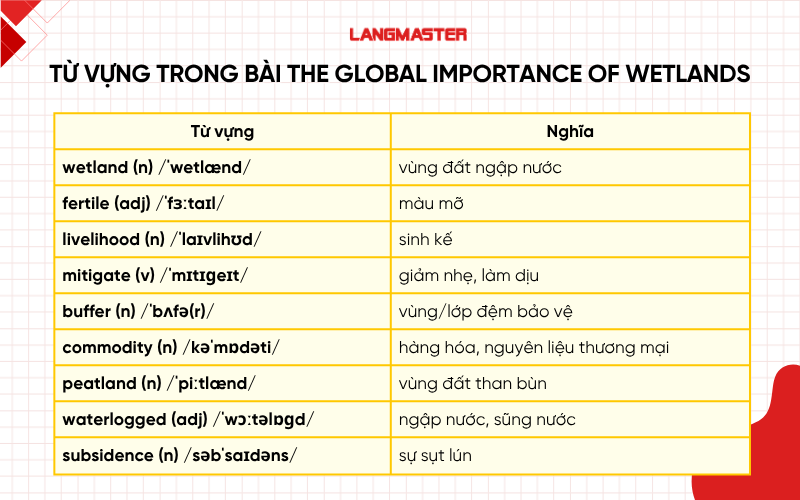
|
Từ vựng |
Nghĩa |
Ví dụ |
|
wetland (n) /ˈwetlænd/ |
vùng đất ngập nước |
Wetlands provide habitats for many species. (Các vùng đất ngập nước cung cấp môi trường sống cho nhiều loài.) |
|
ecosystem (n) /ˈiːkəʊsɪstəm/ |
hệ sinh thái |
Wetlands are complex ecosystems. (Các vùng đất ngập nước là những hệ sinh thái phức tạp.) |
|
fertile (adj) /ˈfɜːtaɪl/ |
màu mỡ |
The region contains fertile agricultural land. (Khu vực này có đất nông nghiệp màu mỡ.) |
|
livelihood (n) /ˈlaɪvlihʊd/ |
sinh kế |
Many local people depend on farming for their livelihoods. (Nhiều người dân địa phương phụ thuộc vào nông nghiệp để kiếm sống.) |
|
mitigate (v) /ˈmɪtɪɡeɪt/ |
giảm nhẹ, làm dịu |
Wetlands can help mitigate climate change. (Các vùng đất ngập nước có thể giúp giảm nhẹ tác động của biến đổi khí hậu.) |
|
buffer (n) /ˈbʌfə(r)/ |
vùng/lớp đệm bảo vệ |
Coastal forests act as buffers against storms. (Rừng ven biển đóng vai trò như vùng đệm bảo vệ trước các cơn bão.) |
|
restore (v) /rɪˈstɔː(r)/ |
khôi phục |
Several projects aim to restore damaged wetlands. (Một số dự án nhằm khôi phục những vùng đất ngập nước đã bị tổn hại.) |
|
commodity (n) /kəˈmɒdəti/ |
hàng hóa, nguyên liệu thương mại |
Palm oil is an internationally traded commodity. (Dầu cọ là một mặt hàng được giao dịch trên thị trường quốc tế.) |
|
peatland (n) /ˈpiːtlænd/ |
vùng đất than bùn |
Peatlands store large quantities of carbon. (Các vùng đất than bùn lưu trữ một lượng lớn carbon.) |
|
waterlogged (adj) /ˈwɔːtəlɒɡd/ |
ngập nước, sũng nước |
Peatlands contain waterlogged organic soil. (Các vùng đất than bùn chứa lớp đất hữu cơ sũng nước.) |
|
cultivation (n) /ˌkʌltɪˈveɪʃn/ |
sự canh tác |
Land was drained for agricultural cultivation. (Đất được rút nước để phục vụ canh tác nông nghiệp.) |
|
carbon emissions (n) |
khí thải carbon |
Forest fires can increase carbon emissions. (Cháy rừng có thể làm gia tăng lượng khí thải carbon.) |
|
clearance (n) /ˈklɪərəns/ |
sự phát quang, dọn sạch |
Forest clearance can damage biodiversity. (Việc phát quang rừng có thể gây tổn hại đến đa dạng sinh học.) |
|
biodiversity (n) /ˌbaɪəʊdaɪˈvɜːsəti/ |
đa dạng sinh học |
The area has extremely high biodiversity. (Khu vực này có mức độ đa dạng sinh học rất cao.) |
|
ditch (n) /dɪtʃ/ |
mương, rãnh |
Workers dug ditches to drain the land. (Công nhân đào các con mương để thoát nước khỏi khu đất.) |
|
drain (v) /dreɪn/ |
rút, thoát nước |
Water was drained from the peatland. (Nước được rút ra khỏi vùng đất than bùn.) |
|
subsidence (n) /səbˈsaɪdəns/ |
sự sụt lún |
Land subsidence can increase the risk of flooding. (Hiện tượng sụt lún đất có thể làm tăng nguy cơ ngập lụt.) |
|
sediment (n) /ˈsedɪmənt/ |
trầm tích |
Sediment run-off can damage wetland ecosystems. (Dòng chảy mang theo trầm tích có thể gây tổn hại đến hệ sinh thái đất ngập nước.) |
|
devastating (adj) /ˈdevəsteɪtɪŋ/ |
gây thiệt hại nghiêm trọng |
Pollution can have devastating environmental effects. (Ô nhiễm có thể gây ra những tác động nghiêm trọng đối với môi trường.) |
|
sustainability (n) /səˌsteɪnəˈbɪləti/ |
tính bền vững |
Local participation is important for sustainability. (Sự tham gia của người dân địa phương rất quan trọng đối với tính bền vững.) |
|
degradation (n) /ˌdeɡrəˈdeɪʃn/ |
sự suy thoái |
Wetland degradation continues in many regions. (Tình trạng suy thoái đất ngập nước vẫn tiếp diễn ở nhiều khu vực.) |
|
cautiously optimistic |
lạc quan một cách thận trọng |
Experts remain cautiously optimistic about future progress. (Các chuyên gia vẫn lạc quan một cách thận trọng về những tiến triển trong tương lai.) |
>> Xem thêm: Lộ trình tự học IELTS Reading từ 0 đến 7.0 hiệu quả tại nhà
Đây là nhóm paraphrase bạn nên đặc biệt chú ý khi luyện Reading bởi đề IELTS hiếm khi lặp nguyên văn thông tin từ passage trong câu hỏi.
|
Trong câu hỏi |
Nghĩa |
Trong bài đọc |
Nghĩa |
|
already been lost |
đã bị mất đi |
have disappeared |
đã biến mất |
|
begin to appreciate the value |
bắt đầu nhận ra/đánh giá cao giá trị |
awareness of the importance is growing |
nhận thức về tầm quan trọng đang tăng lên |
|
continue to benefit |
tiếp tục được hưởng lợi |
provide an income / profit from them |
mang lại thu nhập / hưởng lợi từ chúng |
|
more likely to occur |
có khả năng xảy ra cao hơn |
increases the risk of |
làm tăng nguy cơ |
|
included in discussions |
được tham gia vào các cuộc thảo luận |
involved in planning and decision making |
tham gia vào quá trình lập kế hoạch và ra quyết định |
|
without intention |
không có chủ ý |
not something people set out to do |
không phải điều mọi người cố ý thực hiện |
|
need not be complex |
không cần phải phức tạp |
can be as simple as |
có thể đơn giản như |
|
vary from one nation to the next |
khác nhau giữa các quốc gia |
different governments have different attitudes |
các chính phủ khác nhau có những quan điểm/thái độ khác nhau |
>> Xem thêm: IELTS Reading Yawning: Dịch đề & Giải đề chi tiết
Qua bài The Global Importance of Wetlands, có thể thấy để làm tốt IELTS Reading, người học không chỉ cần hiểu nghĩa từng câu mà còn phải biết xác định keyword, nhận diện paraphrase, tìm đúng vị trí thông tin và phân biệt những chi tiết dễ gây nhiễu. Đặc biệt với các dạng Matching Information hay Matching Features, khả năng đọc có chiến lược đóng vai trò rất quan trọng.
Nếu bạn đang tự luyện IELTS nhưng chưa biết điểm yếu nằm ở đâu hoặc gặp tình trạng làm nhiều đề nhưng điểm vẫn chưa cải thiện ổn định, khoá học IELTS tại Langmaster sẽ là lựa chọn đáng cân nhắc. Với hơn 16 năm kinh nghiệm trong lĩnh vực đào tạo tiếng Anh và đồng hành cùng hàng trăm ngàn học viên trên toàn cầu, Langmaster giúp học viên xây dựng nền tảng tiếng Anh vững chắc, cải thiện từng kỹ năng còn hạn chế và phát triển toàn diện 4 kỹ năng Listening, Speaking, Reading và Writing.
Ưu điểm của khóa học IELTS tại Langmaster:
Coaching 1:1 cùng chuyên gia: Học viên được hỗ trợ trực tiếp để tập trung xử lý những kỹ năng còn yếu, đặc biệt là các vấn đề thường gặp trong Writing như phát triển ý, cấu trúc bài viết, cách sử dụng từ vựng và sửa lỗi ngữ pháp.
Lộ trình học cá nhân hóa theo năng lực và band mục tiêu: Trước khi bắt đầu, học viên được đánh giá đầu vào 4 kỹ năng để xây dựng lộ trình phù hợp với trình độ hiện tại và mục tiêu IELTS. Nhờ đó, người học có thể tập trung cải thiện đúng điểm yếu thay vì học lan man.
Sĩ số lớp nhỏ từ 7–10 học viên: Mô hình lớp học quy mô nhỏ giúp tăng cường tương tác giữa giáo viên và học viên, đồng thời tạo điều kiện để giáo viên theo sát tiến độ, nhận diện lỗi sai và điều chỉnh phương pháp học phù hợp.
Giáo viên IELTS trình độ 7.5-8.0 và chấm chữa bài trong 24 giờ: Học viên được đồng hành bởi đội ngũ giáo viên IELTS có chuyên môn cao, hỗ trợ nhận diện lỗi sai trong quá trình luyện tập và đưa ra hướng cải thiện cụ thể để nâng cao hiệu quả học tập.
Thi thử chuẩn format đề thi thật: Học viên được tham gia các bài thi thử mô phỏng cấu trúc kỳ thi IELTS thực tế, từ đó làm quen với áp lực phòng thi, đánh giá tiến độ và điều chỉnh chiến lược ôn luyện phù hợp.
Cam kết đầu ra bằng văn bản và học lại miễn phí: Langmaster có chính sách cam kết đầu ra bằng văn bản, hỗ trợ học viên học lại miễn phí cho đến khi đạt mục tiêu theo chính sách của chương trình. Thực tế, nhiều học viên Langmaster đã chinh phục band điểm IELTS 7.5+ từ con số 0 và đạt kết quả nổi bật ở từng kỹ năng.
Dưới đây là một trong những kết quả thực tế của học viên sau quá trình học tại Langmaster:
Bên cạnh hình thức học online, học viên có thể lựa chọn hệ thống lớp học IELTS offline tại Hà Nội để tăng cường tương tác trực tiếp và thực hành cùng giáo viên, bạn học. Langmaster hiện có 2 cơ sở:
CS1: Số 169 Xuân Thủy, phường Cầu Giấy, Thành phố Hà Nội
CS2: Số 179 Trường Chinh, phường Phương Liệt, Thành phố Hà Nội
Nếu bạn còn bất kỳ thắc mắc nào về lộ trình học, hình thức phù hợp hay chi phí, đừng ngần ngại liên hệ cho Langmaster để được tư vấn chi tiết nhé!



Tổng hợp đề thi European Heat Wave IELTS Reading Answers kèm phân tích chi tiết, từ vựng và đáp án giúp bạn tối ưu điểm Reading nhanh chóng.

Đề thi IELTS Reading có đáp án mới nhất 2025/2026, cập nhật liên tục đề thi thật và Cambridge, kèm lời giải chi tiết giúp nâng band hiệu quả.
Bài viết tổng hợp chi tiết đề thi IELTS Reading Holidays with a difference, đáp án kèm giải thích chi tiết, từ vựng cần lưu ý khi làm bài giúp bạn luyện thi hiệu quả và nâng cao band điểm.
Bài viết tổng hợp chi tiết đề thi IELTS Reading on the trail of the honey badger, đáp án kèm giải thích chi tiết, từ vựng cần lưu ý khi làm bài giúp bạn luyện thi hiệu quả và nâng cao band điểm.

Khám phá bài đọc Growing more for less IELTS Reading: Tổng hợp đáp án, từ vựng quan trọng và phân tích chi tiết giúp bạn hiểu cách công nghệ vệ tinh hỗ trợ nông nghiệp hiện đại




Hơn 16 năm kinh nghiệm, đào tạo thành công hàng trăm nghìn học viên
Phương pháp giảng dạy hiện đại, học viên tiến bộ rõ rệt
Lộ trình học chuẩn quốc tế, phù hợp với nhu cầu thực tiễn
Giáo viên đạt chuẩn Quốc tế với chất lượng top đầu thị trường, giàu kinh nghiệm
Học online linh hoạt, cam kết đầu ra bằng văn bản