Khóa học
IELTS Online
IELTS Online
Giảm đến 18%
Đăng ký ngay
Mục lục [Ẩn]
Cam 18 Test 4 là một trong những đề thi giúp người học làm quen với cấu trúc, độ khó và các dạng bẫy thường gặp trong cả 4 kỹ năng IELTS: Listening, Reading, Writing và Speaking. Trong bài viết dưới đây, Langmaster sẽ tổng hợp full transcript, đáp án và giải thích chi tiết Cam IELTS 18 Test 4, giúp bạn đối chiếu bài làm, hiểu rõ cách xác định keyword, nhận diện paraphrase, phân tích bẫy đáp án và rút kinh nghiệm để cải thiện kỹ năng làm bài hiệu quả hơn.
| Bạn đang ở band IELTS bao nhiêu? Làm bài test miễn phí và nhận ngay lộ trình học cá nhân hóa. 👉 Đăng ký test IELTS miễn phí ngay |
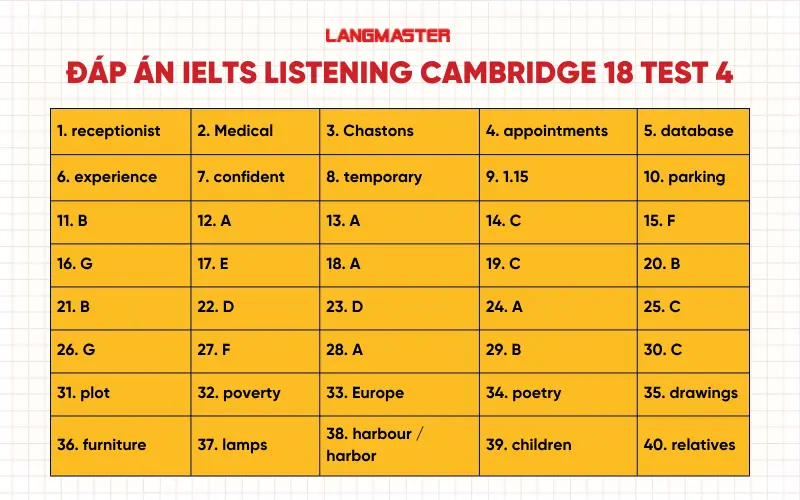
Dưới đây là toàn bộ đáp án IELTS Listening Cam 18 Test 4:
|
1. receptionist |
2. Medical |
3. Chastons |
4. appointments |
5. database |
|
6. experience |
7. confident |
8. temporary |
9. 1.15 |
10. parking |
|
11. B |
12. A |
13. A |
14. C |
15. F |
|
16. G |
17. E |
18. A |
19. C |
20. B |
|
21. B |
22. D |
23. D |
24. A |
25. C |
|
26. G |
27. F |
28. A |
29. B |
30. C |
|
31. plot |
32. poverty |
33. Europe |
34. poetry |
35. drawings |
|
36. furniture |
37. lamps |
38. harbour / harbor |
39. children |
40. relatives |
Bên cạnh đó, bạn có thể xem đề bài và tham khảo phần giải thích đáp án chi tiết TẠI ĐÂY
Green roofs
A. Rooftops covered with grass, vegetable gardens and lush foliage are now a common sight in many cities around the world. More and more private companies and city authorities are investing in green roofs, drawn to their wide-ranging benefits. Among the benefits are saving on energy costs, mitigating the risk of floods, making habitats for urban wildlife, tackling air pollution and even growing food. These increasingly radical urban designs can help cities adapt to the monumental problems they face, such as access to resources and a lack of green space due to development. But the involvement of city authorities, businesses and other institutions is crucial to ensuring their success-as is research investigating different options to suit the variety of rooftop spaces found in cities. The UK is relatively new to developing green roofs, and local governments and institutions are playing a major role in spreading the practice. London is home to much of the UK’s green roof market, mainly due to forward-thinking policies such as the London Plan, which has paved the way to more than doubling the area of green roofs in the capital.
B. Ongoing research is showcasing how green roofs in cities can integrate with ‘living walls’: environmentally friendly walls which are partially or completely covered with greenery, including a growing medium, such as soil or water. Research also indicates that green roofs can be integrated with drainage systems on the ground, such as street trees, so that the water is managed better and the built environment is made more sustainable. There is also evidence to demonstrate the social value of green roofs. Doctors are increasingly prescribing time spent gardening outdoors for patients dealing with anxiety and depression. And research has found that access to even the most basic green spaces can provide a better quality of life for dementia sufferers and help people avoid obesity.
C. In North America, green roofs have become mainstream, with a wide array of expansive, accessible and food-producing roofs installed in buildings. Again, city leaders and authorities have helped push the movement forward -only recently, San Francisco, USA, created a policy requiring new buildings to have green roofs. Toronto, Canada, has policies dating from the 1990s, encouraging the development of urban farms on rooftops. These countries also benefit from having newer buildings than in many parts of the world, which makes it easier to install green roofs. Being able to keep enough water at roof height and distribute it right across the rooftop is crucial to maintaining the plants on any green roof-especially on ‘edible roofs’ where fruit and vegetables are farmed. And it’s much easier to do this in newer buildings, which can typically hold greater weight, than to retro-fit old ones. Having a stronger roof also makes it easier to grow a greater variety of plants, since the soil can be deeper.
D. For green roofs to become the norm for new developments, there needs to be support from public authorities and private investors. Those responsible for maintaining buildings may have to acquire new skills, such as landscaping, and in some cases, volunteers may be needed to help out. Other considerations include installing drainage paths, meeting health and safety requirements and perhaps allowing access for the public, as well as planning restrictions and disruption from regular activities in and around the buildings during installation. To convince investors and developers that installing green roofs is worthwhile, economic arguments are still the most important. The term ‘natural capital’ has been developed to explain the economic value of nature; for example, measuring the money saved by installing natural solutions to protect against flood damage, adapt to climate change or help people lead healthier and happier lives.
E. As the expertise about green roofs grows, official standards have been developed to ensure that they are designed, constructed and maintained properly, and function well. Improvements in the science and technology underpinning green roof development have also led to new variations in the concept. For example, ‘blue roofs’ enable buildings to hold water over longer periods of time, rather than draining it away quickly -crucial in times of heavier rainfall. There are also combinations of green roofs with solar panels, and ‘brown roofs’ which are wilder in nature and maximise biodiversity. If the trend continues, it could create new jobs and a more vibrant and sustainable local food economy -alongside many other benefits. There are still barriers to overcome, but the evidence so far indicates that green roofs have the potential to transform cities and help them function sustainably long into the future. The success stories need to be studied and replicated elsewhere, to make green, blue, brown and food-producing roofs the norm in cities around the world.
Questions 1–5
Reading Passage 1 has five paragraphs, A–E.
Which paragraph contains the following information?
Write the correct letter, A–E, in boxes 1–5 on your answer sheet.
NB You may use any letter more than once.
1. mention of several challenges to be overcome before a green roof can be installed
2. reference to a city where green roofs have been promoted for many years
3. a belief that existing green roofs should be used as a model for new ones
4. examples of how green roofs can work in combination with other green urban initiatives
5. the need to make a persuasive argument for the financial benefits of green roofs
Questions 6–9
Complete the summary below.
Choose ONE WORD ONLY from the passage for each answer.
Write your answers in boxes 6–9 on your answer sheet.
Advantages of green roofs
City rooftops covered with greenery have many advantages. These include lessening the likelihood that floods
will occur, reducing how much money is spent on 6. __________ and creating environments that are suitable
for wildlife. In many cases, they can also be used for producing 7. __________. There are also social benefits
of green roofs. For example, the medical profession recommends 8. __________ an activity to help people
cope with mental health issues. Studies have also shown that the availability of green spaces can prevent
physical problems such as 9. __________.
Questions 10 and 11
Choose TWO letters, A–E.
Write the correct letters in boxes 10 and 11 on your answer sheet.
Which TWO advantages of using newer buildings for green roofs are mentioned in Paragraph C of the
passage?
A. a longer growing season for edible produce
B. more economical use of water
C. greater water-storage capacity
D. ability to cultivate more plant types
E. a large surface area for growing plants
Questions 12 and 13
Choose TWO letters, A–E.
Write the correct letters in boxes 12 and 13 on your answer sheet.
Which TWO aims of new variations on the concept of green roofs are mentioned in Paragraph E of the
passage?
A. to provide habitats for a wide range of species
B. to grow plants successfully even in the wettest climates
C. to regulate the temperature of the immediate environment
D. to generate power from a sustainable source
E. to collect water to supply other buildings
>> Xem thêm: IELTS Reading Cam 16 Test 1: Dịch đề & Giải đề chi tiết

The growth mindset
Over the past century, a powerful idea has taken root in the educational landscape. The concept of intelligence as something innate has been supplanted by the idea that intelligence is not fixed, and that, with the right training, we can be the authors of our own cognitive capabilities. Psychologist Alfred Binet, the developer of the first intelligence tests, was one of many 19th-century scientists who held that earlier view and sought to quantify cognitive ability. Then, in the early 20th century, progressive thinkers revolted against the notion that inherent ability is destiny. Instead, educators such as John Dewey argued that every child’s intelligence could be developed, given the right environment.
‘Growth mindset theory’ is a relatively new and extremely popular-version of this idea. In many schools today you will see hallways covered in motivational posters and hear speeches on the mindset of great sporting heroes who simply believed their way to the top. A major focus of the growth mindset in schools is coaxing students away from seeing failure as an indication of their ability, and towards seeing it as a chance to improve that ability. As educationalist Jeff Howard noted several decades ago: ‘Smart is not something that you just are, smart is something that you can get.’
The idea of the growth mindset is based on the work of psychologist Carol Dweck in California in the 1990s. In one key experiment, Dweck divided a group of 10- to 12-year-olds into two groups. All were told that they had achieved a high score on a test but the first group were praised for their intelligence in achieving this, while the others were praised for their effort. The second group -those who had been instilled with a ‘growth mindset’-were subsequently far more likely to put effort into future tasks. Meanwhile, the former took on only those tasks that would not risk their sense of worth. This group had inferred that success or failure is due to innate ability, and this ‘fixed mindset’ had led them to fear of failure and lack of effort. Praising ability actually made the students perform worse, while praising effort emphasised that change was possible.
One of the greatest impediments to successfully implementing a growth mindset, however, is the education system itself: in many parts of the world, the school climate is obsessed with performance in the form of constant testing, analysing and ranking of students-a key characteristic of the fixed mindset. Nor is it unusual for schools to create a certain cognitive dissonance, when they applaud the benefits of a growth mindset but then hand out fixed target grades in lessons based on performance.
Aside from the implementation problem, the original growth mindset research has also received harsh criticism. The statistician Andrew Gelman claims that ‘their research designs have enough degrees of freedom that they could take their data to support just about any theory at all’. Professor of Psychology Timothy Bates, who has been trying to replicate Dweck’s work, is finding that the results are repeatedly null. He notes that: ‘People with a growth mindset don’t cope any better with failure … Kids with the growth mindset aren’t getting better grades, either before or after our intervention study.
Much of this criticism is not lost on Dweck, and she deserves great credit for responding to it and adapting her work accordingly. In fact, she argues that her work has been misunderstood and misapplied in a range of ways. She has also expressed concerns that her theories are being misappropriated in schools by being conflated with the self-esteem movement: ‘For me the growth mindset is a tool for learning and improvement. It’s not just a vehicle for making children feel good.’
But there is another factor at work here. The failure to translate the growth mindset into the classroom might reflect a misunderstanding of the nature of teaching and learning itself. Growth mindset supporters David Yeager and Gregory Walton claim that interventions should be delivered in a subtle way to maximise their effectiveness. They say that if adolescents perceive a teacher’s intervention as conveying that they are in need of help, this could undo its intended effects.
A lot of what drives students is their innate beliefs and how they perceive themselves. There is a strong correlation between self-perception and achievement, but there is evidence to suggest that the actual effect of achievement on self-perception is stronger than the other way round. To stand up in a classroom and successfully deliver a good speech is a genuine achievement, and that is likely to be more powerfully motivating than vague notions of ‘motivation’itself.
Recent evidence would suggest that growth mindset interventions are not the elixir of student learning that its proponents claim it to be. The growth mindset appears to be a viable construct in the lab, which, when administered in the classroom via targeted interventions, doesn’t seem to work. It is hard to dispute that having faith in the capacity to change is a good attribute for students. Paradoxically, however, that aspiration is not well served by direct interventions that try to instil it.
Motivational posters and talks are often a waste of time, and might well give students a deluded notion of what success actually means. Teaching concrete skills such as how to write an effective introduction to an essay then praising students’ effort in getting there is probably a far better way of improving confidence than telling them how unique they are, or indeed how capable they are of changing their own brains. Perhaps growth mindset works best as a philosophy and not an intervention.
Questions 14–16
Choose the correct letter, A, B, C or D.
Write the correct letter in boxes 14–16 on your answer sheet.
14. What can we learn from the first paragraph?
A. where the notion of innate intelligence first began
B. when ideas about the nature of intelligence began to shift
C. how scientists have responded to changing views of intelligence
D. why thinkers turned away from the idea of intelligence being fixed
15. The second paragraph describes how schools encourage students to
A. identify their personal ambitions.
B. help each other to realise their goals.
C. have confidence in their potential to succeed.
D. concentrate on where their particular strengths lie.
16. In the third paragraph, the writer suggests that students with a fixed mindset
A. tend to be less competitive.
B. generally have a low sense of self-esteem.
C. will only work hard if they are given constant encouragement.
D. are afraid to push themselves beyond what they see as their limitations.
Questions 17–22
Look at the following statements (Questions 17–22) and the list of people below.
Match each statement with the correct person or people, A–E.
Write the correct letter, A–E, in boxes 17–22 on your answer sheet.
NB You may use any letter more than once.
17. The methodology behind the growth mindset studies was not strict enough.
18. The idea of the growth mindset has been incorrectly interpreted.
19. Intellectual ability is an unchangeable feature of each individual.
20. The growth mindset should be promoted without students being aware of it.
21. The growth mindset is not simply about boosting students’ morale.
22. Research shows that the growth mindset has no effect on academic achievement.
Questions 23–26
Do the following statements agree with the views of the writer in Reading Passage 2?
In boxes 23–26 on your answer sheet, write
YES if the statement agrees with the views of the writer
NO if the statement contradicts the views of the writer
NOT GIVEN if it is impossible to say what the writer thinks about this
23. Dweck has handled criticisms of her work in an admirable way.
24. Students’ self-perception is a more effective driver of self-confidence than actual achievement is.
25. Recent evidence about growth mindset interventions has attracted unfair coverage in the media.
26. Deliberate attempts to encourage students to strive for high achievement may have a negative effect.
>> Xem thêm: IELTS Reading Cam 16 Test 3: Dịch đề & Giải đề chi tiết
Alfred Wegener: science, exploration and the theory of continental drift
by Mott T Greene
Introduction
This is a book about the life and scientific work of Alfred Wegener, whose reputation today rests with his theory of continental displacements, better known as ‘continental drift’. Wegener proposed this theory in 1912 and developed it extensively for nearly 20 years. His book on the subject, The Origin of Continents and Oceans, went through four editions and was the focus of an international controversy in his lifetime and for some years after his death.
Wegener’s basic idea was that many mysteries about the Earth’s history could be solved if one supposed that the continents moved laterally, rather than supposing that they remained fixed in place. Wegener showed in great detail how such continental movements were plausible and how they worked, using evidence from a large number of sciences including geology, geophysics, paleontology, and climatology. Wegener’s idea -that the continents move -is at the heart of the theory that guides Earth sciences today: namely plate tectonics. Plate tectonics is in many respects quite different from Wegener’s proposal, in the same way that modern evolutionary theory is very different from the ideas Charles Darwin proposed in the 1850s about biological evolution. Yet plate tectonics is a descendant of Alfred Wegener’s theory of continental drift, in quite the same way that modern evolutionary theory is a descendant of Darwin’s theory of natural selection.
When I started writing about Wegener’s life and work, one of the most intriguing things about him for me was that, although he came up with a theory on continental drift, he was not a geologist. He trained as an astronomer and pursued a career in atmospheric physics. When he proposed the theory of continental displacements in 1912, he was a lecturer in physics and astronomy at the University of Marburg, in southern Germany. However, he was not an ‘unknown’. In 1906 he had set a world record (with his brother Kurt) for time aloft in a hot-air balloon: 52 hours. Between 1906 and 1908 he had taken part in a highly publicized and extremely dangerous expedition to the coast of northeast Greenland. He had also made a name for himself amongst a small circle of meteorologists and atmospheric physicists in Germany as the author of a textbook, Thermodynamics of the Atmosphere (1911), and of a number of interesting scientific papers.
As important as Wegener’s work on continental drift has turned out to be, it was largely a sideline to his interest in atmospheric physics, geophysics, and paleoclimatology * , and thus I have been at great pains to put Wegener’s work on continental drift in the larger context of his other scientific work, and in the even larger context of atmospheric sciences in his lifetime. This is a ‘continental drift book’ only to the extent that Wegener was interested in that topic and later became famous for it. My treatment of his other scientific work is no less detailed, though I certainly have devoted more attention to the reception of his ideas on continental displacement, as they were much more controversial than his other work.
Readers interested in the specific detail of Wegener’s career will see that he often stopped pursuing a given line of investigation (sometimes for years on end), only to pick it up later. I have tried to provide guideposts to his rapidly shifting interests by characterizing different phases of his life as careers in different sciences, which is reflected in the titles of the chapters. Thus, the index should be a sufficient guide for those interested in a particular aspect of Wegener’s life but perhaps not all of it. My own feeling, however, is that the parts do not make as much sense on their own as do all of his activities taken together. In this respect I urge readers to try to experience Wegener’s life as he lived it, with all the interruptions, changes of mind, and renewed efforts this entailed.
Wegener left behind a few published works but, as was standard practice, these reported the results of his work -not the journey he took to reach that point. Only a few hundred of the many thousands of letters he wrote and received in his lifetime have survived and he didn’t keep notebooks or diaries that recorded his life and activities. He was not active (with a few exceptions) in scientific societies, and did not seek to find influence or advance his ideas through professional contacts and politics, spending most of his time at home in his study reading and writing, or in the field collecting observations.
Some famous scientists, such as Newton, Darwin, and Einstein, left mountains of written material behind, hundreds of notebooks and letters numbering in the tens of thousands. Others, like Michael Faraday, left extensive journals of their thoughts and speculations, parallel to their scientific notebooks. The more such material a scientist leaves behind, the better chance a biographer has of forming an accurate picture of how a scientist’s ideas took shape and evolved.
I am firmly of the opinion that most of us, Wegener included, are not in any real sense the authors of our own lives. We plan, think, and act, often with apparent freedom, but most of the time our lives ‘happen to us’, and we only retrospectively turn this happenstance into a coherent narrative of fulfilled intentions. This book, therefore, is a story both of the life and scientific work that Alfred Wegener planned and intended and of the life and scientific work that actually ‘happened to him’. These are, as I think you will soon see, not always the same thing.
Questions 27–30
Do the following statements agree with the claims of the writer in Reading Passage 3?
In boxes 27–30 on your answer sheet, write
YES if the statement agrees with the claims of the writer
NO if the statement contradicts the claims of the writer
NOT GIVEN if it is impossible to say what the writer thinks about this
27. Wegener’s ideas about continental drift were widely disputed while he was alive.
28. The idea that the continents remained fixed in place was defended in a number of respected scientific publications.
29. Wegener relied on a limited range of scientific fields to support his theory of continental drift.
30. The similarities between Wegener’s theory of continental drift and modern-day plate tectonics are enormous.
Questions 31–36
Complete the summary using the list of phrases, A–J, below.
Write the correct letter, A–J, in boxes 31–36 on your answer sheet.
A. modest fame
B. vast range
C. record-breaking achievement
D. research methods
E. select group
F. professional interests
G. scientific debate
H. hazardous exploration
I. biographer’s perspective
J. narrow investigation
Wegener’s life and work
One of the remarkable things about Wegener from a 31. __________ although he proposed a theory of continental drift, he was not a geologist. His 32. __________ were limited to atmospheric physics. However, at the time he proposed his theory of continental drift in 1912, he was already a person of 33. __________. Six years previously, there had been his 34. __________ of 52 hours in a hot-air balloon, followed by his well-publicised but 35. __________ of Greenland’s coast. With the publication of his textbook on thermodynamics, he had also come to the attention of a 36. __________ German scientists.
Questions 37–40
Choose the correct letter, A, B, C or D.
Write the correct letter in boxes 37–40 on your answer sheet.
37. What is Mott T Greene doing in the fifth paragraph?
A. describing what motivated him to write the book
B. explaining why it is desirable to read the whole book
C. suggesting why Wegener pursued so many different careers
D. indicating what aspects of Wegener’s life interested him most
38. What is said about Wegener in the sixth paragraph?
A. He was not a particularly ambitious person.
B. He kept a record of all his scientific observations.
C. He did not adopt many of the scientific practices of the time.
D. He enjoyed discussing new discoveries with other scientists.
39. What does Greene say about some other famous scientists?
A. Their published works had a greater impact than Wegener’s did.
B. They had fewer doubts about their scientific ideas than Wegener did.
C. Their scientific ideas were more controversial than Wegener’s.
D. They are easier subjects to write about than Wegener.
40. What is Greene’s main point in the final paragraph?
A. It is not enough in life to have good intentions.
B. People need to plan carefully if they want to succeed.
C. People have little control over many aspects of their lives.
D. It is important that people ensure they have the freedom to act.
>> Xem thêm: IELTS Reading Cambridge 16 test 4: Dịch và giải chi tiết đáp án
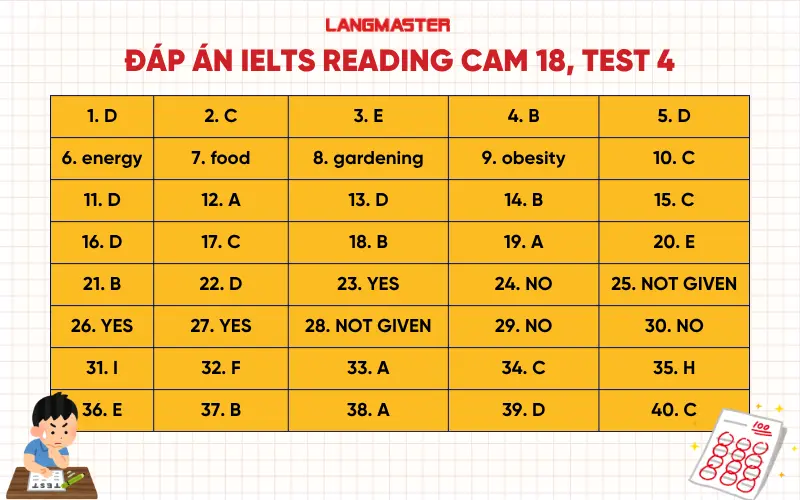
Dưới đây là trọn bộ đáp án IELTS Reading Cam 18, Test 4 bạn có thể tham khảo và đối chiếu với bài làm:
|
1. D |
2. C |
3. E |
4. B |
5. D |
|
6. energy |
7. food |
8. gardening |
9. obesity |
10. C |
|
11. D |
12. A |
13. D |
14. B |
15. C |
|
16. D |
17. C |
18. B |
19. A |
20. E |
|
21. B |
22. D |
23. YES |
24. NO |
25. NOT GIVEN |
|
26. YES |
27. YES |
28. NOT GIVEN |
29. NO |
30. NO |
|
31. I |
32. F |
33. A |
34. C |
35. H |
|
36. E |
37. B |
38. A |
39. D |
40. C |
Giải thích chi tiết
Question 1: D
Thông tin trong bài: “Other considerations include installing drainage paths, meeting health and safety requirements … as well as planning restrictions and disruption from regular activities … during installation.”
Giải thích chi tiết: Đoạn D đề cập hàng loạt khó khăn cần giải quyết trước khi lắp đặt green roofs như hệ thống thoát nước, yêu cầu về an toàn, hạn chế trong quy hoạch và sự gián đoạn hoạt động của tòa nhà. Từ khóa “several challenges” tương ứng trực tiếp với nhiều “considerations” được liệt kê trong đoạn này. Vì vậy đáp án chính xác là D.
Question 2: C
Thông tin trong bài: “Toronto, Canada, has policies dating from the 1990s, encouraging the development of urban farms on rooftops.”
Giải thích chi tiết: Câu hỏi yêu cầu tìm nơi mà green roofs đã được thúc đẩy trong thời gian dài. Cụm “dating from the 1990s” cho thấy Toronto đã áp dụng chính sách hỗ trợ từ những năm 1990, nghĩa là việc thúc đẩy green roofs đã diễn ra nhiều năm. Do đó đáp án là C.
Question 3: E
Thông tin trong bài: “The success stories need to be studied and replicated elsewhere…”
Giải thích chi tiết: Đoạn E nhấn mạnh rằng các mô hình thành công cần được nghiên cứu và nhân rộng sang nơi khác. Ý tưởng này tương đương với việc sử dụng những green roofs hiện có như hình mẫu cho các dự án mới. Từ “replicated” là từ khóa then chốt dẫn đến đáp án E.
Question 4: B
Thông tin trong bài: “Green roofs in cities can integrate with ‘living walls’...” / “...can be integrated with drainage systems on the ground, such as street trees…”
Giải thích chi tiết: Đoạn B đưa ra các ví dụ về việc green roofs kết hợp với những sáng kiến xanh khác như “living walls” và hệ thống cây xanh đô thị. Từ “integrate” xuất hiện nhiều lần và thể hiện rõ ý tưởng phối hợp giữa các giải pháp môi trường. Vì vậy đáp án đúng là B.
Question 5: D
Thông tin trong bài: “To convince investors and developers that installing green roofs is worthwhile, economic arguments are still the most important.”
Giải thích chi tiết: Câu hỏi nhấn mạnh nhu cầu phải thuyết phục người khác về lợi ích tài chính của green roofs. Đoạn D trực tiếp đề cập việc dùng các “economic arguments” để thuyết phục nhà đầu tư và nhà phát triển. Đây là sự paraphrase chính xác của đề bài nên đáp án là D.
Question 6: energy
Thông tin trong bài: “Among the benefits are saving on energy costs…”
Giải thích chi tiết: Tóm tắt đề cập việc giảm số tiền phải chi tiêu. Trong bài, cụm “saving on energy costs” cho thấy khoản tiết kiệm liên quan đến năng lượng. Vì vậy từ cần điền là “energy”.
Question 7: food
Thông tin trong bài: “...even growing food.”
Giải thích chi tiết: Câu hỏi nói green roofs có thể được dùng để sản xuất cái gì. Trong đoạn A, bài đọc nêu trực tiếp khả năng “growing food”. Vì vậy đáp án là “food”.
Question 8: gardening
Thông tin trong bài: “Doctors are increasingly prescribing time spent gardening outdoors…”
Giải thích chi tiết: Đoạn B nói các bác sĩ khuyến khích hoạt động làm vườn ngoài trời để hỗ trợ người gặp vấn đề tâm lý. Từ phù hợp với cấu trúc “recommends ___ an activity” là “gardening”.
Question 9: obesity
Thông tin trong bài: “...help people avoid obesity.”
Giải thích chi tiết: Câu hỏi yêu cầu tìm vấn đề thể chất mà không gian xanh có thể ngăn ngừa. Đoạn B sử dụng trực tiếp từ “obesity”, nên đây là đáp án chính xác.
Question 10: C
Thông tin trong bài:
“Being able to keep enough water at roof height…”
“...newer buildings, which can typically hold greater weight…”
Giải thích chi tiết: Đoạn C cho thấy các tòa nhà mới có thể chịu tải tốt hơn nên giữ được nhiều nước hơn trên mái. Điều này tương ứng với “greater water-storage capacity”. Vì vậy C đúng.
Question 11: D
Thông tin trong bài: “Having a stronger roof also makes it easier to grow a greater variety of plants…”
Giải thích chi tiết: Đoạn C nhấn mạnh mái nhà chắc chắn hơn giúp trồng được nhiều loại cây hơn nhờ lớp đất sâu hơn. Điều này paraphrase trực tiếp thành “ability to cultivate more plant types”. Vì vậy đáp án là D.
Question 12: A
Thông tin trong bài: “‘Brown roofs’ which are wilder in nature and maximise biodiversity.”
Giải thích chi tiết: “Maximise biodiversity” đồng nghĩa với việc tạo môi trường sống cho nhiều loài khác nhau. Vì vậy đáp án A phù hợp nhất.
Question 13: D
Thông tin trong bài: “There are also combinations of green roofs with solar panels…”
Giải thích chi tiết: Solar panels được dùng để tạo năng lượng từ nguồn bền vững là ánh sáng mặt trời. Điều này tương ứng trực tiếp với lựa chọn D.
Question 14: B
Thông tin trong bài: “Then, in the early 20th century, progressive thinkers revolted against the notion that inherent ability is destiny.”
Giải thích chi tiết: Đoạn đầu mô tả thời điểm quan điểm về trí thông minh bắt đầu thay đổi, từ việc xem intelligence là bẩm sinh sang có thể phát triển được. Cụm “in the early 20th century” xác định thời điểm chuyển biến, nên đáp án là B.
Question 15: C
Thông tin trong bài: “A major focus ... is coaxing students away from seeing failure as an indication of their ability…”
Giải thích chi tiết: Các trường học cố gắng giúp học sinh tin rằng thất bại không phản ánh năng lực cố định mà là cơ hội cải thiện. Điều này nhằm xây dựng niềm tin vào khả năng thành công trong tương lai. Vì vậy đáp án C chính xác.
Question 16: D
Thông tin trong bài: “The former took on only those tasks that would not risk their sense of worth.”
Giải thích chi tiết: Học sinh có fixed mindset chỉ chọn nhiệm vụ an toàn để tránh thất bại. Điều này cho thấy sự sợ hãi khi phải vượt khỏi giới hạn bản thân. Vì vậy đáp án D đúng nhất.
Question 17: C (Andrew Gelman)
Thông tin trong bài: “their research designs have enough degrees of freedom…”
Giải thích chi tiết: Andrew Gelman chỉ trích thiết kế nghiên cứu thiếu chặt chẽ và có thể dẫn tới nhiều kết quả tùy ý. Điều này khớp với nhận định về phương pháp nghiên cứu không đủ nghiêm ngặt.
Question 18: B (Carol Dweck)
Thông tin trong bài: “her work has been misunderstood and misapplied…”
Giải thích chi tiết: Carol Dweck cho rằng lý thuyết growth mindset đã bị hiểu sai và áp dụng sai trong trường học. Vì vậy đáp án là B.
Question 19: A (Alfred Binet)
Thông tin trong bài: “the concept of intelligence as something innate…”
Giải thích chi tiết: Alfred Binet thuộc nhóm học giả tin rằng trí thông minh là đặc điểm bẩm sinh và cố định. Điều này tương ứng với nhận định trong câu hỏi.
Question 20: E (David Yeager and Gregory Walton)
Thông tin trong bài: “interventions should be delivered in a subtle way…”
Giải thích chi tiết: Hai nhà nghiên cứu cho rằng growth mindset nên được truyền tải tinh tế để học sinh không nhận ra mình đang bị can thiệp. Vì vậy đáp án E đúng.
Question 21: B (Carol Dweck)
Thông tin trong bài: “It’s not just a vehicle for making children feel good.”
Giải thích chi tiết: Dweck nhấn mạnh growth mindset không chỉ nhằm nâng cao tinh thần hay khiến học sinh cảm thấy vui vẻ. Ý này khớp hoàn toàn với câu hỏi.
Question 22: D (Timothy Bates)
Thông tin trong bài: “Kids with the growth mindset aren’t getting better grades…”
Giải thích chi tiết: Timothy Bates cho rằng growth mindset không giúp cải thiện điểm số học tập. Điều này tương ứng trực tiếp với nhận định của câu hỏi.
Question 23: YES
Thông tin trong bài: “she deserves great credit for responding to it and adapting her work accordingly.”
Giải thích chi tiết: Người viết đánh giá cao cách Dweck phản hồi chỉ trích và điều chỉnh nghiên cứu. Đây là quan điểm tích cực rõ ràng, nên đáp án YES.
Question 24: NO
Thông tin trong bài: “the actual effect of achievement on self-perception is stronger than the other way round.”
Giải thích chi tiết: Người viết cho rằng thành tích thực tế ảnh hưởng đến self-perception mạnh hơn chiều ngược lại. Điều này trái ngược với phát biểu trong câu hỏi nên đáp án là NO.
Question 25: NOT GIVEN
Giải thích chi tiết: Bài đọc đề cập bằng chứng gần đây cho thấy growth mindset interventions không hiệu quả, nhưng không nói gì về việc truyền thông đưa tin công bằng hay thiếu công bằng. Vì vậy đáp án là NOT GIVEN.
Question 26: YES
Thông tin trong bài:
Giải thích chi tiết: Người viết cho rằng những nỗ lực trực tiếp nhằm thúc đẩy học sinh có thể gây tác dụng ngược hoặc tạo nhận thức sai lệch. Điều này đồng ý với phát biểu trong câu hỏi nên đáp án YES.
Question 27: YES
Thông tin trong bài: “...went through four editions and was the focus of an international controversy in his lifetime and for some years after his death.”
Giải thích chi tiết: Đoạn mở đầu khẳng định lý thuyết continental drift của Wegener gây ra “international controversy” ngay trong thời gian ông còn sống. Từ “controversy” cho thấy có nhiều tranh cãi và phản đối mạnh mẽ. Vì vậy phát biểu cho rằng lý thuyết này bị tranh cãi rộng rãi khi Wegener còn sống là chính xác.
Question 28: NOT GIVEN
Thông tin trong bài: “...rather than supposing that they remained fixed in place.”
Giải thích chi tiết: Bài đọc chỉ nhắc tới giả định cũ rằng các lục địa đứng yên, nhưng không đề cập việc quan điểm này được bảo vệ trong các công trình khoa học nổi tiếng hay uy tín. Không có thông tin liên quan đến “respected scientific publications”, vì vậy đáp án là NOT GIVEN.
Question 29: NO
Thông tin trong bài: “...using evidence from a large number of sciences including geology, geophysics, paleontology, and climatology.”
Giải thích chi tiết: Câu hỏi nói Wegener chỉ dựa vào phạm vi khoa học hạn chế. Tuy nhiên bài đọc khẳng định ông sử dụng bằng chứng từ “a large number of sciences”. Điều này trái ngược hoàn toàn với nhận định trong câu hỏi, nên đáp án là NO.
Question 30: NO
Thông tin trong bài: “Plate tectonics is in many respects quite different from Wegener’s proposal...”
Giải thích chi tiết: Bài đọc nhấn mạnh plate tectonics hiện đại khác biệt đáng kể với lý thuyết continental drift ban đầu của Wegener. Dù có mối liên hệ kế thừa, hai học thuyết không giống nhau ở mức “enormous similarities”. Vì vậy đáp án là NO.
Question 31: I (biographer’s perspective)
Thông tin trong bài: “One of the most intriguing things about him for me...”
Giải thích chi tiết: Cụm “for me” cho thấy góc nhìn cá nhân của tác giả tiểu sử khi đánh giá Wegener. Vì vậy cụm phù hợp nhất là “biographer’s perspective”.
Question 32: F (professional interests)
Thông tin trong bài: “He trained as an astronomer and pursued a career in atmospheric physics.”
Giải thích chi tiết: Đoạn văn mô tả lĩnh vực chuyên môn và sự nghiệp khoa học của Wegener, tương ứng với “professional interests”. Vì vậy đáp án là F.
Question 33: A (modest fame)
Thông tin trong bài: “However, he was not an ‘unknown’.”
Giải thích chi tiết: Cụm “not an unknown” cho thấy Wegener đã có danh tiếng nhất định trước khi đưa ra lý thuyết continental drift, dù chưa phải nhà khoa học nổi tiếng toàn cầu. Điều này phù hợp với “modest fame”.
Question 34: C (record-breaking achievement)
Thông tin trong bài: “In 1906 he had set a world record ... for time aloft in a hot-air balloon: 52 hours.”
Giải thích chi tiết: Câu này đề cập trực tiếp đến việc Wegener lập kỷ lục thế giới với thời gian bay khinh khí cầu 52 giờ. Đây rõ ràng là “record-breaking achievement”.
Question 35: H (hazardous exploration)
Thông tin trong bài: “...a highly publicized and extremely dangerous expedition to the coast of northeast Greenland.”
Giải thích chi tiết: Từ “extremely dangerous expedition” thể hiện chuyến thám hiểm đầy nguy hiểm. Điều này tương ứng chính xác với “hazardous exploration”.
Question 36: E (select group)
Thông tin trong bài: “...made a name for himself amongst a small circle of meteorologists and atmospheric physicists in Germany...”
Giải thích chi tiết: “a small circle” được paraphrase thành “select group”. Ý nghĩa đều chỉ một nhóm nhỏ chuyên gia khoa học tại Đức biết đến Wegener. Vì vậy đáp án là E.
Question 37: B
Thông tin trong bài: “My own feeling, however, is that the parts do not make as much sense on their own as do all of his activities taken together.”
Giải thích chi tiết: Tác giả giải thích rằng chỉ khi đọc toàn bộ cuộc đời và sự nghiệp của Wegener thì mọi thứ mới trở nên hợp lý và đầy đủ ý nghĩa. Điều này cho thấy tác giả muốn nhấn mạnh lý do nên đọc toàn bộ cuốn sách thay vì chỉ từng phần riêng lẻ. Vì vậy đáp án là B.
Question 38: A
Thông tin trong bài: “He was not active ... in scientific societies, and did not seek to find influence or advance his ideas through professional contacts and politics...”
Giải thích chi tiết: Đoạn văn cho thấy Wegener không tích cực xây dựng quan hệ hay tìm kiếm ảnh hưởng trong giới học thuật. Điều này phản ánh tính cách không quá tham vọng trong việc phát triển danh tiếng cá nhân. Vì vậy đáp án đúng là A.
Question 39: D
Thông tin trong bài: “The more such material a scientist leaves behind, the better chance a biographer has of forming an accurate picture...”
Giải thích chi tiết: Tác giả so sánh Wegener với những nhà khoa học như Newton hay Darwin - những người để lại rất nhiều tài liệu cá nhân. Điều này khiến họ trở thành đối tượng dễ nghiên cứu hơn đối với người viết tiểu sử. Vì vậy đáp án là D.
Question 40: C
Thông tin trong bài: “...most of the time our lives ‘happen to us’...”
Giải thích chi tiết: Ở đoạn cuối, Greene cho rằng con người không hoàn toàn kiểm soát cuộc đời mình, bởi nhiều sự kiện xảy ra ngoài dự tính cá nhân. Quan điểm trung tâm là con người có rất ít quyền kiểm soát đối với nhiều khía cạnh của cuộc sống. Vì vậy đáp án đúng là C.
>> Xem thêm: Những sai lầm khi luyện IELTS Reading cần tránh và cách khắc phục
| Học mãi mà IELTS không lên band? Học thử IELTS miễn phí cùng giáo viên 7.5+, chấm chữa lỗi sai ngay lập tức. 👉 Đăng ký học thử miễn phí ngay |
Dưới đây là tổng hợp các câu hỏi và bài mẫu IELTS Speaking Part 1 trong Cam 18, Test 4 giúp bạn làm quen với cách trả lời tự nhiên, phát triển ý mạch lạc và học thêm nhiều từ vựng, cách diễn đạt hữu ích để nâng cao band điểm Speaking.
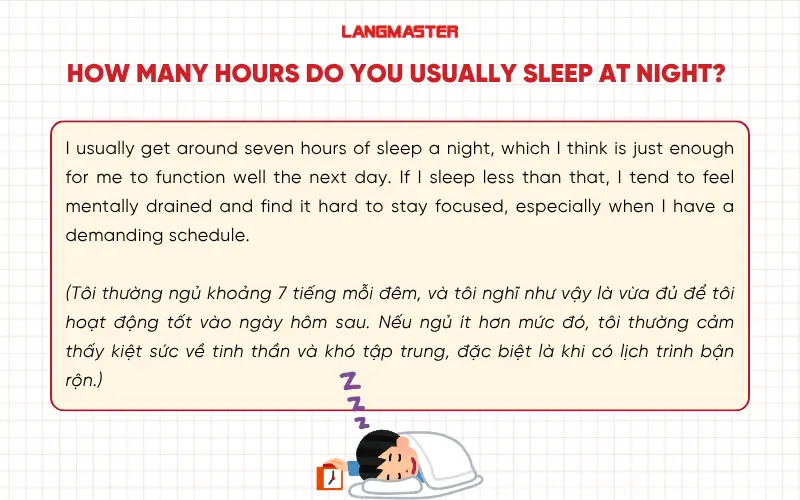
Question 1. How many hours do you usually sleep at night?
(Bạn thường ngủ bao nhiêu tiếng mỗi đêm?)
Sample answer
I usually get around seven hours of sleep a night, which I think is just enough for me to function well the next day. If I sleep less than that, I tend to feel mentally drained and find it hard to stay focused, especially when I have a demanding schedule.
(Tôi thường ngủ khoảng 7 tiếng mỗi đêm, và tôi nghĩ như vậy là vừa đủ để tôi hoạt động tốt vào ngày hôm sau. Nếu ngủ ít hơn mức đó, tôi thường cảm thấy kiệt sức về tinh thần và khó tập trung, đặc biệt là khi có lịch trình bận rộn.)
Vocabulary
Question 2. Do you sometimes sleep during the day? Why/Why not?
(Bạn có thỉnh thoảng ngủ vào ban ngày không? Tại sao có / tại sao không?)
Sample answer
Yes, but only occasionally. If I have had a particularly hectic morning or did not sleep well the night before, I may take a short power nap for about 15 to 20 minutes. It helps me recharge without making me feel groggy afterwards. However, I avoid sleeping for too long during the day because it can interfere with my sleep at night.
(Có, nhưng chỉ thỉnh thoảng thôi. Nếu tôi có một buổi sáng đặc biệt bận rộn hoặc đêm trước ngủ không ngon, tôi có thể chợp mắt khoảng 15 đến 20 phút. Việc này giúp tôi nạp lại năng lượng mà không khiến tôi cảm thấy uể oải sau đó. Tuy nhiên, tôi tránh ngủ quá lâu vào ban ngày vì điều đó có thể ảnh hưởng đến giấc ngủ ban đêm.)
Vocabulary
>> Xem thêm: IELTS Speaking Part 1 Topic Small Business: Bài mẫu & từ vựng band 8+
Question 3. What do you do if you can’t get to sleep at night? Why?
(Bạn làm gì nếu không thể ngủ được vào ban đêm? Tại sao?)
Sample answer
If I cannot fall asleep, I usually avoid looking at my phone because the blue light can make it even harder to drift off. Instead, I try to do something calming, like reading a few pages of a book or listening to soft instrumental music. This helps my mind slow down and puts me in a more relaxed state.
(Nếu không thể ngủ được, tôi thường tránh nhìn vào điện thoại vì ánh sáng xanh có thể khiến việc đi vào giấc ngủ trở nên khó khăn hơn. Thay vào đó, tôi cố làm một việc gì đó nhẹ nhàng, chẳng hạn như đọc vài trang sách hoặc nghe nhạc không lời êm dịu. Điều này giúp tâm trí tôi chậm lại và đưa tôi vào trạng thái thư giãn hơn.)
Vocabulary
Question 4. Do you ever remember the dreams you’ve had while you were asleep?
(Bạn có bao giờ nhớ những giấc mơ mà mình đã mơ khi ngủ không?)
Sample answer
Yes, I do, but not very often. I normally remember my dreams only when they are particularly vivid or emotionally intense. Most of the time, the details fade away shortly after I wake up. I find dreams quite fascinating because they sometimes reflect what I have been thinking about subconsciously.
(Có, nhưng không thường xuyên lắm. Tôi thường chỉ nhớ những giấc mơ khi chúng đặc biệt rõ ràng hoặc có cảm xúc mạnh. Phần lớn thời gian, các chi tiết sẽ dần biến mất ngay sau khi tôi thức dậy. Tôi thấy giấc mơ khá thú vị vì đôi khi chúng phản ánh những điều tôi đang suy nghĩ trong tiềm thức.)
Vocabulary
>> Xem thêm: IELTS Speaking Part 1 Topic Cakes and other sweet things: Bài mẫu & từ vựng
Dưới đây là bài mẫu IELTS Speaking Part 2 trong Cam 18, Test 4 với chủ đề “Describe a time when you met someone who you became good friends with”, giúp bạn tham khảo cách triển khai ý tưởng, sử dụng từ vựng tự nhiên và phát triển câu trả lời mạch lạc hơn trong bài thi Speaking.
Sample Answer band 8.0
One person whom I eventually became very close friends with was a girl named Linh, whom I met during my first year at university. Even though we came from completely different backgrounds, we surprisingly got along almost instantly.
I vividly remember that we first met during an orientation session for freshmen. At that time, I was feeling rather overwhelmed because everything was unfamiliar to me - the campus was enormous, the schedule was hectic, and I barely knew anyone. By coincidence, Linh happened to sit next to me and started a conversation in an extremely friendly and approachable manner.
What impressed me the most was her genuine personality. Unlike many people who tend to engage in superficial small talk, she was remarkably thoughtful and attentive. We quickly discovered that we shared a number of common interests, particularly our passion for English learning, books, and personal development. After that day, we began studying together regularly, grabbing coffee after classes, and supporting each other academically as well as emotionally.
Over time, our friendship developed naturally because we were both willing to listen to each other and offer encouragement during difficult periods. For example, there was a time when I struggled to balance my studies and part-time job, and she constantly motivated me instead of criticizing me. I truly appreciated that because loyal and understanding friends are quite rare nowadays.
Looking back, I would say meeting Linh was one of the most meaningful friendships I have ever formed. She has had a profoundly positive influence on my mindset and personal growth, and I genuinely believe that our friendship will last for many years to come.
Dịch nghĩa
Một người mà sau này tôi trở thành bạn thân là một cô gái tên Linh, người mà tôi gặp vào năm nhất đại học. Mặc dù chúng tôi đến từ những hoàn cảnh hoàn toàn khác nhau, nhưng thật bất ngờ là chúng tôi hòa hợp gần như ngay lập tức.
Tôi vẫn nhớ rất rõ lần đầu chúng tôi gặp nhau là trong buổi định hướng dành cho sinh viên năm nhất. Lúc đó, tôi cảm thấy khá choáng ngợp vì mọi thứ đều xa lạ - khuôn viên trường rất rộng, lịch học dày đặc và tôi hầu như không quen biết ai cả. Tình cờ, Linh ngồi cạnh tôi và bắt đầu cuộc trò chuyện với thái độ vô cùng thân thiện và dễ gần.
Điều khiến tôi ấn tượng nhất là tính cách chân thành của cô ấy. Không giống nhiều người thường chỉ nói chuyện xã giao hời hợt, cô ấy cực kỳ tinh tế và biết quan tâm đến người khác. Chúng tôi nhanh chóng nhận ra rằng mình có nhiều sở thích chung, đặc biệt là niềm đam mê với việc học tiếng Anh, sách và phát triển bản thân. Sau ngày hôm đó, chúng tôi thường xuyên học cùng nhau, đi cà phê sau giờ học và hỗ trợ nhau cả trong học tập lẫn tinh thần.
Theo thời gian, tình bạn của chúng tôi phát triển rất tự nhiên vì cả hai đều sẵn sàng lắng nghe và động viên nhau trong những giai đoạn khó khăn. Ví dụ, đã có lúc tôi gặp khó khăn trong việc cân bằng giữa việc học và công việc làm thêm, và cô ấy luôn động viên thay vì chỉ trích tôi. Tôi thực sự trân trọng điều đó vì những người bạn trung thành và thấu hiểu ngày nay khá hiếm.
Nhìn lại, tôi có thể nói rằng việc gặp Linh là một trong những tình bạn ý nghĩa nhất mà tôi từng có. Cô ấy đã tạo ảnh hưởng vô cùng tích cực đến suy nghĩ cũng như sự trưởng thành của tôi, và tôi thực sự tin rằng tình bạn của chúng tôi sẽ kéo dài trong nhiều năm nữa.
Từ vựng ghi điểm trong bài
>> Xem thêm: IELTS Speaking Part 2: Describe a famous person in your country
Dưới đây là bộ câu hỏi và bài mẫu IELTS Speaking Part 3 trong Cam 18, Test 4 xoay quanh chủ đề friendship and social relationships, giúp bạn cải thiện khả năng diễn đạt, phát triển ý sâu hơn và hướng tới band 7.0+ trong phần thi Speaking.
Question 1: How important is it for children to have lots of friends at school?
(Việc trẻ em có nhiều bạn ở trường quan trọng như thế nào?)
Sample answer
I believe having friends at school plays a crucial role in a child’s social and emotional development. Through friendships, children learn essential interpersonal skills such as communication, cooperation, empathy, and conflict resolution. Moreover, having a supportive social circle can help children feel a greater sense of belonging, which may positively influence their confidence and academic performance.
However, I do not necessarily think that having a large number of friends is the most important factor. In many cases, having a few close and trustworthy friends can be far more beneficial than maintaining numerous superficial relationships. Meaningful friendships often provide emotional support and contribute significantly to a child’s psychological well-being.
(Tôi tin rằng việc có bạn bè ở trường đóng vai trò vô cùng quan trọng đối với sự phát triển xã hội và cảm xúc của trẻ em. Thông qua tình bạn, trẻ học được những kỹ năng giao tiếp thiết yếu như giao tiếp, hợp tác, sự đồng cảm và cách giải quyết mâu thuẫn. Hơn nữa, việc có một vòng tròn bạn bè hỗ trợ có thể giúp trẻ cảm thấy thuộc về một cộng đồng, từ đó tác động tích cực đến sự tự tin và kết quả học tập.
Tuy nhiên, tôi không nghĩ rằng việc có thật nhiều bạn mới là điều quan trọng nhất. Trong nhiều trường hợp, có một vài người bạn thân thiết và đáng tin cậy sẽ có ích hơn nhiều so với việc duy trì nhiều mối quan hệ hời hợt. Những tình bạn ý nghĩa thường mang lại sự hỗ trợ tinh thần và đóng góp lớn cho sức khỏe tâm lý của trẻ.)
Vocabulary
>> Xem thêm: IELTS Speaking Part 3 topic Memory, từ vựng và bài mẫu chi tiết
Question 2: Do you think it is wrong for parents to influence which friends their children have?
(Bạn có nghĩ sẽ là sai lầm trong việc cha mẹ ảnh hưởng đến việc lựa chọn bạn bè của con cái không?)
Sample answer
Personally, I think it is understandable for parents to guide their children regarding friendships, especially when the children are still young and lack sufficient life experience. Parents are generally more capable of identifying negative influences such as peer pressure, unhealthy behavior, or toxic friendships.
That being said, I believe there should be a clear distinction between guidance and control. If parents become overly controlling and attempt to dictate every friendship their child has, it may lead to resentment and limit the child’s ability to make independent decisions. Therefore, parents should offer advice in a balanced and respectful manner rather than imposing strict restrictions.
(Cá nhân tôi cho rằng việc cha mẹ định hướng con cái trong vấn đề bạn bè là điều dễ hiểu, đặc biệt khi trẻ còn nhỏ và thiếu kinh nghiệm sống. Cha mẹ thường có khả năng nhận ra những ảnh hưởng tiêu cực như áp lực bạn bè, hành vi không lành mạnh hoặc các mối quan hệ độc hại.
Tuy vậy, tôi nghĩ cần có sự khác biệt rõ ràng giữa việc định hướng và kiểm soát. Nếu cha mẹ trở nên quá áp đặt và cố gắng quyết định mọi mối quan hệ của con, điều đó có thể gây ra sự phản kháng và hạn chế khả năng đưa ra quyết định độc lập của trẻ. Vì thế, cha mẹ nên đưa ra lời khuyên một cách cân bằng và tôn trọng thay vì áp đặt những quy tắc quá nghiêm ngặt.)
Vocabulary
Question 3: Why do you think children often choose different friends as they get older?
(Bạn nghĩ vì sao trẻ con thường chọn bạn bè khác đi khi chúng lớn lên?)
Sample answer
I think this mainly happens because people’s personalities, interests, and priorities naturally evolve over time. When children are young, they usually choose friends based on simple factors such as proximity or shared hobbies. For example, they may become friends simply because they sit next to each other in class.
As they mature, however, they begin to place greater value on deeper qualities such as loyalty, mutual understanding, and shared values. Consequently, some childhood friendships gradually fade away while new friendships emerge that better reflect their evolving identities and perspectives.
(Tôi nghĩ điều này chủ yếu xảy ra vì tính cách, sở thích và ưu tiên của con người tự nhiên thay đổi theo thời gian. Khi còn nhỏ, trẻ thường chọn bạn dựa trên những yếu tố đơn giản như ở gần nhau hoặc có chung sở thích. Ví dụ, chúng có thể kết bạn chỉ vì ngồi cạnh nhau trong lớp.
Tuy nhiên, khi trưởng thành hơn, họ bắt đầu coi trọng những phẩm chất sâu sắc hơn như sự trung thành, sự thấu hiểu và giá trị sống chung. Vì vậy, một số tình bạn thời thơ ấu dần phai nhạt và những tình bạn mới xuất hiện để phản ánh đúng hơn con người và góc nhìn đang thay đổi của họ.)
Vocabulary
>> Xem thêm: IELTS Speaking Part 3 Topic Success: Bài mẫu & từ vựng Band 8+
Question 4: If a person is moving to a new town, what is a good way for them to make friends?
(Nếu một người chuyển tới một nơi ở mới, cách nào để làm quen bạn mới?)
Sample answer
In my opinion, one of the most effective ways to make friends in a new town is to participate in community activities or join clubs that match personal interests. For instance, attending sports classes, volunteering events, or language exchange programs can create opportunities for natural social interaction.
In addition, maintaining an open-minded and approachable attitude is equally important. People are generally more willing to connect with someone who appears friendly and genuinely interested in others. Building friendships may take time, but consistent social engagement can gradually help newcomers establish meaningful relationships.
(Theo tôi, một trong những cách hiệu quả nhất để kết bạn ở nơi ở mới là tham gia các hoạt động cộng đồng hoặc câu lạc bộ phù hợp với sở thích cá nhân. Ví dụ, tham gia lớp thể thao, hoạt động tình nguyện hoặc chương trình trao đổi ngôn ngữ có thể tạo cơ hội cho những tương tác xã hội tự nhiên.
Ngoài ra, việc giữ thái độ cởi mở và thân thiện cũng quan trọng không kém. Mọi người thường dễ kết nối hơn với những ai thân thiện và thực sự quan tâm đến người khác. Việc xây dựng tình bạn có thể cần thời gian, nhưng việc tích cực giao lưu thường xuyên sẽ dần giúp người mới tạo dựng được các mối quan hệ ý nghĩa.)
Vocabulary
Question 5: Can you think of any disadvantages of making new friends online?
(Có những bất lợi nào trong việc kết bạn trực tuyến?)
Sample answer
Yes, although online friendships can be convenient, they also come with several potential drawbacks. One major concern is the issue of trust because people on the internet can easily hide their true identities or present misleading information about themselves.
Another disadvantage is that online communication often lacks emotional depth compared to face-to-face interaction. Since people mainly communicate through screens, misunderstandings can occur more easily due to the absence of body language and facial expressions. In some cases, excessive reliance on online friendships may even contribute to social isolation in real life.
(Có, mặc dù tình bạn trực tuyến khá tiện lợi, nhưng chúng cũng đi kèm nhiều bất lợi tiềm ẩn. Một vấn đề lớn là sự tin tưởng vì mọi người trên mạng có thể dễ dàng che giấu danh tính thật hoặc cung cấp thông tin sai lệch về bản thân.
Một bất lợi khác là giao tiếp trực tuyến thường thiếu chiều sâu cảm xúc so với giao tiếp trực tiếp. Vì mọi người chủ yếu trò chuyện qua màn hình nên hiểu lầm dễ xảy ra hơn do thiếu ngôn ngữ cơ thể và biểu cảm khuôn mặt. Trong một số trường hợp, việc quá phụ thuộc vào các mối quan hệ trực tuyến thậm chí còn có thể dẫn đến sự cô lập ngoài đời thực.)
Vocabulary
Question 6: Would you say it is harder for people to make new friends as they get older?
(Bạn có nghĩ việc kết bạn sẽ khó khăn đối với mọi người khi họ càng lớn lên không?)
Sample answer
Yes, I would say so. As people grow older, they often become busier with work, family responsibilities, and other personal commitments, leaving them with less time and energy for socializing. Unlike school environments where friendships develop naturally through daily interaction, adults usually need to make a conscious effort to build new relationships.
Furthermore, older individuals may become more cautious and selective when forming friendships because they tend to value emotional compatibility and trust more highly. As a result, making genuine friendships in adulthood can be considerably more challenging than during childhood or adolescence.
(Có, tôi nghĩ là như vậy. Khi con người lớn tuổi hơn, họ thường bận rộn hơn với công việc, gia đình và các trách nhiệm cá nhân khác, khiến họ có ít thời gian và năng lượng để giao lưu xã hội. Không giống môi trường học đường nơi tình bạn phát triển tự nhiên thông qua tương tác hàng ngày, người trưởng thành thường phải chủ động hơn trong việc xây dựng các mối quan hệ mới.
Hơn nữa, người lớn tuổi thường trở nên thận trọng và chọn lọc hơn khi kết bạn vì họ coi trọng sự hòa hợp về cảm xúc và sự tin tưởng hơn. Do đó, việc xây dựng những tình bạn chân thành ở tuổi trưởng thành thường khó khăn hơn đáng kể so với thời thơ ấu hoặc tuổi thiếu niên.)
Vocabulary
>> Xem thêm: IELTS Speaking Part 3 topic Hobbies: Từ vựng, bài mẫu band 8+
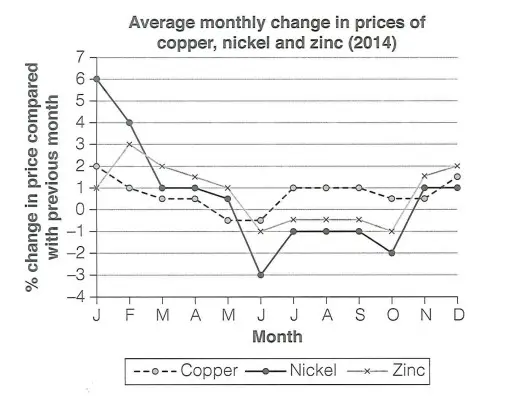
Đề thi Cambridge 18, Test 4, Writing Task 1 yêu cầu bạn miêu tả một biểu đồ đường (line graph) thể hiện sự thay đổi tỷ lệ phần trăm trung bình hàng tháng trong giá của 3 kim loại: đồng (copper), niken (nickel) và kẽm (zinc) trong năm 2014. Dưới đây là đề bài và bài mẫu IELTS Writing Task 1 trong Cam 18, Test 4 giúp bạn tham khảo cách phân tích biểu đồ, lựa chọn số liệu nổi bật và triển khai bài viết
The line graph represents the average percentage change in the price of copper, nickel, and zinc throughout the months of 2014.
Summarise the information by selecting and reporting the main features, and make comparisons where relevant.
Nguồn: Internet
>> Xem thêm: Độ dài bài viết IELTS Writing bao nhiêu là đủ? Cách viết đạt điểm tối đa
Overview (Tổng quan): Nhìn chung, giá của cả ba kim loại đều có sự dao động đáng kể trong năm 2014. Phần lớn các số liệu nằm quanh mức 0% hoặc dưới mức này trong nửa cuối năm. Trong đó, nickel là kim loại có mức biến động mạnh nhất, còn copper nhìn chung ổn định hơn.
Thân bài 1 (Xu hướng Copper & Zinc):
Thân bài 2 (Xu hướng Nickel):
>> Xem thêm: Cách viết Overview IELTS Writing Task 1 chi tiết, đạt điểm cao
The line graph illustrates the average monthly percentage change in the prices of copper, nickel, and zinc throughout the year 2014 compared to the previous month.
Overall, all three metals experienced noticeable fluctuations during the year. Nickel showed the most dramatic changes in price, while copper was comparatively more stable. In addition, the figures for all three metals generally declined during the middle of the year before recovering slightly towards the end of 2014.
Regarding copper and zinc, copper began the year with a modest increase of approximately 2% in January. However, its growth rate gradually declined over the following months and fell to around -1% in June. After that, the figure recovered and remained relatively stable at about 1% from July to September before ending the year slightly higher.
Similarly, zinc recorded a significant rise of roughly 3% in February after starting at around 1% in January. Nevertheless, its price change steadily decreased during the following months and reached approximately -1% in October. Despite this decline, zinc experienced a noticeable rebound in the final two months, finishing the year at nearly 2%.
Nickel, on the other hand, underwent the most substantial volatility. Its price surged to about 6% in January, which was considerably higher than the other two metals. However, the figure dropped sharply in the first half of the year and hit a low of around -3% in June. Between July and September, nickel remained relatively stable at approximately -1%, before falling slightly again in October. Towards the end of the year, the metal recovered moderately and closed the year at around 1%.
Vocabulary
>> Xem thêm: Giải đề Cambridge 15, Test 1 IELTS Writing: Bài mẫu & Từ vựng
Đề bài IELTS Writing Task 2 trong Cambridge 18, Test 4 thuộc dạng Evaluating (To what extent do the advantages outweigh the disadvantages) về chủ đề Già hóa dân số (Ageing population). Dưới đây là đề bài và bài mẫu giúp bạn tham khảo cách phát triển ý tưởng, xây dựng luận điểm thuyết phục và nâng cao band điểm IELTS Writing Task 2.
In many countries, people are now living longer than ever before. Some people say an ageing population creates problems for governments. Other people think there are benefits if society has more elderly people. To what extent do the advantages of having an ageing population outweigh the disadvantages?
(Ở nhiều quốc gia, con người hiện nay sống lâu hơn bao giờ hết. Một số người cho rằng dân số già hóa gây ra nhiều vấn đề cho chính phủ. Tuy nhiên, những người khác lại tin rằng xã hội sẽ nhận được nhiều lợi ích khi có nhiều người cao tuổi hơn. Ở mức độ nào thì những lợi ích của việc có dân số già hóa vượt trội hơn những bất lợi?)
Chủ đề: Già hóa dân số.
Yêu cầu: Đánh giá mức độ và trả lời câu hỏi: Lợi ích của việc có dân số già có lớn hơn bất lợi hay không?
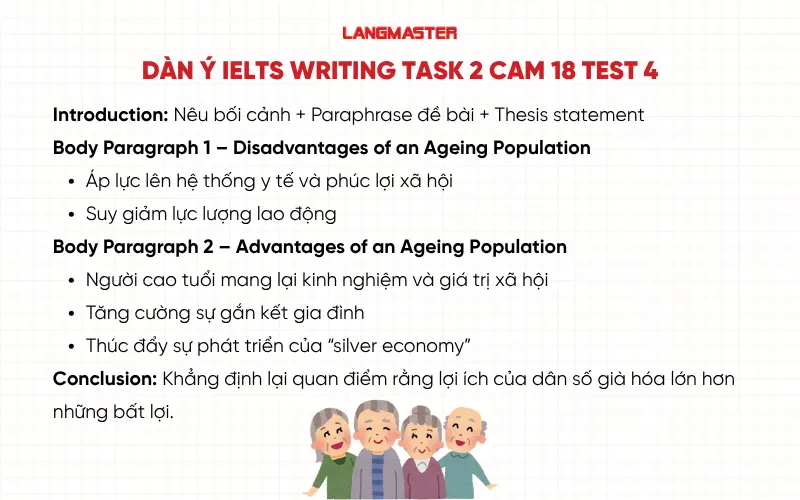
Dàn ý:
Introduction
Body Paragraph 1 – Disadvantages of an Ageing Population
1. Áp lực lên hệ thống y tế và phúc lợi xã hội
2. Suy giảm lực lượng lao động
Body Paragraph 2 – Advantages of an Ageing Population
1. Người cao tuổi mang lại kinh nghiệm và giá trị xã hội
2. Tăng cường sự gắn kết gia đình
3. Thúc đẩy sự phát triển của “silver economy”
Conclusion
Khẳng định lại quan điểm rằng lợi ích của dân số già hóa lớn hơn những bất lợi.
Tóm tắt ngắn gọn: Mặc dù xu hướng này gây áp lực lên hệ thống y tế và lực lượng lao động, người cao tuổi vẫn đóng vai trò quan trọng trong gia đình, xã hội và cả nền kinh tế.
Sample Essay
In many countries, people are living longer due to improvements in healthcare and living conditions, resulting in an ageing population. Although this trend may create several challenges for governments, I believe the advantages outweigh the disadvantages.
On the one hand, an ageing society can place considerable pressure on public services. Older people are generally more likely to suffer from chronic illnesses, meaning governments must spend more money on healthcare systems and pension schemes. This can become a financial burden for the working population, who are responsible for paying taxes to support these services. In addition, as more individuals retire, the labor force may shrink, potentially causing labor shortages and slower economic growth.
On the other hand, elderly people still make valuable contributions to society in many ways. Firstly, they possess extensive life experience and professional knowledge, which can benefit younger generations through mentoring and guidance. Many retired individuals also participate in volunteer activities and community programs, helping maintain social stability.
Furthermore, older people often play an important role within families. In many households, grandparents assist with childcare, allowing parents to focus on their careers and reduce childcare expenses. Finally, the growing demand for healthcare, tourism, and retirement services has led to the expansion of the “silver economy,” creating new business opportunities and jobs.
In conclusion, although an ageing population may lead to economic pressure and workforce shortages, I believe its benefits are more significant because elderly people continue contributing positively to families, society, and the economy.
Bài dịch
Ở nhiều quốc gia, con người đang sống lâu hơn nhờ sự cải thiện trong y tế và điều kiện sống, dẫn đến tình trạng già hóa dân số. Mặc dù xu hướng này có thể tạo ra một số thách thức cho chính phủ, tôi tin rằng những lợi ích mà nó mang lại vẫn lớn hơn những bất lợi.
Một mặt, xã hội già hóa có thể tạo áp lực đáng kể lên các dịch vụ công. Người cao tuổi thường dễ mắc các bệnh mãn tính hơn, đồng nghĩa với việc chính phủ phải chi nhiều tiền hơn cho hệ thống y tế và lương hưu. Điều này có thể trở thành gánh nặng tài chính đối với lực lượng lao động – những người phải đóng thuế để duy trì các dịch vụ này. Ngoài ra, khi ngày càng nhiều người nghỉ hưu, lực lượng lao động có thể bị thu hẹp, từ đó gây thiếu hụt lao động và làm chậm tăng trưởng kinh tế.
Mặt khác, người cao tuổi vẫn đóng góp giá trị cho xã hội theo nhiều cách khác nhau. Trước hết, họ sở hữu kinh nghiệm sống và kiến thức nghề nghiệp phong phú, điều có thể mang lại lợi ích cho thế hệ trẻ thông qua việc cố vấn và hướng dẫn. Nhiều người sau khi nghỉ hưu cũng tham gia các hoạt động tình nguyện và chương trình cộng đồng, góp phần duy trì sự ổn định xã hội.
Hơn nữa, người lớn tuổi thường giữ vai trò quan trọng trong gia đình. Trong nhiều gia đình, ông bà hỗ trợ chăm sóc con cháu, giúp cha mẹ tập trung vào công việc và giảm chi phí chăm sóc trẻ em. Cuối cùng, nhu cầu ngày càng tăng về y tế, du lịch và dịch vụ hưu trí đã thúc đẩy sự phát triển của “nền kinh tế bạc”, từ đó tạo ra nhiều cơ hội việc làm và kinh doanh mới.
Tóm lại, mặc dù dân số già hóa có thể gây áp lực kinh tế và thiếu hụt lao động, tôi tin rằng những lợi ích của xu hướng này vẫn đáng kể hơn vì người cao tuổi tiếp tục đóng góp tích cực cho gia đình, xã hội và nền kinh tế.
Vocabulary
>> Xem thêm: Tổng hợp bài mẫu Discussion Essay IELTS Writing Task 2 hay nhất
Trên đây là toàn bộ phần giải chi tiết Cambridge 18 Test 4 kèm đáp án, transcript, bài mẫu Speaking – Writing và phân tích cách làm cho từng dạng bài. Langmaster hy vọng bài viết này sẽ giúp bạn không chỉ đối chiếu đáp án chính xác mà còn hiểu rõ cách xác định keyword, nhận diện paraphrase, tránh bẫy thường gặp và rút ra chiến thuật làm bài hiệu quả cho cả 4 kỹ năng IELTS.
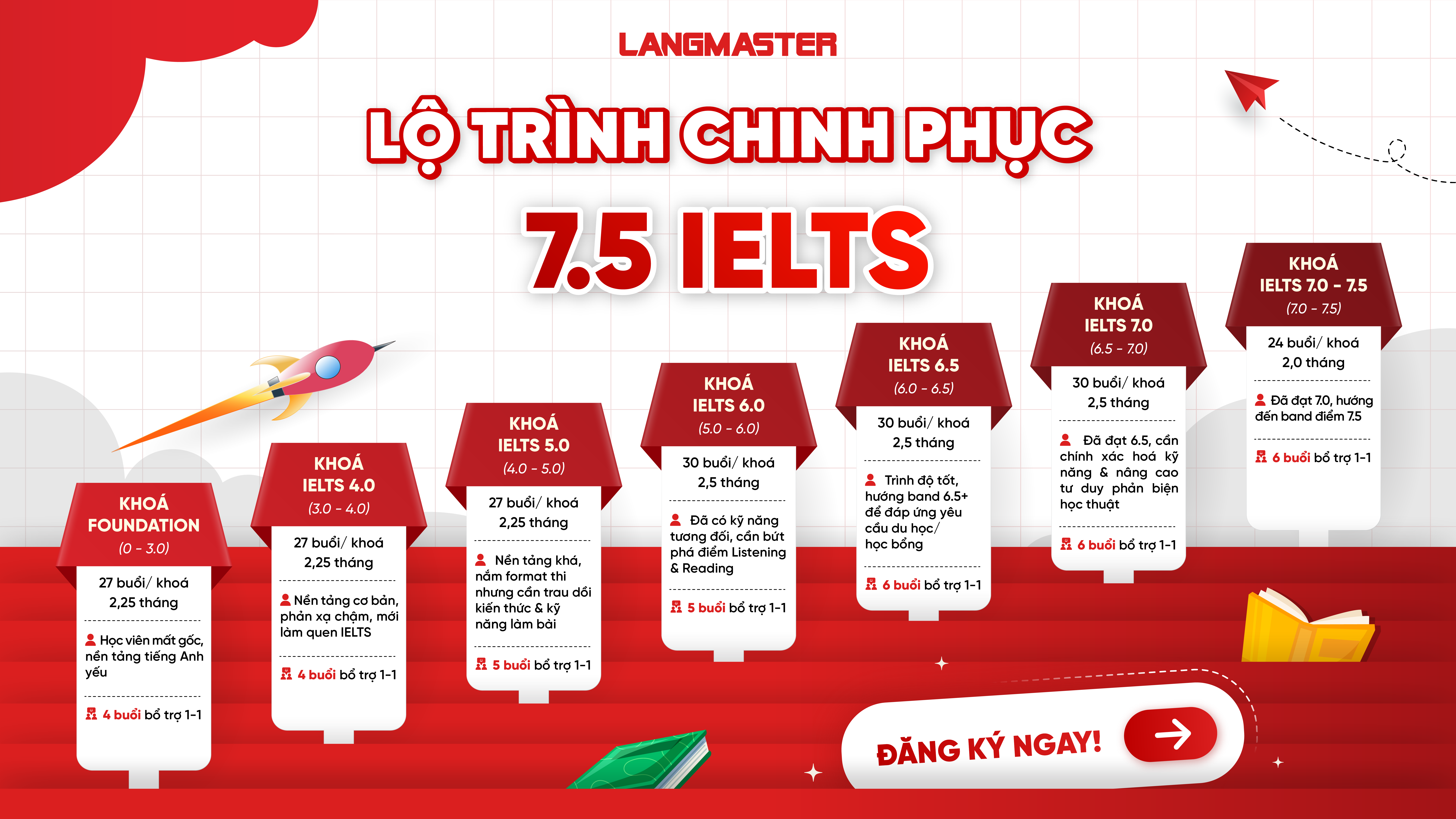
Nếu bạn đang tự học IELTS nhưng thường gặp tình trạng không biết sửa lỗi ở đâu, học lan man, làm đề nhiều nhưng band điểm không tăng, khóa học IELTS tại Langmaster sẽ là lựa chọn đáng cân nhắc. Với hơn 16 năm kinh nghiệm đào tạo tiếng Anh, Langmaster mang đến phương pháp học bài bản cùng đội ngũ giáo viên giàu kinh nghiệm, giúp học viên phát triển toàn diện các kỹ năng IELTS.
Ưu điểm của khoá học IELTS tại Langmaster:
Bên cạnh các lớp IELTS online, học viên cũng có thể lựa chọn học IELTS offline tại Hà Nội để tăng cường tương tác trực tiếp, với 3 cơ sở:
Liên hệ ngay với Langmaster để nhận tư vấn chi tiết về lộ trình học phù hợp nhất!



Bộ đề dự đoán IELTS Writing Quý 2/2026 mới nhất, tổng hợp đầy đủ Task 1 và Task 2 giúp bạn luyện tập đúng trọng tâm và làm quen với xu hướng ra đề.
Cập nhật đề dự đoán IELTS Speaking Quý 3/2026 mới nhất, kèm sample answer band 7+ dịch tiếng Việt chi tiết, đúng chuẩn tiêu chí chấm điểm 4 kỹ năng.
![Giải đề thi thật IELTS Reading ngày 02.04.2026 [FULL ANSWERS]](https://langmaster.edu.vn/storage/uploads/original/2026/04/08/giai-de-thi-ielts-reading-ngay-02-04-2026.png)
Giải đề thi thật IELTS Reading ngày 02.04.2026 với full đáp án chi tiết, giải thích rõ ràng từng câu giúp bạn hiểu cách làm và nâng cao kỹ năng đọc hiệu quả.
![Trọn bộ Expert IELTS level 5.0, 6.0, 7.5 [Download PDF]](https://langmaster.edu.vn/storage/uploads/original/2025/12/31/review-sach-expert-ielts .png)
Bộ sách Expert IELTS (5.0, 6.0, 7.5) do Pearson Longman phát hành là tài liệu luyện thi IELTS bài bản, tích hợp đầy đủ 4 kỹ năng cùng ngữ pháp và từ vựng học thuật theo chủ đề, giúp người học xây dựng nền tảng vững chắc và cải thiện band điểm hiệu quả

Thi tiếng Anh đầu vào đại học là kỳ thi xếp lớp, không ảnh hưởng đến trúng tuyển. Kết quả giúp nhà trường đánh giá năng lực để phân bổ lộ trình học ngoại ngữ phù hợp.




Hơn 16 năm kinh nghiệm, đào tạo thành công hàng trăm nghìn học viên
Phương pháp giảng dạy hiện đại, học viên tiến bộ rõ rệt
Lộ trình học chuẩn quốc tế, phù hợp với nhu cầu thực tiễn
Giáo viên đạt chuẩn Quốc tế với chất lượng top đầu thị trường, giàu kinh nghiệm
Học online linh hoạt, cam kết đầu ra bằng văn bản