
Khóa học
IELTS Online
IELTS Online
Giảm đến 18%
Đăng ký ngay
Mục lục [Ẩn]
Khi ôn tập IELTS Reading, việc luyện kĩ năng giải đề qua các đề thi thật là một cách hiệu quả giúp bạn tăng band điểm nhanh. Bài viết này sẽ giúp bạn giải trọn vẹn đề Cambridge 14 Test 1 Reading Passage 2: “The growth of bike-sharing schemes around the world” với đầy đủ đề bài, câu hỏi, đáp án chi tiết kèm giải thích rõ ràng. Đây sẽ là tài liệu hữu ích để bạn ôn luyện và nâng cao kỹ năng Reading, sẵn sàng chinh phục band điểm mục tiêu trong kỳ thi IELTS.
| Bạn đang ở band IELTS bao nhiêu? Làm bài test miễn phí và nhận ngay lộ trình học cá nhân hóa. 👉 Đăng ký test IELTS miễn phí ngay |
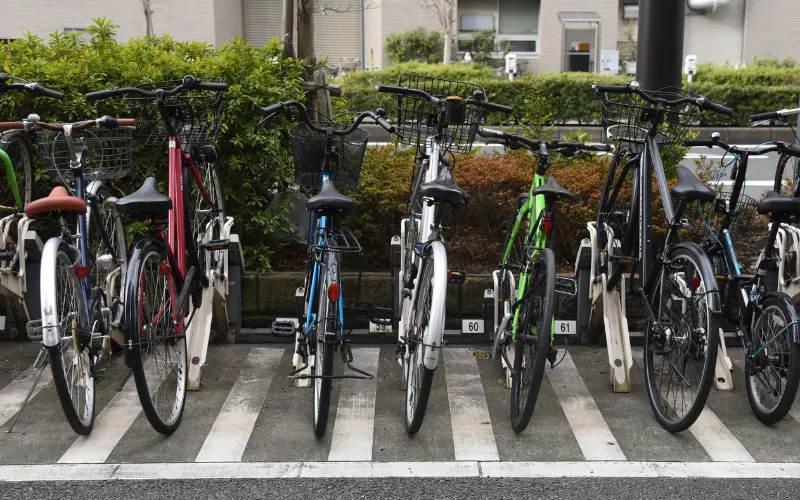
The growth of bike sharing schemes around the world
How Dutch engineer Luud Schimmelpennink helped to devise urban bike-sharing schemes.
A – The original idea for an urban bike-sharing scheme dates back to a summer’s day in 1965. Provo, the organisation that came up with the idea, was a group of Dutch activists who wanted to change society. They believed the scheme, which was known as the Witte Fietsenplan, was an answer to the perceived threats of air pollution and consumerism. In the centre of Amsterdam, they painted a small number of used bikes white. They also distributed leaflets describing the dangers of cars and inviting people to use the white bikes. The bikes were then left unlocked at various locations around the city, to be used by anyone in need of transport.B – Luud Schimmelpennink, a Dutch industrial engineer who still lives and cycles in Amsterdam, was heavily involved in the original scheme. He recalls how the scheme succeeded in attracting a great deal of attention – particularly when it came to publicising Provo’s aims – but struggled to get off the ground. The police were opposed to Provo’s initiatives and almost as soon as the white bikes were distributed around the city, they removed them. However, for Schimmelpennink and for bike-sharing schemes in general, this was just the beginning. ‘The first Witte Fietsenplan was just a symbolic thing,’ he says. ‘We painted a few bikes white, that was all. Things got more serious when | became a member of the Amsterdam city council two years later.’
C – Schimmelpennink seized this opportunity to present a more elaborate Witte Fietsenplan to the city council. ‘My idea was that the municipality of Amsterdam would distribute 10,000 white bikes over the city, for everyone to use,’ he explains. ‘| made serious calculations. It turned out that a white bicycle – per person, per kilometre – would cost the municipality only 10% of what it contributed to public transport per person per kilometre.’ Nevertheless, the council unanimously rejected the plan. ‘They said that the bicycle belongs to the past. They saw a glorious future for the car,’ says Schimmelpennink. But he was not in the least discouraged.
D – Schimmelpennink never stopped believing in bike-sharing, and in the mid-90s, two Danes asked for his help to set up a system in Copenhagen. The result was the world’s first large-scale bike-share programme. It worked on a deposit: ‘You dropped a coin in the bike and when you returned it, you got your money back.’ After setting up the Danish system, Schimmelpennink decided to try his luck again in the Netherlands and this time he succeeded in arousing the interest of the Dutch Ministry of Transport. ‘Times had changed,’ he recalls. ‘People had become more environmentally conscious, and the Danish experiment had proved that bike-sharing was a real possibility.’ A new Witte Fietsenplan was launched in 1999 in Amsterdam. However, riding a white bike was no longer free; it cost one guilder per trip and payment was made with a chip card developed by the Dutch bank Postbank. Schimmelpennink designed conspicuous, sturdy white bikes locked in special racks which could be opened with the chip card – the plan started with 250 bikes, distributed over five stations.
E – Theo Molenaar, who was a system designer for the project, worked alongside Schimmelpennink. ‘ I remember when we were testing the bike racks, he announced that he had already designed better ones. But of course, we had to go through with the ones we had.’ The system, however, was prone to vandalism and theft. ‘After every weekend there would always be a couple of bikes missing,’ Molenaar says.‘ I really have no idea what people did with them, because they could instantly be recognised as white bikes.’ But the biggest blow came when Postbank decided to abolish the chip card, because it wasn’t profitable. ‘That chip card was pivotal to the system,’ Molenaar says. ‘To continue the project we would have needed to set up another system, but the business partner had lost interest.’
F – Schimmelpennink was disappointed, but - characteristically - not for long. In 2002 he got a call from the French advertising corporation JC Decaux, who wanted to set up his bike-sharing scheme in Vienna. ‘That went really well. After Vienna, they set up a system in Lyon. Then in 2007, Paris followed. That was a decisive moment in the history of bike-sharing.’ The huge and unexpected success of the Parisian bike-sharing programme, which now boasts more than 20,000 bicycles, inspired cities all over the world to set up their own schemes, all modelled on Schimmelpennink. ‘It’s wonderful that this happened,’ he says. ‘But financially | didn’t really benefit from it, because | never filed for a patent.’
G – In Amsterdam today, 38% of all trips are made by bike and, along with Copenhagen, it is regarded as one of the two most cycle-friendly capitals in the world - but the city never got another Witte Fietsenplan. Molenaar believes this may be because everybody in Amsterdam already has a bike. Schimmelpennink, however, cannot see that this changes Amsterdam’s need for a bike-sharing scheme. ‘People who travel on the underground don’t carry their bikes around. But often they need additional transport to reach their final destination.’ Although he thinks it is strange that a city like Amsterdam does not have a successful bike-sharing scheme, he is optimistic about the future. ‘In the 60s we didn’t stand a chance because people were prepared to give their lives to keep cars in the city. But that mentality has totally changed.
Questions 14 - 18
The Reading Passage has seven paragraphs, A–G.
Which paragraph contains the following information?
Write the correct letter, A–G, in boxes 14 - 18 on your answer sheet.
NB You may use any letter more than once.
14. a description of how people misused a bike-sharing scheme
15. an explanation of why a proposed bike-sharing scheme was turned down
16. a reference to a person being unable to profit from their work
17. an explanation of the potential savings a bike-sharing scheme would bring
18. reference to the problems a bike-sharing scheme was intended to solve
Questions 19 - 20
Choose TWO letters, A–E. Write the correct letters in boxes 19 and 20 on your answer sheet.
Which TWO of the following statements are made in the text about the Amsterdam bike-sharing scheme of 1999?
A. It was initially opposed by a government department.
B. It failed when a partner in the scheme withdrew support.
C. It aimed to be more successful than the Copenhagen scheme.
D. It was made possible by a change in people’s attitudes.
E. It attracted interest from a range of bike designers.
Questions 21 - 22
Choose TWO letters, A–E. Write the correct letters in boxes 21 and 22 on your answer sheet.
Which TWO of the following statements are made in the text about Amsterdam today?
A. The majority of residents would like to prevent all cars from entering the city.
B. There is little likelihood of the city having another bike-sharing scheme.
C. More trips in the city are made by bike than by any other form of transport.
D. A bike-sharing scheme would benefit residents who use public transport.
E. The city has a reputation as a place that welcomes cyclists.
Questions 23 - 26
Complete the summary below. Choose ONE WORD ONLY from the passage for each answer.
Write your answers in boxes 23 - 26 on your answer sheet.
The first urban bike-sharing scheme
The first bike-sharing scheme was the idea of the Dutch group Provo. The people who belonged to this group were 23 ______. They were concerned about damage to the environment and about 24 ______, and believed that the bike-sharing scheme would draw attention to these issues. As well as painting some bikes white, they handed out 25 ______ that condemned the use of cars.
However, the scheme was not a great success: almost as quickly as Provo left the bikes around the city, the 26 ______ took them away. According to Schimmelpennink, the scheme was intended to be symbolic. The idea was to get people thinking about the issues.
>>> XEM THÊM:
Đề thi IELTS Reading có đáp án mới nhất 2025-2026 [Cập nhật liên tục]
Giải đề Back to the future of skyscraper design [Cam IELTS 14, Test 2]
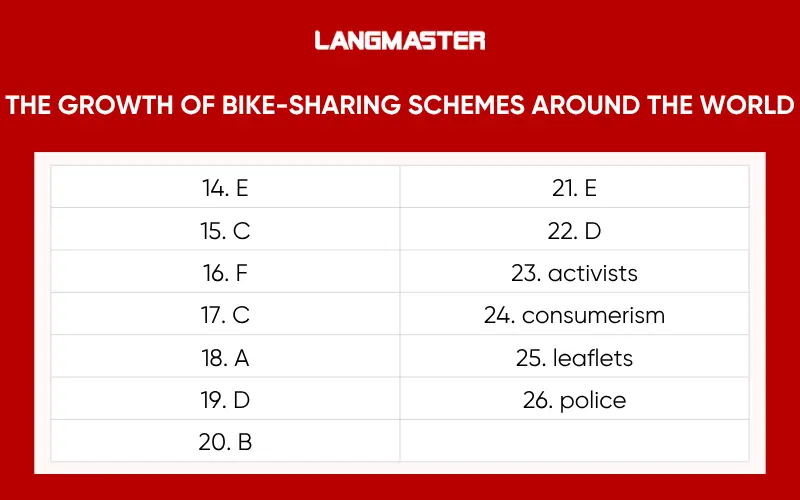
Dưới đây là bảng đáp án đề Cambridge 14 Test 1 Reading Passage 2: The growth of bike-sharing schemes around the world để bạn đối chiếu:
|
14. E |
21. E |
|
15. C |
22. D |
|
16. F |
23. activists |
|
17. C |
24. consumerism |
|
18. A |
25. leaflets |
|
19. D |
26. police |
|
20. B |
Câu 14: Đáp án E
Câu hỏi Tiếng Anh: A description of how people misused a bike-sharing scheme
Dịch câu hỏi: Mô tả về cách mọi người sử dụng sai kế hoạch chia sẻ xe đạp
Vị trí: “The system, however, was prone to vandalism and theft. After every weekend there would always be a couple of bikes missing.”
Phân tích: Đoạn này mô tả tình trạng xe bị phá hoại và mất cắp thường xuyên, cho thấy hệ thống đã bị sử dụng sai mục đích (misused).
Câu 15: Đáp án C
Câu hỏi Tiếng Anh: An explanation of why a proposed bike-sharing scheme was turned down
Dịch câu hỏi: Giải thích lý do vì sao đề xuất kế hoạch chia sẻ xe đạp bị từ chối
Vị trí: Đoạn C: “Nevertheless, the council unanimously rejected the plan. ‘They said that the bicycle belongs to the past. They saw a glorious future for the car.’”
Phân tích: Kế hoạch bị từ chối vì hội đồng cho rằng xe đạp đã lỗi thời và tương lai thuộc về ô tô.
Câu 16: Đáp án F
Câu hỏi Tiếng Anh: A reference to a person being unable to profit from their work
Dịch câu hỏi: Nhắc đến một người không thể kiếm lợi từ công việc của họ
Vị trí: Đoạn F: “But financially I didn’t really benefit from it, because I never filed for a patent.”
Phân tích: Nhân vật không thu được lợi ích tài chính từ ý tưởng của mình vì không đăng ký bản quyền.
Câu 17: Đáp án C
Câu hỏi Tiếng Anh: An explanation of the potential savings a bike-sharing scheme would bring
Dịch câu hỏi: Giải thích về những tiết kiệm tiềm năng mà hệ thống chia sẻ xe đạp sẽ mang lại
Vị trí: Đoạn C: “It turned out that a white bicycle — per person, per kilometre — would cost the municipality only 10% of what it contributed to public transport per person per kilometre.”
Phân tích: Hệ thống xe đạp giúp tiết kiệm chi phí đáng kể (chỉ 10% so với giao thông công cộng), thể hiện lợi ích kinh tế.
Câu 18: Đáp án A
Câu hỏi Tiếng Anh: A reference to the problems a bike-sharing scheme was intended to solve
Dịch câu hỏi: Những vấn đề mà hệ thống chia sẻ xe đạp được tạo ra để giải quyết
Vị trí: Đoạn A: “They believed the scheme… was an answer to the perceived threats of air pollution and consumerism.”
Phân tích: Hệ thống được thiết kế nhằm giải quyết ô nhiễm không khí và chủ nghĩa tiêu dùng.
| Học mãi mà IELTS không lên band? Học thử IELTS miễn phí cùng giáo viên 7.5+, chấm chữa lỗi sai ngay lập tức. 👉 Đăng ký học thử miễn phí ngay |
Câu 19–20: Đáp án B & D
Câu hỏi Tiếng Anh: Which TWO of the following statements are made in the text about the Amsterdam bike-sharing scheme of 1999?
Dịch câu hỏi: Hai câu nào sau đây được đề cập về chương trình chia sẻ xe đạp Amsterdam năm 1999?
Vị trí: Đoạn D & E
Transcript:
“People had become more environmentally conscious…”
“To continue the project we would have needed to set up another system, but the business partner had lost interest.”
Phân tích:
D: Nhận thức về môi trường tăng lên → tạo điều kiện cho kế hoạch được triển khai
B: Dự án thất bại khi đối tác rút lui → mất yếu tố vận hành quan trọng
Câu 21–22: Đáp án D & E
Câu hỏi Tiếng Anh: Which TWO of the following statements are made in the text about Amsterdam today?
Dịch câu hỏi: Hai câu nào sau đây đúng về Amsterdam hiện nay?
Vị trí: Đoạn G
Transcript:
“People who travel on the underground don’t carry their bikes around. But often they need additional transport to reach their final destination.”
“Amsterdam… is regarded as one of the two most cycle-friendly capitals in the world.”
Phân tích:
D: Người dùng tàu điện cần phương tiện bổ sung → bike-sharing hữu ích
E: Thành phố nổi tiếng thân thiện với xe đạp
Câu 23: Đáp án – activists
Câu hỏi Tiếng Anh: The people who belonged to this group were 23…………
Dịch câu hỏi: Những người thuộc nhóm này là 23 …………
Vị trí: Đoạn A: “Provo, the organisation that came up with the idea, was a group of Dutch activists who wanted to change society.”
Phân tích: Câu này mô tả rõ Provo là một nhóm các “activists” (nhà hoạt động xã hội), nên từ cần điền là activists.
Câu 24: Đáp án – consumerism
Câu hỏi Tiếng Anh: They were concerned about damage to the environment and about 24…………
Dịch câu hỏi: Họ lo ngại về thiệt hại môi trường và về 24 …………
Vị trí: Đoạn A: “They believed the scheme… was an answer to the perceived threats of air pollution and consumerism.”
Phân tích: Cụm “air pollution and consumerism” cho thấy ngoài ô nhiễm, họ còn lo ngại về chủ nghĩa tiêu dùng → điền consumerism.
Câu 25: Đáp án – leaflets
Câu hỏi Tiếng Anh: They handed out 25………… that condemned the use of cars
Dịch câu hỏi: Họ phát 25 ………… để lên án việc sử dụng ô tô
Vị trí: Đoạn A: “They also distributed leaflets describing the dangers of cars and inviting people to use the white bikes.”
Phân tích: “distributed leaflets” = phát tờ rơi → từ cần điền là leaflets.
Câu 26: Đáp án – police
Câu hỏi Tiếng Anh: The 26………… took them away
Dịch câu hỏi: 26 ………… đã mang chúng đi
Vị trí: Đoạn B: “The police were opposed to Provo’s initiatives and almost as soon as the white bikes were distributed around the city, they removed them.”
Phân tích: Chủ thể “took them away” là police (cảnh sát), vì họ phản đối kế hoạch và thu hồi xe.
>>> XEM THÊM:
Giải đề IELTS Reading: Why being bored is stimulating [Full answers]
Giải đề What is exploration? IELTS Reading Cam 15, Test 1, Passage 3

Khi chuẩn bị cho kỳ thi IELTS Reading, việc xây dựng vốn từ vựng theo lộ trình khoa học là yếu tố then chốt giúp nâng cao band điểm. Dưới đây là danh sách từ và cụm từ nổi bật được trích từ bài IELTS Reading “The growth of bike-sharing schemes around the world” giúp bạn học tập và ôn luyện hiệu quả.
|
Từ vựng |
Nghĩa |
Ví dụ |
|
devise |
nghĩ ra, phát minh |
He devised a new bike-sharing system for the city. (Anh ấy nghĩ ra một hệ thống chia sẻ xe đạp mới cho thành phố.) |
|
activist |
nhà hoạt động xã hội |
The activists wanted to change society. (Các nhà hoạt động muốn thay đổi xã hội.) |
|
scheme |
kế hoạch, dự án |
The government launched a new transport scheme. (Chính phủ triển khai một kế hoạch giao thông mới.) |
|
consumerism |
chủ nghĩa tiêu dùng |
Consumerism is a growing problem in modern society. (Chủ nghĩa tiêu dùng là vấn đề ngày càng lớn trong xã hội hiện đại.) |
|
leaflet |
tờ rơi |
They handed out leaflets to raise awareness. (Họ phát tờ rơi để nâng cao nhận thức.) |
|
get off the ground |
bắt đầu thành công |
The project struggled to get off the ground. (Dự án gặp khó khăn khi bắt đầu.) |
|
opposed to |
phản đối |
Many people were opposed to the new policy. (Nhiều người phản đối chính sách mới.) |
|
symbolic |
mang tính biểu tượng |
The white bikes were only symbolic. (Những chiếc xe đạp trắng chỉ mang tính biểu tượng.) |
|
seize (an opportunity) |
nắm bắt cơ hội |
He seized the opportunity to present his idea. (Anh ấy nắm bắt cơ hội để trình bày ý tưởng.) |
|
municipality |
chính quyền thành phố |
The municipality funded the project. (Chính quyền thành phố tài trợ dự án.) |
|
calculation |
phép tính, sự tính toán |
The plan was based on careful calculations. (Kế hoạch dựa trên tính toán cẩn thận.) |
|
unanimously |
nhất trí |
The proposal was unanimously rejected. (Đề xuất bị từ chối nhất trí.) |
|
discouraged |
nản lòng |
He was not discouraged by the failure. (Anh ấy không nản lòng trước thất bại.) |
|
deposit |
tiền đặt cọc |
You need to pay a deposit to use the bike. (Bạn cần đặt cọc để sử dụng xe đạp.) |
|
launch |
triển khai, ra mắt |
The new system was launched in 1999. (Hệ thống mới được triển khai vào năm 1999.) |
|
conspicuous |
dễ nhận thấy |
The bikes were painted in a conspicuous color. (Xe được sơn màu dễ nhận thấy.) |
|
sturdy |
chắc chắn |
These bikes are sturdy and reliable. (Những chiếc xe này rất chắc chắn và đáng tin cậy.) |
|
prone to |
dễ bị |
The system was prone to theft. (Hệ thống dễ bị trộm cắp.) |
|
vandalism |
phá hoại |
The bikes suffered from vandalism. (Những chiếc xe bị phá hoại.) |
|
abolish |
bãi bỏ |
The bank decided to abolish the system. (Ngân hàng quyết định bãi bỏ hệ thống.) |
|
pivotal |
then chốt, quan trọng |
This factor was pivotal to success. (Yếu tố này mang tính then chốt cho thành công.) |
|
withdraw (support) |
rút lui, ngừng hỗ trợ |
The partner withdrew support from the project. (Đối tác rút khỏi dự án.) |
|
decisive |
mang tính quyết định |
This was a decisive moment in history. (Đây là thời điểm mang tính quyết định trong lịch sử.) |
|
inspire |
truyền cảm hứng |
The success inspired other cities. (Thành công đã truyền cảm hứng cho các thành phố khác.) |
|
patent |
bằng sáng chế |
He did not apply for a patent. (Ông ấy không đăng ký bằng sáng chế.) |
|
cycle-friendly |
thân thiện với xe đạp |
Amsterdam is a cycle-friendly city. (Amsterdam là thành phố thân thiện với xe đạp.) |
|
additional |
bổ sung |
They need additional transport. (Họ cần phương tiện bổ sung.) |
|
mentality |
tư duy, nhận thức |
People’s mentality has changed over time. (Tư duy của mọi người đã thay đổi theo thời gian.) |
>>> XEM THÊM:
Khi luyện đề IELTS Reading “The growth of bike-sharing schemes around the world”, nhiều học viên thường gặp khó khăn trong việc xác định dạng câu hỏi và áp dụng từ vựng học thuật một cách chính xác. Để đạt hiệu quả cao, cần có một kế hoạch ôn tập logic, kết hợp với chiến lược làm bài rõ ràng và sự hỗ trợ từ giáo viên nhiều kinh nghiệm.
Để đáp ứng nhu cầu, Langmaster xây dựng các khóa học IELTS online với lộ trình cá nhân hóa. Học viên sẽ được giáo viên theo sát, chỉ ra lỗi sai ngay lập tức trong vòng 24 giờ và hướng dẫn phương pháp học tập tối ưu để tiến bộ nhanh chóng hơn.

Tại Langmaster học viên được:
Coaching 1 - 1 với chuyên gia: Học viên được kèm riêng để khắc phục điểm yếu, phân bổ thời gian thi chi tiết, tập trung rèn kỹ năng chưa vững và rút ngắn lộ trình nâng band.
Lộ trình học cá nhân hóa: Thiết kế dựa trên trình độ đầu vào và mục tiêu điểm số, kèm báo cáo tiến bộ hàng tháng.
Sĩ số lớp nhỏ, 7 - 10 học viên: Giáo viên theo sát từng bạn, nhiều cơ hội trao đổi và nhận phản hồi chi tiết.
Giáo viên 7.5+ IELTS: Chấm chữa bài trong 24 giờ, giúp bạn cải thiện nhanh chóng và rõ rệt.
Thi thử định kỳ: Mô phỏng áp lực thi thật, phân tích điểm mạnh - yếu để điều chỉnh chiến lược học.
Cam kết đầu ra, học lại miễn phí: Đảm bảo kết quả, giảm thiểu rủi ro “học xong vẫn chưa đạt mục tiêu”.
Học online tiện lợi, chất lượng như offline: Có bản ghi để xem lại, linh hoạt, tiết kiệm thời gian, chi phí.
Hệ sinh thái học tập toàn diện: Tài liệu chuẩn, bài tập online, cộng đồng học viên và cố vấn luôn đồng hành.
Đăng ký học thử IELTS Online miễn phí ngay hôm nay để trải nghiệm lớp học thực tế, kiểm tra trình độ và nhận lộ trình học tập hiệu quả giúp chinh phục mục tiêu IELTS!
Trên đây là phần giải chi tiết bài đọc IELTS “The growth of bike-sharing schemes around the world”. Trong quá trình ôn luyện, học viên không chỉ cần nắm chắc đáp án chính xác mà còn nên rèn luyện khả năng phân tích từng dạng câu hỏi một cách logic và có hệ thống. Việc tiếp cận từ vựng học thuật trong ngữ cảnh thực tế không chỉ giúp ghi nhớ lâu hơn mà còn góp phần mở rộng vốn từ cần thiết cho kỹ năng đọc học thuật.




![Giải đề thi European Heat Wave IELTS Reading [FULL ANSWER]](https://langmaster.edu.vn/storage/uploads/original/2025/11/20/european-heat-wave-ielts-reading-answers.png)
Tổng hợp đề thi European Heat Wave IELTS Reading Answers kèm phân tích chi tiết, từ vựng và đáp án giúp bạn tối ưu điểm Reading nhanh chóng.
![Đề thi IELTS Reading có đáp án mới nhất 2025-2026 [Cập nhật liên tục]](https://langmaster.edu.vn/storage/uploads/original/2025/12/25/de-thi-ielts-reading.png)
Đề thi IELTS Reading có đáp án mới nhất 2025/2026, cập nhật liên tục đề thi thật và Cambridge, kèm lời giải chi tiết giúp nâng band hiệu quả.
Bài viết tổng hợp chi tiết đề thi IELTS Reading Holidays with a difference, đáp án kèm giải thích chi tiết, từ vựng cần lưu ý khi làm bài giúp bạn luyện thi hiệu quả và nâng cao band điểm.

Bài viết tổng hợp chi tiết đề thi IELTS Reading on the trail of the honey badger, đáp án kèm giải thích chi tiết, từ vựng cần lưu ý khi làm bài giúp bạn luyện thi hiệu quả và nâng cao band điểm.
![Giải đề IELTS Reading Growing more for less [FULL ANSWER]](https://langmaster.edu.vn/storage/uploads/original/2025/10/22/growing-more-for-less-ielts-reading-answers.png)
Khám phá bài đọc Growing more for less IELTS Reading: Tổng hợp đáp án, từ vựng quan trọng và phân tích chi tiết giúp bạn hiểu cách công nghệ vệ tinh hỗ trợ nông nghiệp hiện đại




Hơn 16 năm kinh nghiệm, đào tạo thành công hàng trăm nghìn học viên
Phương pháp giảng dạy hiện đại, học viên tiến bộ rõ rệt
Lộ trình học chuẩn quốc tế, phù hợp với nhu cầu thực tiễn
Giáo viên đạt chuẩn Quốc tế với chất lượng top đầu thị trường, giàu kinh nghiệm
Học online linh hoạt, cam kết đầu ra bằng văn bản

![Giải IELTS Reading Voyage of going beyond The blue line 2 [FULL ANSWERS]](https://langmaster.edu.vn/storage/uploads/original/2026/03/13/ielts-reading-voyage-of-going-beyond-the-blue-line-2 (2).png)
![Giải đề thi IELTS Reading ngày 01.02.2026 [FULL ANSWERS]](https://langmaster.edu.vn/storage/uploads/original/2026/03/16/giai-de-thi-ielts-reading-ngay-01-02-2026.png)
![Giải IELTS Reading Case Study Tourism New Zealand [FULL ANSWERS]](https://langmaster.edu.vn/storage/uploads/original/2026/03/12/case-study-tourism-new-zealand-ielts-reading .png)
![Giải IELTS Reading The dover bronze age boat [FULL ANSWERS]](https://langmaster.edu.vn/storage/uploads/original/2026/03/12/the-dover-bronze-age-boat-ielts-reading (3).png)