Khóa học
IELTS Online
IELTS Online
Giảm đến 18%
Đăng ký ngay
Mục lục [Ẩn]
Khi ôn tập IELTS Reading, việc luyện kĩ năng giải đề qua các đề thi thật là một cách hiệu quả giúp bạn tăng band điểm nhanh. Bài viết này sẽ giúp bạn giải đề IELTS Reading “What is exploration?” với đầy đủ đề bài, câu hỏi, đáp án chi tiết kèm giải thích rõ ràng. Đây sẽ là tài liệu hữu ích để bạn ôn luyện và nâng cao kỹ năng Reading, sẵn sàng chinh phục band điểm mục tiêu trong kỳ thi IELTS.
What is exploration?
We are all explorers. Our desire to discover, and then share that new-found knowledge, is part of what makes us human - indeed, this has played an important part in our success as a species. Long before the first caveman slumped down beside the fire and grunted news that there were plenty of wildebeest over yonder, our ancestors had learnt the value of sending out scouts to investigate the unknown. This questing nature of ours undoubtedly helped our species spread around the globe, just as it nowadays no doubt helps the last nomadic Penan maintain their existence in the depleted forests of Borneo, and a visitor negotiate the subways of New York.
Over the years, we’ve come to think of explorers as a peculiar breed — different from the rest of us, different from those of us who are merely ‘well travelled’, even; and perhaps there is a type of person more suited to seeking out the new, a type of caveman more inclined to risk venturing out. That, however, doesn’t take away from the fact that we all have this enquiring instinct, even today; and that in all sorts of professions — whether artist, marine biologist or astronomer — borders of the unknown are being tested each day.
Thomas Hardy set some of his novels in Egdon Heath, a fictional area of uncultivated land, and used the landscape to suggest the desires and fears of his characters. He is delving into matters we all recognise because they are common to humanity. This is surely an act of exploration, and into a world as remote as the author chooses. Explorer and travel writer Peter Fleming talks of the moment when the explorer returns to the existence he has left behind with his loved ones. The traveller ‘who has for weeks or months seen himself only as a puny and irrelevant alien crawling laboriously over a country in which he has no roots and no background, suddenly encounters his other self, a relatively solid figure, with a place in the minds of certain people’.
In this book about the exploration of the earth’s surface, I have confined myself to those whose travels were real and who also aimed at more than personal discovery. But that still left me with another problem: the word ‘explorer’ has become associated with a past era. We think back to a golden age, as if exploration peaked somehow in the 19th century as if the process of discovery is now on the decline, though the truth is that we have named only one and a half million of this planet’s species, and there may be more than 10 million — and that’s not including bacteria. We have studied only 5 per cent of the species we know. We have scarcely mapped the ocean floors, and know even less about ourselves; we fully understand the workings of only 10 per cent of our brains.
Here is how some of today’s ‘explorers’ define the word. Ran Fiennes, dubbed the ‘greatest lrving explorer’, said, ‘An explorer is someone who has done something that no human has done before and also done something scientifically useful.’ Chris Bonington, a leading mountaineer, felt exploration was to be found in the act of physically touching the unknown: “You have to have gone somewhere new.’ Then Robin Hanbury-Tenison, a campaigner on behalf of remote so-called ‘tribal’ peoples, said, ‘A traveller simply records information about some far-off world, and reports back; but an explorer changes the world.’ Wilfred Thesiger, who crossed Arabia’s Empty Quarter in 1946, and belongs to an era of unmechanised travel now lost to the rest of us, told me, ‘If I'd gone across by camel when I could have gone by car, it would have been a stunt.’ To him, exploration meant bringing back information from a remote place regardless of any great self-discovery.
Each definition is slightly different and tends to reflect the field of endeavour of each pioneer. It was the same whoever I asked: the prominent historian would say exploration was a thing of the past, the cutting-edge scientist would say it was of the present. And so on. They each set their own particular criteria; the common factor in their approach being that they all had, unlike many of us who simply enjoy travel or discovering new things, both a very definite objective from the outset and also a desire to record their findings.
I'd best declare my own bias. As a writer, I’m interested in the exploration of ideas. I’ve done a great many expeditions and each one was unique. I’ve lived for months alone with isolated groups of people all around the world, even two ‘uncontacted tribes’. But none of these things is of the slightest interest to anyone unless, through my books, I’ve found a new slant, explored anew idea. Why? Because the world has moved on. The time has long passed for the great continental voyages - another walk to the poles, another crossing of the Empty Quarter. We know how the land surface of our planet lies; exploration of it is now down to the details - the habits of microbes, say, or the grazing behaviour of buffalo. Aside from the deep sea and deep underground, it’s the era of specialists. However, this is to disregard the role the human mind has in conveying remote places; and this is what interests me: how a fresh interpretation, even of a well-travelled route, can give its readers new insights.

Questions 27–32
Choose the correct letter, A, B, C or D.
27. The writer refers to visitors to New York to illustrate the point that
A. exploration is an intrinsic element of being human.
B. most people are enthusiastic about exploring.
C. exploration can lead to surprising results.
D. most people find exploration daunting.
28. According to the second paragraph, what is the writer’s view of explorers?
A. Their discoveries have brought both benefits and disadvantages.
B. Their main value is in teaching others.
C. They act on an urge that is common to everyone.
D. They tend to be more attracted to certain professions than to others.
29. The writer refers to a description of Egdon Heath to suggest that
A. Hardy was writing about his own experience of exploration.
B. Hardy was mistaken about the nature of exploration.
C. Hardy’s aim was to investigate people’s emotional states.
D. Hardy’s aim was to show the attraction of isolation.
30. In the fourth paragraph, the writer refers to ‘a golden age’ to suggest that
A. the amount of useful information produced by exploration has decreased.
B. fewer people are interested in exploring than in the 19th century.
C. recent developments have made exploration less exciting.
D. we are wrong to think that exploration is no longer necessary.
31. In the sixth paragraph, when discussing the definition of exploration, the writer argues that
A. people tend to relate exploration to their own professional interests.
B. certain people are likely to misunderstand the nature of exploration.
C. the generally accepted definition has changed over time.
D. historians and scientists have more valid definitions than the general public.
32, In the last paragraph, the writer explains that he is interested in
A. how someone’s personality is reflected in their choice of places to visit.
B. the human ability to cast new light on places that may be familiar.
C. how travel writing has evolved to meet changing demands.
D. the feelings that writers experience while travelling.
Questions 33–37
Look at the following statements (Questions 33–37) and the list of explorers below.
Match each statement with the correct explorer, A–E.
You may use any letter more than once.
List of explorers
A. Peter Fleming
B. Ran Fiennes
C. Chris Bonington
D. Robin Hanbury-Tenison
E. Wilfred Thesiger
33. He referred to the relevance of the form of transport used.
34. He described feelings on coming back home after a long journey.
35. He worked for the benefit of specific groups of people.
36. He did not consider learning about oneself an essential part of exploration.
37. He defined exploration as being both unique and of value to others.
Questions 38–40
Complete the summary below.
Choose NO MORE THAN TWO WORDS from the passage for each answer.
The writer has experience of a large number of 38. __________ and was the first stranger that certain previously 39. __________ people had encountered. He believes there is no need for further exploration of Earth’s 40. __________, except to answer specific questions such as how buffalo eat.
>>> XEM THÊM:
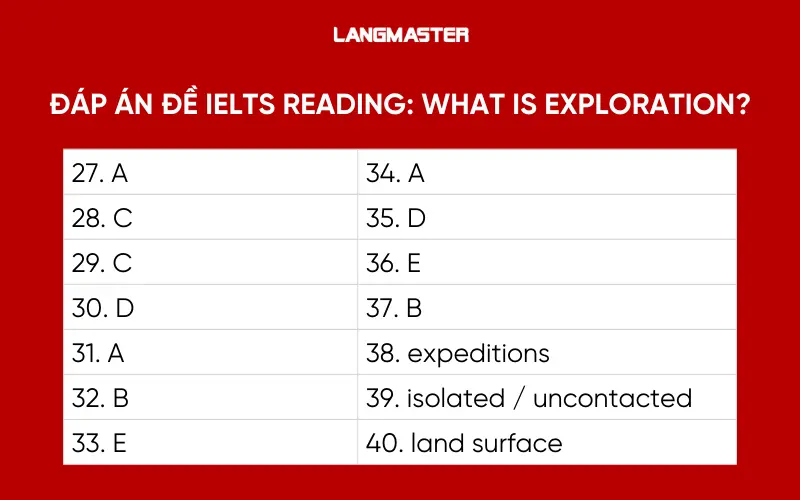
Dưới đây là bảng đáp án để bạn đối chiếu:
|
27. A |
34. A |
|
28. C |
35. D |
|
29. C |
36. E |
|
30. D |
37. B |
|
31. A |
38. expeditions |
|
32. B |
39. isolated / uncontacted |
|
33. E |
40. land surface |
Đáp án chi tiết 27 - 32
27. Paragraph A – Đáp án: A. Exploration is an intrinsic element of being human
Trích đoạn (Paragraph A): “This questing nature of ours undoubtedly helped our species spread around the globe, just as it nowadays no doubt helps the last nomadic Penan maintain their existence in the depleted forests of Borneo, and a visitor negotiate the subways of New York.”
Dịch: Bản năng tìm tòi của con người chắc chắn đã giúp loài người lan rộng khắp thế giới, cũng như ngày nay giúp người Penan du mục tồn tại trong những khu rừng cạn kiệt ở Borneo, hay giúp một du khách di chuyển trong hệ thống tàu điện ngầm New York.
Giải thích: New York được dùng làm ví dụ hiện đại để chứng minh rằng khám phá là bản năng tự nhiên của con người, tồn tại ở mọi thời đại và hoàn cảnh → phù hợp với đáp án A.
28. Paragraph B – Đáp án: C. They act on an urge that is common to everyone
Trích đoạn (Paragraph B): “...we all have this enquiring instinct, even today, and that in all sorts of professions – whether artist, marine biologist or astronomer – borders of the unknown are being tested each day.”
Dịch: Tuy nhiên, tất cả chúng ta đều có bản năng tìm tòi này, ngay cả ngày nay, và trong mọi ngành nghề – từ nghệ sĩ, nhà sinh vật biển đến nhà thiên văn – những ranh giới chưa biết vẫn đang được khám phá mỗi ngày.
Giải thích: Tác giả nhấn mạnh rằng bản năng khám phá là điểm chung của tất cả mọi người, không chỉ riêng các nhà thám hiểm → đáp án C.
29. Paragraph C – Đáp án: C. Hardy’s aim was to investigate people’s emotional states
Trích đoạn (Paragraph C): “Thomas Hardy set some of his novels in Egdon Heath… and used the landscape to suggest the desires and fears of his characters.”
Dịch: Thomas Hardy đặt bối cảnh một số tiểu thuyết của mình tại Egdon Heath và sử dụng cảnh quan để gợi lên những khát vọng và nỗi sợ của các nhân vật.
Giải thích: Egdon Heath được dùng như một công cụ để khắc họa cảm xúc và nội tâm con người, chứ không nhằm miêu tả địa lý hay khám phá thực tế → đáp án C.
30. Paragraph D – Đáp án: D. We are wrong to think that exploration is no longer necessary
Trích đoạn (Paragraph D): “We think back to a golden age… as if exploration peaked somehow in the 19th century… though the truth is that we have named only one and a half million of this planet’s species…”
Dịch: Chúng ta thường nghĩ về một “thời kỳ hoàng kim”, như thể việc khám phá đã đạt đỉnh vào thế kỷ 19, trong khi sự thật là con người mới chỉ đặt tên cho khoảng 1,5 triệu loài trên Trái Đất.
Giải thích: Tác giả bác bỏ quan điểm cho rằng khám phá đã kết thúc, và khẳng định rằng khám phá vẫn rất cần thiết vì hiểu biết của con người còn hạn chế → đáp án D.
31. Paragraph F – Đáp án: A. People tend to relate exploration to their own professional interests
Trích đoạn (Paragraph F): “Each definition is slightly different – and tends to reflect the field of endeavour of each pioneer.”
Dịch: Mỗi định nghĩa về khám phá đều hơi khác nhau và thường phản ánh lĩnh vực hoạt động của từng người tiên phong.
Giải thích: Cách con người định nghĩa “khám phá” thường gắn liền với nghề nghiệp và chuyên môn của họ → đáp án A.
32. Last paragraph – Đáp án: B. The human ability to cast new light on places that may be familiar
Trích đoạn (Last paragraph): “...how a fresh interpretation, even of a well-travelled route, can give its readers new insights.”
Dịch: Điều khiến tôi hứng thú là cách một cách diễn giải mới mẻ, ngay cả với một con đường quen thuộc, vẫn có thể mang lại những góc nhìn mới cho người đọc.
Giải thích: Tác giả quan tâm đến khả năng mang lại góc nhìn mới cho những địa điểm quen thuộc, chứ không phải việc đi đến nơi xa lạ → đáp án B.
Đáp án chi tiết 33 - 37
33. Paragraph E – Đáp án: E. Wilfred Thesiger
Trích đoạn (Paragraph E): “Wilfred Thesiger… told me, ‘If I’d gone across by camel when I could have gone by car, it would have been a stunt.’”
Dịch: Wilfred Thesiger nói rằng nếu ông đi bằng lạc đà trong khi hoàn toàn có thể đi bằng xe hơi, thì đó chỉ là một màn biểu diễn.
Giải thích: Wilfred so sánh lạc đà và xe hơi để làm rõ rằng phương tiện di chuyển có ảnh hưởng đến việc một chuyến đi có được coi là khám phá hay không → đúng với phát biểu về “form of transport”.
34. Paragraph C – Đáp án: A. Peter Fleming
Trích đoạn (Paragraph C): “Peter Fleming talks of the moment when the explorer returns to the existence he has left behind with his loved ones…”
Dịch: Peter Fleming nói về khoảnh khắc nhà thám hiểm trở lại cuộc sống mà anh ta đã rời bỏ, bên cạnh những người thân yêu.
Giải thích: Đoạn văn tập trung miêu tả cảm xúc của nhà thám hiểm khi quay về nhà sau chuyến đi dài, bao gồm sự thay đổi trong cách nhìn nhận bản thân → phù hợp với phát biểu 34.
35. Paragraph E – Đáp án: D. Robin Hanbury-Tenison
Trích đoạn (Paragraph E): “Robin Hanbury-Tenison, a campaigner on behalf of remote so-called ‘tribal’ peoples…”
Dịch: Robin Hanbury-Tenison là một nhà vận động vì quyền lợi của các cộng đồng bộ lạc sống ở vùng xa xôi.
Giải thích: Robin làm việc vì lợi ích của những nhóm người cụ thể, chứ không chỉ vì mục đích cá nhân → đúng với phát biểu 35.
36. Paragraph E – Đáp án: E. Wilfred Thesiger
Trích đoạn (Paragraph E): “Exploration meant bringing back information from a remote place regardless of any great self-discovery.”
Dịch: Theo ông, khám phá có nghĩa là mang thông tin trở về từ một nơi xa xôi, bất kể có đạt được sự khám phá bản thân hay không.
Giải thích: Wilfred không coi việc hiểu rõ bản thân là yếu tố thiết yếu của khám phá, mà chỉ tập trung vào giá trị thông tin → khớp với phát biểu 36.
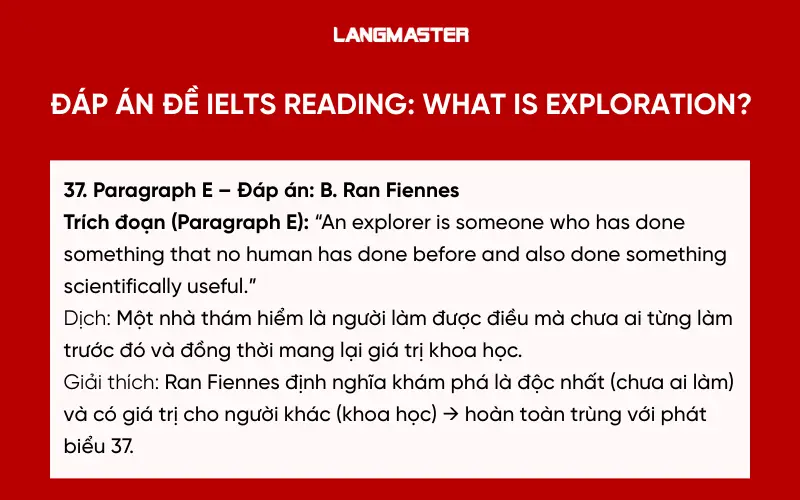
37. Paragraph E – Đáp án: B. Ran Fiennes
Trích đoạn (Paragraph E): “An explorer is someone who has done something that no human has done before and also done something scientifically useful.”
Dịch: Một nhà thám hiểm là người làm được điều mà chưa ai từng làm trước đó và đồng thời mang lại giá trị khoa học.
Giải thích: Ran Fiennes định nghĩa khám phá là độc nhất (chưa ai làm) và có giá trị cho người khác (khoa học) → hoàn toàn trùng với phát biểu 37.
Questions 38–40
38. Đáp án: expeditions
Trích đoạn: “a great many expeditions”
Giải thích: Cụm “a large number of” trong câu hỏi được paraphrase thành a great many, theo sau là danh từ số nhiều expeditions.
39. Đáp án: isolated / uncontacted
Trích đoạn: “isolated groups of people… even two ‘uncontacted tribes’”
Giải thích: Những nhóm người mà tác giả gặp là các cộng đồng từng sống cô lập, chưa tiếp xúc với người ngoài → phù hợp với yêu cầu điền tính từ cho “people”.
40. Đáp án: land surface
Trích đoạn (last paragraph): “We know how the land surface of our planet lies, exploration of it is now down to the details – the habits of microbes, say, or the grazing behaviour of buffalo.”
Dịch: Chúng ta đã biết rõ bề mặt Trái Đất như thế nào; việc khám phá hiện nay chỉ còn là những chi tiết nhỏ, chẳng hạn như tập tính của vi sinh vật hay hành vi gặm cỏ của loài trâu.
Giải thích: Câu văn cho thấy tác giả tin rằng không cần tiếp tục khám phá bề mặt Trái Đất ở quy mô lớn, vì điều đó đã hoàn tất; thay vào đó, khám phá chỉ nên tập trung vào các chi tiết cụ thể. Từ “planet” trong đoạn văn đồng nghĩa với “Earth” trong câu hỏi → đáp án là land surface.
>>> XEM THÊM:
Đề thi IELTS Reading có đáp án mới nhất 2025-2026 [Cập nhật liên tục]
Giải đề Back to the future of skyscraper design [Cam IELTS 14, Test 2]
Khi chuẩn bị cho kỳ thi IELTS Reading, việc xây dựng vốn từ vựng theo lộ trình khoa học là yếu tố then chốt giúp nâng cao band điểm. Đặc biệt, quá trình luyện tập với đề thi thật hoặc các bài đọc mẫu sẽ giúp thí sinh ghi nhớ từ mới hiệu quả hơn và biết cách áp dụng chúng trong ngữ cảnh. Dưới đây là danh sách từ và cụm từ nổi bật được trích từ bài IELTS Reading “What is exploration?” giúp bạn học tập và ôn luyện hiệu quả.
|
Từ vựng |
Nghĩa |
Ví dụ |
|
explorer |
nhà thám hiểm |
“An explorer is someone who has done something that no human has done before and also done something scientifically useful.” (Một nhà thám hiểm là người đã làm điều chưa từng có con người nào làm trước đây và đồng thời tạo ra giá trị khoa học.) |
|
questing nature |
bản tính ham khám phá |
“This questing nature of ours undoubtedly helped our species spread around the globe.” (Chính bản tính ham khám phá này đã giúp loài người lan rộng khắp toàn cầu.) |
|
enquiring instinct |
bản năng tò mò, ham tìm hiểu |
“That, however, doesn’t take away from the fact that we all have this enquiring instinct, even today.” (Tuy nhiên, điều đó không phủ nhận thực tế rằng tất cả chúng ta đều có bản năng tò mò, ngay cả ngày nay.) |
|
golden age |
thời kỳ hoàng kim |
“We think back to a golden age, as if exploration peaked somehow in the 19th century.” (Chúng ta thường nhìn lại một thời kỳ hoàng kim, như thể hoạt động khám phá đã đạt đỉnh vào thế kỷ 19.) |
|
confined myself to |
giới hạn bản thân vào |
“I have confined myself to those whose travels were real and who also aimed at more than personal discovery.” (Tôi giới hạn bản thân vào việc viết về những người có các chuyến đi thực sự và không chỉ nhằm khám phá cá nhân.) |
|
uncontacted tribes |
các bộ tộc chưa từng tiếp xúc |
“I’ve lived for months alone with isolated groups of people all around the world, even two ‘uncontacted tribes’.” (Tôi đã sống nhiều tháng một mình với các nhóm người biệt lập trên khắp thế giới, thậm chí với hai bộ tộc chưa từng tiếp xúc.) |
|
land surface |
bề mặt đất liền |
“We know how the land surface of our planet lies; exploration of it is now down to the details.” (Chúng ta đã biết bề mặt đất liền của Trái Đất ra sao; việc khám phá giờ đây chỉ còn tập trung vào các chi tiết.) |
|
grazing behaviour |
tập tính ăn cỏ |
“…the habits of microbes, say, or the grazing behaviour of buffalo.” (…chẳng hạn như tập tính của vi sinh vật hoặc tập tính ăn cỏ của trâu.) |
>>> XEM THÊM:
Khi luyện đề IELTS Reading với bài “What is exploration?”, nhiều học viên vẫn lúng túng trong việc nhận diện dạng câu hỏi cũng như vận dụng từ vựng học thuật cho đúng ngữ cảnh. Để cải thiện kết quả, người học cần một lộ trình ôn tập bài bản, đi kèm chiến thuật làm bài rõ ràng và sự đồng hành của đội ngũ giáo viên giàu kinh nghiệm. Thấu hiểu điều đó, Langmaster thiết kế các khóa IELTS online với lộ trình cá nhân hóa, giúp học viên được theo sát sát sao, nhận phản hồi chi tiết trong vòng 24 giờ và áp dụng phương pháp học tập hiệu quả để nâng cao trình độ nhanh chóng.

Tại Langmaster, học viên được trải nghiệm hệ thống học tập toàn diện với nhiều lợi thế nổi bật:
Coaching 1–1 cùng chuyên gia: Được kèm cặp riêng nhằm khắc phục điểm yếu, xây dựng chiến lược phân bổ thời gian làm bài hiệu quả và tập trung nâng cao những kỹ năng còn hạn chế để rút ngắn lộ trình tăng band.
Lớp học quy mô nhỏ (7–10 học viên): Giáo viên theo sát từng người, tạo điều kiện tương tác tối đa và phản hồi chi tiết trong suốt quá trình học.
Lộ trình cá nhân hóa: Thiết kế dựa trên trình độ đầu vào và mục tiêu điểm số cụ thể, đi kèm báo cáo tiến độ hàng tháng để theo dõi sự cải thiện.
Đội ngũ giáo viên IELTS 7.5+: Chấm chữa bài trong vòng 24 giờ, giúp học viên nhận ra lỗi sai và cải thiện nhanh chóng, rõ rệt.
Thi thử định kỳ: Mô phỏng sát kỳ thi thật, phân tích điểm mạnh – điểm yếu để điều chỉnh chiến lược ôn luyện phù hợp.
Cam kết đầu ra, học lại miễn phí: Đảm bảo kết quả học tập, giảm thiểu rủi ro “học xong vẫn chưa đạt mục tiêu”.
Học online tiện lợi, chất lượng như offline: Có bản ghi bài học để xem lại, linh hoạt thời gian, tiết kiệm chi phí.
Hệ sinh thái học tập đồng bộ: Tài liệu chuẩn hóa, bài tập online, cộng đồng học viên và đội ngũ cố vấn luôn đồng hành trong suốt quá trình ôn luyện.
Đăng ký học thử IELTS Online miễn phí ngay hôm nay để trải nghiệm lớp học IELTS online tốt nhất cho người mới bắt đầu tại Langmaster, giúp bạn từng bước làm chủ kỹ năng IELTS Reading và tự tin chinh phục mục tiêu IELTS đã đặt ra!
Tóm lại, việc luyện tập đề IELTS Reading “What is exploration?” không chỉ giúp học viên xác định chính xác đáp án mà còn rèn luyện tư duy phân tích mạch lạc theo từng dạng câu hỏi. Thông qua việc áp dụng từ vựng học thuật vào ngữ cảnh thực tế, người học có thể ghi nhớ sâu hơn và từng bước xây dựng nền tảng từ vựng vững chắc cho kỹ năng đọc học thuật trong IELTS.


![Giải đề thi European Heat Wave IELTS Reading [FULL ANSWER]](https://langmaster.edu.vn/storage/uploads/original/2025/11/20/european-heat-wave-ielts-reading-answers.png)
Tổng hợp đề thi European Heat Wave IELTS Reading Answers kèm phân tích chi tiết, từ vựng và đáp án giúp bạn tối ưu điểm Reading nhanh chóng.
![Đề thi IELTS Reading có đáp án mới nhất 2025-2026 [Cập nhật liên tục]](https://langmaster.edu.vn/storage/uploads/original/2025/12/25/de-thi-ielts-reading.png)
Đề thi IELTS Reading có đáp án mới nhất 2025/2026, cập nhật liên tục đề thi thật và Cambridge, kèm lời giải chi tiết giúp nâng band hiệu quả.
Bài viết tổng hợp chi tiết đề thi IELTS Reading Holidays with a difference, đáp án kèm giải thích chi tiết, từ vựng cần lưu ý khi làm bài giúp bạn luyện thi hiệu quả và nâng cao band điểm.
Bài viết tổng hợp chi tiết đề thi IELTS Reading on the trail of the honey badger, đáp án kèm giải thích chi tiết, từ vựng cần lưu ý khi làm bài giúp bạn luyện thi hiệu quả và nâng cao band điểm.
![Giải đề IELTS Reading Growing more for less [FULL ANSWER]](https://langmaster.edu.vn/storage/uploads/original/2025/10/22/growing-more-for-less-ielts-reading-answers.png)
Khám phá bài đọc Growing more for less IELTS Reading: Tổng hợp đáp án, từ vựng quan trọng và phân tích chi tiết giúp bạn hiểu cách công nghệ vệ tinh hỗ trợ nông nghiệp hiện đại



Hơn 16 năm kinh nghiệm, đào tạo thành công hàng trăm nghìn học viên
Phương pháp giảng dạy hiện đại, học viên tiến bộ rõ rệt
Lộ trình học chuẩn quốc tế, phù hợp với nhu cầu thực tiễn
Giáo viên đạt chuẩn Quốc tế với chất lượng top đầu thị trường, giàu kinh nghiệm
Học online linh hoạt, cam kết đầu ra bằng văn bản

.png)