Khóa học
IELTS Online
IELTS Online
Giảm đến 18%
Đăng ký ngay
Mục lục [Ẩn]
Short Answer Questions là một dạng câu hỏi quen thuộc trong bài thi IELTS Reading nhưng lại khiến nhiều thí sinh mất điểm do trả lời sai số từ hoặc xác định thông tin chưa chính xác. Trong bài viết này, bạn sẽ tìm thấy tổng hợp các bài tập Short Answer Questions IELTS Reading kèm hướng dẫn cách làm và những lưu ý quan trọng giúp nâng cao kỹ năng đọc và cải thiện điểm số hiệu quả.
Trong bài thi IELTS Reading, dạng Short Answer Questions yêu cầu thí sinh trả lời câu hỏi dựa trên thông tin xuất hiện trực tiếp trong đoạn văn. Thông thường, đáp án chỉ được phép viết từ một đến ba từ hoặc một con số, tùy theo quy định của đề bài. Mục đích của dạng câu hỏi này là đánh giá khả năng đọc hiểu chi tiết, kỹ năng tìm kiếm thông tin cụ thể cũng như việc sử dụng đúng từ ngữ được lấy từ văn bản.
Dưới đây là chi tiết các bước làm bài dạng Short Answer IELTS Reading:
Đọc kỹ yêu cầu đề bài (Instruction): Kiểm tra số lượng từ tối đa/tối thiểu được phép điền (ví dụ: NO MORE THAN TWO WORDS AND/OR A NUMBER) để không bị mất điểm đáng tiếc
Đọc câu hỏi và gạch chân keywords: Xác định các từ khóa chính (danh từ riêng, thời gian, từ chuyên ngành) và dự đoán loại từ cần điền (danh từ, động từ, số liệu)
Quét (Scan) thông tin trong bài đọc: Tìm các từ khóa hoặc từ đồng nghĩa (paraphrase) của chúng trong văn bản để xác định đoạn văn chứa đáp án idp ielts
Đọc kỹ và chọn đáp án: Đọc kỹ các câu xung quanh từ khóa để xác định câu trả lời chính xác nhất. Đáp án thường là từ/cụm từ có sẵn trong văn bản, không cần tự suy luận
Kiểm tra lại: Đảm bảo đáp án phù hợp về mặt ngữ pháp và số lượng từ quy định
BẠN CÓ THỂ XEM CHIẾN LƯỢC LÀM BÀI CHI TIẾT TẠI ĐÂY: Chiến thuật làm dạng bài Short Answer Question trong IELTS Reading
RUBIK’S CUBE
How the puzzle achieved success
Erno Rubik first studied sculpture and then later architecture in Budapest, where he went on to become a teacher of interior design. It was while he was working as a teacher that he began the preliminary work on an invention that he called the ‘Magic Cube'.
Rubik was inspired by geometric puzzles such as the Chinese tangram, a puzzle consisting of various triangles, a square and a parallelogram which can be combined to create different shapes and figures. However, unlike the tangram, which is two-dimensional, Rubik was more interested in investigating how three-dimensional forms, such as the cube, could be moved and combined to produce other forms.
His design consisted of a cube made up of layers of individual smaller cubes, and each smaller cube could be turned in any direction except diagonally. To ensure that the cubes could move independently, without falling apart, Rubik first attempted to join them together using elastic bands. However, this proved to be impossible, so Rubik then solved the problem by assembling them using a rounded interior. This permitted them to move smoothly and easily. He experimented with different ways of marking the smaller cubes, but ended up with the simple solution of giving a different colour to each side. The object was to twist the layers of small cubes so that each side of the large cube was an identical colour.
Rubik took out a patent for the Cube in 1977 and started manufacturing it in the same year. The Cube came to the attention of a Hungarian businessman, Tibor Laczi, who then demonstrated it at the Nuremberg Toy Fair. When British toy expert Tom Kremer saw it, he thought it was amazing and he persuaded a manufacturer, Ideal Toys, to produce 1 million of them in 1979. Ideal Toys renamed the Cube after the toy’s inventor, and in 1980, Rubik’s Cube was shown at toy fairs all over the world. It won that year’s prize in Germany for Best Puzzle. Rubik’s Cube is believed to be the world’s best-selling puzzle; since its invention, more than 300 million Cubes have been sold worldwide.
Bài tập
Now complete the summary. Choose NO MORE THAN TWO WORDS from the passage to each answer.
Rubik’s Cube
Originally named the 1 …………., Rubik’s Cube consists of a number of smaller cubes organised in 2 ……….. The smaller cubes can be twisted in almost any way, though not 3 …………... The Cube’s 4 ………… is shaped in a way that allows the smaller cubes to move smoothly. Each side of the smaller cubes has a different colour, and the aim of the puzzle is to organise the cubes so that the colours on the sides of the large cube are 5 …………….. The manufacturers of the puzzle changed the name of the Cube to the name of its 6 ……………. it has now sold more than any other 7 ………… in the world.
Đáp án:
Magic Cube
layers
diagonally
interior
identical colour
inventor
puzzle
>>> XEM THÊM:
Đề thi IELTS Reading có đáp án mới nhất 2025-2026 [Cập nhật liên tục]
Giải đề Back to the future of skyscraper design [Cam IELTS 14, Test 2]
REDUCING ERRORS IN MEMORY
Sleep may reduce mistakes in memory, according to a first-of-its-kind study led by a scientist at Michigan State University.
The findings, which appear in the September issue of the journal Learning El Memory, have practical implications for many people, from students doing multiple-choice tests to elderly people confusing their medicine, says Kimberly Fenn, principal investigator and assistant professor of psychology.
‘It’s easy to muddle things in your mind,’ Fenn says. This research suggests that after sleep, you’re better able to pick out the incorrect parts of that memory.’ Fenn and colleagues from the University of Chicago and Washington University in St Louis studied the presence of incorrect or false memory in groups of college students. While previous research has shown that sleep improves memory, this study is the first one that looks at errors in memory, she said.
Study participants were ‘trained’ by being shown or listening to lists of words. Then, twelve hours later, they were shown individual words and asked to identify which words they had seen or heard in the earlier session. One group of students was trained at 10 a.m. and tested at 10 p.m. after the course of a normal sleepless day. Another group was trained at night and tested twelve hours later in the morning, after about six hours of sleep. Three experiments were conducted. In each experiment, the results showed that students who had slept did not have as many problems with false memory and chose fewer incorrect words.
How does sleep help? The answer isn’t known, Fenn said, but she suspects it may be due to sleep strengthening the source of the memory. The source, or context in which the information is acquired, is a vital element of the memory process. In other words, it may be easier to remember something if you can also remember where you first heard or saw it. Or perhaps the people who didn’t sleep as much during the study received so much other information during the day that this affected their memory ability, Fenn said.
Further research is needed, she said, adding that she plans to study different population groups, particularly the elderly. ‘We know older individuals generally have worse memory performance than younger individuals. We also know from other research that elderly individuals tend to be more prone to false memories,’ Fenn said. ‘Given the work we’ve done, it’s possible that sleep may actually help them to reject this false information. And potentially this could help to improve their quality of life.’
Adapted from Michigan State University News http://news.msu.edu/story/6804
Bài tập:
Complete the summary using the list of words and phrases, A-J, below.
Fenn’s Memory Experiments
The groups in the study saw or heard lists of words at 1 ……….. times of the day. After 2 ……. hours, the groups tried to identify these words correctly in a test. Before the test, one group had 3 ……… sleep and chose the words in the evening. The other group had their test in the morning.
In three experiments, the results were 4 ………. the groups that had slept during the experiment remembered 5 ………… words correctly than the other groups.
A. more
B. complex
C. 12
D. six
E. less
F. ten
G. different
H. no
I. fewer
J. the same
Đáp án:
different
12
six
the same
fewer
SPEED READING
What is speed reading, and why do we need it?
A. Speed reading is not just about reading fast. It is also about how much information you can remember when you have finished reading. The World Championship Speed-Reading Competition says that its top competitors average between 1,000 and 2,000 words a minute. But they must remember at least 50 percent of this in order to qualify for the competition.
B. Nowadays, speed reading has become an essential skill in any environment where people have to master a large volume of information. Professional workers need reading skills to help them get through many documents every day, while students under pressure to deal with assignments may feel they have to read more and read faster all the time.
C. Although there are various methods to increase reading speed, the trick is deciding what information you want first. For example, if you only want a rough outline of an issue, then you can skim the material quickly and extract the key facts. However, if you need to understand every detail in a document, then you must read it slowly enough to understand this.
D. Even when you know how to ignore irrelevant detail, there are other improvements you can make to your reading style which will increase your speed. For example, most people can read much faster if they read silently. Reading each word aloud takes time for the information to make a complete circuit in your brain before being pronounced. Some researchers believe that as long as the first and last letters are in place, the brain can still understand the arrangement of the other letters in the word because it logically puts each piece into place.
E. Chunking is another important method. Most people learn to read either letter by letter or word by word. As you improve, this changes. You will probably find that you are fixing your eyes on a block of words, then moving your eyes to the next block of words, and so on. You are reading blocks of words at a time, not individual words one by one. You may also notice that you do not always go from one block to the next: sometimes you may move back to a previous block if you are unsure about something.
F. A skilled reader will read a lot of words in each block. He or she will only look at each block for an instant and will then move on. Only rarely will the reader’s eyes skip back to a previous block of words. This reduces the amount of work that the reader’s eyes have to do. It also increases the volume of information that can be taken in over a given period of time.
G. On the other hand, a slow reader will spend a lot of time reading small blocks of words. He or she will skip back often, losing the flow and structure of the text, and muddling their overall understanding of the subject. This irregular eye movement quickly makes the reader tired. Poor readers tend to dislike reading because they feel it is difficult to concentrate and comprehend written information.
H. The best tip anyone can have to improve their reading speed is to practise. In order to do this effectively, a person must be engaged in the material and want to know more. If you find yourself constantly having to re-read the same paragraph, you may want to switch to reading material that grabs your attention. If you enjoy what you are reading, you will make quicker progress.
Adapted from speed-reading-techniques.com
Bài tập:
The reading passage has seven paragraphs, A-H.
Which paragraph contains the following information?
Write the correct letter, A-H.
NB You may use any letter more than once.
the types of people who need to read more quickly
the fastest reading speeds
how a reader can become confused
why reading material should be interesting
a definition of speed reading
what you should consider before you start reading
Đáp án:
B
A
G
H
A
C
>>> XEM THÊM:
Giải đề IELTS Reading: Why being bored is stimulating [Full answers]
Giải đề What is exploration? IELTS Reading Cam 15, Test 1, Passage 3
LEARNING COLOR WORDS
Young children struggle with color concepts, and the reason for this may have something to do with how we use the words that describe them.
A. In the course of the first few years of their lives, children who are brought up in English- speaking homes successfully master the use of hundreds of words. Words for objects, actions, emotions, and many other aspects of the physical world quickly become part of their infant repertoire. For some reason, however, when it comes to learning color words, the same children perform very badly. At the age of four months, babies can distinguish between basic color categories. Yet it turns out they do this in much the same way as blind children. "Blue" and "yellow" appear in older children's expressive language in answer to questions such as "What color is this?", but their mapping of objects to individual colors is haphazard and interchangeable. If shown a blue cup and asked about its color, typical two-year-olds seem as likely to come up with "red" as "blue." Even after hundreds of training trials, children as old as four may still end up being unable to accurately sort objects by color.
B. In an effort to work out why this is, cognitive scientists at Stanford University in California hypothesized that children's incompetence at color-word learning may be directly linked to the way these words are used in English. While word order for color adjectives varies, they are used overwhelmingly in pre-nominal position (e.g. "blue cup"); in other words, the adjective comes before the noun it is describing. This is in contrast to post-nominal position (e.g. "The cup is blue") where the adjective comes after the noun. It seems that the difficulty children have may not be caused by any unique property of color, or indeed, of the world. Rather, it may simply come down to the challenge of having to make predictions from color words to the objects they refer to, instead of being able to make predictions from the world of objects to the color words.
To illustrate, the word "chair" has a meaning that applies to the somewhat varied set of entities in the world that people use for sitting on. Chairs have features, such as arms and legs and backs, that are combined to some degree in a systematic way; they turn up in a range of chairs of different shapes, sizes, and ages. It could be said that children learn to narrow down the set of cues that make up a chair and in this way they learn the concept associated with that word. On the other hand, color words tend to be unique and not bound to other specific co-occurring features; there is nothing systematic about color words to help cue their meaning. In the speech that adults direct at children, color adjectives occur pre-nominally ("blue cup") around 70 percent of the time. This suggests that most of what children hear from adults will, in fact, be unhelpful in learning what color words refer to.
C. To explore this idea further, the research team recruited 41 English children aged between 23 and 29 months and carried out a three-phase experiment. It consisted of a pre-test, followed by training in the use of color words, and finally a post-test that was identical to the pre-test. The pre- and post-test materials comprised six objects that were novel to the children. There were three examples of each object in each of three colors—red, yellow, and blue. The objects were presented on trays, and in both tests, the children were asked to pick out objects in response to requests in which the color word was either a pre nominal ("Which is the red one?") or a post-nominal ("Which one is red?").
In the training, the children were introduced to a "magic bucket" containing five sets of items familiar to 26-month-olds (balls, cups, crayons, glasses, and toy bears) in each of the three colors. The training was set up so that half the children were presented with the items one by one and heard them labelled with color words used pre-nominally ("This is a red crayon"), while the other half were introduced to the same items described with a post-nominal color word ("This crayon is red"). After the training, the children repeated the selection task on the unknown items in the post-test. To assess the quality of children's understanding of the color words, and the effect of each type of training, correct choices on items that were consistent across the pre- and post-tests were used to measure children's color knowledge.
D. Individual analysis of pre- and post-test data, which confirmed parental vocabulary reports, showed the children had at least some knowledge of the three colour words: they averaged two out of three correct choices in response to both pre- and post-nominal question types, which, it has been pointed out, is better than chance. When children's responses to the question types were assessed independently, performance was at its most consistent when children were both trained and tested on post-nominal adjectives, and worst when trained on pre-nominal adjectives and tested on post-nominal adjectives. Only children who had been trained with post- nominal color-word presentation and then tested with post-nominal question types were significantly more accurate than chance. Comparing the pre- and post-test scores across each condition revealed a significant decline in performance when children were both pre- and post-tested with questions that placed the color words pre-nominally.
As predicted, when children are exposed to color adjectives in post-nominal position, they learn them rapidly (after just five training trials per color); when they are presented with them pre-nominally, as English overwhelmingly tends to do, children show no signs of learning.
Bài tập:
Complete the summary below. Choose NO MORE THAN TWO WORDS from the passage for each answer.
The Hypothesis
Children learn many words quite quickly, but their ability to learn colour words takes longer than expected. In fact, despite 5 ......................... many four-year olds still struggle to arrange objects into colour categories. Scientists have hypothesised that this is due to the 6 ......................... of the adjectives in a phrase or sentence and the challenges this presents.
While objects consist of a number of 7 ......................... that can be used to recognise other similar objects, the 8 ......................... of a colour cannot be developed using the same approach. As a consequence, the way colour words tend to be used in English may be 9 ......................... to children.
Đáp án
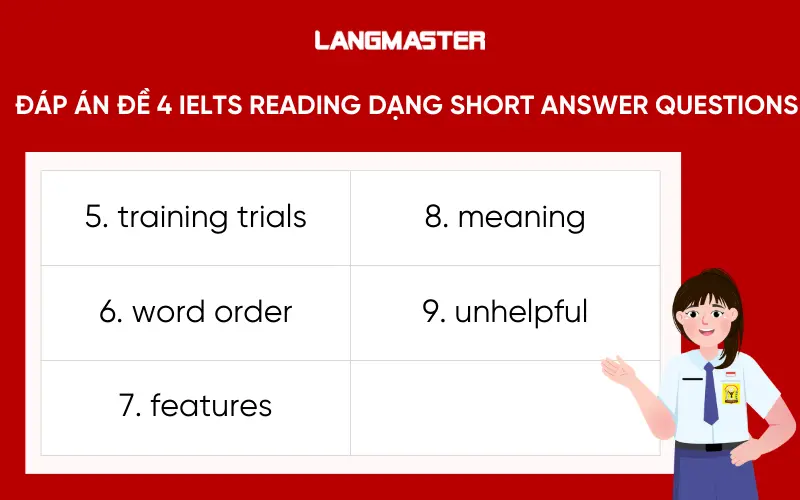
5. training trials
6. word order
7. features
8. meaning
9. unhelpful
>>> XEM THÊM: Bài tập True/False/Not given IELTS Reading có đáp án chi tiết
OUT OF AFRICA: SOLAR ENERGY FROM THE SAHARA
Vivienne Wait reports on how the Sahara Desert could offer a truly green solution to Europe’s energy problems.
A. For years, the Sahara has been regarded by many Europeans as a terra incognita* of little economic value or importance. But this idea may soon change completely. Politicians and scientists on both sides of the Mediterranean are beginning to focus on the Sahara’s potential to provide power for Europe in the future. They believe the desert’s true value comes from the fact that it is dry and empty. Some areas of the Sahara reach 45 degrees centigrade on many afternoons. It is, in other words, a gigantic natural storehouse of solar energy.
B. A few years ago, scientists began to calculate just how much energy the Sahara holds. They were astonished at the answer. In theory, a 90,600 square kilometre chunk of the Sahara - smaller than Portugal and a little over 1% of its total area - could yield the same amount of electricity as all the world’s power plants combined. A smaller square of 15,500 square kilometres - about the size of Connecticut - could provide electricity for Europe’s 500 million people. 'I admit I was sceptical until I did the calculations myself,’ says Michael Pawlyn, director of Exploration Architecture, one of three British environmental companies comprising the Sahara Forest Project, which is testing solar plants in Oman and the United Arab Emirates. Pawlyn calls the Sahara’s potential ’staggering’.
C. At the moment, no one is proposing the creation of a solar power station the size of a small country. But a relatively well-developed technology exists, which proponents say could turn the Sahara’s heat and sunlight into a major source of electricity - Concentrating Solar Power (CSP). Unlike solar panels, which convert sunlight directly into electricity, CSP utilises mirrors which focus light on water pipes or boilers to produce very hot steam to operate the turbines of generators. Small CSP plants have produced power in California’s Mojave Desert since the 1980s. The Sahara Forest Project proposes building CSP plants in areas below sea level (the Sahara has several such depressions) so that sea water can flow into them. This water would then be purified and used for powering turbines and washing dust off the mirrors. Waste water would then supply irrigation to areas around the stations, creating lush oases - hence the ’forest’ in the group’s name.
D. But producing Significant quantities of electricity means building huge arrays of mirrors and pipes across hundreds of miles of remote desert, which is expensive. Gerry Wolff, an engineer who heads DESERTEC, an international consortium of solar-power scientists, says they have estimated it will cost about $59 billion to begin transmitting power from the Sahara by 2020.
E. Building plants is just part of the challenge. One of the drawbacks to CSP technology is that it works at maximum efficiency only in sunny, hot climates - and deserts tend to be distant from population centres. To supply Europe with 20% of its electricity needs, more than 19,300 kilometres of cables would need to be laid under the Mediterranean, says Gunnar Asplund, head of HVDC research at ABB Power Technologies in Ludvika, Sweden. Indeed, to use renewable sources of power, including solar, wind and tidal, Europe will need to build completely new electrical grids. That’s because existing infrastructures, built largely for the coal-fired plants that supply 80% of Europe’s power, would not be suitable for carrying the amount of electricity generated by the Sahara. Germany’s government-run Aerospace Centre, which researches energy, estimates that replacing those lines could raise the cost of building solar plants in the Sahara and sending significant amounts of power to Europe to about $485 billion over the next 40 years. Generous government subsidies will be needed. ‘Of course it costs a lot of money,’ says Asplund. ‘It’s a lot cheaper to burn coal than to make solar power in the Sahara.’
F. Meanwhile, some companies are getting started. Seville engineering company Abengoa is building one solar - thermal plant in Algeria and another in Morocco, while a third is being built in Egypt by a Spanish-Japanese joint venture. The next step will be to get cables in place. Although the European Parliament has passed a law that aids investors who help the continent reach its goal of getting 20% of its power from renewable energy by 2020, it could take years to create the necessary infrastructure.
G. Nicholas Dunlop, secretary-general of the London-based NGO e-Parliament, thinks companies should begin transmitting small amounts of solar power as soon as the North African plants begin operating, by linking a few cable lines under the Med. 'I call it the Lego method,’ he says. ‘Build it piece by piece.’ If It can be shown that power from the Sahara can be produced profitably, he says, companies and governments will soon jump in. If they do, perhaps airplane passengers flying across the Sahara will one day count the mirrors and patches of green instead of staring at sand.
adapted from Time Magazine *terra incognita - Latin, meaning ‘an unknown land'
Bài tập:
Complete the summary below. Choose NO MORE THAN TWO WORDS from the passage for each answer.
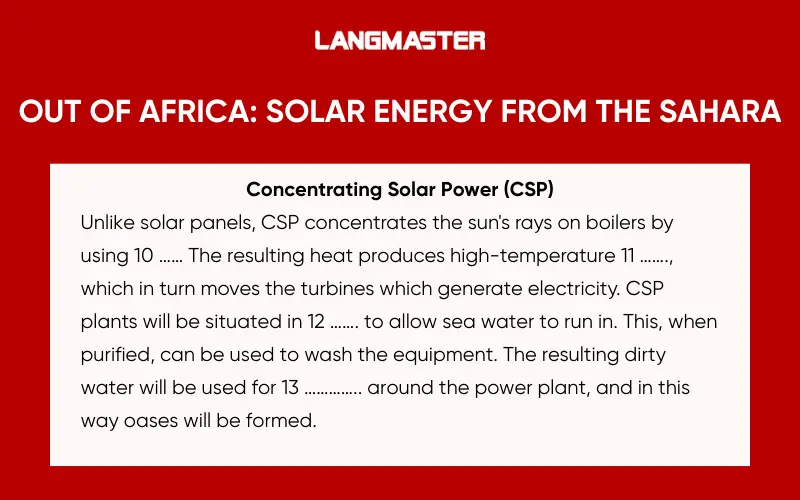
Concentrating Solar Power (CSP)
Unlike solar panels, CSP concentrates the sun's rays on boilers by using 10 …… The resulting heat produces high-temperature 11 ……., which in turn moves the turbines which generate electricity. CSP plants will be situated in 12 ……. to allow sea water to run in. This, when purified, can be used to wash the equipment. The resulting dirty water will be used for 13 ………….. around the power plant, and in this way oases will be formed.
Đáp án:
11. mirrors
12. steam
13. depressions
14. irrigation
Read the following text about pedestrian zones in cities.
A large number of European towns and cities have made part of their centres car-free since the early 1960s. These are often accompanied by car parks on the edge of the pedestrianised zone, and, in the larger cases, park and ride schemes. Central Copenhagen is one of the largest and oldest examples: the auto-free zone is centred on Strøget, a pedestrian shopping street, which is in fact not a single street but a series of interconnected avenues which create a very large auto-free zone, although it is crossed in places by streets with vehicular traffic. Most of these zones allow delivery trucks to service the businesses located there during the early morning, and street-cleaning vehicles will usually go through these streets after most shops have closed for the night.
In North America, where a more commonly used term is pedestrian mall, such areas are still in their infancy. Few cities have pedestrian zones, but some have pedestrianised single streets. Many pedestrian streets are surfaced with cobblestones, or pavement bricks, which discourage any kind of wheeled traffic, including wheelchairs. They are rarely completely free of motor vehicles.
Bài tập:
Fill the gaps below with NO MORE THAN 3 WORDS from the text.
In some cases, people are encouraged to park 1. ________ of the town or city centre.
The only vehicles permitted in most pedestrian zones are those used for 2. ________ or 3. ________ cleaning.
Certain types of road surface can be used to 4. ________ traffic.
Đáp án:
on the edge
delivery trucks
street
discourage wheeled
>>> XEM THÊM: Giải đề IELTS Reading: Why zoos are good - Cam 14, Test 4, Passage 2
Dưới đây là lưu ý khi làm bài tập Short Answer Questions IELTS Reading:
Tuân thủ giới hạn từ: Đếm kỹ số từ trước khi điền. Sai số từ (ví dụ yêu cầu 1 từ nhưng điền 2 từ) sẽ bị tính là sai toàn bộ câu.
Ưu tiên sử dụng từ/cụm từ xuất hiện trong bài đọc: Sử dụng chính xác từ/cụm từ trong văn bản, không tự ý thay đổi (ngoại trừ chia lại thì hoặc số ít/nhiều nếu cần thiết để đúng ngữ pháp).
Xác định vị trí thông tin theo thứ tự câu hỏi: Thông tin các câu hỏi (1, 2, 3...) xuất hiện lần lượt theo trình tự trong bài đọc, giúp bạn dễ dàng định vị.
Chú ý đến paraphrase và từ đồng nghĩa: Keywords trong câu hỏi thường được thay thế bằng từ đồng nghĩa hoặc diễn đạt khác trong đoạn văn, cần chú ý tìm các từ này.
Đảm bảo sự phù hợp về ngữ pháp và ngữ cảnh: Câu trả lời cần phù hợp về ngữ pháp với câu hỏi (danh từ, động từ, v.v.) và phù hợp ngữ cảnh.
Chỉ dựa trên thông tin trong bài đọc: Chỉ dựa trên thông tin trong bài đọc (within the passage), không sử dụng ý kiến cá nhân.
>>> XEM THÊM: Cách tăng tốc độ đọc hiểu và cải thiện điểm trong bài thi IELTS Reading
Khi luyện tập dạng Short Answer Questions trong IELTS Reading, nhiều học viên thường gặp khó khăn trong việc xác định thông tin chính xác trong bài đọc, đặc biệt khi câu trả lời yêu cầu đúng số lượng từ và bám sát nội dung trong đoạn văn. Nếu không nắm rõ chiến lược skimming, scanning và cách xác định từ khóa, người học rất dễ mất thời gian hoặc chọn sai đáp án.
Nhằm hỗ trợ học viên đạt mục tiêu điểm số mong muốn, Langmaster xây dựng các khóa học IELTS online với lộ trình cá nhân hóa. Học viên sẽ được giảng viên theo sát, chỉ ra lỗi sai ngay lập tức trong vòng 24 giờ và hướng dẫn phương pháp học tập tối ưu để tiến bộ nhanh chóng hơn.
Tại Langmaster học viên được:
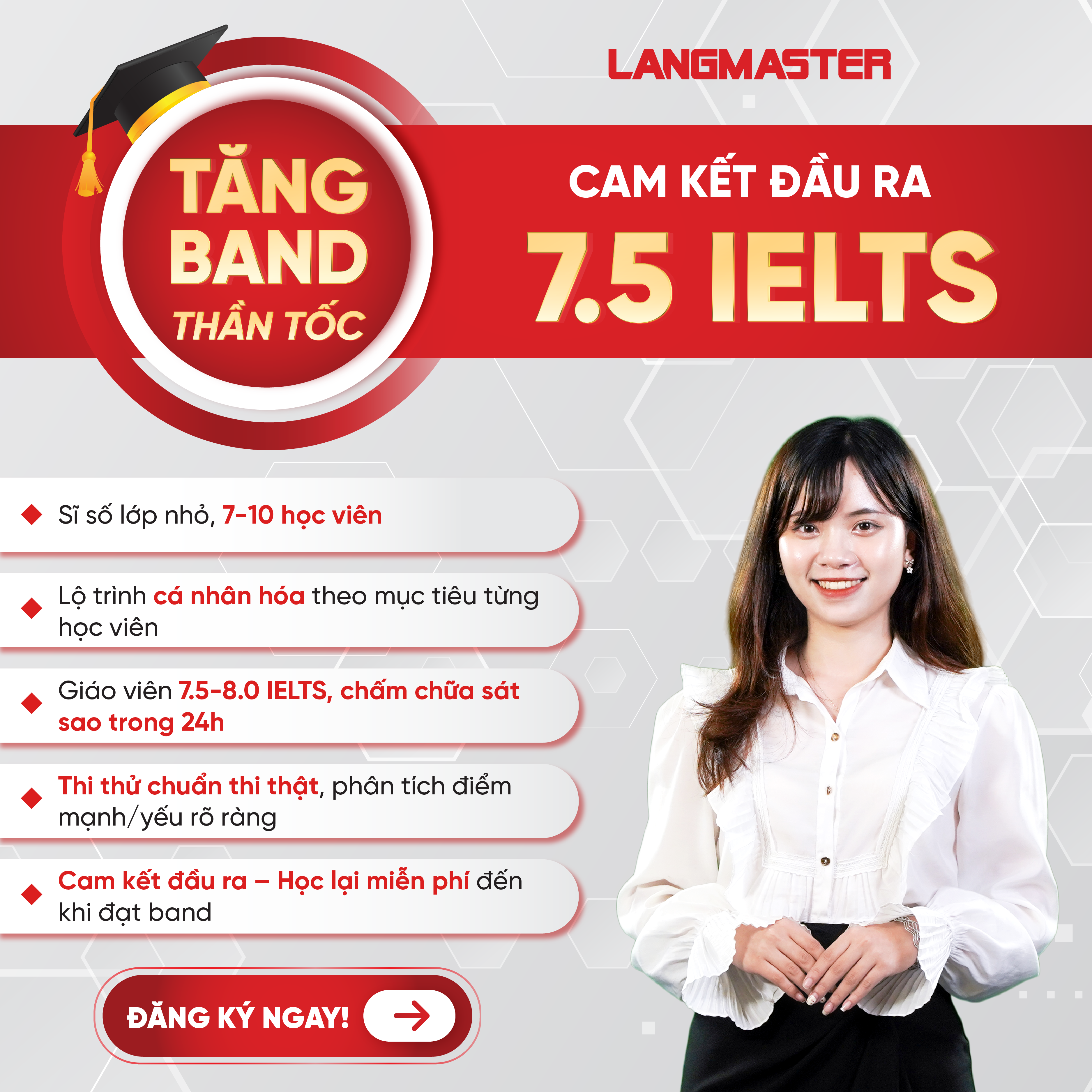
Coaching 1 - 1 với chuyên gia: Học viên được kèm riêng để khắc phục điểm yếu, phân bổ thời gian thi chi tiết, tập trung rèn kỹ năng chưa vững và rút ngắn lộ trình nâng band.
Lộ trình học cá nhân hóa: Thiết kế dựa trên trình độ đầu vào và mục tiêu điểm số, kèm báo cáo tiến bộ hàng tháng.
Sĩ số lớp nhỏ, 7 - 10 học viên: Giáo viên theo sát từng bạn, nhiều cơ hội trao đổi và nhận phản hồi chi tiết.
Giáo viên 7.5+ IELTS: Chấm chữa bài trong 24 giờ, giúp bạn cải thiện nhanh chóng và rõ rệt.
Thi thử định kỳ: Mô phỏng áp lực thi thật, phân tích điểm mạnh - yếu để điều chỉnh chiến lược học.
Cam kết đầu ra, học lại miễn phí: Đảm bảo kết quả, giảm thiểu rủi ro “học xong vẫn chưa đạt mục tiêu”.
Học online tiện lợi, chất lượng như offline: Có bản ghi để xem lại, linh hoạt, tiết kiệm thời gian, chi phí.
Hệ sinh thái học tập toàn diện: Tài liệu chuẩn, bài tập online, cộng đồng học viên và cố vấn luôn đồng hành.
Đăng ký học thử IELTS Online miễn phí ngay hôm nay để kiểm tra trình độ, trải nghiệm lớp học thực tế và nhận lộ trình học phù hợp giúp bạn chinh phục mục tiêu IELTS nhanh chóng.
Trên đây là tổng hợp các bài tập Short Answer Questions IELTS Reading giúp bạn luyện tập và làm quen với một trong những dạng câu hỏi phổ biến trong bài thi Reading. Hy vọng bộ bài tập trong bài viết sẽ giúp bạn nâng cao kỹ năng IELTS Reading, đồng thời xây dựng chiến lược làm bài hiệu quả hơn cho kỳ thi sắp tới. Đừng quên luyện tập đều đặn và bổ sung thêm từ vựng học thuật để đạt được band điểm IELTS mong muốn.

![Giải đề thi European Heat Wave IELTS Reading [FULL ANSWER]](https://langmaster.edu.vn/storage/uploads/original/2025/11/20/european-heat-wave-ielts-reading-answers.png)
Tổng hợp đề thi European Heat Wave IELTS Reading Answers kèm phân tích chi tiết, từ vựng và đáp án giúp bạn tối ưu điểm Reading nhanh chóng.
![Đề thi IELTS Reading có đáp án mới nhất 2025-2026 [Cập nhật liên tục]](https://langmaster.edu.vn/storage/uploads/original/2025/12/25/de-thi-ielts-reading.png)
Đề thi IELTS Reading có đáp án mới nhất 2025/2026, cập nhật liên tục đề thi thật và Cambridge, kèm lời giải chi tiết giúp nâng band hiệu quả.
Bài viết tổng hợp chi tiết đề thi IELTS Reading Holidays with a difference, đáp án kèm giải thích chi tiết, từ vựng cần lưu ý khi làm bài giúp bạn luyện thi hiệu quả và nâng cao band điểm.
Bài viết tổng hợp chi tiết đề thi IELTS Reading on the trail of the honey badger, đáp án kèm giải thích chi tiết, từ vựng cần lưu ý khi làm bài giúp bạn luyện thi hiệu quả và nâng cao band điểm.
![Giải đề IELTS Reading Growing more for less [FULL ANSWER]](https://langmaster.edu.vn/storage/uploads/original/2025/10/22/growing-more-for-less-ielts-reading-answers.png)
Khám phá bài đọc Growing more for less IELTS Reading: Tổng hợp đáp án, từ vựng quan trọng và phân tích chi tiết giúp bạn hiểu cách công nghệ vệ tinh hỗ trợ nông nghiệp hiện đại




Hơn 16 năm kinh nghiệm, đào tạo thành công hàng trăm nghìn học viên
Phương pháp giảng dạy hiện đại, học viên tiến bộ rõ rệt
Lộ trình học chuẩn quốc tế, phù hợp với nhu cầu thực tiễn
Giáo viên đạt chuẩn Quốc tế với chất lượng top đầu thị trường, giàu kinh nghiệm
Học online linh hoạt, cam kết đầu ra bằng văn bản

![Giải đề IELTS Reading: Why being bored is stimulating [Full answers]](https://langmaster.edu.vn/storage/uploads/original/2026/03/09/why-being-bored-is-stimulating-ielts-reading.png)