Khóa học
IELTS Online
IELTS Online
Giảm đến 18%
Đăng ký ngay
Mục lục [Ẩn]
Bạn vừa tham gia kỳ thi IELTS Reading ngày 26-6-2026 tại BC Lancaster và muốn kiểm tra lại đáp án? Trong bài viết này, Langmaster sẽ cung cấp lời giải chi tiết cho toàn bộ đề thi IELTS Reading 26.6.2026, giúp bạn hiểu rõ cách xác định đáp án, nhận diện bẫy thường gặp trong từng dạng bài và tích lũy thêm nhiều từ vựng học thuật quan trọng. Cùng đối chiếu kết quả và rút kinh nghiệm để chinh phục band điểm IELTS Reading mục tiêu nhé!
| Bạn đang ở band IELTS bao nhiêu? Làm bài test miễn phí và nhận ngay lộ trình học cá nhân hóa. 👉 Đăng ký test IELTS miễn phí ngay |
The History of Pencil
The beginning of the story of pencils started with a lightning. Graphite, the main material for producing pencil, was discovered in 1564 in Borrowdale in England when a lightning struck a local tree during a thunder. Local people found out that the black substance spotted at the root of the unlucky tree was different from burning ash of wood. It was soft, thus left marks everywhere. Chemistry was barely out of its infancy at the time, so people mistook it for lead, equally black but much heavier. It was soon put to use by locals in marking their sheep for ownership and calculation.
Britain turns out to be major country where mines of graphite can be detected and developed. Even so, the first pencil was invented elsewhere. As graphite is soft, it requires some form of encasement. In Italy, graphite sticks were initially wrapped in string or sheepskin for stability, becoming perhaps the very first pencil in the world. Then around 1560, an Italian couple made what are likely the first blueprints for the modern, wood-encased carpentry pencil. Their version was a flat, oval, more compact type of pencil. Their concept involved the hollowing out of a stick of juniper wood. Shortly thereafter in 1662, a superior technique was discovered by German people: two wooden halves were carved, a graphite stick inserted, and the halves then glued together – essentially the same method in use to this day. The news of the usefulness of these early pencils spread far and wide, attracting the attention of artists all over the known world.
Although graphite core in pencils is still referred to as lead, modern pencils do not contain lead as the “lead” of the pencil is actually a mix of finely ground graphite and clay powders. This mixture is important because the amount of clay content added to the graphite depends on the intended pencil hardness, and the amount of time spent on grinding the mixture determines the quality of the lead. The more clay you put in, the higher hardness the core has. Many pencils across the world, and almost all in Europe, are graded on the European system. This system of naming used B for black and H for hard; a pencil’s grade was described by a sequence or successive Hs or Bs such as BB and BBB for successively softer leads, and HH and HHH for successively harder ones. Then the standard writing pencil is graded HB.
In England, pencils continue to be made from whole sawn graphite. But with the mass production of pencils, they are getting drastically more popular in many countries with each passing decade. As demands rise, appetite for graphite soars.
According to the United States Geological Survey (USGS), world production of natural graphite in 2012 was 1,100,000 tonnes, of which the following major exporters are: China, India, Brazil, North Korea and Canada. However, much in contrast with its intellectual application in producing pencils, graphite was also widely used in the military. During the reign of Elizabeth I, Borrowdale graphite was used as a refractory material to line moulds for cannonballs, resulting in rounder, smoother balls that could be fired farther, contributing to the strength of the English navy. This particular deposit of graphite was extremely pure and soft, and could easily be broken into sticks. Because of its military importance, this unique mine and its production were strictly controlled by the Crown.
That the United States did not use pencils in the outer space till they spent $1000 to make a pencil to use in zero gravity conditions is in fact a fiction. It is widely known that astronauts in Russia used grease pencils, which don’t have breakage problem. But it is also a fact that their counterparts in the United States used pencils in the outer space before real zero gravity pencil was invented. They preferred mechanical pencils, which produced fine line, much clearer than the smudgy lines left by the grease pencils that Russians favored. But the lead tips of these mechanical pencils broke often. That bit of graphite floating around the space capsule could get into someone’s eye, or even find its way into machinery or electronics, causing an electrical short or other problems. But despite the fact that the Americans did invent zero gravity pencils later, they stuck to mechanical pencils for many years.
Against the backcloth of a digitalized world, the prospect of pencils seems bleak. In reality, it does not. The application of pencils has by now become so widespread that they can be seen everywhere, such as classrooms, meeting rooms and art rooms, etc. A spectrum of users are likely to continue to use it into the future: students to do math works, artists to draw on sketch pads, waiters or waitresses to mark on order boards, make-up professionals to apply to faces, and architects to produce blue prints. The possibilities seem limitless.
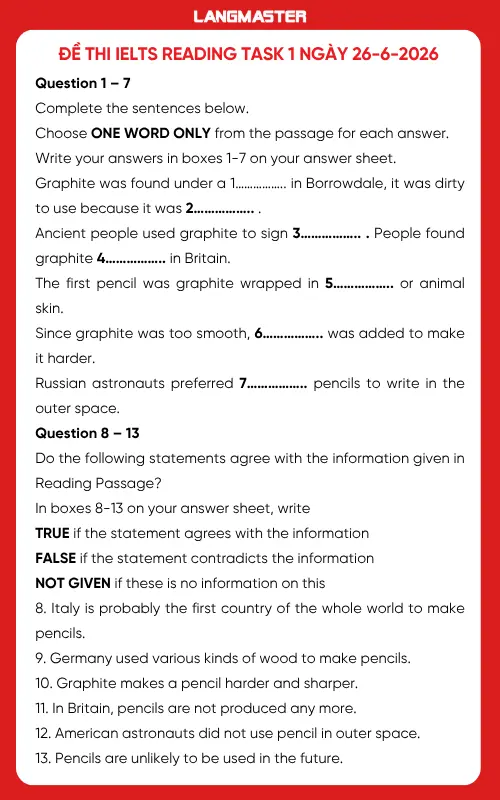
Question 1 – 7
Complete the sentences below.
Choose ONE WORD ONLY from the passage for each answer.
Write your answers in boxes 1-7 on your answer sheet.
Graphite was found under a 1…………….. in Borrowdale, it was dirty to use because it was 2…………….. .
Ancient people used graphite to sign 3…………….. . People found graphite 4…………….. in Britain.
The first pencil was graphite wrapped in 5…………….. or animal skin.
Since graphite was too smooth, 6…………….. was added to make it harder.
Russian astronauts preferred 7…………….. pencils to write in the outer space.
Question 8 – 13
Do the following statements agree with the information given in Reading Passage?
In boxes 8-13 on your answer sheet, write
TRUE if the statement agrees with the information
FALSE if the statement contradicts the information
NOT GIVEN if these is no information on this
8. Italy is probably the first country of the whole world to make pencils.
9. Germany used various kinds of wood to make pencils.
10. Graphite makes a pencil harder and sharper.
11. In Britain, pencils are not produced any more.
12. American astronauts did not use pencil in outer space.
13. Pencils are unlikely to be used in the future.
>> Xem thêm:
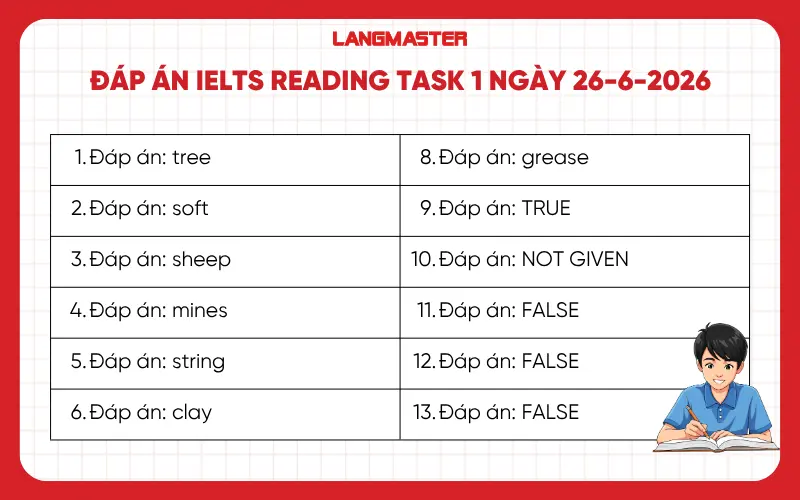
Question 1: Đáp án: tree
Dẫn chứng: "Graphite, the main material for producing pencil, was discovered in 1564 in Borrowdale in England when a lightning struck a local tree during a thunder. Local people found out that the black substance spotted at the root of the unlucky tree..."
Giải thích chi tiết: Đáp án là tree vì đoạn văn cho biết graphite được phát hiện sau khi tia sét đánh trúng một cái cây tại Borrowdale. Sau sự kiện này, người dân địa phương phát hiện chất màu đen nằm ở phần gốc cây. Câu hỏi yêu cầu hoàn thành câu "Graphite was found under a..." nên từ phù hợp nhất được lấy trực tiếp từ bài đọc là tree. Thí sinh cần chú ý dạng bài Sentence Completion thường paraphrase thông tin. Trong bài, cụm "at the root of the unlucky tree" được diễn đạt lại thành "found under a tree".
Từ vựng lưu ý:
lightning strike: sét đánh
root: rễ cây, gốc cây
substance: chất, vật chất
discover: phát hiện
Question 2: Đáp án: soft
Dẫn chứng: "It was soft, thus left marks everywhere."
Giải thích chi tiết: Đáp án là soft. Ngay sau khi được phát hiện, graphite được mô tả là rất mềm nên dễ để lại dấu vết trên nhiều bề mặt khác nhau. Câu hỏi paraphrase ý này thành "it was dirty to use" bởi vì việc để lại dấu vết khắp nơi khiến graphite trở nên khá bẩn và bất tiện khi sử dụng. Từ khóa quan trọng để xác định đáp án là "left marks everywhere" tương ứng với nguyên nhân là graphite quá soft.
Từ vựng lưu ý:
soft: mềm
leave marks: để lại dấu vết
thus: vì thế, do đó
everywhere: khắp nơi
Question 3: Đáp án: sheep
Dẫn chứng: "It was soon put to use by locals in marking their sheep for ownership and calculation."
Giải thích chi tiết: Đáp án là sheep. Bài đọc cho biết người dân địa phương nhanh chóng sử dụng graphite để đánh dấu cừu nhằm xác định quyền sở hữu. Trong câu hỏi, cụm "used graphite to sign..." là cách diễn đạt khác của "marking their sheep". Đây là dạng paraphrase rất phổ biến trong IELTS Reading, trong đó động từ mark được thay thế bằng sign hoặc identify.
Từ vựng lưu ý:
sheep: cừu
ownership: quyền sở hữu
mark: đánh dấu
calculation: tính toán
Question 4: Đáp án: mines
Dẫn chứng: "Britain turns out to be major country where mines of graphite can be detected and developed."
Giải thích chi tiết: Đáp án là mines. Đoạn văn đề cập rằng Anh là quốc gia lớn có thể phát hiện và khai thác các mỏ graphite. Câu hỏi viết lại thành "People found graphite ... in Britain", vì vậy danh từ phù hợp là mines. Thí sinh cần lưu ý không chọn graphite hay country vì yêu cầu ngữ pháp của câu hoàn chỉnh cần một danh từ chỉ nơi graphite được tìm thấy.
Từ vựng lưu ý:
mine: mỏ khoáng sản
detect: phát hiện
develop: khai thác, phát triển
major: lớn, quan trọng
Question 5: Đáp án: string
Dẫn chứng: "In Italy, graphite sticks were initially wrapped in string or sheepskin for stability..."
Giải thích chi tiết: Đáp án là string. Bài đọc giải thích rằng những cây bút chì đầu tiên thực chất là các thanh graphite được quấn bằng dây hoặc da cừu để tăng độ chắc chắn. Trong câu hỏi, cụm "animal skin" chính là cách paraphrase của từ sheepskin, do đó từ còn thiếu phải là string. Đây là một bẫy thường gặp khi IELTS đưa một phần đáp án vào câu hỏi dưới dạng từ đồng nghĩa.
Từ vựng lưu ý:
string: dây
sheepskin: da cừu
wrap: quấn, bọc
stability: sự ổn định
Question 6: Đáp án: clay
Dẫn chứng:
"The 'lead' of the pencil is actually a mix of finely ground graphite and clay powders."
"The more clay you put in, the higher hardness the core has."
Giải thích chi tiết: Đáp án là clay. Ngày nay lõi bút chì không chỉ chứa graphite mà còn được trộn thêm đất sét. Đất sét giúp tăng độ cứng của lõi bút chì và điều chỉnh các cấp độ đậm nhạt khác nhau. Câu hỏi diễn đạt lại thành "Since graphite was too smooth, ... was added to make it harder." Mặc dù bài đọc không dùng từ smooth mà nhấn mạnh vào độ mềm của graphite, thông tin về việc thêm clay để tăng độ cứng vẫn dẫn trực tiếp đến đáp án.
Từ vựng lưu ý:
clay: đất sét
hardness: độ cứng
graphite: than chì
finely ground: được nghiền mịn
Question 7: Đáp án: grease
Dẫn chứng: "It is widely known that astronauts in Russia used grease pencils..."
Giải thích chi tiết: Đáp án là grease. Đoạn văn nói rõ các phi hành gia Nga sử dụng grease pencils trong không gian vì chúng không gặp vấn đề gãy ngòi như bút chì thông thường. Trong khi đó, các phi hành gia Mỹ lại thích sử dụng bút chì cơ khí (mechanical pencils). Vì câu hỏi yêu cầu điền một từ duy nhất trước từ pencils, đáp án chính xác là grease.
Từ vựng lưu ý:
grease pencil: bút sáp dầu
astronaut: phi hành gia
outer space: không gian vũ trụ
mechanical pencil: bút chì kim
breakage: sự gãy vỡ, hỏng hóc
Question 8: Đáp án: TRUE
Dẫn chứng: "In Italy, graphite sticks were initially wrapped in string or sheepskin for stability, becoming perhaps the very first pencil in the world."
Giải thích chi tiết: Đáp án là TRUE vì bài đọc cho biết tại Ý, các thanh graphite được quấn bằng dây hoặc da cừu và trở thành "perhaps the very first pencil in the world" (có lẽ là cây bút chì đầu tiên trên thế giới). Từ perhaps trong bài tương ứng với từ probably trong câu hỏi. Do đó, ý nghĩa của câu hỏi hoàn toàn phù hợp với thông tin được cung cấp trong bài đọc. Đây là một ví dụ điển hình về dạng paraphrase trong IELTS Reading, khi perhaps được thay bằng probably nhưng không làm thay đổi nội dung.
Từ vựng lưu ý:
perhaps = probably: có lẽ
stability: sự ổn định
wrapped in: được quấn bằng
become: trở thành
Question 9: Đáp án: NOT GIVEN
Dẫn chứng: "Two wooden halves were carved, a graphite stick inserted, and the halves then glued together..."
Giải thích chi tiết: Đáp án là NOT GIVEN. Bài đọc chỉ đề cập rằng người Đức phát minh ra kỹ thuật ghép hai nửa gỗ lại với nhau để đặt lõi graphite vào bên trong. Tuy nhiên, không có bất kỳ thông tin nào cho biết họ sử dụng nhiều loại gỗ khác nhau để sản xuất bút chì. Câu hỏi đề cập đến "various kinds of wood" nhưng bài đọc hoàn toàn không nhắc đến số lượng hay chủng loại gỗ được sử dụng. Khi bài đọc không xác nhận cũng không phủ nhận thông tin được nêu trong câu hỏi, đáp án phải là NOT GIVEN.
Từ vựng lưu ý:
wooden halves: hai nửa miếng gỗ
carve: đục, chạm khắc
insert: đưa vào
glue together: dán lại với nhau
Question 10: Đáp án: FALSE
Dẫn chứng: "The more clay you put in, the higher hardness the core has."
Giải thích chi tiết: Đáp án là FALSE. Câu hỏi cho rằng graphite làm bút chì cứng hơn và sắc hơn. Tuy nhiên, bài đọc giải thích rõ rằng độ cứng của lõi bút chì phụ thuộc vào lượng clay (đất sét) được thêm vào chứ không phải graphite. Trên thực tế, graphite vốn là vật liệu mềm, đó chính là lý do người ta phải trộn thêm đất sét để tăng độ cứng. Như vậy thông tin trong câu hỏi trái ngược hoàn toàn với nội dung bài đọc.
Từ vựng lưu ý:
hardness: độ cứng
core: lõi
graphite: than chì
clay: đất sét
Question 11: Đáp án: FALSE
Dẫn chứng: "In England, pencils continue to be made from whole sawn graphite."
Giải thích chi tiết: Đáp án là FALSE. Câu hỏi cho rằng ở Anh hiện nay không còn sản xuất bút chì nữa. Tuy nhiên, bài đọc khẳng định rất rõ rằng việc sản xuất bút chì tại Anh vẫn tiếp tục diễn ra thông qua cụm từ "continue to be made". Đây là dấu hiệu cho thấy hoạt động sản xuất vẫn đang tồn tại. Vì vậy, nội dung câu hỏi mâu thuẫn trực tiếp với thông tin trong bài đọc.
Từ vựng lưu ý:
continue to be made: tiếp tục được sản xuất
whole sawn graphite: than chì nguyên khối đã được cắt
production: sản xuất
manufacture: chế tạo
Question 12: Đáp án: FALSE
Dẫn chứng: "But it is also a fact that their counterparts in the United States used pencils in the outer space before real zero gravity pencil was invented."
Giải thích chi tiết: Đáp án là FALSE. Bài đọc nêu rõ rằng các phi hành gia Mỹ đã sử dụng bút chì trong không gian trước khi loại bút chì dành riêng cho môi trường không trọng lực được phát minh. Họ chủ yếu sử dụng mechanical pencils (bút chì kim). Vì vậy, nhận định "American astronauts did not use pencil in outer space" hoàn toàn trái ngược với thông tin được cung cấp trong bài đọc.
Từ vựng lưu ý:
counterpart: đối tác, người tương ứng
mechanical pencil: bút chì kim
outer space: không gian vũ trụ
zero gravity: môi trường không trọng lực
Question 13: Đáp án: FALSE
Dẫn chứng: "A spectrum of users are likely to continue to use it into the future."
"The possibilities seem limitless."
Giải thích chi tiết: Đáp án là FALSE. Mặc dù bài đọc thừa nhận rằng thế giới ngày càng số hóa (digitalized world), tác giả lại cho rằng tương lai của bút chì không hề ảm đạm. Nhiều nhóm người như học sinh, họa sĩ, kiến trúc sư hay nhân viên phục vụ vẫn sẽ tiếp tục sử dụng bút chì trong tương lai. Cụm từ "likely to continue to use it into the future" cho thấy bút chì vẫn có triển vọng phát triển và duy trì vai trò của mình. Vì vậy, nhận định rằng bút chì khó có thể được sử dụng trong tương lai là trái ngược với quan điểm của tác giả.
Từ vựng lưu ý:
spectrum of users: nhiều nhóm người dùng khác nhau
digitalized world: thế giới số hóa
limitless: không giới hạn
prospect: triển vọng
bleak: ảm đạm, không khả quan
Jellyfish – The New Rulers of the Oceans
A. Jellyfish have become an increasing problem for beach destinations and coastal areas around the world. They are now present in nearly every ocean, from the icy Arctic to warm tropical waters. While many marine species face challenges adapting to environmental changes, jellyfish populations continue to grow steadily.
Although they appear harmless as they drift with ocean currents, jellyfish possess remarkable survival abilities. They do not have claws, teeth, or even a brain, yet their tentacles contain powerful stinging cells that help them capture prey and defend themselves. For this reason, jellyfish are considered some of the most feared but least understood creatures in marine ecosystems.
B. According to Dr. Monty Graham from the University of South Alabama, jellyfish can serve as important indicators of the health of coastal ecosystems. Rising jellyfish numbers often suggest that an ecosystem is experiencing environmental stress. While annual fluctuations may occur, long-term observations reveal a significant increase in jellyfish populations.
Scientific concern first intensified during the 1980s when vast numbers of Mnemiopsis leidyi, a jellyfish species native to the Atlantic Ocean, invaded the Black Sea. At the time, the ecosystem had already been weakened by excessive anchovy fishing. Researchers believe these jellyfish were accidentally transported by ships before multiplying rapidly and consuming both anchovy eggs and the plankton needed by young fish.
C. Although large jellyfish blooms can naturally occur in healthy oceans, scientists are increasingly documenting more severe and frequent outbreaks worldwide. Dr. Anthony Richardson of the University of Queensland explains that once jellyfish become established in a favorable environment, they can expand rapidly and outcompete other marine organisms. As a result, some marine ecosystems may gradually shift from being dominated by fish to being dominated by jellyfish.
D. A study conducted by Richardson and his colleagues examined the factors responsible for jellyfish population explosions and highlighted the urgent need for action. Their research indicates that several human activities contribute directly to this problem, including overfishing, nutrient pollution from fertilizers and sewage, and climate change.
Overfishing is considered one of the primary causes. The large-scale removal of fish from marine ecosystems has reduced natural controls on jellyfish populations. Small fish normally help regulate jellyfish numbers through both predation and competition for food resources. When fish populations decline, jellyfish are able to reproduce and spread more easily.
Another major factor is eutrophication, a process caused by excessive amounts of nitrogen and phosphorus entering the ocean through agricultural runoff and waste discharge. These nutrients encourage algae blooms, which lower oxygen levels in the water and create so-called “dead zones.” Such environments favor jellyfish because they require less oxygen than fish. While fish tend to avoid oxygen-poor waters, jellyfish can survive and even flourish under these conditions.
E. Researchers also suggest that climate change may allow jellyfish to expand beyond their traditional habitats. As ocean temperatures continue to rise, many tropical marine species are gradually moving toward the poles. Since numerous venomous jellyfish species originate in tropical regions, they may increasingly appear in densely populated subtropical and temperate coastal areas.
F. Once jellyfish become dominant within an ecosystem, fish populations often struggle to recover. By feeding on fish eggs and larvae, jellyfish reduce the chances of fish returning to previous population levels. Richardson describes this situation as two alternative stable states: one controlled by fish and the other controlled by jellyfish.
Unfortunately, ecosystems dominated by jellyfish are unable to support the nutritional needs of many marine animals, including larger fish, seabirds, and marine mammals. Consequently, when fish populations decline, the species that depend on them also suffer.
Scientists refer to this phenomenon as a “jellyfish monoculture.” Similar to how a diverse tropical forest loses biodiversity when replaced by a plantation of a single tree species, marine ecosystems lose ecological richness when jellyfish become the dominant organisms.
The impact is not limited to the environment. Large jellyfish populations also create serious economic problems. In the Gulf of Mexico, for example, shrimp fishermen have experienced substantial financial losses because enormous numbers of jellyfish clog and damage fishing nets.
G. Experts argue that a deeper understanding of jellyfish biology, including their feeding patterns and preferred environmental conditions, is essential for determining the exact causes of recent population increases and developing effective solutions.
Since restoring an ecosystem after jellyfish become dominant is extremely difficult, Richardson and his colleagues advocate a strategy of prevention rather than treatment. They recommend reducing overfishing, limiting the flow of fertilizers and sewage into the oceans, and addressing climate change wherever possible. Such measures may help prevent jellyfish from gaining even greater control over marine ecosystems in the future.
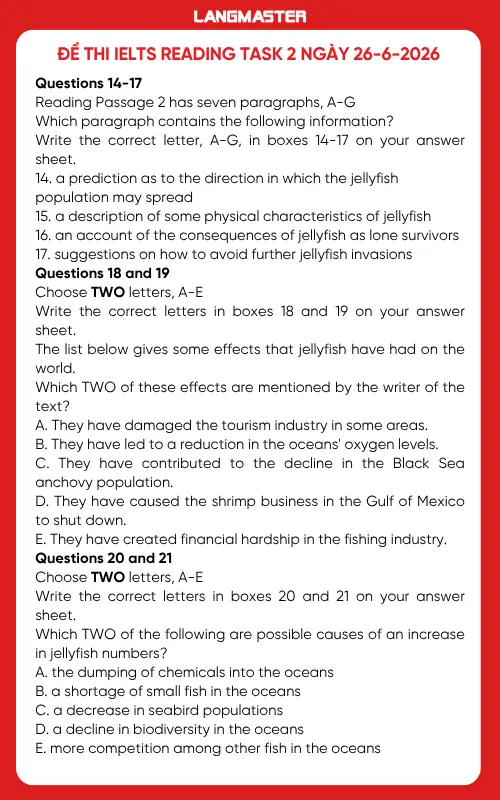
Questions 14-17
Reading Passage 2 has seven paragraphs, A-G
Which paragraph contains the following information?
Write the correct letter, A-G, in boxes 14-17 on your answer sheet.
14 a prediction as to the direction in which the jellyfish population may spread
15 a description of some physical characteristics of jellyfish
16 an account of the consequences of jellyfish as lone survivors
17 suggestions on how to avoid further jellyfish invasions
Questions 18 and 19
Choose TWO letters, A-E
Write the correct letters in boxes 18 and 19 on your answer sheet.
The list below gives some effects that jellyfish have had on the world.
Which TWO of these effects are mentioned by the writer of the text?
A They have damaged the tourism industry in some areas.
B They have led to a reduction in the oceans' oxygen levels.
C They have contributed to the decline in the Black Sea anchovy population.
D They have caused the shrimp business in the Gulf of Mexico to shut down.
E They have created financial hardship in the fishing industry.
Questions 20 and 21
Choose TWO letters, A-E
Write the correct letters in boxes 20 and 21 on your answer sheet.
Which TWO of the following are possible causes of an increase in jellyfish numbers?
A the dumping of chemicals into the oceans
B a shortage of small fish in the oceans
C a decrease in seabird populations
D a decline in biodiversity in the oceans
E more competition among other fish in the oceans
Questions 22-26
Complete the sentences below.
Choose NO MORE THAN TWO WORDS from the passage for each answer.
Write your answers in boxes 22-26 on your answer sheet.
22 Some fish in the oceans may be unable to sustain their population as the jellyfish eat their......
23 The state of jellyfish becoming the main ocean species has been named......
24 Increasing numbers of jellyfish can damage...... used for commercial fishing.
25 Understanding basic facts about jellyfish, such as the...... of the ocean which suits them best, may help control their numbers.
26 Richardson believes it is better to direct attention to...... instead of just trying to solve existing problems.
>> Xem thêm:
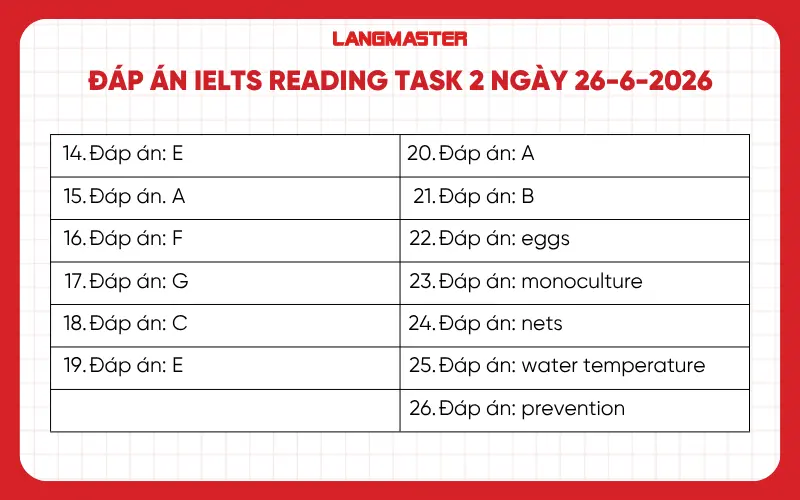
Question 14: Đáp án: E
Dẫn chứng: "As water warms, tropical species are moving towards the poles. Many venomous jellyfish species are tropical and could move into more densely populated subtropical and temperate regions."
Giải thích chi tiết: Đáp án là E vì đoạn E đưa ra dự đoán về hướng mở rộng phạm vi phân bố của sứa trong tương lai. Tác giả cho rằng hiện tượng nóng lên toàn cầu đang khiến nhiệt độ đại dương tăng lên, kéo theo sự dịch chuyển của nhiều loài sinh vật biển từ vùng nhiệt đới về phía các cực. Các loài sứa có độc vốn sinh sống ở vùng nhiệt đới cũng có thể xuất hiện ngày càng nhiều tại các khu vực cận nhiệt đới và ôn đới đông dân cư. Câu hỏi sử dụng cụm từ a prediction as to the direction in which the jellyfish population may spread, trong khi bài đọc diễn đạt bằng cụm moving towards the poles và could move into. Đây là một dạng paraphrase rất phổ biến trong IELTS Reading. Thí sinh cần chú ý các từ khóa như prediction, spread, move into và towards the poles.
Từ vựng lưu ý:
tropical species: loài nhiệt đới
temperate regions: vùng ôn đới
move towards: di chuyển về phía
geographical range: phạm vi phân bố
Question 15: Đáp án: A
Dẫn chứng: "They lack sharp claws, piercing teeth or even a brain. Despite this, they are armed with an amazing arsenal of weapons, especially the stinging power of their tentacles."
Giải thích chi tiết: Đáp án là A. Ngay trong đoạn mở đầu, tác giả mô tả nhiều đặc điểm vật lý của sứa như không có móng vuốt sắc nhọn, không có răng nhọn và thậm chí không có não bộ. Tuy nhiên, chúng sở hữu các xúc tu có khả năng gây đau nhờ các tế bào chích độc. Đây chính là phần mô tả về đặc điểm hình thái và cấu tạo cơ thể của sứa mà câu hỏi yêu cầu. Cụm từ physical characteristics được paraphrase thông qua việc liệt kê các bộ phận cơ thể của sứa như claws, teeth, brain và tentacles.
Từ vựng lưu ý:
physical characteristics: đặc điểm thể chất
piercing teeth: răng sắc nhọn
tentacle: xúc tu
stinging power: khả năng gây đau bằng nọc độc
Question 16: Đáp án: F
Dẫn chứng:
"Unfortunately, where there is a jellyfish-dominated state then this does not support the nutritional needs of other fish, marine mammals, and seabirds.”
"In other words an ecosystem that loses fish also loses the species that depend on fish for survival."
Giải thích chi tiết: Đáp án là F. Đoạn F tập trung mô tả những hậu quả xảy ra khi sứa trở thành loài thống trị trong hệ sinh thái biển. Khi số lượng cá suy giảm và sứa chiếm ưu thế, nhiều loài động vật khác như chim biển, động vật có vú dưới biển và các loài cá lớn cũng bị ảnh hưởng do mất nguồn thức ăn. Câu hỏi dùng cụm từ lone survivors để chỉ tình trạng sứa trở thành nhóm sinh vật thống trị sau khi các loài khác suy giảm mạnh. Nội dung này hoàn toàn tương ứng với khái niệm jellyfish-dominated state được đề cập trong đoạn F.
Từ vựng lưu ý:
dominate: thống trị
nutritional needs: nhu cầu dinh dưỡng
marine mammals: động vật có vú dưới biển
depend on: phụ thuộc vào
Question 17: Đáp án: G
Dẫn chứng: "They recommend a halt to overfishing small fish that are vital to keeping jellyfish in check, reducing the amount of fertilizer and sewage running off into the oceans, and finally, if possible, confronting climate change."
Giải thích chi tiết: Đáp án là G. Đây là đoạn cuối của bài đọc, nơi các nhà khoa học đưa ra các giải pháp nhằm ngăn chặn sự bùng nổ của quần thể sứa trong tương lai. Các biện pháp được đề xuất bao gồm giảm đánh bắt quá mức, hạn chế lượng phân bón và nước thải đổ ra biển, đồng thời giải quyết vấn đề biến đổi khí hậu. Câu hỏi yêu cầu tìm đoạn chứa suggestions on how to avoid further jellyfish invasions, và toàn bộ đoạn G chính là phần đưa ra khuyến nghị để phòng ngừa thay vì chỉ xử lý hậu quả.
Từ vựng lưu ý:
recommendation: khuyến nghị
overfishing: đánh bắt quá mức
run-off: dòng chảy mang chất thải
prevention rather than cure: phòng bệnh hơn chữa bệnh
Question 18: Đáp án: C
Dẫn chứng: "Scientists believe that this species of jellyfish came in on the bottom of a ship and then rapidly multiplied, feeding on anchovy eggs and the plankton that young fish rely on."
Giải thích chi tiết: Đáp án là C. Bài đọc cho biết loài sứa Mnemiopsis leidyi đã xâm nhập vào Biển Đen và ăn trứng cá cơm (anchovy eggs) cũng như sinh vật phù du cần thiết cho sự phát triển của cá non. Điều này góp phần làm suy giảm quần thể cá cơm trong khu vực. Mặc dù tác giả không trực tiếp nói rằng sứa là nguyên nhân duy nhất khiến số lượng cá cơm giảm, nhưng cụm từ feeding on anchovy eggs cho thấy chúng đã góp phần vào sự suy giảm đó. Từ khóa quan trọng là contributed to the decline, bởi bài đọc mô tả tác động gián tiếp chứ không khẳng định hoàn toàn.
Từ vựng lưu ý:
anchovy: cá cơm
multiply rapidly: sinh sôi nhanh chóng
rely on: phụ thuộc vào
contribute to: góp phần và
Question 19: Đáp án: E
Dẫn chứng:
"One result of large jellyfish populations is the economic effect it has had on the fishing industry.”
"Resulting in millions of dollars in losses."
Giải thích chi tiết: Đáp án là E. Đoạn F đề cập rõ ràng rằng sự gia tăng mạnh của quần thể sứa đã gây ra những tổn thất kinh tế nghiêm trọng cho ngành đánh bắt thủy sản. Tại Vịnh Mexico, ngư dân đánh bắt tôm gặp nhiều khó khăn khi sứa làm đầy lưới, khiến lưới bị hư hỏng và gây thiệt hại lên tới hàng triệu đô la. Đây chính là minh chứng cho việc sứa gây ra financial hardship (khó khăn tài chính) đối với ngành đánh bắt cá. Câu hỏi sử dụng cụm từ financial hardship, trong khi bài đọc diễn đạt bằng millions of dollars in losses.
Từ vựng lưu ý:
economic effect: tác động kinh tế
fishing industry: ngành thủy sản
financial hardship: khó khăn tài chính
loss: tổn thất, thiệt hại
Question 20: Đáp án: A
Dẫn chứng: "Jellyfish outbreaks are linked directly to human actions, including overfishing, the input of fertilizer and sewage into the ocean, and climate change."
Giải thích chi tiết: Đáp án là A. Bài đọc cho biết sự bùng nổ số lượng sứa có liên quan trực tiếp đến việc phân bón và nước thải được đưa vào đại dương. Mặc dù đáp án không sử dụng chính xác cụm từ fertilizer and sewage, phương án A diễn đạt lại bằng cụm the dumping of chemicals into the oceans. Đây là một hình thức paraphrase khá phổ biến trong IELTS Reading, khi các chất gây ô nhiễm như phân bón và nước thải được khái quát hóa thành chemicals. Việc các chất này đổ ra biển dẫn đến hiện tượng phú dưỡng (eutrophication), tạo điều kiện thuận lợi cho sứa phát triển mạnh.
Từ vựng lưu ý:
sewage: nước thải
fertilizer: phân bón
eutrophication: hiện tượng phú dưỡng
be linked to: có liên quan đến
Question 21: Đáp án: B
Dẫn chứng:
"This is because small fish appear to keep jellyfish in check by predation and competition."
"So, once we remove fish, jellyfish can proliferate."
Giải thích chi tiết: Đáp án là B. Bài đọc giải thích rằng các loài cá nhỏ đóng vai trò kiểm soát số lượng sứa thông qua việc săn mồi và cạnh tranh thức ăn. Khi số lượng cá nhỏ suy giảm do đánh bắt quá mức, sứa mất đi các đối thủ cạnh tranh và thiên địch tự nhiên nên có thể sinh sôi nhanh chóng. Cụm từ a shortage of small fish trong câu hỏi tương ứng với tình huống remove fish được đề cập trong bài đọc. Đây là một nguyên nhân trực tiếp dẫn đến sự gia tăng số lượng sứa.
Từ vựng lưu ý:
keep in check: kiểm soát
predation: sự săn mồi
competition: cạnh tranh
proliferate: sinh sôi, phát triển mạnh
Question 22: Đáp án: eggs
Dẫn chứng: "By feeding on fish eggs, the jellyfish successfully prevent fish from returning to their normal population numbers."
Giải thích chi tiết: Đáp án là eggs. Đoạn F giải thích rằng sứa ăn trứng cá, từ đó ngăn cản các quần thể cá phục hồi số lượng ban đầu. Câu hỏi paraphrase ý này thành "may be unable to sustain their population", nghĩa là cá không thể duy trì hoặc khôi phục số lượng của mình. Từ cần điền là danh từ trực tiếp xuất hiện trong bài đọc.
Từ vựng lưu ý:
fish eggs: trứng cá
population numbers: quy mô quần thể
sustain: duy trì
prevent: ngăn cản
Question 23: Đáp án: monoculture
Dẫn chứng: "This state has been defined as a 'monoculture of jellyfish'."
Giải thích chi tiết: Đáp án là monoculture. Bài đọc sử dụng thuật ngữ monoculture of jellyfish để mô tả tình trạng sứa trở thành loài chiếm ưu thế trong hệ sinh thái biển. Trong câu hỏi, cụm "the state of jellyfish becoming the main ocean species" chính là cách diễn đạt lại của khái niệm này. Vì yêu cầu chỉ điền tối đa hai từ và câu hỏi hỏi về tên gọi của hiện tượng nên từ chính xác nhất là monoculture.
Từ vựng lưu ý:
monoculture: hệ sinh thái chỉ bị chi phối bởi một loài
biodiversity: đa dạng sinh học
dominant species: loài thống trị
ecosystem: hệ sinh thái
Question 24: Đáp án: nets
Dẫn chứng: "A jellyfish boom that fills nets, causing them to break and resulting in millions of dollars in losses."
Giải thích chi tiết: Đáp án là nets. Bài đọc đề cập đến việc số lượng sứa tăng mạnh tại Vịnh Mexico khiến các tấm lưới đánh cá bị đầy sứa, thậm chí bị rách và hư hỏng. Câu hỏi paraphrase cụm "fills nets, causing them to break" thành "damage ... used for commercial fishing". Danh từ phù hợp nhất cần điền là nets.
Từ vựng lưu ý:
net: lưới đánh cá
commercial fishing: đánh bắt thương mại
break: làm hỏng, làm rách
loss: tổn thất
Question 25: Đáp án: water temperature
Dẫn chứng: "Experts say that a greater understanding of jellyfish, including their ideal water temperature and feeding habits..."
Giải thích chi tiết: Đáp án là water temperature. Trong đoạn G, các chuyên gia cho rằng việc hiểu rõ nhiệt độ nước lý tưởng cùng với tập tính kiếm ăn của sứa sẽ giúp xác định nguyên nhân của các đợt bùng phát và tìm ra biện pháp kiểm soát hiệu quả. Câu hỏi diễn đạt lại bằng cụm "the ... of the ocean which suits them best", tương ứng với ideal water temperature trong bài đọc.
Từ vựng lưu ý:
ideal: lý tưởng
water temperature: nhiệt độ nước
feeding habits: tập tính ăn uống
determine: xác định
Question 26: Đáp án: prevention
Dẫn chứng: "Richardson and his colleagues propose focusing on 'prevention rather than cure'."
Giải thích chi tiết: Đáp án là prevention. Ở phần kết của bài đọc, Richardson nhấn mạnh rằng việc ngăn ngừa sự bùng nổ của sứa sẽ hiệu quả hơn nhiều so với việc xử lý hậu quả sau khi chúng đã thống trị hệ sinh thái. Câu hỏi paraphrase cụm "prevention rather than cure" thành "direct attention to ... instead of just trying to solve existing problems". Vì vậy, từ cần điền là prevention.
Từ vựng lưu ý:
prevention: sự phòng ngừa
cure: giải pháp khắc phục
focus on: tập trung vào
rather than: thay vì
| Học mãi mà IELTS không lên band? Học thử IELTS miễn phí cùng giáo viên 7.5+, chấm chữa lỗi sai ngay lập tức. 👉 Đăng ký học thử miễn phí ngay |
Mechanisms of Linguistic Change
A. The changes that have caused the most disagreement are those in pronunciation. We have various sources of evidence for the pronunciations of earlier times, such as the spellings, the treatment of words borrowed from other languages or borrowed by them, the descriptions of contemporary grammarians and spelling-reformers, and the modern pronunciations in all the languages and dialects concerned From the middle of the sixteenth century, there are in England writers who attempt to describe the position of the speech-organs for the production of English phonemes, and who invent what are in effect systems of phonetic symbols. These various kinds of evidence, combined with a knowledge of the mechanisms of speech-production, can often give us a very good idea of the pronunciation of an earlier age, though absolute certainty is never possible.
B. When we study the pronunciation of a language over any period of a few generations or more, we find there are always large-scale regularities in the changes: for example, over a certain period of time, just about all the long [a:] vowels in a language may change into long [e:] vowels, or all the [b] consonants in a certain position (for example at the end of a word) may change into [p] consonants. Such regular changes are often called sound laws. There are no universal sound laws (even though sound laws often reflect universal tendencies), but simply particular sound laws for one given language (or dialect) at one given period.
C. It is also possible that fashion plays a part in the process of change. It certainly plays a part in the spread of change: one person imitates another, and people with the most prestige are most likely to be imitated, so that a change that takes place in one social group may be imitated (more or less accurately) by speakers in another group. When a social group goes up or down in the world, its pronunciation of Russian, which had formerly been considered desirable, became on the contrary an undesirable kind of accent to have, so that people tried to disguise it. Some of the changes in accepted English pronunciation in the seventeenth and eighteenth centuries have been shown to consist in the replacement of one style of pronunciation by another style already existing, and it is likely that such substitutions were a result of the great social changes of the period: the increased power and wealth of the middle classes, and their steady infiltration upwards into the ranks of the landed gentry, probably carried elements of middle-class pronunciation into upper-class speech.
D. A less specific variant of the argument is that the imitation of children is imperfect: they copy their parents’ speech, but never reproduce it exactly. This is true, but it is also true that such deviations from adult speech are usually corrected in later childhood. Perhaps it is more significant that even adults show a certain amount of random variation in their pronunciation of a given phoneme, even if the phonetic context is kept unchanged. This, however, cannot explain changes in pronunciation unless it can be shown that there is some systematic trend in the failures of imitation: if they are merely random deviations they will cancel one another out and there will be no net change in the language.
E. One such force which is often invoked is the principle of ease, or minimization of effort. The change from fussy to fuzzy would be an example of assimilation, which is a very common kind of change. Assimilation is the changing of a sound under the influence of a neighbouring one. For example, the word scant was once skamt, but the /m/ has been changed to /n/ under the influence of the following /t/. Greater efficiency has hereby been achieved, because /n/ and /t/ are articulated in the same place (with the tip of the tongue against the teeth-ridge), whereas /m/ is articulated elsewhere (with the two lips). So the place of articulation of the nasal consonant has been changed to conform with that of the following plosive. A more recent example of the same kind of thing is the common pronunciation of football as football.
F. Assimilation is not the only way in which we change our pronunciation in order to increase efficiency. It is very common for consonants to be lost at the end of a word: in Middle English, word-final [-n] was often lost in unstressed syllables, so that baken ‘to bake’ changed from [‘ba:kan] to [‘ba:k3], and later to [ba:k]. Consonant-clusters are often simplified. At one time there was a [t] in words like castle and Christmas, and an initial [k] in words like knight and know. Sometimes a whole syllable is dropped out when two successive syllables begin with the same consonant (haplology): a recent example is temporary, which in Britain is often pronounced as if it were tempory.
>> Xem thêm: Giải đề Cam 17 Test 2 Insight or evolution IELTS Reading
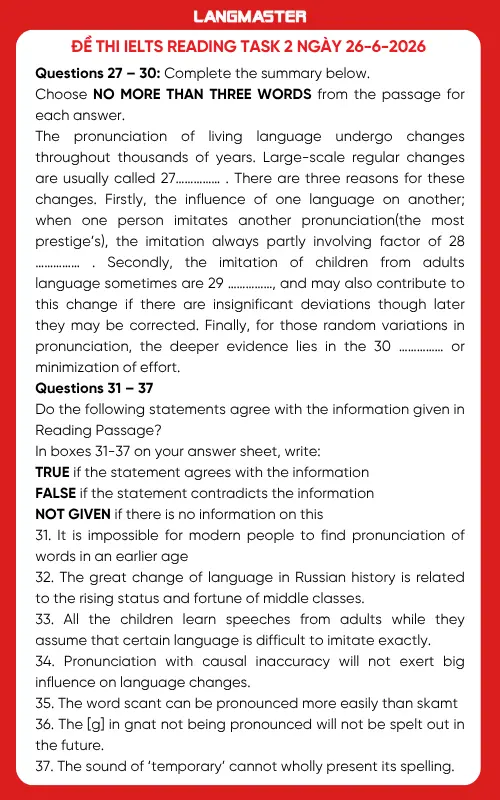
Questions 27 – 30
Complete the summary below.
Choose NO MORE THAN THREE WORDS from the passage for each answer.
The pronunciation of living language undergo changes throughout thousands of years. Large-scale regular changes are usually called 27…………… . There are three reasons for these changes. Firstly, the influence of one language on another; when one person imitates another pronunciation(the most prestige’s), the imitation always partly involving factor of 28 …………… . Secondly, the imitation of children from adults language sometimes are 29 ……………, and may also contribute to this change if there are insignificant deviations though later they may be corrected. Finally, for those random variations in pronunciation, the deeper evidence lies in the 30 …………… or minimization of effort.
Questions 31 – 37
Do the following statements agree with the information given in Reading Passage?
In boxes 31-37 on your answer sheet, write:
TRUE if the statement agrees with the information
FALSE if the statement contradicts the information
NOT GIVEN if there is no information on this
31. It is impossible for modern people to find pronunciation of words in an earlier age
32. The great change of language in Russian history is related to the rising status and fortune of middle classes.
33. All the children learn speeches from adults while they assume that certain language is difficult to imitate exactly.
34. Pronunciation with causal inaccuracy will not exert big influence on language changes.
35. The word scant can be pronounced more easily than skamt
36. The [g] in gnat not being pronounced will not be spelt out in the future.
37. The sound of ‘temporary’ cannot wholly present its spelling.
Questions 38 – 40
Look at the following sentences and the list of statements below. Match each statement with the correct sentence, A-D.
Write the correct letter, A-D, in boxes 38-40 on your answer sheet.
A. Since the speakers can pronounce it with less effort
B. Assimilation of a sound under the influence of a neighbouring one
C. It is a trend for changes in pronunciation in a large scale in a given period
D. Because the speaker can pronounce [n] and [t] both in the same time
38. As a consequence, ‘b’ will be pronounced as
39. The pronunciation of [mt] changed to [nt]
40. The omit of ‘t” in the sound of Christmas
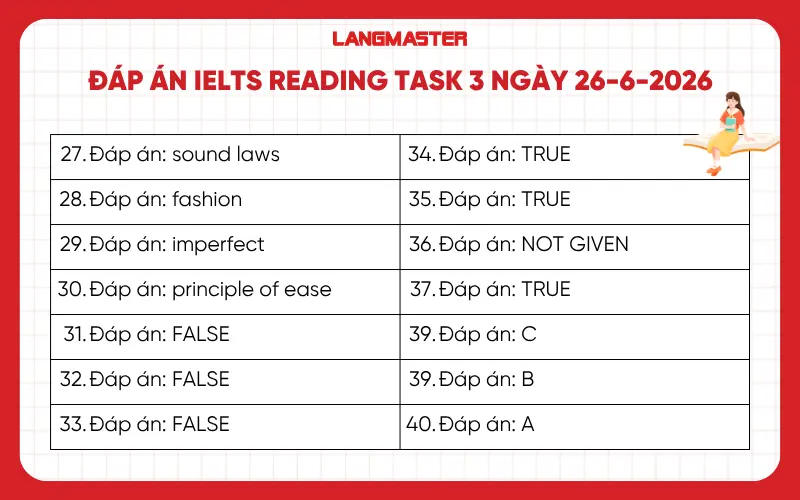
Question 27: Đáp án: sound laws
Dẫn chứng: "Such regular changes are often called sound laws." (Paragraph B)
Giải thích chi tiết: Đáp án là sound laws. Trong đoạn B, tác giả giải thích rằng khi nghiên cứu sự thay đổi cách phát âm của một ngôn ngữ qua nhiều thế hệ, người ta nhận thấy những biến đổi mang tính hệ thống và lặp lại trên quy mô lớn. Những thay đổi này được gọi là sound laws. Câu hỏi paraphrase cụm "large-scale regular changes" thành chính nội dung được trình bày trong bài đọc. Đây là một thuật ngữ quan trọng trong ngôn ngữ học lịch sử dùng để chỉ những quy luật biến đổi âm thanh diễn ra một cách có hệ thống trong một ngôn ngữ hoặc phương ngữ nhất định.
Từ vựng lưu ý:
sound law: quy luật biến đổi âm thanh
pronunciation: phát âm
regular change: sự thay đổi có tính quy luật
dialect: phương ngữ
Question 28: Đáp án: fashion
Dẫn chứng: "It is also possible that fashion plays a part in the process of change. It certainly plays a part in the spread of change: one person imitates another..." (Paragraph C)
Giải thích chi tiết: Đáp án là fashion. Đoạn C cho rằng thời trang ngôn ngữ hoặc xu hướng xã hội có thể đóng vai trò trong quá trình thay đổi cách phát âm. Khi một người bắt chước cách phát âm của người khác, đặc biệt là những người có địa vị hoặc uy tín cao trong xã hội, sự thay đổi đó có thể lan rộng sang các nhóm xã hội khác. Câu hỏi mô tả hiện tượng một người bắt chước cách phát âm của người khác và yêu cầu xác định yếu tố liên quan đến quá trình này. Từ khóa imitates another pronunciation dẫn trực tiếp đến ý tưởng fashion plays a part trong bài đọc.
Từ vựng lưu ý:
fashion: xu hướng, mốt
prestige: uy tín, địa vị
imitate: bắt chước
social group: tầng lớp xã hội
Question 29: Đáp án: imperfect
Dẫn chứng: "A less specific variant of the argument is that the imitation of children is imperfect: they copy their parents' speech, but never reproduce it exactly." (Paragraph D)
Giải thích chi tiết: Đáp án là imperfect. Đoạn D đề cập đến giả thuyết cho rằng trẻ em không hoàn toàn tái tạo chính xác cách phát âm của cha mẹ. Mặc dù chúng cố gắng bắt chước ngôn ngữ của người lớn, vẫn luôn tồn tại những khác biệt nhỏ trong quá trình sao chép. Câu hỏi paraphrase trực tiếp nội dung này thành "the imitation of children from adults language sometimes are...". Vì vậy từ cần điền là imperfect. Tuy nhiên tác giả cũng lưu ý rằng phần lớn những sai lệch này thường được sửa chữa khi trẻ lớn lên.
Từ vựng lưu ý:
imperfect: không hoàn hảo
reproduce: tái tạo
deviation: sự sai lệch
adult speech: lời nói của người lớn
Question 30: Đáp án: principle of ease
Dẫn chứng: "One such force which is often invoked is the principle of ease, or minimization of effort." (Paragraph E)
Giải thích chi tiết: Đáp án là principle of ease. Trong đoạn E, tác giả đưa ra lời giải thích sâu hơn cho những biến đổi trong cách phát âm bằng nguyên lý tiết kiệm công sức khi nói. Theo nguyên lý này, con người có xu hướng điều chỉnh âm thanh để việc phát âm trở nên dễ dàng và hiệu quả hơn. Câu hỏi đã paraphrase trực tiếp cụm "principle of ease" bằng phần sau của câu là "or minimization of effort". Vì yêu cầu lấy từ trong bài đọc và không quá ba từ, đáp án chính xác là principle of ease.
Từ vựng lưu ý:
principle of ease: nguyên lý tối giản nỗ lực phát âm
minimization of effort: giảm thiểu công sức
assimilation: đồng hóa âm
speech production: quá trình tạo ra âm thanh lời nói
Question 31: Đáp án: FALSE
Dẫn chứng: "These various kinds of evidence, combined with a knowledge of the mechanisms of speech-production, can often give us a very good idea of the pronunciation of an earlier age, though absolute certainty is never possible." (Paragraph A)
Giải thích chi tiết: Đáp án là FALSE. Câu hỏi cho rằng con người hiện đại không thể xác định được cách phát âm của từ ngữ trong quá khứ. Tuy nhiên, đoạn A khẳng định các nhà ngôn ngữ học có thể sử dụng nhiều nguồn bằng chứng khác nhau như cách viết, từ vay mượn, mô tả của các nhà ngữ pháp học và các phương ngữ hiện đại để tái dựng tương đối chính xác cách phát âm trước đây. Mặc dù tác giả thừa nhận rằng không thể đạt được sự chắc chắn tuyệt đối (absolute certainty is never possible), điều đó không có nghĩa là việc xác định phát âm trong quá khứ là bất khả thi. Đây là dạng bẫy thường gặp khi IELTS biến đổi từ "không hoàn toàn chắc chắn" thành "không thể".
Từ vựng lưu ý:
absolute certainty: sự chắc chắn tuyệt đối
evidence: bằng chứng
earlier age: thời kỳ trước đây
speech-production: quá trình tạo âm
Question 32: Đáp án: FALSE
Dẫn chứng: "The increased power and wealth of the middle classes, and their steady infiltration upwards into the ranks of the landed gentry, probably carried elements of middle-class pronunciation into upper-class speech." (Paragraph C)
Giải thích chi tiết: Đáp án là FALSE. Đoạn C nói về những thay đổi trong cách phát âm tiếng Anh vào thế kỷ XVII và XVIII khi tầng lớp trung lưu ngày càng giàu có và có ảnh hưởng hơn. Tuy nhiên, câu hỏi lại đề cập đến Russian history. Bài đọc chỉ nhắc đến tiếng Nga như một ví dụ về loại giọng từng được coi là đáng mong muốn rồi sau đó mất đi vị thế xã hội, chứ không hề nói sự thay đổi lớn trong lịch sử ngôn ngữ Nga có liên quan đến tầng lớp trung lưu. Vì vậy, thông tin trong câu hỏi không phù hợp với nội dung bài đọc.
Từ vựng lưu ý:
middle classes: tầng lớp trung lưu
wealth: sự giàu có
infiltration: sự thâm nhập
upper-class speech: cách nói của tầng lớp thượng lưu
Question 33: Đáp án: FALSE
Dẫn chứng: "They copy their parents' speech, but never reproduce it exactly." (Paragraph D)
Giải thích chi tiết: Đáp án là FALSE. Đoạn D chỉ nói rằng trẻ em bắt chước lời nói của cha mẹ nhưng không thể tái tạo hoàn toàn chính xác. Tuy nhiên, câu hỏi khẳng định rằng all the children đều học ngôn ngữ từ người lớn đồng thời nhận thức được việc bắt chước chính xác là khó khăn. Bài đọc không đề cập đến việc trẻ em có nhận thức như vậy, cũng không sử dụng từ mang tính tuyệt đối như all. Đây là trường hợp thông tin trong câu hỏi bị diễn giải quá mức so với nội dung thực tế.
Từ vựng lưu ý:
reproduce exactly: tái tạo chính xác
imitation: sự bắt chước
deviation: sai lệch
assumption: giả định
Question 34: Đáp án: TRUE
Dẫn chứng: "If they are merely random deviations they will cancel one another out and there will be no net change in the language." (Paragraph D)
Giải thích chi tiết: Đáp án là TRUE. Tác giả giải thích rằng những sai lệch ngẫu nhiên trong cách phát âm thường triệt tiêu lẫn nhau và không tạo ra sự thay đổi đáng kể trong ngôn ngữ. Điều này hoàn toàn tương ứng với nhận định rằng những lỗi phát âm mang tính ngẫu nhiên sẽ không gây ảnh hưởng lớn đến sự biến đổi của ngôn ngữ. Từ khóa quan trọng là random deviations và no net change, cho thấy tác động tổng thể bằng không.
Từ vựng lưu ý:
random deviation: sai lệch ngẫu nhiên
cancel out: triệt tiêu
net change: thay đổi tổng thể
pronunciation variation: biến thể phát âm
Question 35: Đáp án: TRUE
Dẫn chứng: "Greater efficiency has hereby been achieved, because /n/ and /t/ are articulated in the same place..." (Paragraph E)
Giải thích chi tiết: Đáp án là TRUE. Đoạn E giải thích rằng từ skamt dần biến thành scant do hiện tượng đồng hóa âm (assimilation). Âm /m/ được thay thế bằng âm /n/ vì /n/ và /t/ được phát âm ở cùng vị trí trong khoang miệng, giúp việc phát âm trở nên hiệu quả và dễ dàng hơn. Vì vậy, cách phát âm scant thực sự thuận tiện hơn skamt. Đây chính là ví dụ minh họa cho nguyên lý tiết kiệm công sức phát âm (principle of ease).
Từ vựng lưu ý:
efficiency: hiệu quả
articulate: phát âm
assimilation: đồng hóa âm
place of articulation: vị trí cấu âm
Question 36: Đáp án: NOT GIVEN
Dẫn chứng: "At one time there was a [t] in words like castle and Christmas, and an initial [k] in words like knight and know." (Paragraph F)
Giải thích chi tiết: Đáp án là NOT GIVEN. Bài đọc chỉ cho biết trong quá khứ các từ như knight và know từng phát âm âm /k/ đầu từ, nhưng hiện nay âm đó đã bị lược bỏ trong phát âm. Tuy nhiên, tác giả không đưa ra bất kỳ thông tin nào về việc cách viết của những từ này có thay đổi trong tương lai hay không. Câu hỏi đề cập đến vấn đề chính tả trong tương lai (will not be spelt out in the future), trong khi bài đọc hoàn toàn không nhắc tới điều này.
Từ vựng lưu ý:
spelling: chính tả
omit: lược bỏ
initial consonant: phụ âm đầu
future change: thay đổi trong tương lai
Question 37: Đáp án: TRUE
Dẫn chứng: "A recent example is temporary, which in Britain is often pronounced as if it were tempory." (Paragraph F)
Giải thích chi tiết: Đáp án là TRUE. Đoạn F cho biết từ temporary trong tiếng Anh Anh thường được phát âm như tempory, tức là một âm tiết đã bị lược bỏ trong lời nói. Điều này cho thấy cách phát âm không còn phản ánh đầy đủ cách viết ban đầu của từ. Câu hỏi diễn đạt lại hiện tượng này bằng nhận định rằng âm thanh của từ temporary không thể thể hiện hoàn toàn cách đánh vần của nó. Nội dung này hoàn toàn phù hợp với thông tin trong bài đọc.
Từ vựng lưu ý:
syllable: âm tiết
haplology: hiện tượng lược bỏ âm tiết
pronunciation: phát âm
Question 38: Đáp án: C
Dẫn chứng: "All the [b] consonants in a certain position may change into [p] consonants." (Paragraph B)
Giải thích chi tiết: Đáp án là C. Đoạn B mô tả sự thay đổi hàng loạt của một âm trong một giai đoạn nhất định, ví dụ âm /b/ chuyển thành /p/. Đây chính là xu hướng thay đổi phát âm trên quy mô lớn trong một khoảng thời gian xác định, tương ứng với mô tả ở phương án C.
Question 39: Đáp án: B
Dẫn chứng: "The word scant was once skamt, but the /m/ has been changed to /n/ under the influence of the following /t/." (Paragraph E)
Giải thích chi tiết: Đáp án là B. Sự thay đổi từ /mt/ thành /nt/ là ví dụ điển hình của hiện tượng assimilation, tức là một âm thay đổi dưới ảnh hưởng của âm đứng cạnh nó. Trong trường hợp này, âm /m/ chịu ảnh hưởng của âm /t/ phía sau và chuyển thành /n/.
Question 40: Đáp án: A
Dẫn chứng:
"Consonant-clusters are often simplified."
"At one time there was a [t] in words like castle and Christmas." (Paragraph F)
Giải thích chi tiết: Đáp án là A. Âm /t/ trong từ Christmas dần biến mất vì người nói có xu hướng đơn giản hóa cụm phụ âm để phát âm dễ dàng hơn. Điều này phản ánh nguyên lý tiết kiệm công sức khi nói (less effort), phù hợp với phương án A. Việc lược bỏ phụ âm là một dạng biến đổi phát âm rất phổ biến trong lịch sử ngôn ngữ.
IELTS Reading là một trong những kỹ năng khiến nhiều thí sinh mất điểm do hạn chế về từ vựng học thuật, khả năng paraphrase và kỹ năng xử lý các dạng câu hỏi phức tạp. Không ít người học dành nhiều thời gian luyện đề nhưng vẫn gặp khó khăn trong việc xác định từ khóa, tìm đáp án chính xác và quản lý thời gian làm bài.
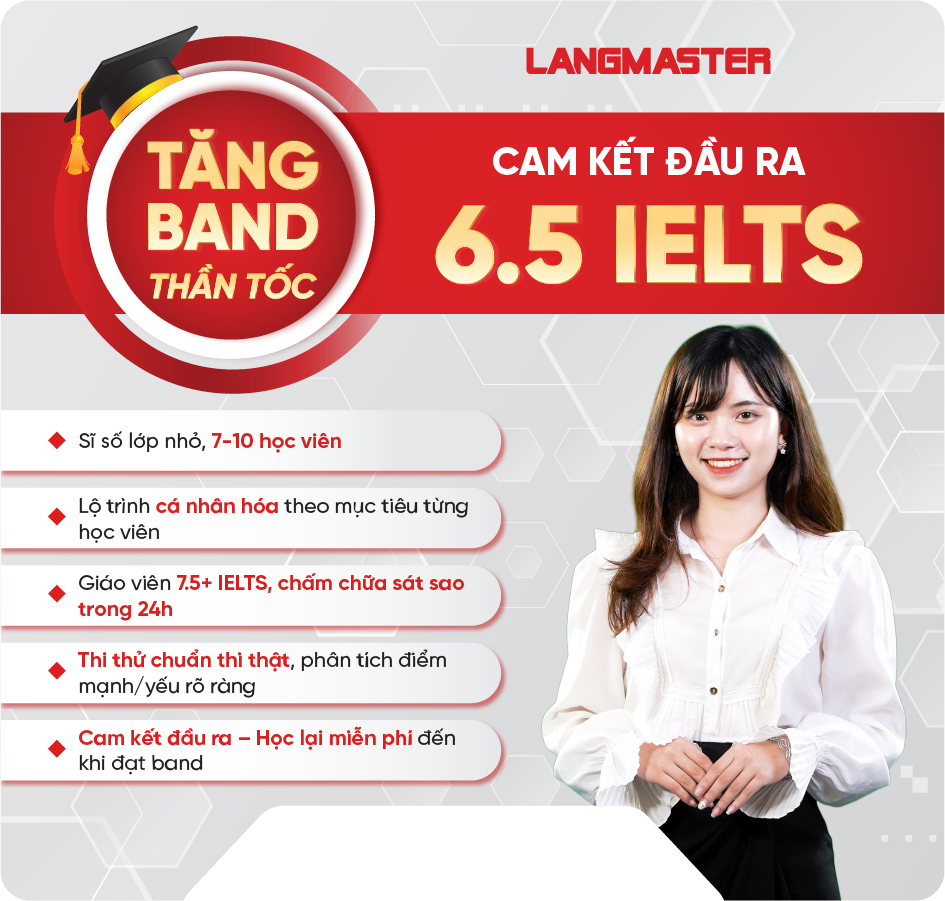
Để cải thiện band điểm Reading một cách bài bản, người học cần có lộ trình phù hợp kết hợp giữa việc xây dựng nền tảng ngôn ngữ và rèn luyện kỹ năng làm bài theo từng dạng câu hỏi. Tại Langmaster, học viên được đồng hành bởi đội ngũ giáo viên IELTS giàu kinh nghiệm cùng chương trình học được thiết kế cá nhân hóa theo trình độ và mục tiêu band điểm.
Hình thức học linh hoạt: Langmaster triển khai hai hình thức học tiếng Anh linh hoạt ONLINE và OFFLINE. Các lớp OFFLINE đang được tổ chức tại 3 cơ sở dành cho học viên khu vực Hà Nội: 169 Xuân Thủy (Cầu Giấy); 179 Trường Chinh (Thanh Xuân): N03-T7 Ngoại giao đoàn (Bắc Từ Liêm).
Chi phí tiết kiệm - Cam kết đầu ra bằng văn bản: Chỉ từ 2-3 triệu đồng/tháng, phù hợp với học sinh, sinh viên hoặc người đi làm, giúp bạn tối ưu cả chi phí lẫn hiệu quả, khi được học theo lộ trình rõ ràng và có người hướng dẫn sát sao.
Coaching 1 - 1 với chuyên gia: Học viên được kèm riêng để khắc phục điểm yếu, phân bổ thời gian thi chi tiết, tập trung rèn kỹ năng chưa vững và rút ngắn lộ trình nâng band.
Lộ trình học cá nhân hóa: Thiết kế dựa trên trình độ đầu vào và mục tiêu điểm số, kèm báo cáo tiến bộ hàng tháng.
Sĩ số lớp nhỏ, 7 - 10 học viên: Giáo viên theo sát từng bạn, nhiều cơ hội trao đổi và nhận phản hồi chi tiết.
Giáo viên 7.5+ IELTS: Chấm chữa bài trong 24 giờ, giúp bạn cải thiện nhanh chóng và rõ rệt.
Thi thử định kỳ: Mô phỏng áp lực thi thật, phân tích điểm mạnh - yếu để điều chỉnh chiến lược học.
Nếu bạn đang mong muốn cải thiện kỹ năng IELTS Reading và chinh phục band điểm mục tiêu trong thời gian ngắn, hãy đăng ký nhận tư vấn miễn phí từ Langmaster để được đánh giá trình độ và xây dựng lộ trình học phù hợp.
Đề IELTS Reading ngày 26-6-2026 không chỉ kiểm tra vốn từ vựng mà còn yêu cầu khả năng nhận diện paraphrase và phân tích thông tin chính xác. Hy vọng phần giải chi tiết trên đã giúp bạn hiểu rõ cách làm bài và rút kinh nghiệm cho những lần luyện đề tiếp theo. Đừng quên luyện tập thường xuyên và xây dựng lộ trình học phù hợp để chinh phục band điểm IELTS mục tiêu.



![Giải đề thi European Heat Wave IELTS Reading [FULL ANSWER]](https://langmaster.edu.vn/storage/uploads/original/2025/11/20/european-heat-wave-ielts-reading-answers.png)
Tổng hợp đề thi European Heat Wave IELTS Reading Answers kèm phân tích chi tiết, từ vựng và đáp án giúp bạn tối ưu điểm Reading nhanh chóng.
![Đề thi IELTS Reading có đáp án mới nhất 2025-2026 [Cập nhật liên tục]](https://langmaster.edu.vn/storage/uploads/original/2025/12/25/de-thi-ielts-reading.png)
Đề thi IELTS Reading có đáp án mới nhất 2025/2026, cập nhật liên tục đề thi thật và Cambridge, kèm lời giải chi tiết giúp nâng band hiệu quả.

Bài viết tổng hợp chi tiết đề thi IELTS Reading Holidays with a difference, đáp án kèm giải thích chi tiết, từ vựng cần lưu ý khi làm bài giúp bạn luyện thi hiệu quả và nâng cao band điểm.

Bài viết tổng hợp chi tiết đề thi IELTS Reading on the trail of the honey badger, đáp án kèm giải thích chi tiết, từ vựng cần lưu ý khi làm bài giúp bạn luyện thi hiệu quả và nâng cao band điểm.
![Giải đề IELTS Reading Growing more for less [FULL ANSWER]](https://langmaster.edu.vn/storage/uploads/original/2025/10/22/growing-more-for-less-ielts-reading-answers.png)
Khám phá bài đọc Growing more for less IELTS Reading: Tổng hợp đáp án, từ vựng quan trọng và phân tích chi tiết giúp bạn hiểu cách công nghệ vệ tinh hỗ trợ nông nghiệp hiện đại




Hơn 16 năm kinh nghiệm, đào tạo thành công hàng trăm nghìn học viên
Phương pháp giảng dạy hiện đại, học viên tiến bộ rõ rệt
Lộ trình học chuẩn quốc tế, phù hợp với nhu cầu thực tiễn
Giáo viên đạt chuẩn Quốc tế với chất lượng top đầu thị trường, giàu kinh nghiệm
Học online linh hoạt, cam kết đầu ra bằng văn bản


.png)
.png)