Khóa học
IELTS Online
IELTS Online
Giảm đến 18%
Đăng ký ngay
Mục lục [Ẩn]
Bài đọc Palm Oil, trong cuốn Cambridge 17 Test 3 là một trong những bài kiểm tra toàn diện nhất về kỹ năng Reading IELTS, mang tính học thuật cao. Bài viết này sẽ cung cấp hướng dẫn giải chi tiết từng câu, từ những câu hỏi True/False/Not Given hóc búa đến các dạng Matching phức tạp, giúp bạn ôn luyện Skill Reading hiệu quả và nâng cao band điểm của mình.
Palm oil
A
Palm oil is an edible oil derived from the fruit of the African oil palm tree, and is currently the most consumed vegetable oil in the world. It’s almost certainly in the soap we wash with in the morning, the sandwich we have for lunch, and the biscuits we snack on during the day. Why is palm oil so attractive for manufacturers? Primarily because its unique properties – such as remaining solid at room temperature – make it an ideal ingredient for long-term preservation, allowing many packaged foods on supermarket shelves to have ‘best before’ dates of months, even years, into the future.
B
Many farmers have seized the opportunity to maximize the planting of oil palm trees. Between 1990 and 2012, the global land area devoted to growing oil palm trees grew from 6 to 17 million hectares, now accounting for around ten percent of total cropland in the entire world. From a mere two million tonnes of palm oil being produced annually globally 50 years ago, there are now around 60 million tonnes produced every single year, a figure looking likely to double or even triple by the middle of the century.
C
However, there are multiple reasons why conservationists cite the rapid spread of oil palm plantations as a major concern. There are countless news stories of deforestation, habitat destruction and dwindling species populations, all as a direct result of land clearing to establish oil palm tree monoculture on an industrial scale, particularly in Malaysia and Indonesia. Endangered species – most famously the Sumatran orangutan, but also rhinos, elephants, tigers, and numerous other fauna – have suffered from the unstoppable spread of oil palm plantations.
D
‘Palm oil is surely one of the greatest threats to global biodiversity,’ declares Dr Farnon Ellwood of the University of the West of England, Bristol. ‘Palm oil is replacing rainforest, and rainforest is where all the species are. That’s a problem.’ This has led to some radical questions among environmentalists, such as whether consumers should try to boycott palm oil entirely.
Meanwhile Bhavani Shankar, Professor at London’s School of Oriental and African Studies, argues, ‘It’s easy to say that palm oil is the enemy and we should be against it. It makes for a more dramatic story, and it’s very intuitive. But given the complexity of the argument, I think a much more nuanced story is closer to the truth.’
E
One response to the boycott movement has been the argument for the vital role palm oil plays in lifting many millions of people in the developing world out of poverty. Is it desirable to have palm oil boycotted, replaced, eliminated from the global supply chain, given how many low-income people in developing countries depend on it for their livelihoods? How best to strike a utilitarian balance between these competing factors has become a serious bone of contention.
F
Even the deforestation argument isn’t as straightforward as it seems. Oil palm plantations produce at least four and potentially up to ten times more oil per hectare than soybean, rapeseed, sunflower or other competing oils. That immensely high yield – which is predominantly what makes it so proftable – is potentially also an ecological beneft. If ten times more palm oil can be produced from a patch of land than any competing oil, then ten times more land would need to be cleared in order to produce the same volume of oil from that competitor.
As for the question of carbon emissions, the issue really depends on what oil palm trees are replacing. Crops vary in the degree to which they sequester carbon – in other words, the amount of carbon they capture from the atmosphere and store within the plant. The more carbon a plant sequesters, the more it reduces the effect of climate change. As Shankar explains: ‘[Palm oil production] actually sequesters more carbon in some ways than other alternatives. […] Of course, if you’re cutting down virgin forest it’s terrible – that’s what’s happening in Indonesia and Malaysia, it’s been allowed to get out of hand. But if it’s replacing rice, for example, it might actually sequester more carbon.’
G
The industry is now regulated by a group called the Roundtable on Sustainable Palm Oil (RSPO), consisting of palm growers, retailers, product manufacturers, and other interested parties. Over the past decade or so, an agreement has gradually been reached regarding standards that producers of palm oil have to meet in order for their product to be regarded as officially ‘sustainable’. The RSPO insists upon no virgin forest clearing, transparency and regular assessment of carbon stocks, among other criteria. Only once these requirements are fully satisfied is the oil allowed to be sold as certified sustainable palm oil (CSPO). Recent figures show that the RSPO now certifies around 12 million tonnes of palm oil annually, equivalent to roughly 21 percent of the world’s total palm oil production.
H
There is even hope that oil palm plantations might not need to be such sterile monocultures, or ‘green deserts’, as Ellwood describes them. New research at Ellwood’s lab hints at one plant which might make all the difference. The bird’s nest fern (Asplenium nidus) grows on trees in an epiphytic fashion (meaning it’s dependent on the tree only for support, not for nutrients), and is native to many tropical regions, where as a keystone species it performs a vital ecological role. Ellwood believes that reintroducing the bird’s nest fern into oil palm plantations could potentially allow these areas to recover their biodiversity, providing a home for all manner of species, from fungi and bacteria, to invertebrates such as insects, amphibians, reptiles and even mammals.
Questions 14–20
Reading Passage 2 has eight sections, A–H.
Which section contains the following information?
Write the correct letter, A–H, in boxes 14–20 on your answer sheet.
14. examples of a range of potential environmental advantages of oil palm tree cultivation
15. description of an organisation which controls the environmental impact of palm oil production
16. examples of the widespread global use of palm oil
17. reference to a particular species which could benefit the ecosystem of oil palm plantations
18. Figures illustrating the rapid expansion of the palm oil industry
19. an economic justification for not opposing the palm oil industry
20. examples of creatures badly affected by the establishment of oil palm plantations
Questions 21 and 22
Choose TWO letters, A–E.
Write the correct letters in boxes 21 and 22 on your answer sheet.
Which TWO statements are made about the Roundtable on Sustainable Palm Oil (RSPO)?
A. Its membership has grown steadily over the course of the last decade.
B. It demands that certified producers be open and honest about their practices.
C. It took several years to establish its set of criteria for sustainable palm oil certification.
D. Its regulations regarding sustainability are stricter than those governing other industries.
E. It was formed at the request of environmentalists concerned about the loss of virgin forests.
Questions 23–26
Complete the sentences below.
Choose NO MORE THAN TWO WORDS from the passage for each answer
Write your answers in boxes 23–26 on your answer sheet.
23. One advantage of palm oil for manufacturers is that it stays__________ even when not refrigerated.
24. The__________ is the best known of the animals suffering habitat loss as a result of the spread of oil palm plantations.
25. As one of its criteria for the certification of sustainable palm oil, the RSPO insists that growers check__________ on a routine basis.
26. Ellwood and his researchers are looking into whether the bird’s nest fern could be restored__________ in areas where oil palm trees are grown.
>>> Xem thêm: Những sai lầm khi luyện IELTS Reading cần tránh và cách khắc phục
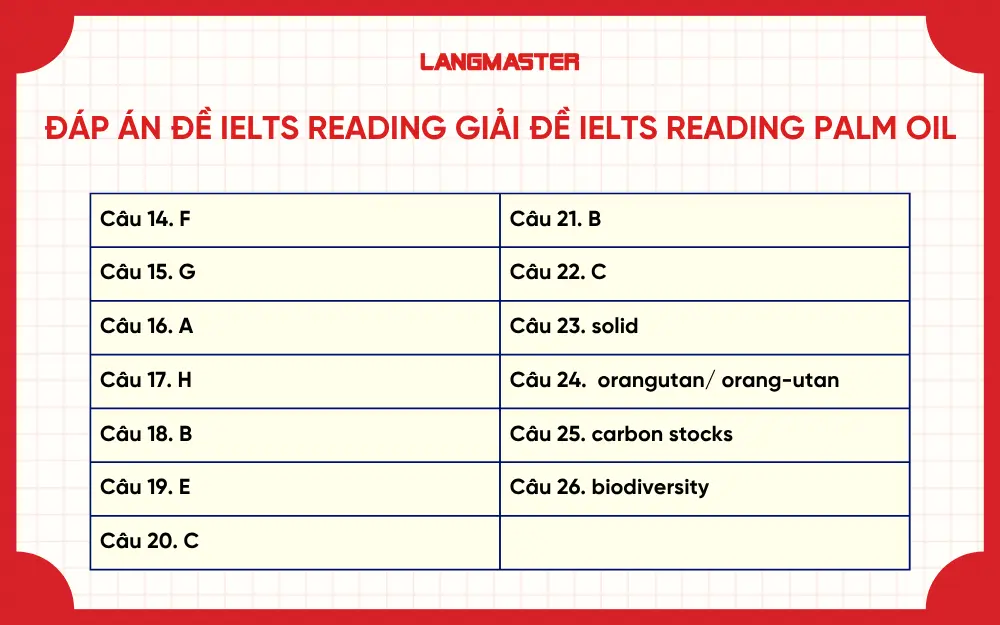
|
Câu 14. F |
Câu 21. B |
|
Câu 15. G |
Câu 22. C |
|
Câu 16. A |
Câu 23. solid |
|
Câu 17. H |
Câu 24. (Sumatran) orangutan/ orang-utan |
|
Câu 18. B |
Câu 25. carbon stocks |
|
Câu 19. E |
Câu 26. biodiversity |
|
Câu 20. C |
Giải thích chi tiết:
Câu 14 – Đáp án: F
Câu hỏi: Examples of a range of potential environmental advantages of oil palm tree cultivation
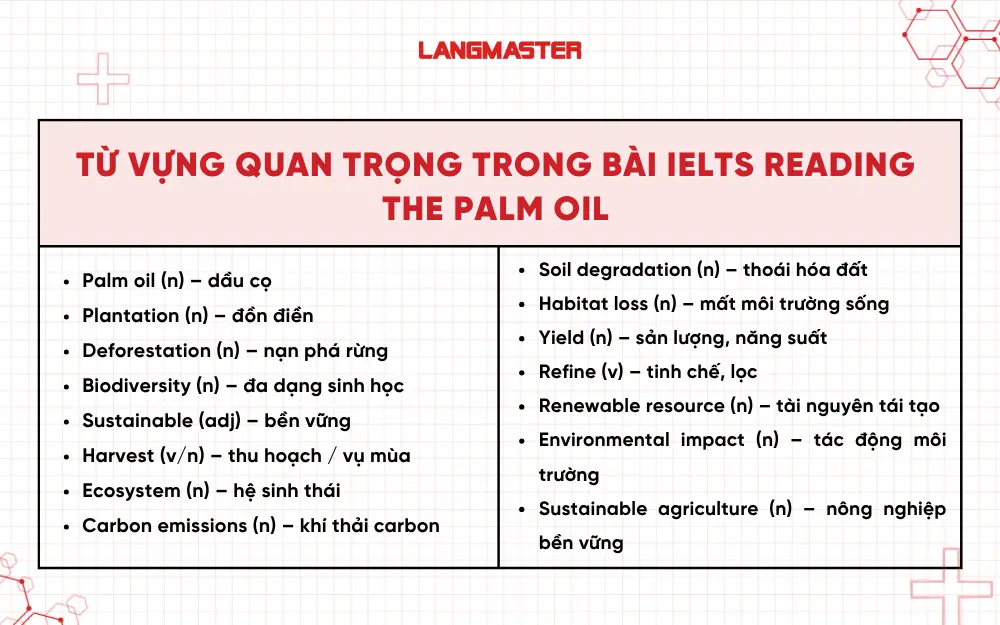
Từ khóa: environmental advantages – lợi ích môi trường
Giải thích: Trong Section F, đoạn 1, câu 2–3 cho biết:
“Oil palm plantations produce at least four and potentially up to ten times more oil per hectare than soybean, rapeseed, sunflower or other competing oils. That immensely high yield is potentially also an ecological benefit.”
→ Dầu cọ có năng suất cao hơn gấp 4–10 lần các loại dầu khác, nghĩa là giúp tiết kiệm diện tích đất, giảm phá rừng. Đây là lợi ích sinh thái tiềm năng.
→ Đáp án: F
Câu 15 – Đáp án: G
Câu hỏi: Description of an organisation which controls the environmental impact of palm oil production
Từ khóa: organisation – kiểm soát tác động môi trường
Giải thích: Section G nói về RSPO (Roundtable on Sustainable Palm Oil) – tổ chức giám sát và cấp chứng nhận sản xuất dầu cọ bền vững.
“The industry is now regulated by a group called the Roundtable on Sustainable Palm Oil (RSPO)... producers have to meet standards in order for their product to be regarded as officially ‘sustainable’.”
→ Phần này mô tả tổ chức điều tiết, đặt ra tiêu chuẩn về tính bền vững và tác động môi trường.
→ Đáp án: G
Câu 16 – Đáp án: A
Câu hỏi: Examples of the widespread global use of palm oil
Từ khóa: global use – sử dụng rộng rãi
Giải thích: Section A, câu 2–3:
“It’s almost certainly in the soap we wash with in the morning, the sandwich we have for lunch, and the biscuits we snack on during the day.”
→ Đưa ví dụ cụ thể cho thấy dầu cọ xuất hiện phổ biến trong đời sống hàng ngày, từ thực phẩm đến sản phẩm chăm sóc cá nhân.
→ Đáp án: A
Câu 17 – Đáp án: H
Câu hỏi: Reference to a particular species which could benefit the ecosystem of oil palm plantations
Từ khóa: species – benefit – ecosystem
Giải thích: Section H nhắc đến bird’s nest fern (dương xỉ tổ chim):
“Ellwood believes that reintroducing the bird’s nest fern into oil palm plantations could potentially allow these areas to recover their biodiversity.”
→ Loài bird’s nest fern có thể giúp phục hồi hệ sinh thái trong các đồn điền dầu cọ.
→ Đáp án: H
Câu 18 – Đáp án: B
Câu hỏi: Figures illustrating the rapid expansion of the palm oil industry
Từ khóa: figures – expansion – growth
Giải thích: Section B, câu 1–3:
“Between 1990 and 2012, the global land area devoted to growing oil palm trees grew from 6 to 17 million hectares... from 2 million tonnes to 60 million tonnes annually.”
→ Cung cấp số liệu cụ thể về sự tăng trưởng nhanh chóng của ngành công nghiệp dầu cọ.
→ Đáp án: B
Câu 19 – Đáp án: E
Câu hỏi: An economic justification for not opposing the palm oil industry
Từ khóa: economic justification – lý do kinh tế
Giải thích: Section E: “Palm oil plays a vital role in lifting many millions of people in the developing world out of poverty.”
→ Nêu lý do kinh tế để không tẩy chay dầu cọ, vì nó giúp hàng triệu người thoát nghèo.
→ Đáp án: E
Câu 20 – Đáp án: C
Câu hỏi: Examples of creatures badly affected by the establishment of oil palm plantations
Từ khóa: creatures – affected
Giải thích: Section C: “Endangered species – most famously the Sumatran orangutan, but also rhinos, elephants, tigers – have suffered from the unstoppable spread of oil palm plantations.”
→ Liệt kê nhiều loài động vật bị ảnh hưởng nghiêm trọng bởi việc mở rộng đồn điền dầu cọ.
→ Đáp án: C
Câu 21 – Đáp án: B
Câu hỏi: Which two statements are made about the RSPO?
Giải thích: Section G: “The RSPO insists upon no virgin forest clearing, transparency and regular assessment of carbon stocks.”
→ “Transparency” = yêu cầu nhà sản xuất minh bạch trong hoạt động.
→ Đáp án: B
Câu 22 – Đáp án: C
Giải thích: Section G: “Over the past decade or so, an agreement has gradually been reached regarding standards that producers of palm oil have to meet.”
→ Mất nhiều năm (khoảng một thập kỷ) để đạt được thỏa thuận về các tiêu chí.
→ Đáp án: C
Câu 23 – Đáp án: solid
Câu hỏi: One advantage of palm oil for manufacturers is that it stays ______ even when not refrigerated.
Giải thích: Section A: “...such as remaining solid at room temperature...” → Ưu điểm của dầu cọ: giữ dạng rắn ở nhiệt độ phòng.
→ Đáp án: solid
Câu 24 – Đáp án: (Sumatran) orangutan / orang-utan
Giải thích: Section C: “Endangered species – most famously the Sumatran orangutan – have suffered from the unstoppable spread of oil palm plantations.”
→ Loài động vật tiêu biểu chịu ảnh hưởng là đười ươi Sumatra.
→ Đáp án: orangutan
Câu 25 – Đáp án: carbon stocks
Giải thích: Section G: “The RSPO insists upon ... regular assessment of carbon stocks.” → Một tiêu chí của RSPO là kiểm tra trữ lượng carbon định kỳ.
→ Đáp án: carbon stocks
Câu 26 – Đáp án: biodiversity
Giải thích: Section H: “...reintroducing the bird’s nest fern into oil palm plantations could potentially allow these areas to recover their biodiversity.” → Nghiên cứu của Ellwood nhằm khôi phục đa dạng sinh học trong các đồn điền dầu cọ.
→ Đáp án: biodiversity
>> Xem thêm:
>> Xem thêm: Thời gian làm Reading IELTS: Chiến lược phân bổ và mẹo làm bài hiệu quả
Để đạt điểm cao trong IELTS Reading, điều quan trọng là học theo một lộ trình khoa học, có sự kèm cặp của giảng viên và nhận được phản hồi cụ thể cho từng bài làm. Đây cũng chính là lý do nhiều bạn tin tưởng lựa chọn khóa học IELTS online tại Langmaster – nơi mang đến cho học viên những trải nghiệm học tập vượt trội:
Ưu đãi đặc biệt – HỌC THỬ MIỄN PHÍ: Giúp bạn trải nghiệm phương pháp giảng dạy và cảm nhận sự khác biệt ngay từ buổi học đầu tiên.
KẾT LUẬN: Như vậy, chúng ta đã vừa cùng nhau phân tích và giải chi tiết đề IELTS Reading Cambridge 17 Test 3 về chủ đề Palm Oil. Bài viết đã làm rõ các kỹ năng cần thiết để tìm thông tin, nhận biết từ khóa và áp dụng chiến lược đọc hiểu hiệu quả. Hy vọng hướng dẫn này sẽ giúp bạn tự tin hơn khi làm bài và cải thiện điểm số Reading IELTS. Chúc bạn học tập hiệu quả và đạt kết quả cao trong kỳ thi IELTS sắp tới!


![Giải đề thi European Heat Wave IELTS Reading [FULL ANSWER]](https://langmaster.edu.vn/storage/uploads/original/2025/11/20/european-heat-wave-ielts-reading-answers.png)
Tổng hợp đề thi European Heat Wave IELTS Reading Answers kèm phân tích chi tiết, từ vựng và đáp án giúp bạn tối ưu điểm Reading nhanh chóng.
![Đề thi IELTS Reading có đáp án mới nhất 2025-2026 [Cập nhật liên tục]](https://langmaster.edu.vn/storage/uploads/original/2025/12/25/de-thi-ielts-reading.png)
Đề thi IELTS Reading có đáp án mới nhất 2025/2026, cập nhật liên tục đề thi thật và Cambridge, kèm lời giải chi tiết giúp nâng band hiệu quả.

Bài viết tổng hợp chi tiết đề thi IELTS Reading Holidays with a difference, đáp án kèm giải thích chi tiết, từ vựng cần lưu ý khi làm bài giúp bạn luyện thi hiệu quả và nâng cao band điểm.
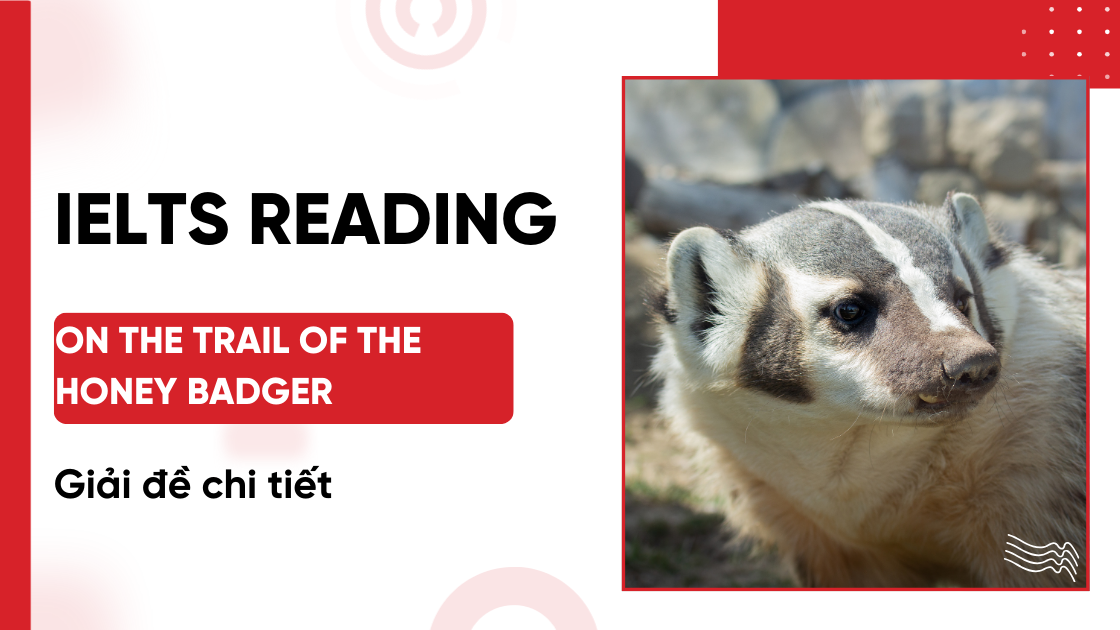
Bài viết tổng hợp chi tiết đề thi IELTS Reading on the trail of the honey badger, đáp án kèm giải thích chi tiết, từ vựng cần lưu ý khi làm bài giúp bạn luyện thi hiệu quả và nâng cao band điểm.
![Giải đề IELTS Reading Growing more for less [FULL ANSWER]](https://langmaster.edu.vn/storage/uploads/original/2025/10/22/growing-more-for-less-ielts-reading-answers.png)
Khám phá bài đọc Growing more for less IELTS Reading: Tổng hợp đáp án, từ vựng quan trọng và phân tích chi tiết giúp bạn hiểu cách công nghệ vệ tinh hỗ trợ nông nghiệp hiện đại




Hơn 16 năm kinh nghiệm, đào tạo thành công hàng trăm nghìn học viên
Phương pháp giảng dạy hiện đại, học viên tiến bộ rõ rệt
Lộ trình học chuẩn quốc tế, phù hợp với nhu cầu thực tiễn
Giáo viên đạt chuẩn Quốc tế với chất lượng top đầu thị trường, giàu kinh nghiệm
Học online linh hoạt, cam kết đầu ra bằng văn bản

![Giải đề thi IELTS Reading: Listening to the Ocean [Full Answer]](https://langmaster.edu.vn/storage/uploads/original/2025/10/13/listening-to-the-ocean-ielts-reading-2.png)

.png)
![Giải đề IELTS Reading: Neuroaesthetics [Full answers]](https://langmaster.edu.vn/storage/uploads/original/2025/10/11/giai-de-ielts-reading-neuroaesthetics.png)


.png)