Khóa học
IELTS Online
IELTS Online
Giảm đến 18%
Đăng ký ngay
Mục lục [Ẩn]
Giải đề IELTS Reading “Neuroaesthetics” kèm đáp án chi tiết và danh sách từ vựng quan trọng giúp bạn luyện thi hiệu quả và nâng cao band điểm.
Khi ôn tập IELTS Reading, việc luyện kĩ năng giải đề qua các đề thi thật là một cách hiệu quả giúp bạn tăng band điểm nhanh. Bài viết này sẽ giúp bạn giải trọn vẹn đề thi thật IELTS Reading “Neuroaesthetics” với đầy đủ đề bài, câu hỏi, đáp án chi tiết kèm giải thích rõ ràng. Đây sẽ là tài liệu hữu ích để bạn ôn luyện và nâng cao kỹ năng Reading, sẵn sàng chinh phục band điểm mục tiêu trong kỳ thi IELTS.
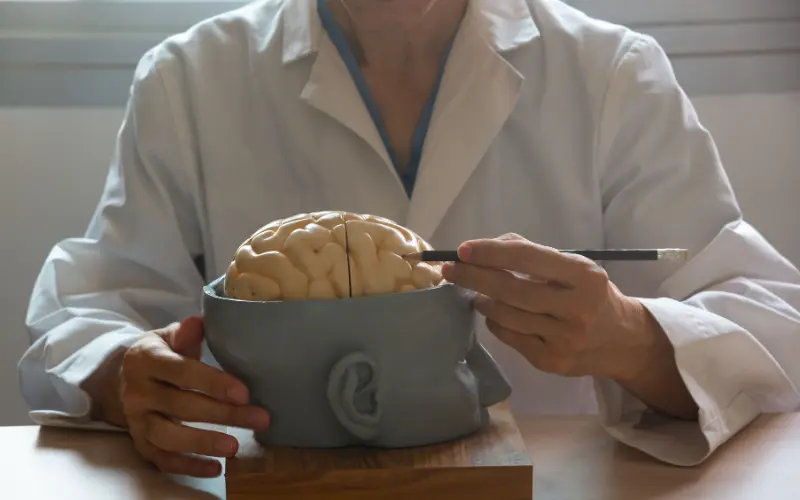
Neuroaesthetics
An emerging discipline called neuroaesthetics is seeking to bring scientific objectivity to the study of art, and has already given us a better understanding of many masterpieces. The blurred imagery of Impressionist paintings seems to stimulate the brain’s amygdala, for instance. Since the amygdala plays a crucial role in our feelings, that finding might explain why many people find these pieces so moving.
Could the same approach also shed light on abstract twentieth-century pieces, from Mondrian’s geometrical blocks of colour, to Pollock’s seemingly haphazard arrangements of splashed paint on canvas? Sceptics believe that people claim to like such works simply because they are famous. We certainly do have an inclination to follow the crowd. When asked to make simple perceptual decisions such as matching a shape to its rotated image, for example, people often choose a definitively wrong answer if they see others doing the same. It is easy to imagine that this mentality would have even more impact on a fuzzy concept like art appreciation, where there is no right or wrong answer.
Angelina Hawley-Dolan, of Boston College, Massachusetts, responded to this debate by asking volunteers to view pairs of paintings – either the creations of famous abstract artists or the doodles of infants, chimps and elephants. They then had to judge which they preferred. A third of the paintings were given no captions, while many were labelled incorrectly -volunteers might think they were viewing a chimp’s messy brush strokes when they were actually seeing an acclaimed masterpiece. In each set of trials, volunteers generally preferred the work of renowned artists, even when they believed it was by an animal or a child. It seems that the viewer can sense the artist’s vision in paintings, even if they can’t explain why.
Robert Pepperell, an artist based at Cardiff University, creates ambiguous works that are neither entirely abstract nor clearly representational. In one study, Pepperell and his collaborators asked volunteers to decide how ‘powerful’ they considered an artwork to be, and whether they saw anything familiar in the piece. The longer they took to answer these questions, the more highly they rated the piece under scrutiny, and the greater their neural activity. It would seem that the brain sees these images as puzzles, and the harder it is to decipher the meaning, the more rewarding is the moment of recognition.
And what about artists such as Mondrian, whose paintings consist exclusively of horizontal and vertical lines encasing blocks of colour? Mondrian’s works are deceptively simple, but eye-tracking studies confirm that they are meticulously composed, and that simply rotating a piece radically changes the way we view it. With the originals, volunteers’eyes tended to stay longer on certain places in the image, but with the altered versions, they would flit across a piece more rapidly. As a result, the volunteers considered the altered versions less pleasurable when they later rated the work.
In a similar study, Oshin Vartanian of Toronto University asked volunteers to compare original paintings with ones which he had altered by moving objects around within the frame. He found that almost everyone preferred the original, whether it was a Van Gogh still life or an abstract by Miro. Vartanian also found that changing the composition of the paintings reduced activation in those brain areas linked with meaning and interpretation.
In another experiment, Alex Forsythe of the University of Liverpool analysed the visual intricacy of different pieces of art, and her results suggest that many artists use a key level of detail to please the brain. Too little and the work is boring, but too much results in a kind of ‘perceptual overload’, according to Forsythe. What’s more, appealing pieces both abstract and representational, show signs of ‘fractals’ – repeated motifs recurring in different scales, fractals are common throughout nature, for example in the shapes of mountain peaks or the branches of trees. It is possible that our visual system, which evolved in the great outdoors, finds it easier to process such patterns.
It is also intriguing that the brain appears to process movement when we see a handwritten letter, as if we are replaying the writer’s moment of creation. This has led some to wonder whether Pollock’s works feel so dynamic because the brain reconstructs the energetic actions the artist used as he painted. This may be down to our brain’s ‘mirror neurons’, which are known to mimic others’ actions. The hypothesis will need to be thoroughly tested, however. It might even be the case that we could use neuroaesthetic studies to understand the longevity of some pieces of artwork. While the fashions of the time might shape what is currently popular, works that are best adapted to our visual system may be the most likely to linger once the trends of previous generations have been forgotten.
It’s still early days for the field of neuroaesthetics – and these studies are probably only a taste of what is to come. It would, however, be foolish to reduce art appreciation to a set of scientific laws. We shouldn’t underestimate the importance of the style of a particular artist, their place in history and the artistic environment of their time. Abstract art offers both a challenge and the freedom to play with different interpretations. In some ways, it’s not so different from science, where we are constantly looking for systems and decoding meaning so that we can view and appreciate the world in a new way.
Questions 27-30
Choose the correct letter, A, B, C or D.
Write the correct letter in boxes 27-30 on your answer sheet.
27. In the second paragraph, the writer refers to a shape- matching test in order to illustrate
A. the subjective nature of art appreciation.
B. the reliance of modern art on abstract forms.
C. our tendency to be influenced by the opinions of others.
D. a common problem encountered when processing visual data.
28. Angelina Hawley-Dolan’s findings indicate that people
A. mostly favour works of art which they know well.
B. hold fixed ideas about what makes a good work of art.
C. are often misled by their initial expectations of a work of art.
D. have the ability to perceive the intention behind works of art.
29. Results of studies involving Robert Pepperell’s pieces suggest that people
A. can appreciate a painting without fully understanding it.
B. find it satisfying to work out what a painting represents.
C. vary widely in the time they spend looking at paintings.
D. generally prefer representational art to abstract art.
30. What do the experiments described in the fifth paragraph suggest about the paintings of Mondrian?
A. They are more carefully put together than they appear.
B. They can be interpreted in a number of different ways.
C. They challenge our assumptions about shape and colour.
D. They are easier to appreciate than many other abstract works.
Questions 31-33
Complete the summary using the list of words, A-H, below.
Write the correct letters, A-H, in boxes 31-33 on your answer sheet.
A. interpretation
B. complexity
C. emotions
D. movements
E. skill
F. layout
G. concern
H. images
Art and the Brain
The discipline of neuroaesthetics aims to bring scientific objectivity to the study of art. Neurological studies of the brain, for example, demonstrate the impact which Impressionist paintings have on our 31 ………………………….Alex Forsythe of the University of Liverpool believes many artists give their works the precise degree of 32 …………………………. which most appeals to the viewer’s brain. She also observes that pleasing works of art often contain certain repeated 33 ………………………….which occur frequently in the natural world.
Questions 34-39
Do the following statements agree with the views of the writer in the Reading Passage?
In boxes 34-39 on your answer sheet, write
YES if the statement agrees with the views of the writer
NO if the statement contradicts the views of the writer
NOT GIVEN if there is no information on this
34. Forsythe’s findings contradicted previous beliefs on the function of ‘fractals’ in art.
35. Certain ideas regarding the link between ‘mirror neurons’ and art appreciation require further verification.
36. People’s taste in paintings depends entirely on the current artistic trends of the period.
37. Scientists should seek to define the precise rules which govern people’s reactions to works of art.
38. Art appreciation should always involve taking into consideration the cultural context in which an artist worked.
39. It is easier to find meaning in the field of science than in that of art.
Question 40
Choose the correct letter; A, B, C or D.
Write the correct letter in box 40 on your answer sheet.
40. What would be the most appropriate subtitle for the article?
A. Some scientific insights into how the brain responds to abstract art
B. Recent studies focusing on the neural activity of abstract artists
C. A comparison of the neurological bases of abstract and representational art
D. How brain research has altered public opinion about abstract art
>>> XEM THÊM:
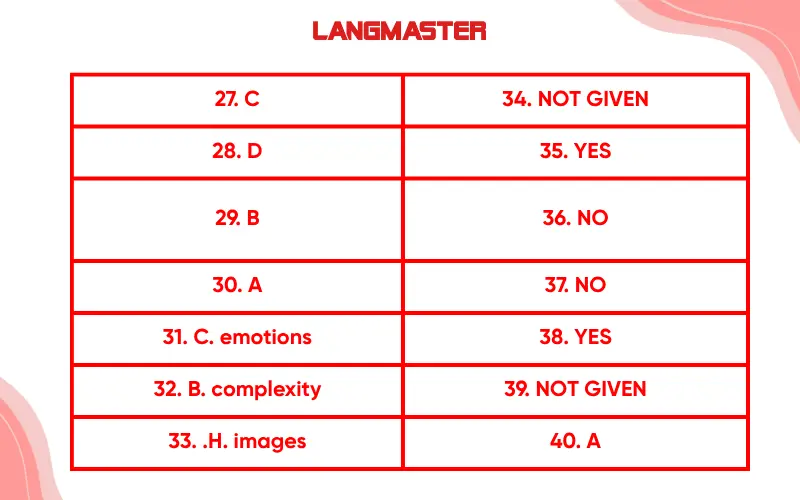
Dưới đây là bảng đáp án để đối chiếu:
|
27. C |
34. NOT GIVEN |
|
28. D |
35. YES |
|
29. B |
36. NO |
|
30. A |
37. NO |
|
31. C. emotions |
38. YES |
|
32. B. complexity |
39. NOT GIVEN |
|
33. .H. images |
40. A |
Đáp án chi tiết 27 - 31
27. “People often choose a definitively wrong answer if they see others doing the same. It is easy to imagine that this mentality would have even more impact on a fuzzy concept like art appreciation...”
→ Thí nghiệm này minh họa xu hướng con người dễ bị ảnh hưởng bởi ý kiến của người khác.
Đáp án: C. our tendency to be influenced by the opinions of others
28. “Volunteers generally preferred the work of renowned artists, even when they believed it was by an animal or a child. It seems that the viewer can sense the artist’s vision…”
→ Kết quả cho thấy người xem có khả năng cảm nhận được ý đồ hay tầm nhìn của nghệ sĩ, dù không biết lý do.
Đáp án: D. have the ability to perceive the intention behind works of art
29. “The longer they took to answer... the more highly they rated the piece... the harder it is to decipher the meaning, the more rewarding is the moment of recognition.”
→ Người xem thấy thỏa mãn khi cố gắng hiểu ý nghĩa bức tranh.
Đáp án: B. find it satisfying to work out what a painting represents
30. “Mondrian’s works are deceptively simple, but eye-tracking studies confirm that they are meticulously composed...”
→ Tranh Mondrian được sắp đặt tỉ mỉ hơn vẻ ngoài đơn giản của chúng.
Đáp án: A. They are more carefully put together than they appear
Đáp án chi tiết 31 - 33
31. “The blurred imagery of Impressionist paintings seems to stimulate the brain’s amygdala... the amygdala plays a crucial role in our feelings.”
→ Tranh ấn tượng tác động đến cảm xúc của người xem.
Đáp án: C. emotions
32. “Too little and the work is boring, but too much results in perceptual overload.”
→ Nghệ sĩ thường tạo ra độ phức tạp vừa phải để làm hài lòng não bộ.
Đáp án: B. complexity
33. “Appealing pieces... show signs of ‘fractals’ – repeated motifs recurring in different scales... common throughout nature.”
→ Tác phẩm hấp dẫn thường có các họa tiết hoặc hình ảnh lặp lại trong tự nhiên.
Đáp án: H. images
Đáp án chi tiết 34 - 39
34. Không có thông tin nói rằng phát hiện của Forsythe mâu thuẫn với nghiên cứu trước.
Đáp án: NOT GIVEN
35. “The hypothesis will need to be thoroughly tested, however.”
→ Giả thuyết này cần được kiểm chứng thêm.
Đáp án: YES
36. “While the fashions of the time might shape what is currently popular, works... best adapted to our visual system may linger.”
→ Thị hiếu nghệ thuật không hoàn toàn phụ thuộc vào xu hướng.
Đáp án: NO
37. “It would be foolish to reduce art appreciation to a set of scientific laws.”
→ Tác giả phản đối việc cố xác định quy luật khoa học cho nghệ thuật.
Đáp án: NO
38. “We shouldn’t underestimate the importance of the style of a particular artist, their place in history and the artistic environment of their time.”
→ Khi đánh giá nghệ thuật cần xem xét bối cảnh văn hóa và thời đại.
Đáp án: YES
39. “In some ways, it’s not so different from science...”
→ Tác giả không nói lĩnh vực nào dễ hiểu hơn.
Đáp án: NOT GIVEN
Đáo án chi tiết 40
40. Đoạn 1: “An emerging discipline called neuroaesthetics is seeking to bring scientific objectivity to the study of art, and has already given us a better understanding of many masterpieces. “
Đoạn 2. “Could the same approach also shed light on abstract twentieth-century pieces, […]
→ Bài viết tập trung vào cách não phản ứng với nghệ thuật trừu tượng và những nghiên cứu thần kinh liên quan.
Đáp án: A. Some scientific insights into how the brain responds to abstract art
>>> XEM THÊM:
Khi bước vào hành trình giải đề IELTS Reading, việc xây dựng vốn từ vựng theo một lộ trình khoa học là yếu tố then chốt để cải thiện band điểm. Bài viết này mang đến danh sách từ vựng IELTS Reading quan trọng trong bài “Neuroaesthetics” giúp bạn tăng tốc độ đọc hiểu, nâng cao khả năng phân tích thông tin và từng bước đạt kết quả tốt hơn ở kỳ thi chính thức.
|
Từ / Cụm từ |
Nghĩa tiếng Việt |
Ví dụ trong bài đọc |
|
emerging discipline |
lĩnh vực mới nổi |
“An emerging discipline called neuroaesthetics is seeking to bring scientific objectivity to the study of art.” |
|
neuroaesthetics |
khoa học thần kinh thẩm mỹ |
“An emerging discipline called neuroaesthetics is seeking to bring scientific objectivity to the study of art.” |
|
scientific objectivity |
tính khách quan khoa học |
“...to bring scientific objectivity to the study of art.” |
|
masterpiece |
kiệt tác |
“...has already given us a better understanding of many masterpieces.” |
|
blurred imagery |
hình ảnh mờ ảo |
“The blurred imagery of Impressionist paintings seems to stimulate the brain’s amygdala.” |
|
stimulate |
kích thích |
“...seems to stimulate the brain’s amygdala.” |
|
amygdala |
hạch hạnh nhân (trong não, điều khiển cảm xúc) |
“Since the amygdala plays a crucial role in our feelings...” |
|
crucial role |
vai trò quan trọng |
“Since the amygdala plays a crucial role in our feelings...” |
|
moving |
cảm động |
“...might explain why many people find these pieces so moving.” |
|
shed light on |
làm sáng tỏ |
“Could the same approach also shed light on abstract twentieth-century pieces...?” |
|
abstract |
trừu tượng |
“Could the same approach also shed light on abstract twentieth-century pieces...?” |
|
geometrical blocks of colour |
khối màu hình học |
“...from Mondrian’s geometrical blocks of colour...” |
|
haphazard |
ngẫu nhiên, bừa bãi |
“...Pollock’s seemingly haphazard arrangements of splashed paint...” |
|
inclination |
xu hướng, khuynh hướng |
“We certainly do have an inclination to follow the crowd.” |
|
follow the crowd |
chạy theo số đông |
“We certainly do have an inclination to follow the crowd.” |
|
perceptual decisions |
quyết định nhận thức |
“When asked to make simple perceptual decisions such as matching a shape to its rotated image...” |
|
mentality |
tư duy, tâm lý |
“It is easy to imagine that this mentality would have even more impact on a fuzzy concept like art appreciation.” |
|
fuzzy concept |
khái niệm mơ hồ |
“...a fuzzy concept like art appreciation, where there is no right or wrong answer.” |
|
art appreciation |
sự cảm thụ nghệ thuật |
“...a fuzzy concept like art appreciation...” |
|
doodle |
nét vẽ nguệch ngoạc |
“...the doodles of infants, chimps and elephants.” |
|
caption |
chú thích |
“A third of the paintings were given no captions...” |
|
renowned |
nổi tiếng |
“Volunteers generally preferred the work of renowned artists...” |
|
vision (of the artist) |
tầm nhìn, ý đồ nghệ thuật |
“It seems that the viewer can sense the artist’s vision in paintings.” |
|
ambiguous |
mơ hồ, đa nghĩa |
“...creates ambiguous works that are neither entirely abstract nor clearly representational.” |
|
representational |
mang tính hiện thực |
“...neither entirely abstract nor clearly representational.” |
|
under scrutiny |
được xem xét kỹ lưỡng |
“...the more highly they rated the piece under scrutiny.” |
|
decipher |
giải mã, hiểu ra |
“...the harder it is to decipher the meaning, the more rewarding is the moment of recognition.” |
|
rewarding |
mang lại cảm giác thỏa mãn |
“...the more rewarding is the moment of recognition.” |
|
meticulously |
tỉ mỉ, cẩn thận |
“...eye-tracking studies confirm that they are meticulously composed.” |
|
eye-tracking studies |
nghiên cứu theo dõi chuyển động mắt |
“Eye-tracking studies confirm that they are meticulously composed.” |
|
flit across |
lướt nhanh qua |
“...they would flit across a piece more rapidly.” |
|
composition |
bố cục |
“...changing the composition of the paintings reduced activation...” |
|
activation |
sự kích hoạt |
“...reduced activation in those brain areas linked with meaning and interpretation.” |
|
intricacy |
độ phức tạp, tinh vi |
“...analysed the visual intricacy of different pieces of art.” |
|
perceptual overload |
quá tải nhận thức |
“...too much results in a kind of ‘perceptual overload’.” |
|
fractals |
cấu trúc lặp, họa tiết tự đồng dạng |
“...appealing pieces... show signs of ‘fractals’ – repeated motifs recurring in different scales.” |
|
motif |
họa tiết, mô-típ lặp lại |
“...repeated motifs recurring in different scales.” |
|
visual system |
hệ thống thị giác |
“...our visual system, which evolved in the great outdoors...” |
|
intriguing |
thú vị, kích thích tò mò |
“It is also intriguing that the brain appears to process movement...” |
|
mirror neurons |
nơ-ron gương |
“This may be down to our brain’s ‘mirror neurons’, which are known to mimic others’ actions.” |
|
hypothesis |
giả thuyết |
“The hypothesis will need to be thoroughly tested, however.” |
|
longevity |
sự lâu bền, tuổi thọ |
“...to understand the longevity of some pieces of artwork.” |
|
underestimate |
đánh giá thấp |
“We shouldn’t underestimate the importance of the style of a particular artist.” |
|
artistic environment |
môi trường nghệ thuật |
“...their place in history and the artistic environment of their time.” |
|
interpretation |
sự diễn giải |
“Abstract art offers both a challenge and the freedom to play with different interpretations.” |
|
decode meaning |
giải mã ý nghĩa |
“...we are constantly looking for systems and decoding meaning so that we can view and appreciate the world...” |
>>> XEM THÊM:
Khi luyện đề IELTS Reading “Neuroaesthetics”, nhiều học viên thường gặp khó khăn trong việc xác định dạng câu hỏi và áp dụng từ vựng học thuật một cách chính xác. Để đạt hiệu quả cao, cần có một kế hoạch ôn tập logic, kết hợp với chiến lược làm bài rõ ràng và sự hỗ trợ từ giáo viên nhiều kinh nghiệm. Để đáp ứng nhu cầu, Langmaster xây dựng các khóa học IELTS online với lộ trình cá nhân hóa. Học viên sẽ được giảng viên theo sát, chỉ ra lỗi sai ngay lập tức trong vòng 24 giờ và hướng dẫn phương pháp học tập tối ưu để tiến bộ nhanh chóng hơn.

Tại Langmaster học viên được:
Đăng ký học thử IELTS Online miễn phí ngay hôm nay để trải nghiệm lớp học thực tế, kiểm tra trình độ và nhận lộ trình học tập hiệu quả, giúp bạn thành thạo kỹ năng IELTS Reading và chinh phục mục tiêu IELTS!
Khi ôn luyện đề IELTS Reading “Neuroaesthetics?”, học viên không chỉ nắm vững đáp án đúng mà còn phát triển khả năng phân tích theo từng dạng câu hỏi một cách logic. Việc kết hợp từ vựng học thuật trong ngữ cảnh thực tế giúp ghi nhớ hiệu quả, đồng thời mở rộng vốn từ cần thiết cho kỹ năng đọc học thuật.




![Giải đề thi European Heat Wave IELTS Reading [FULL ANSWER]](https://langmaster.edu.vn/storage/uploads/original/2025/11/20/european-heat-wave-ielts-reading-answers.png)
Tổng hợp đề thi European Heat Wave IELTS Reading Answers kèm phân tích chi tiết, từ vựng và đáp án giúp bạn tối ưu điểm Reading nhanh chóng.
![Đề thi IELTS Reading có đáp án mới nhất 2025-2026 [Cập nhật liên tục]](https://langmaster.edu.vn/storage/uploads/original/2025/12/25/de-thi-ielts-reading.png)
Đề thi IELTS Reading có đáp án mới nhất 2025/2026, cập nhật liên tục đề thi thật và Cambridge, kèm lời giải chi tiết giúp nâng band hiệu quả.

Bài viết tổng hợp chi tiết đề thi IELTS Reading Holidays with a difference, đáp án kèm giải thích chi tiết, từ vựng cần lưu ý khi làm bài giúp bạn luyện thi hiệu quả và nâng cao band điểm.

Bài viết tổng hợp chi tiết đề thi IELTS Reading on the trail of the honey badger, đáp án kèm giải thích chi tiết, từ vựng cần lưu ý khi làm bài giúp bạn luyện thi hiệu quả và nâng cao band điểm.
![Giải đề IELTS Reading Growing more for less [FULL ANSWER]](https://langmaster.edu.vn/storage/uploads/original/2025/10/22/growing-more-for-less-ielts-reading-answers.png)
Khám phá bài đọc Growing more for less IELTS Reading: Tổng hợp đáp án, từ vựng quan trọng và phân tích chi tiết giúp bạn hiểu cách công nghệ vệ tinh hỗ trợ nông nghiệp hiện đại



Hơn 16 năm kinh nghiệm, đào tạo thành công hàng trăm nghìn học viên
Phương pháp giảng dạy hiện đại, học viên tiến bộ rõ rệt
Lộ trình học chuẩn quốc tế, phù hợp với nhu cầu thực tiễn
Giáo viên đạt chuẩn Quốc tế với chất lượng top đầu thị trường, giàu kinh nghiệm
Học online linh hoạt, cam kết đầu ra bằng văn bản




![Giải đề Stonehenge [IELTS Reading Cambridge 18, Test 2, Reading Passage 1]](https://langmaster.edu.vn/storage/uploads/original/2025/10/10/stonehenge-ielts-reading.png)