Khóa học
IELTS Online
IELTS Online
Giảm đến 18%
Đăng ký ngay
Mục lục [Ẩn]
Nếu bạn đang tìm “cam 15 ielts reading test 3” để tự luyện Reading mà vẫn hiểu rõ vì sao đúng – sai, bài viết này dành cho bạn. Trong IELTS Reading Cambridge 15 test 3, mình sẽ dịch đề đầy đủ, hướng dẫn cách đọc – cách tìm keywords, và giải chi tiết từng câu theo đúng logic ra đáp án, giúp bạn tránh bẫy thường gặp và tăng tốc độ làm bài. Xem ngay phần dịch đề + đáp án kèm phân tích để luyện đúng hướng và cải thiện band Reading rõ rệt.
Dưới đây là chi tiết đáp án IELTS Reading Cambridge 15 test 3:
|
11. family |
20. G-i |
31. E |
|
12. collectors |
21. wheels |
32. D |
|
13. income |
22. filter |
33. F |
|
14. A - iii |
23. waste |
34. B |
|
15. B - vi |
25. performance |
35. C |
|
16. C - v |
26. servicing |
36. G |
|
17. D - x |
27. C |
37. B |
|
18. F - iv |
28. B |
38. D |
|
19. F - viii |
29. F |
39. A |
|
20. G - i |
30. A |
40. A |
>> Xem thêm:
Driverless Cars IELTS Reading Cam 15 Test 1: Hướng dẫn giải chi tiết
IELTS Reading Cambridge 15 test 2: Giải đề và phân tích chi tiết
READING PASSAGE 1
You should spend about 20 minutes on Questions 1-13 which are based on Reading Passage 1 below.
Henry Moore (1898-1986)
A. Henry Moore was born in Castleford, a small town near Leeds in the north of England. He was the seventh child of Raymond Moore and his wife Mary Baker. He studied at Castleford Grammar School from 1909 to 1915, where his early interest in art was encouraged by his teacher Alice Gostick. After leaving school, Moore hoped to become a sculptor, but instead he complied with his father’s wish that he train as a schoolteacher (Q1). He had to abandon his training in 1917 when he was sent to France to fight in the First World War.
B. After the war, Moore enrolled at the Leeds School of Art, where he studied for two years. In his first year, he spent most of his time drawing. Although he wanted to study sculpture, no teacher was appointed until his second year (Q2). At the end of that year, he passed the sculpture examination and was awarded a scholarship to the Royal College of Art in London. In September 1921, he moved to London and began three years of advanced study in sculpture.
C. Alongside the instruction he received at the Royal College, Moore visited many of the London museums, particularly the British Museum, which had a wide-ranging collection of ancient sculpture. During these visits, he discovered the power and beauty of ancient Egyptian and African sculpture (Q4). As he became increasingly interested in these “primitive” forms of art, he turned away from European sculptural traditions.
D. After graduating, Moore spent the first six months of 1925 travelling in France. When he visited the Trocadero Museum in Paris, he was impressed by a cast of a Mayan sculpture of the rain spirit (Q5). It was a male reclining figure with its knees drawn up together, and its head at a right angle to its body. Moore became fascinated with this stone sculpture, which he thought had a power and originality that no other stone sculpture possessed (Q6). He himself started carving a variety of subjects in stone, including depictions of reclining women, mother-and-child groups, and masks.
E. Moore’s exceptional talent soon gained recognition, and in 1926 he started work as a sculpture instructor at the Royal College. In 1933, he became a member of a group of young artists called Unit One. The aim of the group was to convince the English public of the merits of the emerging international movement in modern art and architecture (Q7).
F. Around this time, Moore moved away from the human figure to experiment with abstract shapes. In 1931, he held an exhibition at the Leicester Galleries in London. His work was enthusiastically welcomed by fellow sculptors, but the reviews in the press were extremely negative and turned Moore into a notorious figure. There were calls for his resignation from the Royal College (Q8), and the following year, when his contract expired, he left to start a sculpture department at the Chelsea School of Art in London.
G. Throughout the 1930s, Moore did not show any inclination to please the British public. He became interested in the paintings of the Spanish artist Pablo Picasso, whose work inspired him to distort the human body in a radical way. At times, he seemed to abandon the human figure altogether. The pages of his sketchbooks from this period show his ideas for abstract sculptures that bore little resemblance to the human form.
H. In 1940, during the Second World War, Moore stopped teaching at the Chelsea School and moved to a farmhouse about 20 miles north of London. A shortage of materials forced him to focus on drawing (Q9). He did numerous small sketches of Londoners, later turning these ideas into large coloured drawings in his studio. In 1942, he returned to Castleford to make a series of sketches of the miners who worked there (Q10). In 1944, Harlow, a town near London, offered Moore a commission for a sculpture depicting a family (Q11). The resulting work signifies a dramatic change in Moore’s style, away from the experimentation of the 1930s towards a more natural and humanistic subject matter. He did dozens of studies in clay for the sculpture, and these were cast in bronze and issued in editions of seven to nine copies each. In this way, Moore’s work became available to collectors all over the world (Q12). The boost to his income enabled him to take on ambitious projects and start working on the scale he felt his sculpture demanded (Q13).
I. Critics who had begun to think that Moore had become less revolutionary were proven wrong by the appearance, in 1950, of the first of Moore’s series of standing figures in bronze, with their harsh and angular pierced forms and distinct impression of menace. Moore also varied his subject matter in the 1950s with such works as Warrior with Shield and Falling Warrior. These were rare examples of Moore’s use of the male figure and owe something to his visit to Greece in 1951, when he had the opportunity to study ancient works of art.
J. In his final years, Moore created the Henry Moore Foundation to promote art appreciation and to display his work. Moore was the first modern English sculptor to achieve international critical acclaim and he is still regarded as one of the most important sculptors of the 20th century.
Question 1-7
Do the following statements agree with the claims of the writer in Reading Passage 1?
In boxes 1-7 on your answer sheet, write
TRUE if the statement agrees with the information
FALSE if the statement contradicts the information
NOT GIVEN if there is no information on this
On leaving school, Moore did what his father wanted him to do.
Moore began studying sculpture in his first term at the Leeds School of Art.
When Moore started at the Royal College of Art, its reputation for teaching sculpture was excellent.
Moore became aware of ancient sculpture as a result of visiting London Museums.
The Trocadero Museum’s Mayan sculpture attracted a lot of public interest.
Moore thought the Mayan sculpture was similar in certain respects to other stone sculptures.
The artists who belonged to Unit One wanted to make modern art and architecture more popular.
Question 8-13
Complete the notes below.
Choose ONE WORD ONLY from the passage for each answer.
Write your answers in boxes 8-13 on your answer sheet.
Moore’s career as an artist
1930s
Moore’s exhibition at the Leicester Galleries is criticised by the press
Moore is urged to offer his 8………………… and leave the Royal College.
1940s
Moore turns to drawing because 9…………………. for sculpting are not readily available
While visiting his hometown, Moore does some drawings of 10………………….
Moore is employed to produce a sculpture of a 11…………………
12………………. start to buy Moore’s work
Moore’s increased 13…………………. makes it possible for him to do more ambitious sculptures
1950s
Moore’s series of bronze figures marks a further change in his style
Trên đây là toàn bộ đề thi Cambridge 15 test 3 passage 1: Henry Moore, bạn có thể tham khảo bài dịch và giải thích đáp án chi tiết TẠI ĐÂY.

READING PASSAGE 2
You should spend about 20 minutes on Questions 14-26 which are based on Reading Passage 2 below.
The Desolenator: producing clean water
A. Travelling around Thailand in the 1990s, William Janssen was impressed with the basic rooftop solar heating systems that were on many homes, where energy from the sun was absorbed by a plate and then used to heat water for domestic use. Two decades later Janssen developed that basic idea he saw in Southeast Asia into a portable device that uses the power from the sun to purify water.
(Khi đi khắp Thái Lan vào những năm một nghìn chín trăm chín mươi, William Janssen đã ấn tượng với những hệ thống làm nóng nước bằng năng lượng mặt trời kiểu đơn giản trên mái nhà có ở nhiều gia đình, trong đó năng lượng từ mặt trời được hấp thụ bởi một tấm thu nhiệt rồi dùng để làm nóng nước phục vụ sinh hoạt. Hai thập kỷ sau, Janssen đã phát triển ý tưởng cơ bản mà ông thấy ở Đông Nam Á thành một thiết bị di động sử dụng năng lượng mặt trời để lọc nước.)
B. The Desolenator operates as a mobile desalination unit that can take water from different places, such as the sea, rivers, boreholes and rain, and purify it for human consumption. It is particularly valuable in regions where natural groundwater reserves have been polluted, or where seawater is the only water source available.
Janssen saw that there was a need for a sustainable way to clean water in both the developing and the developed countries when he moved to the United Arab Emirates and saw large-scale water processing. ‘I was confronted with the enormous carbon footprint that the Gulf nations have because of all of the desalination that they do, he says.
(Desolenator hoạt động như một thiết bị khử mặn di động, có thể lấy nước từ nhiều nơi khác nhau như biển, sông, giếng khoan và nước mưa, rồi làm sạch để con người có thể sử dụng. Thiết bị đặc biệt hữu ích ở những khu vực mà nguồn nước ngầm tự nhiên đã bị ô nhiễm, hoặc nơi nước biển là nguồn nước duy nhất sẵn có.
Janssen nhận ra nhu cầu về một cách làm sạch nước bền vững ở cả các nước đang phát triển lẫn các nước phát triển khi ông chuyển đến Các Tiểu vương quốc Ả Rập Thống nhất và chứng kiến hoạt động xử lý nước quy mô lớn. “Tôi đã đối mặt với dấu chân carbon khổng lồ mà các quốc gia vùng Vịnh tạo ra vì tất cả hoạt động khử mặn mà họ thực hiện,” ông nói.)
C. The Desolenator can produce 15 litres of drinking water per day, enough to sustain a family for cooking and drinking. Its main selling point is that unlike standard desalination techniques, it doesn’t require a generated power supply: just sunlight. It measures 120 cm by 90 cm, and is easy to transport, thanks to its two wheels. Water enters through a pipe, and flows as a thin film between a sheet of double glazing and the surface of a solar panel, where it is heated by the sun. The warm water flows into a small boiler (heated by a solar-powered battery) where it is converted to steam. When the steam cools, it becomes distilled water. The device has a very simple filter to trap particles, and this can easily be shaken to remove them. There are two tubes for liquid coming out: one for the waste – salt from seawater, fluoride, etc. – and another for the distilled water. The performance of the unit is shown on an LCD screen and transmitted to the company which provides servicing when necessary.
(Desolenator có thể tạo ra mười lăm lít nước uống mỗi ngày, đủ để duy trì một gia đình cho việc nấu ăn và uống. Điểm bán hàng chính của nó là, không giống các kỹ thuật khử mặn tiêu chuẩn, thiết bị không cần nguồn điện tạo ra từ bên ngoài: chỉ cần ánh nắng mặt trời. Thiết bị có kích thước một trăm hai mươi xen-ti-mét nhân chín mươi xen-ti-mét và dễ vận chuyển nhờ hai bánh xe. Nước đi vào qua một ống dẫn, rồi chảy thành một lớp màng mỏng giữa một tấm kính hai lớp và bề mặt của tấm pin mặt trời, nơi nước được mặt trời làm nóng. Nước ấm chảy vào một nồi hơi nhỏ (được làm nóng bằng pin chạy bằng năng lượng mặt trời) và được chuyển thành hơi nước. Khi hơi nước nguội đi, nó trở thành nước cất. Thiết bị có một bộ lọc rất đơn giản để giữ lại các hạt cặn, và có thể dễ dàng lắc để loại chúng ra. Có hai ống dẫn chất lỏng đầu ra: một ống cho phần thải — muối từ nước biển, flo, v.v. — và một ống cho nước cất. Hiệu suất hoạt động của thiết bị được hiển thị trên màn hình LCD và được truyền về công ty, nơi sẽ cung cấp dịch vụ bảo trì khi cần.)
D. A recent analysis found that at least two-thirds of the world’s population lives with severe water scarcity for at least a month every year. Janssen says that by 2030 half of the world’s population will be living with water stress – where the demand exceeds the supply over a certain period of time. ‘It is really important that a sustainable solution is brought to the market that is able to help these people,’ he says. Many countries ‘don’t have the money for desalination plants, which are very expensive to build. They don’t have the money to operate them, they are very maintenance intensive, and they don’t have the money to buy the diesel to run the desalination plants, so it is a really bad situation.’
(Một phân tích gần đây cho thấy ít nhất hai phần ba dân số thế giới phải sống trong tình trạng khan hiếm nước nghiêm trọng ít nhất một tháng mỗi năm. Janssen cho rằng đến năm hai nghìn không trăm ba mươi, một nửa dân số thế giới sẽ sống trong tình trạng căng thẳng về nước — khi nhu cầu vượt quá nguồn cung trong một khoảng thời gian nhất định. “Điều thực sự quan trọng là đưa ra thị trường một giải pháp bền vững có thể giúp những người này,” ông nói. Nhiều quốc gia “không có tiền để xây các nhà máy khử mặn, vốn rất đắt đỏ. Họ cũng không có tiền để vận hành, vì các nhà máy này đòi hỏi bảo trì rất nhiều, và họ cũng không có tiền mua dầu diesel để chạy các nhà máy khử mặn, nên đó là một tình huống thực sự tồi tệ.”)
E. The device is aimed at a wide variety of users – from homeowners in the developing world who do not have a constant supply of water to people living off the grid in rural parts of the US (Q18). The first commercial versions of the Desolenator are expected to be in operation in India early next year, after field tests are carried out. The market for the self-sufficient devices in developing countries is twofold – those who cannot afford the money for the device outright and pay through microfinance, and middle-income homes that can lease their own equipment. “People in India don’t pay for a fridge outright; they pay for it over six months. They would put the Desolenator on their roof and hook it up to their municipal supply and they would get very reliable drinking water on a daily basis,’ Janssen says. In the developed world, it is aimed at niche markets where tap water is unavailable – for camping, on boats, or for the military, for instance.
(Thiết bị hướng đến nhiều nhóm người dùng — từ các hộ gia đình ở thế giới đang phát triển không có nguồn cung nước ổn định cho đến những người sống tách lưới điện ở các vùng nông thôn của Mỹ (Câu 18). Các phiên bản thương mại đầu tiên của Desolenator được kỳ vọng sẽ đi vào hoạt động tại Ấn Độ vào đầu năm tới, sau khi hoàn tất các thử nghiệm thực địa. Thị trường cho các thiết bị tự vận hành ở các nước đang phát triển có hai nhóm chính — những người không đủ khả năng mua ngay thiết bị và sẽ trả thông qua tài chính vi mô, và các hộ gia đình thu nhập trung bình có thể thuê thiết bị của riêng họ. “Ở Ấn Độ, người ta không trả tiền mua tủ lạnh một lần; họ trả dần trong sáu tháng. Họ sẽ đặt Desolenator trên mái nhà và kết nối với nguồn cung nước đô thị, và họ sẽ có nước uống rất ổn định mỗi ngày,” Janssen nói. Ở các nước phát triển, thiết bị nhắm đến những thị trường ngách nơi không có nước máy — ví dụ như đi cắm trại, trên thuyền, hoặc cho quân đội.)
F. Prices will vary according to where it is bought. In the developing world, the price will depend on what deal aid organisations can negotiate. In developed countries, it is likely to come in at $1,000 (£685) a unit, said Janssen. ‘We are a venture with a social mission. We are aware that the product we have envisioned is mainly finding application in the developing world and humanitarian sector and that this is the way we will proceed. We do realise, though, that to be a viable company there is a bottom line to keep in mind,’ he says
(Giá sẽ khác nhau tùy theo nơi mua. Ở các nước đang phát triển, mức giá sẽ phụ thuộc vào thỏa thuận mà các tổ chức viện trợ có thể đàm phán. Ở các nước phát triển, Janssen cho biết thiết bị có khả năng được bán ở mức một nghìn đô la Mỹ (sáu trăm tám mươi lăm bảng Anh) mỗi chiếc. “Chúng tôi là một dự án khởi nghiệp mang sứ mệnh xã hội. Chúng tôi hiểu rằng sản phẩm mà chúng tôi hình dung chủ yếu sẽ được ứng dụng ở thế giới đang phát triển và lĩnh vực nhân đạo, và đó là cách chúng tôi sẽ tiến hành. Tuy vậy, chúng tôi cũng nhận ra rằng để trở thành một công ty khả thi, vẫn cần tính đến lợi nhuận cuối cùng,” ông nói.)
G. The company itself is based at Imperial College London, although Janssen, its chief executive, still lives in the UAE. It has raised £340,000 in funding so far. Within two years, he says, the company aims to be selling 1,000 units a month, mainly in the humanitarian field. They are expected to be sold in areas such as Australia, northern Chile, Peru, Texas and California.
(Công ty đặt trụ sở tại Imperial College London, mặc dù Janssen, giám đốc điều hành, vẫn sống ở UAE. Đến nay công ty đã huy động được ba trăm bốn mươi nghìn bảng Anh vốn đầu tư. Ông cho biết trong vòng hai năm, công ty đặt mục tiêu bán một nghìn thiết bị mỗi tháng, chủ yếu trong lĩnh vực nhân đạo. Các thiết bị được dự kiến sẽ được bán ở những khu vực như Úc, miền bắc Chile, Peru, Texas và California.)
Questions 14-20
Reading Passage 2 has nine paragraphs, A-H
Choose the correct heading for each section from the list of headings below
Write the correct number, i-x, in boxes 14-20 on your answer sheet.
List of Headings
|
i Getting the finance for production ii An unexpected benefit iii From initial inspiration to new product iv The range of potential customers for the device v What makes the device different from alternatives vi Cleaning water from a range of sources vii Overcoming production difficulties viii Profit not the primary goal ix A warm welcome for the device x The number of people affected by water shortages |
14 Section A 15 Section B 16 Section C 17 Section D 18 Section E 19 Section F 20 Section G |
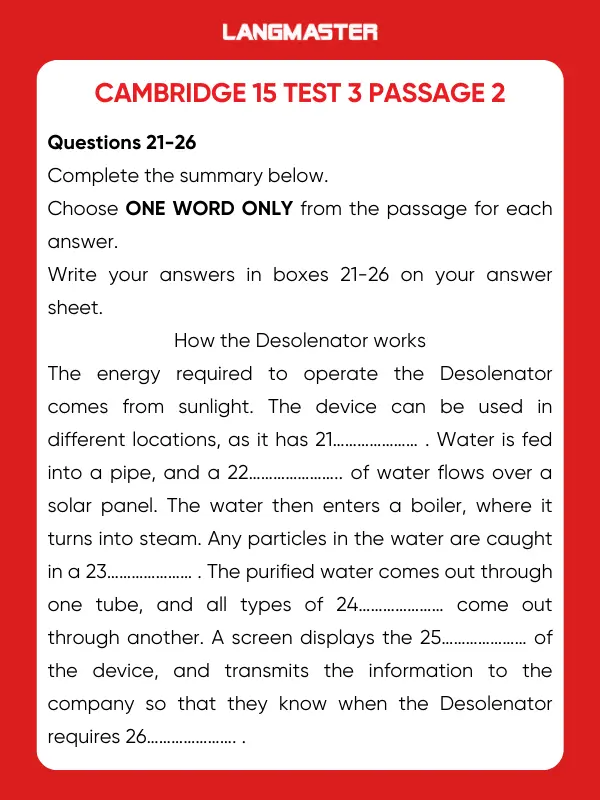
Questions 21-26
Complete the summary below.
Choose ONE WORD ONLY from the passage for each answer.
Write your answers in boxes 21-26 on your answer sheet.
How the Desolenator works
The energy required to operate the Desolenator comes from sunlight. The device can be used in different locations, as it has 21………………… . Water is fed into a pipe, and a 22………………….. of water flows over a solar panel. The water then enters a boiler, where it turns into steam. Any particles in the water are caught in a 23………………… . The purified water comes out through one tube, and all types of 24………………… come out through another. A screen displays the 25………………… of the device, and transmits the information to the company so that they know when the Desolenator requires 26…………………. .
>> Xem thêm: Giải đề IELTS Reading: Stepwells [Full answers]
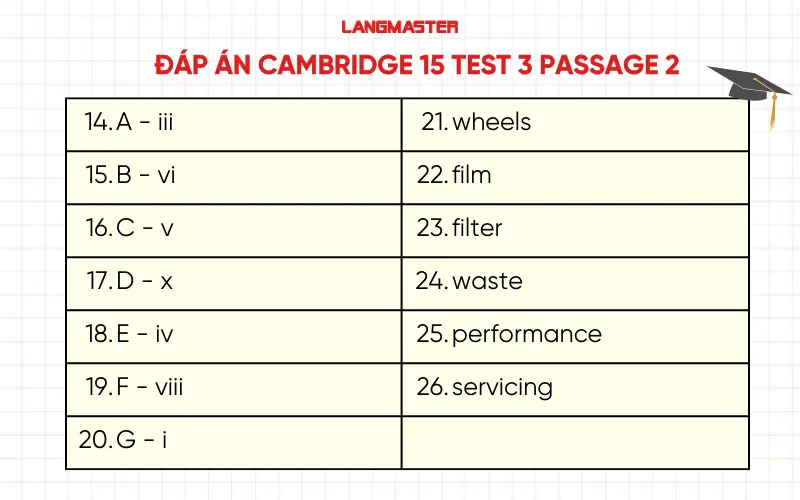
14. Đáp án: A - iii
Vị trí thông tin: Section A – câu nói về việc Janssen đi Thái Lan và “Two decades later … developed that basic idea … into a portable device …”
Giải thích: Đoạn A mô tả rõ tiến trình từ cảm hứng ban đầu (thấy hệ thống nước nóng năng lượng mặt trời trên mái nhà ở Thái Lan) đến việc phát triển thành sản phẩm mới (thiết bị di động dùng năng lượng mặt trời để lọc nước). Vì vậy heading iii phù hợp nhất.
15. Đáp án: B - vi
Vị trí thông tin: Section B – câu: “can take water from different places, such as the sea, rivers, boreholes and rain, and purify it …”
Giải thích: Ý chính của đoạn B là thiết bị có thể lấy nước từ nhiều nguồn khác nhau (biển, sông, giếng khoan, nước mưa) rồi làm sạch để uống. Đây chính xác là nội dung của heading vi.
16. Đáp án: C - v
Vị trí thông tin: Section C – câu: “Its main selling point is that unlike standard desalination techniques, it doesn’t require a generated power supply: just sunlight.”
Giải thích: Đoạn C nhấn mạnh điểm khác biệt quan trọng nhất của Desolenator so với phương pháp khử mặn thông thường: không cần nguồn điện tạo ra, chỉ cần ánh nắng mặt trời. Đây là “USP/điểm nổi bật so với lựa chọn khác”, khớp với heading v
17. Đáp án: D - x
Vị trí thông tin: Section D – câu: “at least two-thirds of the world’s population …” và “by 2030 half of the world’s population …”
Giải thích: Đoạn D tập trung vào quy mô người bị ảnh hưởng bởi khan hiếm nước, đưa số liệu hiện tại (ít nhất hai phần ba dân số) và dự báo tương lai (đến năm hai nghìn không trăm ba mươi, một nửa dân số). Vì vậy heading x là phù hợp nhất.
18. Đáp án: E - iv
Vị trí thông tin: Section E – câu: “aimed at a wide variety of users … from homeowners in the developing world … to people living off the grid …” và phần nói về camping/boats/military.
Giải thích: Đoạn E liệt kê nhiều nhóm người dùng mục tiêu: hộ gia đình ở các nước đang phát triển thiếu nước ổn định, người sống off-grid ở Mỹ, và thị trường ngách ở các nước phát triển (cắm trại, thuyền, quân đội). Nội dung này đúng với heading iv về phạm vi khách hàng tiềm năng.
19. Đáp án: F - viii
Vị trí thông tin: Section F – câu: “We are a venture with a social mission … mainly finding application in the developing world and humanitarian sector …” và “to be a viable company there is a bottom line …”
Giải thích: Đoạn F nhấn mạnh công ty có sứ mệnh xã hội, sản phẩm chủ yếu phục vụ thế giới đang phát triển và lĩnh vực nhân đạo, đồng thời thừa nhận vẫn cần “bottom line” để tồn tại. Trọng tâm là không đặt lợi nhuận là ưu tiên số một, nên heading viii phù hợp.
20. Đáp án: G - i
Vị trí thông tin: Section G – câu: “It has raised £340,000 in funding so far.”
Giải thích: Đoạn G nói trực tiếp về nguồn vốn huy động của công ty (đã gọi vốn được ba trăm bốn mươi nghìn bảng Anh) và kế hoạch mở rộng bán hàng. Nội dung này khớp nhất với heading i về tài chính/nguồn vốn để triển khai sản xuất – hoạt động.
21. Đáp án: wheels
Vị trí thông tin: Section C – câu: “...easy to transport, thanks to its two wheels.”
Giải thích: Tóm tắt nói thiết bị dùng được ở nhiều nơi vì có thứ giúp dễ di chuyển. Đoạn C nêu rõ thiết bị dễ vận chuyển nhờ two wheels → chọn wheels (một từ).
22. Đáp án: film
Vị trí thông tin: Section C – câu: “...flows as a thin film ...”
Giải thích: Tóm tắt cần danh từ chỉ “một lớp nước” chảy qua tấm pin mặt trời. Bài dùng đúng cụm “thin film” → đáp án là film.
23. Đáp án: filter
Vị trí thông tin: Section C – câu: “The device has a very simple filter to trap particles ...”
Giải thích: Tóm tắt nói hạt bụi/cặn bị giữ lại trong một thứ gì đó. Đoạn C gọi đó là filter → đáp án filter.
24. Đáp án: waste
Vị trí thông tin: Section C – câu: “...one for the waste – salt from seawater, fluoride, etc. – and another for the distilled water.”
Giải thích: Tóm tắt nói nước tinh khiết ra một ống, còn “mọi loại …” ra ống khác. Đoạn C dùng đúng từ waste để chỉ phần thải (muối, fluoride, v.v.) → đáp án waste.
25. Đáp án: performance
Vị trí thông tin: Section C – câu: “The performance of the unit is shown on an LCD screen ...”
Giải thích: “A screen displays the … of the device” khớp trực tiếp với “performance … is shown on an LCD screen” → đáp án performance.
26. Đáp án: servicing
Vị trí thông tin: Section C – câu: “...transmitted to the company which provides servicing when necessary.”
Giải thích: Tóm tắt nói công ty nhận dữ liệu để biết khi nào thiết bị cần “…” (bảo trì/sửa chữa). Trong bài dùng đúng từ servicing → đáp án servicing.
>> Xem thêm:
READING PASSAGE 3
You should spend about 20 minutes on Questions 27-40 which are based on Reading Passage 3 below.
Why fairy tales are really scary tales
Some people think that fairy tales are just stories to amuse children, but their universal and enduring appeal may be due to more serious reasons
A. People of every culture tell each other fairy tales but the same story often takes a variety of forms in different parts of the world. In the story of Little Red Riding Hood that European children are familiar with, a young girl on the way to see her grandmother meets a wolf and tells him where she is going. The wolf runs on ahead and disposes of the grandmother, then gets into bed dressed in the grandmother’s clothes to wait for Little Red Riding Hood. You may think you know the story – but which version? In some versions, the wolf swallows up the grandmother, while in others it locks her in a cupboard. In some stories Red Riding Hood gets the better of the wolf on her own, while in others a hunter or a woodcutter hears her cries and comes to her rescue.
(Người thuộc mọi nền văn hóa đều kể cho nhau nghe truyện cổ tích, nhưng cùng một câu chuyện thường có nhiều biến thể khác nhau ở những nơi khác nhau trên thế giới. Trong câu chuyện Cô bé quàng khăn đỏ mà trẻ em châu Âu quen thuộc, một cô bé trên đường đến thăm bà ngoại gặp một con sói và kể cho nó biết mình đang đi đâu. Con sói chạy trước và xử lý bà ngoại, rồi chui vào giường, mặc quần áo của bà để chờ Cô bé quàng khăn đỏ. Bạn có thể nghĩ rằng mình đã biết câu chuyện này – nhưng là phiên bản nào? Ở một số phiên bản, con sói nuốt chửng bà ngoại, còn ở những phiên bản khác, nó nhốt bà vào trong tủ. Ở một số câu chuyện, Cô bé quàng khăn đỏ tự mình đánh bại con sói, còn ở những câu chuyện khác, một thợ săn hoặc tiều phu nghe tiếng kêu cứu của cô và đến giải cứu.)
B. The universal appeal of these tales is frequently attributed to the idea that they contain cautionary messages: in the case of Little Red Riding Hood, to listen to your mother, and avoid talking to strangers. ‘It might be what we find interesting about this story is that it’s got this survival-relevant information in it,’ says anthropologist Jamie Tehrani at Durham University in the UK. But his research suggests otherwise. ‘We have this huge gap in our knowledge about the history and prehistory of storytelling, despite the fact that we know this genre is an incredibly ancient one,’ he says. That hasn’t stopped anthropologists, folklorists and other academics devising theories to explain the importance of fairy tales in human society. Now Tehrani has found a way to test these ideas, borrowing a technique from evolutionary biologists.
(Sức hấp dẫn phổ quát của những câu chuyện này thường được cho là đến từ việc chúng chứa các thông điệp mang tính cảnh báo: trong trường hợp Cô bé quàng khăn đỏ, đó là hãy nghe lời mẹ và tránh nói chuyện với người lạ. “Có thể điều khiến chúng ta thấy câu chuyện này thú vị là vì nó chứa thông tin liên quan đến sinh tồn,” nhà nhân học Jamie Tehrani tại Đại học Durham (Vương quốc Anh) nói. Nhưng nghiên cứu của ông lại gợi ý điều ngược lại. “Chúng ta có một khoảng trống kiến thức rất lớn về lịch sử và tiền sử của việc kể chuyện, mặc dù chúng ta biết thể loại này là một thể loại cực kỳ cổ xưa,” ông nói. Điều đó không ngăn các nhà nhân học, nhà nghiên cứu dân gian học và các học giả khác xây dựng những lý thuyết để giải thích tầm quan trọng của truyện cổ tích trong xã hội loài người. Giờ đây, Tehrani đã tìm ra một cách để kiểm nghiệm các ý tưởng này, bằng cách mượn một kỹ thuật từ sinh học tiến hóa.)
C. To work out the evolutionary history, development and relationships among groups of organisms, biologists compare the characteristics of living species in a process called ‘phylogenetic analysis’. Tehrani has used the same approach to compare related versions of fairy tales to discover how they have evolved and which elements have survived longest.
(Để tìm ra lịch sử tiến hóa, sự phát triển và mối quan hệ giữa các nhóm sinh vật, các nhà sinh học so sánh đặc điểm của các loài đang sống trong một quá trình gọi là “phân tích phát sinh chủng loại” (phylogenetic analysis). Tehrani đã sử dụng cách tiếp cận tương tự để so sánh các phiên bản liên quan của truyện cổ tích nhằm khám phá chúng đã tiến hóa như thế nào và những yếu tố nào tồn tại lâu bền nhất.)
D. Tehrani’s analysis focused on Little Red Riding Hood in its many forms, which include another Western fairy tale known as The Wolf and the Kids. Checking for variants of these two tales and similar stories from Africa, East Asia and other regions, he ended up with 58 stories recorded from oral traditions. Once his phylogenetic analysis had established that they were indeed related, he used the same methods to explore how they have developed and altered over time.
(Phân tích của Tehrani tập trung vào Cô bé quàng khăn đỏ dưới nhiều hình thức, trong đó có một truyện cổ tích phương Tây khác được biết đến với tên Sói và đàn dê con. Khi kiểm tra các biến thể của hai câu chuyện này và những câu chuyện tương tự từ châu Phi, Đông Á và các khu vực khác, cuối cùng ông thu thập được năm mươi tám câu chuyện được ghi lại từ truyền thống truyền miệng. Sau khi phân tích phát sinh chủng loại xác lập rằng chúng thực sự có liên hệ với nhau, ông dùng các phương pháp tương tự để khảo sát cách chúng phát triển và thay đổi theo thời gian.)
E. First he tested some assumptions about which aspects of the story alter least as it evolves, indicating their importance. Folklorists believe that what happens in a story is more central to the story than the characters in it – that visiting a relative, only to be met by a scary animal in disguise, is more fundamental than whether the visitor is a little girl or three siblings, or the animal is a tiger instead of a wolf.
(Trước hết, ông kiểm tra một số giả định về việc những khía cạnh nào của câu chuyện thay đổi ít nhất khi nó tiến hóa, qua đó cho thấy tầm quan trọng của chúng. Các nhà dân gian học tin rằng những gì xảy ra trong câu chuyện mang tính cốt lõi hơn so với các nhân vật trong đó — rằng việc đi thăm một người thân rồi gặp một con vật đáng sợ đang cải trang quan trọng hơn việc người đi thăm là một bé gái hay ba anh em, hoặc con vật là hổ thay vì sói.)
F. However, Tehrani found no significant difference in the rate of evolution of incidents compared with that of characters. Certain episodes are very stable because they are crucial to the story, but there are lots of other details that can evolve quite freely,’ he says. Neither did his analysis support the theory that the central section of a story is the most conserved part. He found no significant difference in the flexibility of events there compared with the beginning or the end.
(Tuy nhiên, Tehrani không tìm thấy sự khác biệt đáng kể nào về tốc độ tiến hóa của các tình tiết so với các nhân vật. “Một số phân đoạn rất ổn định vì chúng đóng vai trò thiết yếu đối với câu chuyện, nhưng có rất nhiều chi tiết khác có thể thay đổi khá tự do,” ông nói. Phân tích của ông cũng không ủng hộ giả thuyết cho rằng phần trung tâm của một câu chuyện là phần được bảo tồn nhiều nhất. Ông không phát hiện sự khác biệt đáng kể nào về mức độ linh hoạt của các sự kiện ở đó so với phần mở đầu hoặc phần kết thúc.)
G. But the really big surprise came when he looked at the cautionary elements of the story. ‘Studies on hunter-gatherer folk tales suggest that these narratives include really important information about the environment and the possible dangers that may be faced there – stuff that’s relevant to survival,’ he says. Yet in his analysis such elements were just as flexible as seemingly trivial details. What, then, is important enough to be reproduced from generation to generation?
(Nhưng bất ngờ lớn nhất thực sự đến khi ông xem xét các yếu tố mang tính cảnh báo trong câu chuyện. “Các nghiên cứu về truyện dân gian của các cộng đồng săn bắt – hái lượm cho thấy những câu chuyện này bao gồm những thông tin rất quan trọng về môi trường và các mối nguy hiểm có thể gặp phải ở đó — những thứ liên quan đến sinh tồn,” ông nói. Thế nhưng trong phân tích của ông, các yếu tố như vậy lại linh hoạt không kém những chi tiết tưởng như vụn vặt. Vậy thì, điều gì đủ quan trọng để được tái kể từ thế hệ này sang thế hệ khác?)
H. The answer, it would appear, is fear-blood-thirsty and gruesome aspects of the story, such as the eating of the grandmother by the wolf, turned out to be the best preserved of all. Why are these details retained by generations of storytellers, when other features are not? Tehrani has an idea: ‘In an oral context, a story won’t survive because of one great teller. It also needs to be interesting when it’s told by someone who’s not necessarily a great storyteller.’ Maybe being swallowed whole by a wolf, then cut out of its stomach alive is so gripping that it helps the story remain popular, no matter how badly it’s told.
(Câu trả lời dường như là các khía cạnh gây sợ hãi, khát máu và rùng rợn của câu chuyện — chẳng hạn cảnh con sói ăn thịt bà ngoại — hóa ra lại là những chi tiết được bảo tồn tốt nhất trong tất cả. Vì sao những chi tiết này được các thế hệ người kể chuyện giữ lại, trong khi những đặc điểm khác thì không? Tehrani có một giả thuyết: “Trong bối cảnh truyền miệng, một câu chuyện không thể tồn tại chỉ nhờ một người kể xuất sắc. Nó cũng cần phải hấp dẫn khi được kể bởi một người không nhất thiết là một người kể chuyện giỏi.” Có lẽ việc bị sói nuốt chửng nguyên con, rồi lại được moi ra khỏi bụng nó khi vẫn còn sống hấp dẫn đến mức giúp câu chuyện luôn được yêu thích, dù người kể có kể vụng về đến đâu.)
I. Jack Zipes at the University of Minnesota, Minneapolis, is unconvinced by Tehrani’s views on fairy tales. ‘Even if they’re gruesome, they won’t stick unless they matter,’ he says. He believes the perennial theme of women as victims in stories like Little Red Riding Hood explains why they continue to feel relevant. But Tehrani points out that although this is often the case in Western versions, it is not always true elsewhere. In Chinese and Japanese versions, often known as The Tiger Grandmother, the villain is a woman, and in both Iran and Nigeria, the victim is a boy.
(Jack Zipes tại Đại học Minnesota, Minneapolis không bị thuyết phục bởi quan điểm của Tehrani về truyện cổ tích. “Ngay cả khi chúng rùng rợn, chúng cũng sẽ không bám lại nếu chúng không có ý nghĩa,” ông nói. Ông tin rằng chủ đề dai dẳng về phụ nữ là nạn nhân trong những câu chuyện như Cô bé quàng khăn đỏ giải thích vì sao chúng vẫn luôn có vẻ liên quan. Nhưng Tehrani chỉ ra rằng dù điều này thường đúng trong các phiên bản phương Tây, nó không phải lúc nào cũng đúng ở nơi khác. Trong các phiên bản Trung Quốc và Nhật Bản, thường được gọi là Bà ngoại hổ, kẻ phản diện là một người phụ nữ; và ở cả Iran lẫn Nigeria, nạn nhân lại là một cậu bé.)
J. Mathias Clasen at Aarhus University in Denmark isn’t surprised by Tehrani’s findings. ‘Habits and morals change, but the things that scare us, and the fact that we seek out entertainment that’s designed to scare us – those are constant,’ he says. Clasen believes that scary stories teach us what it feels like to be afraid without having to experience real danger, and so build up resistance to negative emotions.
(Mathias Clasen tại Đại học Aarhus (Đan Mạch) không ngạc nhiên trước các phát hiện của Tehrani. “Thói quen và đạo đức thay đổi, nhưng những thứ khiến chúng ta sợ hãi, và việc chúng ta tìm kiếm sự giải trí được thiết kế để làm ta sợ — những điều đó là hằng số,” ông nói. Clasen tin rằng các câu chuyện đáng sợ dạy chúng ta cảm giác sợ hãi như thế nào mà không cần trải qua nguy hiểm thật, từ đó xây dựng khả năng chống chịu trước những cảm xúc tiêu cực.)
Questions 27-31
Complete each sentence with the correct ending, A-F, below.
Write the correct letter, A-F, in boxes 27-31 on your answer sheet.
27 In fairy tales, details of the plot
28 Tehrani rejects the idea that the useful lessons for life in fairy tales
29 Various theories about the social significance of fairy tales
30 Insights into the development of fairy tales
31 All the fairy tales analysed by Tehrani
A may be provided through methods used in biological research.
B are the reason for their survival.
C show considerable global variation.
D contain animals which transform to become humans.
E were originally spoken rather than written.
F have been developed without factual basis.
Questions 32-36
Complete the summary using the list of words, A-I, below.
Write the correct letter, A-I, in boxes 32-36 on your answer sheet.
Phylogenetic analysis of Little Red Riding Hood
Tehrani used techniques from evolutionary biology to find out if 32………………….. existed among 58 stories from around the world. He also wanted to know which aspects of the stories had fewest 33…………………., as he believed these aspects would be the most important ones. Contrary to other beliefs, he found that some 34……………………. that were included in a story tended to change over time, and that the middle of a story seemed no more important than the other parts. He was also surprised that parts of a story which seemed to provide some sort of 35…………………. were unimportant. The aspect that he found most important in a story’s survival was 36…………………
ending
events
warning
links
records
variations
horror
people
plot
Questions 37-40
Choose the correct letter, A, B, C or D.
Write the correct letter in boxes 37-40 on your answer sheet.
37 What method did Jamie Tehrani use to test his ideas about fairy tales?
He compared oral and written forms of the same stories.
He looked at many different forms of the same basic story.
He looked at unrelated stories from many different countries.
He contrasted the development of fairy tales with that of living creatures.
38 When discussing Tehrani’s views, Jack Zipes suggests that
Tehrani ignores key changes in the role of women.
stories which are too horrific are not always taken seriously.
Tehrani overemphasises the importance of violence in stories.
features of stories only survive if they have a deeper significance.
39 Why does Tehrani refer to Chinese and Japanese fairy tales?
to indicate that Jack Zipes’ theory is incorrect
to suggest that crime is a global problem
to imply that all fairy tales have a similar meaning
to add more evidence for Jack Zipes’ ideas
40 What does Mathias Clasen believe about fairy tales?
They are a safe way of learning to deal with fear.
They are a type of entertainment that some people avoid.
They reflect the changing values of our society.
They reduce our ability to deal with real-world problems.
>> Xem thêm: Tổng hợp tài liệu luyện thi IELTS Reading miễn phí cơ bản đến nâng cao
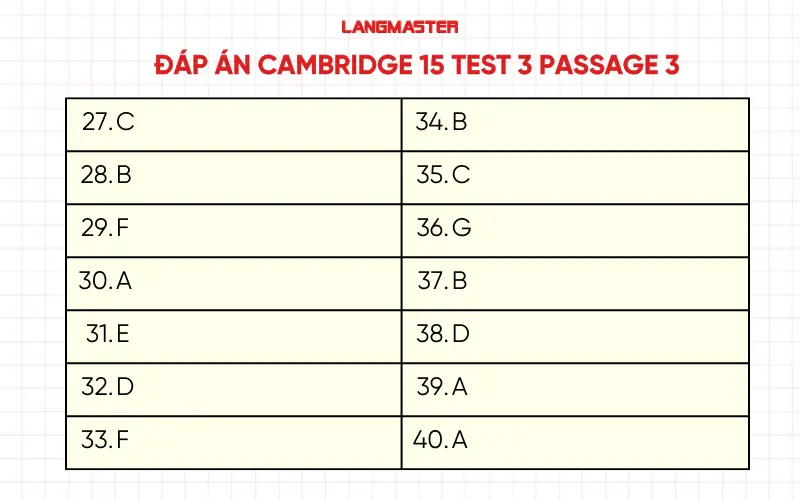
27. Đáp án: C
Vị trí thông tin: Paragraph A – “the same story often takes a variety of forms in different parts of the world”, và các ví dụ nhiều phiên bản khác nhau của Little Red Riding Hood.
Giải thích: Đoạn A nhấn mạnh cùng một truyện cổ tích nhưng có nhiều biến thể tùy khu vực (nuốt bà hay nhốt tủ, tự thoát hay được cứu). Vì vậy “details of the plot” show considerable global variation → C.
28. Đáp án: B
Vị trí thông tin: Paragraph G – “cautionary elements… were just as flexible as seemingly trivial details” + câu hỏi “What… is important enough to be reproduced…?”
Giải thích: Tehrani cho thấy các yếu tố “bài học sinh tồn/cảnh báo” không được bảo tồn tốt hơn các chi tiết vụn vặt, tức ông bác bỏ quan điểm rằng các bài học hữu ích chính là lý do truyện tồn tại qua nhiều thế hệ. Do đó chọn “are the reason for their survival” → B.
29. Đáp án: F
Vị trí thông tin: Paragraph B – “huge gap in our knowledge…” nhưng “That hasn’t stopped… devising theories…”
Giải thích: Bài đọc nói rõ dù còn khoảng trống lớn về bằng chứng/hiểu biết lịch sử, giới học thuật vẫn đưa ra nhiều lý thuyết về vai trò xã hội của truyện cổ tích. Điều này khớp với ý “được phát triển khi chưa có nền tảng факт/bằng chứng vững chắc” → F.
30. Đáp án: A
Vị trí thông tin: Paragraph B-C – Tehrani “borrowing a technique from evolutionary biologists” và dùng “phylogenetic analysis”.
Giải thích: “Insights into the development of fairy tales” (hiểu biết về sự phát triển/tiến hóa của truyện) được tạo ra nhờ phương pháp mượn từ sinh học (phylogenetic analysis). Vì vậy chọn A.
31. Đáp án: E
Vị trí thông tin: Paragraph D – “58 stories recorded from oral traditions.”
Giải thích: “Oral traditions” nghĩa là các truyện được lưu truyền bằng truyền miệng trước khi được ghi chép. Vì vậy, tất cả truyện Tehrani phân tích “were originally spoken rather than written” → E.
32. Đáp án: D
Vị trí thông tin: Paragraph D – “Once his phylogenetic analysis had established that they were indeed related …”
Giải thích: Tóm tắt nói Tehrani muốn biết liệu có “…” tồn tại giữa năm mươi tám câu chuyện khắp thế giới hay không. Đoạn D cho thấy ông dùng phân tích phát sinh chủng loại để xác định các câu chuyện có liên hệ/related → chọn links.
33. Đáp án: F
Vị trí thông tin: Paragraph E – “First he tested some assumptions about which aspects of the story alter least as it evolves …”
Giải thích: “which aspects … had fewest …” nghĩa là những khía cạnh thay đổi ít nhất khi câu chuyện tiến hóa. Từ trong danh sách phù hợp nhất là variations (ít biến thể/ít thay đổi).
34. Đáp án: B
Vị trí thông tin: Paragraph F – “no significant difference in the rate of evolution of incidents compared with that of characters …” và “flexibility of events …”
Giải thích: Tóm tắt nói ông phát hiện trái với niềm tin trước đó rằng một số “…” trong câu chuyện có xu hướng thay đổi theo thời gian. Đoạn F bàn trực tiếp về mức độ thay đổi của incidents/events → chọn events.
35. Đáp án: C
Vị trí thông tin: Paragraph G – “cautionary elements …” và “Yet … such elements were just as flexible …”
Giải thích: “parts … provide some sort of …” chính là các yếu tố mang tính cảnh báo/cautionary. Trong danh sách, từ tương ứng là warning.
36. Đáp án: G
Vị trí thông tin: Paragraph H – “fear-blood-thirsty and gruesome aspects … best preserved …”
Giải thích: Đoạn H kết luận những chi tiết đáng sợ/rùng rợn/ghê rợn là thứ được bảo tồn tốt nhất và giúp câu chuyện sống sót qua nhiều thế hệ → chọn horror.
37. Đáp án: B
Vị trí thông tin: Paragraph C–D – Tehrani dùng “phylogenetic analysis” để “compare related versions of fairy tales”, nghiên cứu Little Red Riding Hood “in its many forms” và thu thập 58 phiên bản.
Giải thích: Phương pháp của Tehrani là so sánh nhiều phiên bản khác nhau của cùng một câu chuyện cơ bản để xem chúng tiến hóa ra sao. Vì vậy chọn B
38. Đáp án: D
Vị trí thông tin: Paragraph I – Jack Zipes: “Even if they’re gruesome, they won’t stick unless they matter.”
Giải thích: Zipes cho rằng chi tiết dù rùng rợn đến đâu cũng không tồn tại lâu nếu không có ý nghĩa sâu hơn. Điều này khớp trực tiếp với D
39. Đáp án: A
Vị trí thông tin: Paragraph I – Tehrani phản biện Zipes bằng cách nói chủ đề “women as victims” đúng ở phiên bản phương Tây nhưng không đúng ở nơi khác; ví dụ Trung Quốc/Nhật (villain là phụ nữ) và Iran/Nigeria (victim là bé trai).
Giải thích: Tehrani đưa ví dụ truyện Trung Quốc và Nhật để chỉ ra điểm yếu trong lập luận của Zipes rằng truyện tồn tại vì chủ đề phụ nữ là nạn nhân. Vì vậy chọn A
40. Đáp án: A
Vị trí thông tin: Paragraph J – Clasen: scary stories “teach us what it feels like to be afraid without having to experience real danger”, giúp “build up resistance to negative emotions.”
Giải thích: Clasen tin truyện đáng sợ giúp con người trải nghiệm nỗi sợ một cách an toàn (không gặp nguy hiểm thật) và rèn sức chống chịu cảm xúc. Vì vậy chọn A.
>> Xem thêm: Cách làm Matching Features IELTS Reading “ẵm trọn” điểm cao
Khi luyện IELTS Reading, nhiều người học gặp chung một vấn đề: đọc thì hiểu, nhưng làm bài lại sai hoặc không kịp thời gian. Nguyên nhân không nằm ở việc bạn “chưa học đủ nhiều”, mà ở chỗ chưa được trang bị đúng chiến lược đọc – phân tích – xử lý paraphrase theo chuẩn IELTS. Khi thiếu một hệ thống xử lý bài bản, càng làm nhiều đề càng dễ rơi vào vòng lặp: làm – sai – chữa qua loa – làm tiếp – band vẫn đứng yên.
Thực tế, không ít học viên học IELTS trong thời gian dài nhưng band điểm vẫn “giậm chân tại chỗ”. Họ chăm chỉ làm đề, ghi chép từ vựng, học mẹo rời rạc, nhưng thiếu một lộ trình rõ ràng gắn với mục tiêu band điểm cụ thể.
Với hơn 16 năm kinh nghiệm đào tạo tiếng Anh, Langmaster xây dựng khóa học IELTS online theo tư duy hệ thống, đi từ nền tảng đến nâng cao, bám sát từng mục tiêu band điểm cụ thể thay vì dạy chung một khung cho tất cả học viên.
Lớp học online sĩ số nhỏ: Mỗi lớp chỉ từ 7-10 học viên, đảm bảo thời lượng tương tác cao. Giáo viên theo sát tiến trình từng người, sửa lỗi chi tiết và điều chỉnh cách học phù hợp với năng lực cá nhân. Đây là điểm khác biệt lớn so với các lớp IELTS online đông người trên thị trường.
Lộ trình học cá nhân hóa theo trình độ và mục tiêu band điểm: Trước khi vào học, học viên được đánh giá đầu vào đầy đủ bốn kỹ năng. Qua đó, Langmaster xây dựng lộ trình phù hợp: từ củng cố nền tảng cho người mất gốc, đến luyện kỹ năng làm bài cho mục tiêu IELTS. Từ đó, lớp học không chỉ “học theo giáo trình”, mà tập trung đúng phần cần cải thiện để tránh học lan man và tiết kiệm thời gian.
Giáo viên chuẩn quốc tế, chấm chữa kỹ lưỡng: Đội ngũ giáo viên sở hữu chứng chỉ IELTS 7.5+, giàu kinh nghiệm giảng dạy và luyện thi. Bài tập được chấm chữa chi tiết trong 24h, chỉ rõ lỗi sai, nguyên nhân và cách cải thiện cụ thể, không nhận xét chung chung.
Luyện đề và thi thử định kỳ theo format thật: Học viên thường xuyên được luyện đề và tham gia các bài thi thử sát đề thi IELTS, giúp học viên làm quen với áp lực thời gian; Nắm rõ chiến lược làm bài và nhận diện điểm mạnh – điểm yếu để điều chỉnh lộ trình kịp thời. Nhờ vậy, người học tránh được cảm giác “ngợp đề” và giảm sai sót do tâm lý khi vào phòng thi.
Coaching 1-1 cùng chuyên gia: Phù hợp với học viên cần bứt band trong thời gian ngắn, hoặc gặp khó khăn ở một kỹ năng cụ thể. Giáo viên tập trung xử lý đúng “điểm nghẽn” cá nhân.
Học online nhưng không học một mình: Dù học online, học viên vẫn được tương tác trực tiếp với giáo viên, luyện nói thường xuyên, nhận phản hồi liên tục và sử dụng hệ sinh thái học tập hỗ trợ đầy đủ, giúp duy trì động lực và tiến độ học tập.
Trên đây là toàn bộ nội dung dịch đề và giải chi tiết đáp án cho bài Cambridge 15 test 3, giúp người học nắm rõ ý chính từng đoạn, hiểu cách xác định từ khóa, nhận diện paraphrase và tránh các bẫy thường gặp trong IELTS Reading. Nếu mục tiêu của bạn là học IELTS online một cách bài bản, có lộ trình rõ ràng và được sửa đúng lỗi để tăng band thật, khóa học IELTS online tại Langmaster là lựa chọn phù hợp để rút ngắn thời gian và tối ưu hiệu quả học tập.

![Giải đề thi European Heat Wave IELTS Reading [FULL ANSWER]](https://langmaster.edu.vn/storage/uploads/original/2025/11/20/european-heat-wave-ielts-reading-answers.png)
Tổng hợp đề thi European Heat Wave IELTS Reading Answers kèm phân tích chi tiết, từ vựng và đáp án giúp bạn tối ưu điểm Reading nhanh chóng.
![Đề thi IELTS Reading có đáp án mới nhất 2025-2026 [Cập nhật liên tục]](https://langmaster.edu.vn/storage/uploads/original/2025/12/25/de-thi-ielts-reading.png)
Đề thi IELTS Reading có đáp án mới nhất 2025/2026, cập nhật liên tục đề thi thật và Cambridge, kèm lời giải chi tiết giúp nâng band hiệu quả.
Bài viết tổng hợp chi tiết đề thi IELTS Reading Holidays with a difference, đáp án kèm giải thích chi tiết, từ vựng cần lưu ý khi làm bài giúp bạn luyện thi hiệu quả và nâng cao band điểm.
Bài viết tổng hợp chi tiết đề thi IELTS Reading on the trail of the honey badger, đáp án kèm giải thích chi tiết, từ vựng cần lưu ý khi làm bài giúp bạn luyện thi hiệu quả và nâng cao band điểm.
![Giải đề IELTS Reading Growing more for less [FULL ANSWER]](https://langmaster.edu.vn/storage/uploads/original/2025/10/22/growing-more-for-less-ielts-reading-answers.png)
Khám phá bài đọc Growing more for less IELTS Reading: Tổng hợp đáp án, từ vựng quan trọng và phân tích chi tiết giúp bạn hiểu cách công nghệ vệ tinh hỗ trợ nông nghiệp hiện đại




Hơn 16 năm kinh nghiệm, đào tạo thành công hàng trăm nghìn học viên
Phương pháp giảng dạy hiện đại, học viên tiến bộ rõ rệt
Lộ trình học chuẩn quốc tế, phù hợp với nhu cầu thực tiễn
Giáo viên đạt chuẩn Quốc tế với chất lượng top đầu thị trường, giàu kinh nghiệm
Học online linh hoạt, cam kết đầu ra bằng văn bản

![Giải Cam IELTS 15, Test 1, Reading Passage 1: Nutmeg - a valuable spice [FULL ANSWERS]](https://langmaster.edu.vn/storage/uploads/original/2026/01/21/nutmeg-a-valuable-spice-reading-answers (1).png)
.png)
.png)
.png)
.png)