Khóa học
IELTS Online
IELTS Online
Giảm đến 18%
Đăng ký ngay
Mục lục [Ẩn]
Trong quá trình luyện IELTS Reading, việc thực hành với các đề thi thật là phương pháp hiệu quả để cải thiện band điểm nhanh chóng. Bài viết này sẽ hướng dẫn bạn chinh phục trọn vẹn đề IELTS Reading “The fashion industry”, bao gồm đề bài, hệ thống câu hỏi, đáp án kèm phân tích chi tiết và dễ hiểu. Đây chắc chắn sẽ là nguồn tài liệu hữu ích giúp bạn rèn luyện kỹ năng Reading và tiến gần hơn tới band điểm mong muốn trong kỳ thi IELTS.
Reading passage 2
The fashion industry
Questions 14-20
Reading Passage 2 has seven sections, A-G.
Choose the correct heading for each section from the list of headings below. Write the correct number, in boxes 14-20 on your answer sheet.
List of Heading
i. How new clothing styles are created
ii. The rise of the fashion industry
iii. Joining the garment pieces together
iv. Producing materials with a range of features
v. The importance of the fashion industry
vi. Factors affecting international commerce
vii. The attractions of becoming a fashion model
viii. Making patterns for people with different body shapes
List of Sections
Questions 21-24
Complete the summary below.
Choose NO MORE THAN TWO WORDS from the passage for each answer. Write your answers in boxes 21-24 on your answer sheet.
The development of a modern fashion industry
Up until the middle of the 19th century, people generally wore handmade clothes. After that, the situation changed, and by the 20th century, many clothes were mass-produced. This development was partly due to inventions like the 21……….. It was also the result of general changes in manufacturing systems, as well as the spread of shops like 22……….. The changes also led to the standardization of sizes and 23…………… Today, despite the fact that the fashion industry originated in 24……………, it has become a truly international enterprise.
Questions 25 and 26
Choose TWO letters, A-E.
Write the correct letters in boxes 25 and 26 on your answer sheet.
Which TWO of the following statements does the writer make about garment assembly?
Nguồn: Internet
>> Xem thêm:
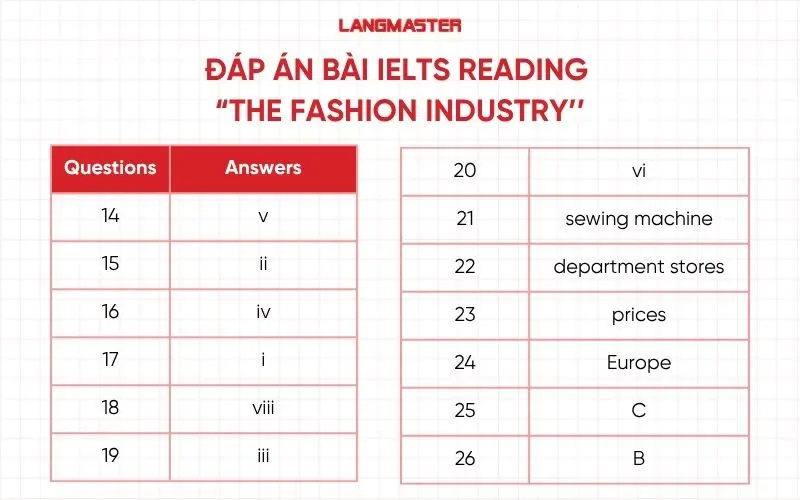
|
Questions |
Answers |
|
14 |
v |
|
15 |
ii |
|
16 |
iv |
|
17 |
i |
|
18 |
viii |
|
19 |
iii |
|
20 |
vi |
|
21 |
sewing machine |
|
22 |
department stores |
|
23 |
prices |
|
24 |
Europe |
|
25 |
C |
|
26 |
D |
Câu 14: v (The importance of the fashion industry)
Đoạn A mở đầu bằng việc mô tả quy mô to lớn và sức ảnh hưởng kinh tế của ngành thời trang – “a multibillion-dollar global enterprise” – đồng thời nhấn mạnh rằng ngành này chiếm “a significant share of world economic output”. Toàn đoạn thể hiện rõ vai trò quan trọng của thời trang trong nền kinh tế toàn cầu, vì vậy tiêu đề phù hợp nhất là The importance of the fashion industry.
Câu 15: ii (The rise of the fashion industry)
Đoạn B trình bày sự thay đổi lớn trong ngành thời trang kể từ giữa thế kỷ 19: từ quần áo may thủ công sang sản xuất hàng loạt nhờ sự ra đời của máy may, hệ thống nhà máy và cửa hàng bách hóa. Đây là quá trình hình thành và phát triển của ngành thời trang hiện đại, nên tiêu đề chính xác là The rise of the fashion industry.
Câu 16: iv (Producing materials with a range of features)
Đoạn C tập trung vào quy trình tạo ra các loại vải và sợi với nhiều đặc tính khác nhau: khả năng chống tia UV, chống bẩn, giữ hoặc tản nhiệt, và bảo vệ khỏi nguy hiểm. Đây chính là nội dung mô tả việc sản xuất vật liệu với nhiều đặc tính đa dạng, nên đáp án đúng là Producing materials with a range of features.
Câu 17: i (How new clothing styles are created)
Đoạn D nói về vai trò của các nhà thiết kế thời trang. Tác giả chỉ ra rằng dù một số người như Coco Chanel hay Calvin Klein nổi tiếng toàn cầu, đa số nhà thiết kế lại làm việc ẩn danh, thiết kế dựa trên nhu cầu thị trường và lấy cảm hứng từ phim ảnh, đường phố hay thể thao. Nội dung này cho thấy cách mà các kiểu quần áo mới được hình thành, nên tiêu đề chính xác là How new clothing styles are created.
Câu 18: viii (Making patterns for people with different body shapes)
Đoạn E tập trung mô tả giai đoạn tạo mẫu rập (templates) cho quần áo. Văn bản nhấn mạnh rằng do tỷ lệ cơ thể người thay đổi theo cân nặng, mẫu rập không thể chỉ đơn giản phóng to hoặc thu nhỏ. Đây chính là nội dung của tiêu đề Making patterns for people with different body shapes.
Câu 19: iii (Joining the garment pieces together)
Đoạn F tập trung vào giai đoạn lắp ráp quần áo, mô tả cách các mảnh vải được may lại với nhau để tạo thành sản phẩm hoàn chỉnh. Dù có nhiều công nghệ tự động hỗ trợ, việc may vẫn là công đoạn đòi hỏi lao động thủ công. Nội dung này hoàn toàn trùng khớp với tiêu đề Joining the garment pieces together.
Câu 20: vi (Factors affecting international commerce)
Đoạn G bàn về các yếu tố thương mại quốc tế ảnh hưởng đến ngành dệt may: trước đây từng bị hạn chế bởi “quotas and tariffs”, nhưng từ thập niên 1980, các biện pháp bảo hộ đã được thay thế bằng chính sách “free trade” dưới sự giám sát của các tổ chức toàn cầu. Do đó, tiêu đề phù hợp nhất là Factors affecting international commerce.
Câu 21: sewing machine
Trong phần tóm tắt, bài viết nói: “By the beginning of the 20th century, with the development of new technologies such as the sewing machine…” → rõ ràng “sewing machine” là phát minh quan trọng thúc đẩy ngành thời trang hiện đại.
Câu 22: department stores
Câu văn: “…and the growth of department stores and other retail outlets, clothing had increasingly come to be mass-produced…” → sự phát triển của department stores là yếu tố thúc đẩy quá trình sản xuất hàng loạt.
Câu 23: prices
Đoạn B cũng khẳng định: “sold at fixed prices” → nghĩa là quần áo được bán theo giá cố định, nên từ cần điền là prices.
Câu 24: Europe
Trong đoạn B có nêu rõ: “Although the fashion industry developed first in Europe…” → vì vậy nơi khởi nguồn ngành thời trang hiện đại chính là Europe.
Câu 25: C
Trong đoạn F: “the majority rely on separately owned manufacturing firms or contractors to produce garments to their specifications.” → hầu hết doanh nghiệp thuê công ty khác sản xuất theo yêu cầu. Do đó, lựa chọn C là đúng.
Câu 26: B
Đoạn F mô tả quá trình lắp ráp quần áo (assembly process) trong đó, mặc dù nhiều công đoạn đã được tự động hóa nhờ “computer-guided machinery”, nhưng “the fundamental process of sewing remains labour-intensive”. Câu này cho thấy rằng phần lớn công việc may vẫn cần đến sự khéo léo và tay nghề của con người, chứ chưa thể thay thế hoàn toàn bằng máy móc. Vì vậy, đáp án chính xác là B.
| Học mãi mà IELTS không lên band? Học thử IELTS miễn phí cùng giáo viên 7.5+, chấm chữa lỗi sai ngay lập tức. 👉 Đăng ký học thử miễn phí ngay |
>> Xem thêm:
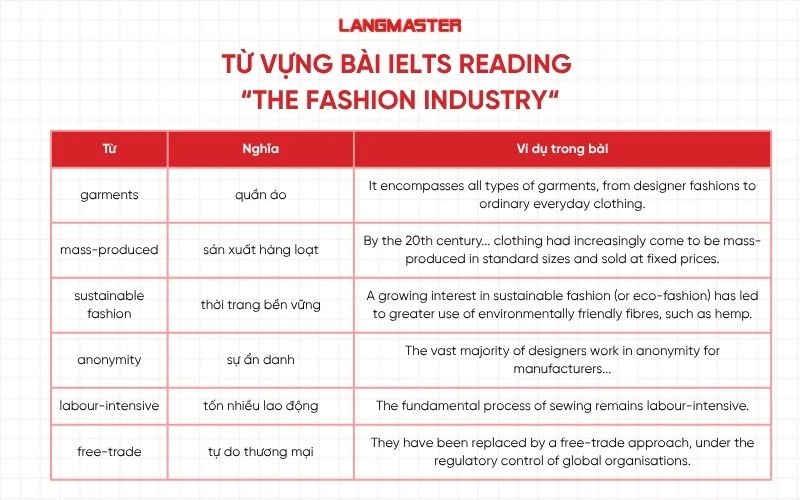
Trong quá trình ôn luyện IELTS Reading, việc trau dồi vốn từ vựng IELTS đều đặn và có chiến lược là yếu tố then chốt, đặc biệt khi bạn thực hành với đề thi mẫu. Danh sách dưới đây tổng hợp những từ/cụm từ quan trọng từ bài IELTS Reading “The fashion industry”, bao gồm cả thuật ngữ chuyên ngành và những từ có khả năng xuất hiện lặp lại trong nhiều đề Reading khác.
|
Từ vựng |
Dịch nghĩa |
Ví dụ trong bài |
|
enterprise |
doanh nghiệp |
The fashion industry is a multibillion-dollar global enterprise devoted to the business of making and selling clothes. |
|
garments |
quần áo |
It encompasses all types of garments, from designer fashions to ordinary everyday clothing. |
|
output |
sản lượng |
However, by any measure, the industry accounts for a significant share of world economic output. |
|
mass-produced |
sản xuất hàng loạt |
By the beginning of the 20th century... clothing had increasingly come to be mass-produced in standard sizes and sold at fixed prices. |
|
retail outlets |
cửa hàng bán lẻ |
By the beginning of the 20th century... and the growth of department stores and other retail outlets, clothing had increasingly come to be mass-produced. |
|
synthetic fibres |
sợi tổng hợp |
Today, these processes are highly automated... and fabrics made from both natural fibres and synthetic fibres (such as nylon, acrylic, and polyester) are produced. |
|
sustainable fashion |
thời trang bền vững |
A growing interest in sustainable fashion (or eco-fashion) has led to greater use of environmentally friendly fibres, such as hemp. |
|
moisture absorption |
khả năng thấm hút ẩm |
In addition, high-tech synthetic fabrics confer such properties as moisture absorption... |
|
stain resistance |
khả năng chống vết bẩn |
In addition, high-tech synthetic fabrics confer such properties as... stain resistance... |
|
dissipation |
sự tản nhiệt |
In addition, high-tech synthetic fabrics confer such properties as... retention or dissipation of body heat... |
|
prestigious |
danh giá |
Historically, very few fashion designers have become famous brands such as Coco Chanel or Calvin Klein, who have been responsible for prestigious high-fashion collections. |
|
anonymity |
sự ẩn danh |
The vast majority of designers work in anonymity for manufacturers... |
|
templates |
mẫu rập |
An important stage in garment production is the translation of the clothing design into templates, in a range of sizes, for cutting the cloth. |
|
proportions |
tỷ lệ |
Because the proportions of the human body change with increases or decreases in weight, templates cannot simply be scaled up or down. |
|
computer-guided knives |
dao điều khiển bằng máy tính |
For all but the most expensive clothing, fabric cutting is accomplished by computer-guided knives or high-intensity lasers... |
|
labour-intensive |
tốn nhiều lao động |
Nevertheless, the fundamental process of sewing remains labour-intensive. |
|
quotas |
hạn ngạch |
For much of the period following World War II, trade in textiles and garments was strictly regulated... which imposed quotas and tariffs. |
|
tariffs |
thuế quan |
For much of the period following World War II, trade in textiles and garments was strictly regulated... which imposed quotas and tariffs. |
|
protectionist measures |
biện pháp bảo hộ |
Since the 1980s, these protectionist measures... have gradually been abandoned. |
|
free-trade |
tự do thương mại |
They have been replaced by a free-trade approach, under the regulatory control of global organisations. |
>> Xem thêm:
Trong hành trình ôn luyện IELTS Reading, nhiều bạn thường gặp khó khăn không chỉ ở tốc độ làm bài mà còn ở việc hệ thống lại chiến lược đọc hiểu một cách khoa học. Để khắc phục điều này, bạn cần có sự đồng hành từ một chương trình học rõ ràng và đội ngũ giảng viên có kinh nghiệm thực chiến, những người có thể giúp bạn tiết kiệm thời gian và nhanh chóng đạt kết quả mong muốn.
Với hơn 16 năm kinh nghiệm giảng dạy tiếng Anh, Langmaster mang đến các khóa học IELTS được thiết kế phù hợp với từng mục tiêu và năng lực đầu vào của học viên. Chính những ưu điểm nổi bật dưới đây đã giúp khóa học của Langmaster trở thành lựa chọn đáng tin cậy cho những ai muốn chinh phục IELTS một cách bền vững:
Langmaster triển khai hai hình thức học tiếng Anh linh hoạt ONLINE và OFFLINE. Các lớp OFFLINE đang được tổ chức tại 3 cơ sở dành cho học viên khu vực Hà Nội:
169 Xuân Thủy (Cầu Giấy)
179 Trường Chinh (Thanh Xuân)
N03-T7 Ngoại giao đoàn (Bắc Từ Liêm)
Đặc biệt, bạn còn có thể tham gia lớp học thử miễn phí tại Langmaster. Với hình thức nhóm nhỏ, lớp học thử giúp bạn trực tiếp trải nghiệm phương pháp giảng dạy và đánh giá mức độ phù hợp của khóa học trước khi đưa ra quyết định đăng ký chính thức.
Kết luận:
Việc phân tích đề thi IELTS Reading “The fashion industry” không chỉ giúp bạn nắm rõ đáp án mà còn hiểu được logic làm bài và cách suy luận hiệu quả cho kỳ thi IELTS. Việc luyện tập thường xuyên với đề thi thật sẽ giúp bạn nâng cao tốc độ đọc, vốn từ vựng và kỹ năng xử lý thông tin. Hãy coi đây là tài liệu ôn tập hữu ích để bạn tự tin chinh phục band điểm mục tiêu trong kỳ thi IELTS Reading.

![Giải đề thi European Heat Wave IELTS Reading [FULL ANSWER]](https://langmaster.edu.vn/storage/uploads/original/2025/11/20/european-heat-wave-ielts-reading-answers.png)
Tổng hợp đề thi European Heat Wave IELTS Reading Answers kèm phân tích chi tiết, từ vựng và đáp án giúp bạn tối ưu điểm Reading nhanh chóng.
![Đề thi IELTS Reading có đáp án mới nhất 2025-2026 [Cập nhật liên tục]](https://langmaster.edu.vn/storage/uploads/original/2025/12/25/de-thi-ielts-reading.png)
Đề thi IELTS Reading có đáp án mới nhất 2025/2026, cập nhật liên tục đề thi thật và Cambridge, kèm lời giải chi tiết giúp nâng band hiệu quả.
Bài viết tổng hợp chi tiết đề thi IELTS Reading Holidays with a difference, đáp án kèm giải thích chi tiết, từ vựng cần lưu ý khi làm bài giúp bạn luyện thi hiệu quả và nâng cao band điểm.
Bài viết tổng hợp chi tiết đề thi IELTS Reading on the trail of the honey badger, đáp án kèm giải thích chi tiết, từ vựng cần lưu ý khi làm bài giúp bạn luyện thi hiệu quả và nâng cao band điểm.
![Giải đề thi IELTS Reading: Listening to the Ocean [Full Answer]](https://langmaster.edu.vn/storage/uploads/original/2025/10/13/listening-to-the-ocean-ielts-reading-2.png)
Khám phá bài Listening to the Ocean trong IELTS Reading: tóm tắt, từ vựng quan trọng, đáp án chi tiết và mẹo làm bài hiệu quả để đạt band cao!




Hơn 16 năm kinh nghiệm, đào tạo thành công hàng trăm nghìn học viên
Phương pháp giảng dạy hiện đại, học viên tiến bộ rõ rệt
Lộ trình học chuẩn quốc tế, phù hợp với nhu cầu thực tiễn
Giáo viên đạt chuẩn Quốc tế với chất lượng top đầu thị trường, giàu kinh nghiệm
Học online linh hoạt, cam kết đầu ra bằng văn bản

![Giải đề IELTS Reading: Multiple intelligences [Full answers]](https://langmaster.edu.vn/storage/images/2025/09/30/multiple-intelligences-ielts-reading-answers.webp)
![Crossing the Threshold IELTS READING - Giải đề thi thật [Full answers]](https://langmaster.edu.vn/storage/images/2025/09/30/crossing-the-threshold-ielts-reading-giai-de-thi-that-1759249459.webp)
![Nature's Useful Designs IELTS READING - Giải đề thi thật [Full answers]](https://langmaster.edu.vn/storage/images/2025/10/01/natures-useful-designs-ielts-reading-giai-de-thi-that-1759308834.webp)
![The Art of deception IELTS Reading: Giải đề thi thật [Full Answers]](https://langmaster.edu.vn/storage/images/2025/09/30/the-art-of-deception-ielts-reading-answers.webp)
![Giải đề IELTS Reading: Electroreception [Full answers]](https://langmaster.edu.vn/storage/images/2025/10/01/giai-de-ielts-reading-electroreception.webp)