Khóa học
IELTS Online
IELTS Online
Giảm đến 18%
Đăng ký ngay
Mục lục [Ẩn]
Bạn đang ôn luyện kỹ năng Reading và gặp khó khăn với bài Learning a Second Language – IELTS Reading Answers? Đây là một trong những chủ đề dễ “bẫy” thí sinh vì lượng từ học thuật lớn và các câu hỏi yêu cầu khả năng suy luận cao. Trong bài viết này, Langmaster sẽ giúp bạn hiểu rõ nội dung bài đọc, phân tích từng dạng câu hỏi, đồng thời cung cấp từ vựng, và đáp án chi tiết. Nhờ đó, bạn không chỉ vượt qua phần đọc này dễ dàng mà còn cải thiện kỹ năng đọc hiểu tổng thể cho toàn bộ kỳ thi IELTS Reading.
Reading Passage
Learning a Second Language
A. Various studies of second language learning have all shown that the benefits of learning a second language are much broader than simply the ability to speak in another language. Research affirms the importance of second language education regarding intellectual potential, scholastic achievement, first language skills, citizenship, and the economy.
B. Learning a second language in this context is not learning a second language as a natural process when one acquires a first language. After childhood, the areas of the brain that are responsible for language acquisition become more fixed, and the process of picking up additional languages becomes more academic and less organic. The specific context concerns a person who has learned his or her first language automatically and is now learning a new language through a teacher, self-teaching, or teaching oneself with a book or maybe online.
C. School children can get unexpected benefits from learning a foreign language. Educational research shows that results in English and Science are better for students who study one. The reasons for this are not altogether clear: perhaps the study skills acquired and used for studying another language also strengthen study skills used in other areas and it could also strengthen the ability to analyze and interpret information. It also seems that knowledge of the grammar of students’ native language is often made clearer to them through explicitly learning another language’s grammar. A foreign language is a whole new system with distinct rules, etymology, and meaning, which are just a few of the complexities of a language. Learning a new one puts the brain to task by recognizing this new language structure. As the brain works out meaning and makes full use of this new arsenal to express ideas, it seems that it sharpens skills in reading, negotiating, and problem-solving.
D. Multi-tasking is stressful for those who are not skilled at it. People who are multilingual are proficient at slipping from one language system to another and using totally different language mechanics. This is very distracting and demanding work, not only for the tongue and language faculties but also especially for the brain. People who have developed multilingual abilities are highly proficient multi-taskers and commit very few errors when juggling various activities.
E. Related to this, with other factors held constant, several pieces of research have also shown that multilingual adults experienced the onset of Alzheimer’s and dementia at a later age of 75 compared to monolingual adults, who had the first signs at age 71. The studies were conducted with other variables such as gender, overall health, educational level, and economic status, but there were no significant results that contributed to the mentioned diseases as significantly as the number of languages spoken. It seems that the more the brain is used, the better its functions work. Learning a new language structure entails familiarising with vocabulary and rules, and converting this memorized information into communication. This strengthens memory because the brain has built its ability to associate information with mnemonics in order to retain information better. Hence, multilingual people have that are more exercised and quicker to recall.
F. Since a language is a doorway to a particular culture, learning a new language enables a brain person to have a broader understanding of the race or culture that speaks it. Opening up to a culture allows people to be more flexible and appreciative of other ways of doing and looking at things. As a result, if people are multilingual, they have the advantage of seeing the world from different vantage points. In today’s interconnectedness, this is a valuable tool, and with universal unemployment problems, a multilingual ability is definitely a competitive edge over others. Businesses are of course interested in people who have the ability to improve their intelligence, flexibility, openness to diverse people, and decision-making skills. And these are just bonuses to the evident ability to communicate in several languages and cross-cultural barriers. Additionally, speaking another language can simply give people a lot of pleasure, as they can communicate with others in their native language.
G. Finally, self-confidence is a normal consequence of learning a new language. By simply mastering one skill, the other faculties are developed. No matter their background, people tend to gravitate around multilingual people because of their skills; others simply find the openness and quick-mindedness of multi-lingual people naturally attractive. It is an interesting outcome, not at all something that is expected as a result when people embark on learning a new language, but trying to understand a language and the heritage that goes with it will put the learner in a position of self-discovery. It makes learners come to terms with how they view the world and other cultures and have more appreciation of their own.
H. The cognitive and neurological benefits of learning a foreign language extend from early childhood to old age, as the brain more efficiently processes information and staves off cognitive decline. These cognitive and neurological benefits are instantly apparent, but there occurs a host of social, cultural, and personal benefits, among them the ability to explore a culture through its native tongue or talk to someone with whom it might otherwise not be able to communicate. Learning a second language is best introduced at the earliest age possible, but learning it at a much later age is still very much worthwhile.
Questions 1-5
Choose the correct letter A, B, C or D.
Write the correct letter in boxes 1 – 5 on your answer sheet.
1. Studies have shown that second language learning can even affect…………….
2. The benefits that second language learning creates with children’s study of other subjects……
3. Switching from one language to another…………….
4. The ability to switch from one language to another……………….
5. Bilingualism…………………
Questions 6-9
Do the following statements agree with the views of the writer of the text?
In boxes 6-9 on your answer sheet write:
YES if the statement agrees with the writer’s views
NO if the statement doesn’t agree with the writer’s views
NOT GIVEN if it is impossible to say what the writer thinks about this
6. Other health issues can affect an individual’s likeliness to avoid Alzheimer’s disease as much as second language abilities.
7. Studies have shown salaries are significantly higher for those people who are multilingual.
8. Multilingual people have a better ability to make decisions.
9. Multilingual people have longer life expectancies.
Questions 10-13
Complete each sentence with the correct ending (A G) below.
Write the correct letter (A G) in answer boxes 10-13 on your answer sheet.
10. An additional benefit of learning a second language
11. A successful second language learner
12. A society’s traditions are better understood by a learner who
13. The time to learn a second language

>> Xem thêm:
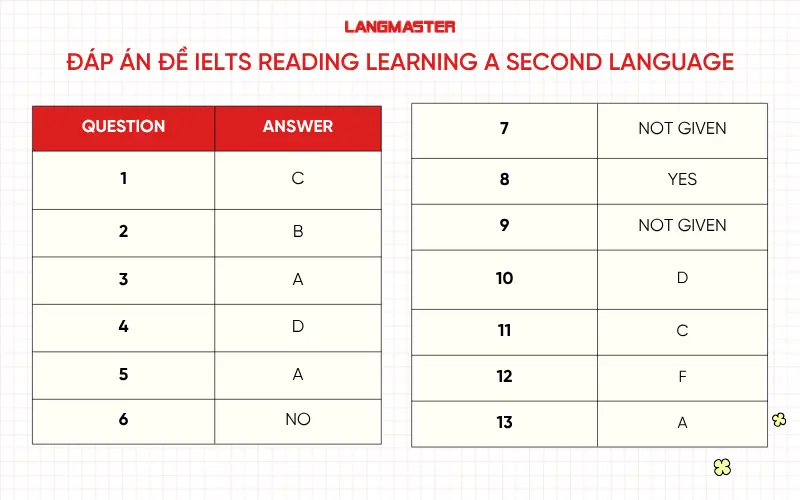
1. Đáp án: C
Thông tin: Đoạn C: “It also seems that knowledge of the grammar of students’ native language is often made clearer to them through explicitly learning another language’s grammar.”
Giải thích: Nghiên cứu cho thấy việc học ngôn ngữ thứ hai giúp học sinh hiểu rõ hơn ngữ pháp của tiếng mẹ đẻ. Như vậy, việc học ngoại ngữ ảnh hưởng tích cực đến khả năng sử dụng ngôn ngữ thứ nhất, nên đáp án đúng là C.
2. Đáp án: B
Thông tin: Đoạn C: “Educational research shows that results in English and Science are better for students who study one. The reasons for this are not altogether clear…”
Giải thích: Đoạn văn cho biết học sinh học ngoại ngữ có kết quả tốt hơn trong môn Tiếng Anh và Khoa học, nhưng “the reasons are not altogether clear”, nghĩa là nguyên nhân chưa được hiểu rõ hoàn toàn.
3. Đáp án: A
Thông tin: Đoạn D: “This is very distracting and demanding work, not only for the tongue and language faculties but also especially for the brain.”
Giải thích: Đoạn này nói rằng việc chuyển đổi giữa các hệ thống ngôn ngữ là công việc “demanding” và “distracting”, tức đòi hỏi nhiều nỗ lực, khó khăn cho não bộ. Do đó đáp án đúng là A.
4. Đáp án: D.
Thông tin: Đoạn D: “People who have developed multilingual abilities are highly proficient multi-taskers and commit very few errors when juggling various activities.”
Giải thích: Những người nói được nhiều ngôn ngữ rất giỏi trong việc làm nhiều việc cùng lúc (“highly proficient multi-taskers”), do vậy kỹ năng chuyển đổi ngôn ngữ giúp họ phát triển kỹ năng đa nhiệm → đáp án D.
5. Đáp án: A
Thông tin: Đoạn E: “Research have also shown that multilingual adults experienced the onset of Alzheimer’s and dementia at a later age of 75 compared to monolingual adults, who had the first signs at age 71.”
Giải thích: Người song ngữ/multilingual xuất hiện dấu hiệu Alzheimer muộn hơn (75 tuổi) so với người chỉ biết một ngôn ngữ (71 tuổi). Điều đó chứng tỏ song ngữ giúp trì hoãn sự khởi phát bệnh Alzheimer, nên đáp án là A.
6. Đáp án: NO
Thông tin: Đoạn E: “The studies were conducted with other variables such as gender, overall health, educational level, and economic status, but there were no significant results that contributed to the mentioned diseases as significantly as the number of languages spoken.”
Giải thích: Đoạn E nói rõ rằng các yếu tố khác như sức khỏe tổng thể, giới tính, học vấn, kinh tế không ảnh hưởng đến bệnh Alzheimer nhiều bằng việc biết nhiều ngôn ngữ. → Câu khẳng định rằng “các vấn đề sức khỏe khác ảnh hưởng nhiều như khả năng song ngữ” là sai, nên đáp án là NO.
7. Đáp án: NOT GIVEN
Thông tin: Không có đoạn nào trong văn bản đề cập đến thu nhập hoặc mức lương của người song ngữ.
8. Đáp án: YES
Thông tin: Đoạn F: “Businesses are of course interested in people who have the ability to improve their intelligence, flexibility, openness to diverse people, and decision-making skills.”
Giải thích: Đoạn F khẳng định rằng người nói được nhiều ngôn ngữ có kỹ năng ra quyết định tốt hơn, và điều này được doanh nghiệp đánh giá cao. → Đồng ý với quan điểm tác giả → YES.
9. Đáp án: NOT GIVEN
Thông tin: Không có đoạn nào nói rằng người song ngữ sống lâu hơn.
10. Đáp án: D
Thông tin: Đoạn G: “Finally, self-confidence is a normal consequence of learning a new language. By simply mastering one skill, the other faculties are developed.”
Giải thích: Đoạn G nói rằng sự tự tin là kết quả tự nhiên của việc học ngôn ngữ mới, khiến người học cảm thấy tốt hơn về bản thân mình. → “feel better about themselves” = D.
11. Đáp án: C
Thông tin: Đoạn G: “No matter their background, people tend to gravitate around multilingual people because of their skills; others simply find the openness and quick-mindedness of multi-lingual people naturally attractive.”
Giải thích: Người nói được nhiều ngôn ngữ (học thành công) thường được người khác yêu mến, bị thu hút tự nhiên (“naturally attractive”). → Đáp án đúng là C.
12. Đáp án: F
Thông tin: Đoạn F: “Since a language is a doorway to a particular culture, learning a new language enables a person to have a broader understanding of the race or culture that speaks it.”
Giải thích: Việc học ngôn ngữ của một cộng đồng giúp người học hiểu sâu hơn về văn hoá và truyền thống của xã hội đó, nên đáp án là F.
13. Đáp án: A
Thông tin: Đoạn H: “Learning a second language is best introduced at the earliest age possible, but learning it at a much later age is still very much worthwhile.”
Giải thích: Đoạn H nói rằng học ngôn ngữ sớm là tốt nhất, nhưng học ở tuổi muộn hơn vẫn có giá trị, nghĩa là không nhất thiết phải học khi còn nhỏ → A.
>> Xem thêm: Giải đề IELTS Reading: How deserts are formed [Full answers]
Việc nắm vững từ vựng chủ đề Learning a Second Language sẽ giúp bạn hiểu sâu hơn nội dung bài đọc và trả lời chính xác các câu hỏi IELTS Reading. Đây đều là những từ thường xuất hiện trong các đoạn văn nói về lợi ích, quá trình và tác động của việc học ngoại ngữ — vì vậy, hãy ghi nhớ cách phát âm, nghĩa và ví dụ thực tế để dễ dàng vận dụng trong cả kỹ năng Reading lẫn Speaking.
Acquire (v)
Cognitive (adj)
Multilingual (adj)
Retain (v)
Flexibility (n)
Delay (v)
Culture (n)
Confidence (n)
Problem-solving (n)
Cross-cultural (adj)
>> Xem thêm:
Nhiều bạn khi luyện đề Learning a Second Language – IELTS Reading Answers thường gặp không ít khó khăn: từ việc không nắm được từ vựng học thuật, kỹ năng tìm thông tin chi tiết, cho đến việc mất quá nhiều thời gian đọc hiểu và phân tích câu hỏi. Điều này khiến quá trình học IELTS Reading trở nên áp lực, đặc biệt với người mới bắt đầu hoặc đã lâu không tiếp xúc với tiếng Anh.
Nếu bạn đang tìm kiếm một giải pháp học hiệu quả, Langmaster chính là lựa chọn hoàn hảo. Với hơn 16 năm kinh nghiệm đào tạo tiếng Anh và luyện thi IELTS, Langmaster - trung tâm luyện thi IELTS uy tín, chất lượng hàng đầu Việt Nam, đã đồng hành giúp hàng nghìn học viên chinh phục band điểm mơ ước chỉ sau vài tháng học đúng lộ trình.
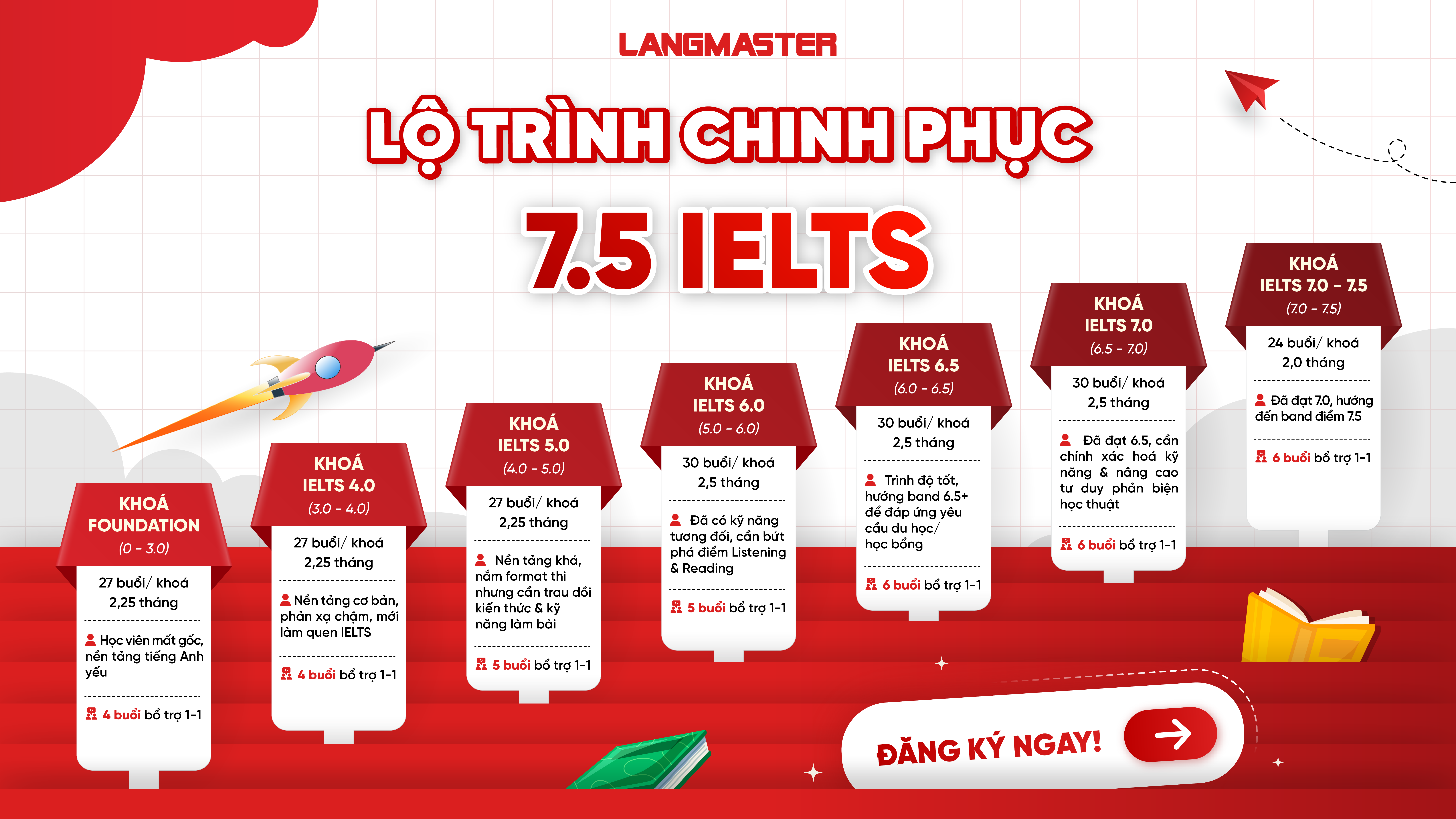
Điểm đặc biệt của khóa học IELTS online tại Langmaster nằm ở mô hình lớp nhỏ (7–10 học viên), cho phép giáo viên theo sát từng cá nhân. Bạn được sửa lỗi chi tiết ngay trong buổi học, luyện tập phản xạ và phát triển kỹ năng đọc hiểu chuyên sâu với giáo viên IELTS 7.5+.
Trước khi bắt đầu, bạn sẽ được kiểm tra trình độ 4 kỹ năng để xác định band hiện tại, từ đó nhận lộ trình học cá nhân hóa theo mục tiêu điểm số. Trong khóa học, học viên được nhận báo cáo tiến độ hàng tháng, tham gia các buổi coaching 1-1 cùng chuyên gia IELTS, và đặc biệt là cam kết đầu ra bằng văn bản – học lại miễn phí cho đến khi đạt band mục tiêu.
Langmaster hiện đang triển khai chương trình HỌC THỬ MIỄN PHÍ, giúp bạn trực tiếp trải nghiệm phương pháp giảng dạy hiệu quả, môi trường học chuyên nghiệp và đội ngũ giảng viên tận tâm.
Đăng ký ngay hôm nay để chinh phục chủ đề Learning a Second Language – IELTS Reading và tiến gần hơn đến mục tiêu band điểm bạn mong muốn!


![Giải đề thi European Heat Wave IELTS Reading [FULL ANSWER]](https://langmaster.edu.vn/storage/uploads/original/2025/11/20/european-heat-wave-ielts-reading-answers.png)
Tổng hợp đề thi European Heat Wave IELTS Reading Answers kèm phân tích chi tiết, từ vựng và đáp án giúp bạn tối ưu điểm Reading nhanh chóng.
![Đề thi IELTS Reading có đáp án mới nhất 2025-2026 [Cập nhật liên tục]](https://langmaster.edu.vn/storage/uploads/original/2025/12/25/de-thi-ielts-reading.png)
Đề thi IELTS Reading có đáp án mới nhất 2025/2026, cập nhật liên tục đề thi thật và Cambridge, kèm lời giải chi tiết giúp nâng band hiệu quả.
Bài viết tổng hợp chi tiết đề thi IELTS Reading Holidays with a difference, đáp án kèm giải thích chi tiết, từ vựng cần lưu ý khi làm bài giúp bạn luyện thi hiệu quả và nâng cao band điểm.
Bài viết tổng hợp chi tiết đề thi IELTS Reading on the trail of the honey badger, đáp án kèm giải thích chi tiết, từ vựng cần lưu ý khi làm bài giúp bạn luyện thi hiệu quả và nâng cao band điểm.
![Giải đề IELTS Reading Growing more for less [FULL ANSWER]](https://langmaster.edu.vn/storage/uploads/original/2025/10/22/growing-more-for-less-ielts-reading-answers.png)
Khám phá bài đọc Growing more for less IELTS Reading: Tổng hợp đáp án, từ vựng quan trọng và phân tích chi tiết giúp bạn hiểu cách công nghệ vệ tinh hỗ trợ nông nghiệp hiện đại




Hơn 16 năm kinh nghiệm, đào tạo thành công hàng trăm nghìn học viên
Phương pháp giảng dạy hiện đại, học viên tiến bộ rõ rệt
Lộ trình học chuẩn quốc tế, phù hợp với nhu cầu thực tiễn
Giáo viên đạt chuẩn Quốc tế với chất lượng top đầu thị trường, giàu kinh nghiệm
Học online linh hoạt, cam kết đầu ra bằng văn bản


![Giải đề Learning to Work IELTS Reading with Location [FULL ANSWER]](https://langmaster.edu.vn/storage/uploads/original/2025/10/28/learning-to-walk-ielts-reading.png)