Khóa học
IELTS Online
IELTS Online
Giảm đến 18%
Đăng ký ngay
Mục lục [Ẩn]
Khi ôn tập IELTS Reading, việc luyện kĩ năng giải đề qua các đề thi thật là một cách hiệu quả giúp bạn tăng band điểm nhanh. Bài viết này sẽ giúp bạn giải trọn vẹn đề thi thật IELTS Reading Science and The Stradivarius với hệ thống đề bài, câu hỏi, đáp án chi tiết kèm giải thích rõ ràng. Đây sẽ là tài liệu hữu ích để bạn ôn luyện và nâng cao kỹ năng Reading, sẵn sàng chinh phục band điểm mục tiêu trong kỳ thi IELTS.
Science and the Stradivarius: Uncovering the secret of quality
A.
Violins made by long-dead Italian craftsmen from the Cremona region are beautiful works of art, coveted by collectors as well as players. Particularly outstanding violins have reputedly changed hands for over a million pounds. In contrast, fine modern instruments can be bought for under £100. Do such figures really reflect such large differences in quality? After more than a hundred years of vigorous debate, this question remains highly contentious, provoking strongly held but divergent views among musicians, violin makers and scientists alike.
B.
Every violin, whether a Stradivarius or the cheapest factory-made copy, has a distinctive 'voice’ of its own. Just as any musician can immediately recognise the difference between Domingo and Pavarotti singing the same operatic aria, so a skilled violinist can distinguish between different qualities in the sound produced by individual Stradivari or Guarneri violins. Individual notes on a single instrument sound different each time they are played, which suggests that the perceived tone of a violin must be related to the overall design of the instrument, rather than the frequencies of particular resonances on it. But although various attempts have been made to analyse such global properties, it is extremely difficult to distinguish between a fine Stradivarius instrument and an indifferent modern copy on the basis of the measured response alone. The ear is a supreme detection device, and a system has yet to be developed which can match the brain's sophisticated ability to assess complex sounds.
C.
So how do skilled violinmakers optimise the tone of an instrument during the construction process? They begin by selecting a wood of the highest possible quality for the front and back plates (or parts of the violin), which they test by tapping with a hammer and judging how well it 'rings’. The next important step is to skillfully carve the plates out of the solid wood, taking great care to get the right degree of arching and variations in thickness. Traditional makers optimise the thickness by testing the ‘feel’ of the plates when they are flexed, and by the sounds produced when they are tapped at different positions with the knuckles.
D.
However, in the last 50 years or so a group of violin makers has emerged who have tried to take a more overtly scientific approach to violin making. One common practice they have adopted is to replace the traditional flexing and tapping of plates by controlled measurements. During the carving process, the thinned plates are sprinkled with flakes of glitter and suspended horizontally above a loudspeaker. The glitter forms a pattern each time the loudspeaker excites a resonance. The aim is to interactively 'tune' these first few free plate resonances to specified patterns.
E.
Unfortunately, there are very few examples of such measurements for really fine Italian instruments because their owners are naturally reluctant to allow their violins to be taken apart for the sake of science. The few tests that have been performed suggest that the first Italian makers may have tuned the resonant modes of the individual plates - which they could identify as they tapped them - to exact musical intervals. This would be consistent with the prevailing Renaissance view of ’perfection1, which was measured in terms of numbers and exact ratios. However, there is no historical data to support this case.
F.
Another factor that affects sound quality is the presence of moisture. To achieve the quality of “vibrancy” in a violin requires high-quality wood with low internal damping. By measuring the pattern of growth-rings in the wood of a Stradivarius, we know that the Italian violin makers sometimes used planks of wood that had only been seasoned for five years. However, such wood is now 300 years old, and the intrinsic internal damping will almost certainly have decreased with time. The age of the wood may therefore automatically contribute to the improved quality of older instruments. This may also explain why the quality of a modern instrument appears to improve in its first few years.
G.
Another factor thought to account for sound quality is the nature of the varnish used to protect the instrument. One of the most popular theories for well over a century to account for the Stradivarius secret has been that the varnish had some sort of 'magic' composition. However, historical research has shown that it was very similar to the varnish used today. So apart from the possibility that the Italian varnish was contaminated with the wings of passing insects and debris from the workshop floor, there is no convincing evidence to support the idea of a secret formula.
H.
Other researchers, meanwhile, have claimed that Stradivarius's secret was to soak the timber in water, to leach out supposedly harmful chemicals, before it was seasoned. Although this would be consistent with the idea that the masts and cars of recently sunken Venetian war galleys might have been used to make violins, other scientific and historical evidence to support this view is unconvincing.
I.
In conclusion, science has not provided any convincing evidence to set Cremonese instruments apart from the finest violins made by skilled craftsmen today. Indeed, some leading soloists do occasionally play on modern instruments. However, the foremost soloists - and, not surprisingly, violin dealers, who have a vested interest in maintaining the Cremonese legend of intrinsic superiority - remain utterly unconvinced.

Questions 1-8
Reading Passage has nine paragraphs, A-l
Choose the correct heading for paragraphs A and C-l from the list of headings below.
Write the correct number, i-xi, in boxes 1-8 on your answer sheet.
List of Headings
i. An analysis of protective coatings
ii. Applying technology to violin production
iii. Location - a key factor
iv. A controversial range of prices
v. Techniques of mass production
vi. The advantages of older wood
vii. A re-evaluation of documentary evidence
viii. The mathematical basis of earlier design
ix. Manual woodworking techniques
x. Preferences of top musicians
xi. The use of saturated wood
xii. The challenge for scientists
Questions 9-13
Do the following statements agree with the information given in Reading Passage?
In boxes 9-13 on your answer sheet, write
TRUE if the statement agrees with the information
FALSE if the statement contradicts the information
NOT GIVEN if there is no information on this
9. The quality of any particular note played on the same violin varies.
10. Scientific instruments analyse complex sound more accurately than humans.
11. The quality of handmade violins varies according to the musical ability of the craftsman.
12. Modern violins seem to improve in their early years.
13. Modern violins are gaining in popularity amongst the top violinists
| Học mãi mà IELTS không lên band? Học thử IELTS miễn phí cùng giáo viên 7.5+, chấm chữa lỗi sai ngay lập tức. 👉 Đăng ký học thử miễn phí ngay |
>> Xem thêm: Thời gian làm Reading IELTS: Chiến lược phân bổ và mẹo làm bài hiệu quả
|
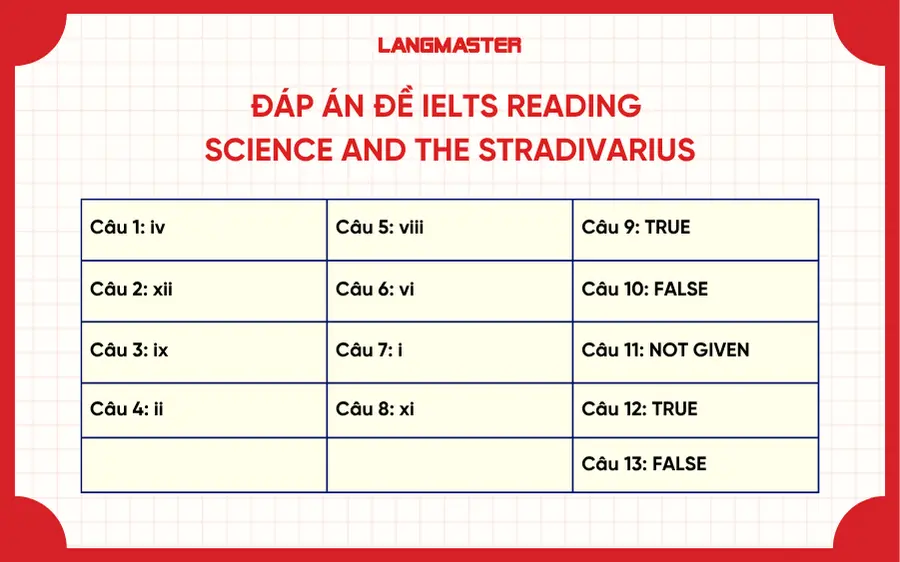
Câu 1: iv |
Câu 5: viii |
Câu 9: TRUE |
|
Câu 2: xii |
Câu 6: vi |
Câu 10: FALSE |
|
Câu 3: ix |
Câu 7: i |
Câu 11: NOT GIVEN |
|
Câu 4: ii |
Câu 8: xi |
Câu 12: TRUE |
|
Câu 13: FALSE |
GIẢI THÍCH CHI TIẾT
Questions 1-8
Câu 1: Paragraph A - iv: A controversial range of prices (Một loạt giá gây tranh cãi)
Phân tích: Đoạn A nói về giá trị cực cao của đàn violin cổ như Stradivarius (hơn 1 triệu bảng), trong khi đàn hiện đại chỉ dưới 100 bảng, và tranh cãi liệu sự chênh lệch giá có tương xứng chất lượng không.
Thông tin trong bài: “Violins made by long-dead Italian craftsmen ... for over a million pounds ... After more than a hundred years of vigorous debate, this question remains highly contentious.”
→ Dịch: Những cây vĩ cầm do những nghệ nhân người Ý đã khuất chế tạo... với giá hơn một triệu bảng Anh... Sau hơn một trăm năm tranh luận sôi nổi, câu hỏi này vẫn còn gây nhiều tranh cãi
=> Nhấn mạnh sự tranh cãi về giá cả và chất lượng, nên chọn iv.
Câu 2: Paragraph B - xii: The challenge for scientists (Thách thức đối với các nhà khoa học)
Thông tin trong bài: “It is extremely difficult to distinguish between a fine Stradivarius instrument and an indifferent modern copy... The ear is a supreme detection device, and a system has yet to be developed which can match the brain's sophisticated ability to assess complex sounds.”
→ Dịch: Thật khó để phân biệt giữa một nhạc cụ Stradivarius tuyệt vời và một bản sao hiện đại tầm thường... Tai là một thiết bị phát hiện tối cao, và vẫn chưa có hệ thống nào được phát triển có thể sánh được với khả năng tinh vi của não bộ trong việc đánh giá những âm thanh phức tạp.”
Phân tích: Đoạn nói rằng dù đã có nhiều phép đo và thử nghiệm, khoa học vẫn chưa thể phân biệt chính xác sự khác biệt giữa đàn Stradivarius và bản sao hiện đại. Lý do là vì tai và não người tinh vi hơn bất kỳ công cụ khoa học nào trong việc đánh giá âm thanh.
=> Đây là thách thức đối với các nhà khoa học, nên chọn đáp án xii
Câu 3: Paragraph C - ix: Manual woodworking techniques (Kỹ thuật chế biến gỗ thủ công)
Thông tin trong bài: “They begin by selecting wood of the highest quality ... tapping with a hammer ... carve the plates ... testing the feel of the plates when flexed.”
→ Dịch: “Họ bắt đầu bằng cách chọn gỗ có chất lượng cao nhất... gõ bằng búa... chạm khắc các tấm gỗ... thử cảm giác của các tấm gỗ khi uốn cong.”
Phân tích: Đoạn này mô tả quá trình chế tác thủ công truyền thống của thợ làm đàn: chọn gỗ, gõ, uốn, chạm khắc.
=> ix. Manual woodworking techniques là đúng.
Câu 4: Paragraph D - ii: Applying technology to violin production (ứng dụng công nghệ vào sản xuất violin)
Thông tin trong bài: “A group of violin makers ... take a more overtly scientific approach... replace the traditional flexing and tapping with controlled measurements... sprinkled with glitter... tune the resonances.”
→ Dịch: “Một nhóm thợ làm đàn violin... áp dụng phương pháp khoa học hơn... thay thế cách uốn cong và gõ truyền thống bằng các phép đo được kiểm soát... rắc kim tuyến... điều chỉnh độ cộng hưởng.”
Phân tích: Đoạn nói về việc áp dụng phương pháp khoa học, công nghệ hiện đại để làm đàn.
=> chọn đáp án có keyword technology ii là đúng.
Câu 5: Paragraph E - viii: The mathematical basis of earlier design (Cơ sở toán học của thiết kế trước đó)
Thông tin trong bài: “... may have tuned the resonant modes ... to exact musical intervals. This would be consistent with the Renaissance view of ‘perfection’, measured in terms of numbers and exact ratios.”
→ Dịch: “... có thể đã điều chỉnh các chế độ cộng hưởng... theo các quãng nhạc chính xác. Điều này phù hợp với quan điểm thời Phục Hưng về ‘sự hoàn hảo’, được đo lường bằng số lượng và tỷ lệ chính xác.”
Phân tích: Đoạn nói rằng người Ý xưa có thể đã chỉnh đàn theo tỉ lệ âm nhạc, con số và tỉ lệ toán học, phù hợp triết lý Phục hưng.
=> Đề cập đến cơ sở toán học và tỉ lệ âm nhạc trong thiết kế đàn thời xưa, chọn đáp án viii
Câu 6: Paragraph F - vi: The advantages of older wood (Ưu điểm của gỗ cũ)
Thông tin trong bài: “... wood that had only been seasoned for five years. However, such wood is now 300 years old ... The age of the wood may therefore automatically contribute to the improved quality.”
→ Dịch: “... gỗ chỉ mới được ủ năm năm. Tuy nhiên, loại gỗ đó hiện đã 300 năm tuổi... Do đó, tuổi của gỗ có thể tự động góp phần nâng cao chất lượng.”
Phân tích: Đoạn này bàn về tuổi của gỗ – gỗ cũ giảm độ ẩm, giảm ma sát nội, nên âm thanh tốt hơn.
=> vi. The advantages of older wood (Gỗ cũ giúp âm thanh đàn trở nên ấm và vang hơn.)
Câu 7: Paragraph G - i: An analysis of protective coatings (Phân tích lớp phủ bảo vệ)
Thông tin trong bài: “... the varnish had some sort of ‘magic’ composition. However, historical research has shown that it was very similar to the varnish used today.”
→ Dịch: “... lớp vecni này có một thành phần ‘ma thuật’ nào đó. Tuy nhiên, nghiên cứu lịch sử đã chỉ ra rằng nó rất giống với lớp vecni được sử dụng ngày nay.”
Phân tích: Nói về lớp sơn bảo vệ (varnish), bác bỏ giả thuyết về công thức bí mật.
=> i. An analysis of protective coatings (Phân tích lớp sơn bảo vệ của đàn Stradivarius.)
Câu 8: Paragraph H - xi: The use of saturated wood (Việc sử dụng gỗ bão hòa)
Thông tin trong bài: “Stradivarius's secret was to soak the timber in water ... before it was seasoned.”
→ Dịch: “Bí quyết của Stradivarius là ngâm gỗ trong nước... trước khi ủ.”
Phân tích: Mô tả giả thuyết ngâm gỗ trong nước để loại bỏ hóa chất.
=> xi. The use of saturated wood (Giả thuyết rằng bí mật nằm ở việc dùng gỗ đã được ngâm.)
Câu 9. The quality of any particular note played on the same violin varies.
Thông tin trong bài: “Individual notes on a single instrument sound different each time they are played.”
Phân tích: Câu trong bài nói đúng hệt với nội dung trên — chất lượng của từng nốt thay đổi mỗi lần chơi. → TRUE
Câu 10. Scientific instruments analyse complex sound more accurately than humans.
Thông tin trong bài: “The ear is a supreme detection device ... a system has yet to be developed which can match the brain’s ability.”
Phân tích: Bài nói ngược lại với câu hỏi: tai người tốt hơn máy. → FALSE
Câu 11. The quality of handmade violins varies according to the musical ability of the craftsman.
Phân tích: Không có thông tin nào trong bài nói tay nghề âm nhạc của người thợ ảnh hưởng đến chất lượng đàn. → NOT GIVEN
Câu 12. Modern violins seem to improve in their early years.
Thông tin trong bài: “This may also explain why the quality of a modern instrument appears to improve in its first few years.”
Phân tích: Bài nói chính xác điều này — đàn mới cải thiện trong những năm đầu.
→ TRUE
Câu 13. Modern violins are gaining in popularity amongst the top violinists.
Thông tin trong bài: “Some leading soloists do occasionally play on modern instruments. However, the foremost soloists ... remain utterly unconvinced.”
Phân tích: Câu hỏi nói rằng đàn hiện đại đang được ưa chuộng → trái ngược với bài, vì các nghệ sĩ hàng đầu vẫn không tin tưởng đàn hiện đại. → FALSE
>> Xem thêm:
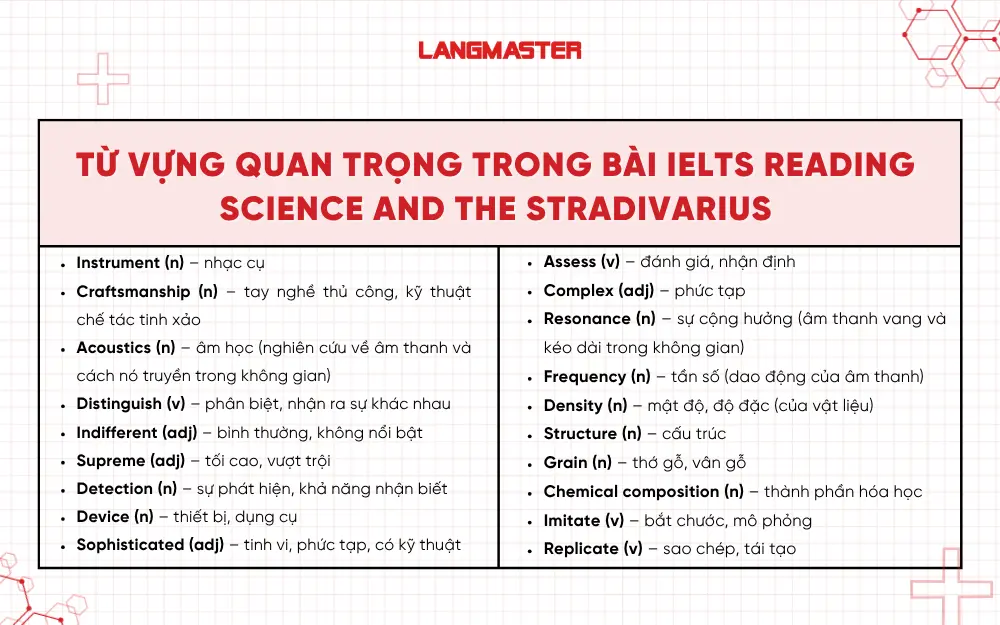
>> Xem thêm: [TỔNG HỢP] TỪ VỰNG IELTS READING THEO CHỦ ĐỀ THƯỜNG GẶP
Để chinh phục điểm cao Reading IELTS, việc học theo lộ trình rõ ràng, có giảng viên hướng dẫn chi tiết và nhận phản hồi từng bài là cực kỳ quan trọng. Đây cũng là lý do nhiều học viên lựa chọn khóa học IELTS tại Langmaster, nơi cung cấp:
Langmaster triển khai hai hình thức học tiếng Anh linh hoạt ONLINE và OFFLINE. Các lớp OFFLINE đang được tổ chức tại 3 cơ sở dành cho học viên khu vực Hà Nội:
169 Xuân Thủy (Cầu Giấy)
179 Trường Chinh (Thanh Xuân)
N03-T7 Ngoại giao đoàn (Bắc Từ Liêm)
Đừng để rào cản tiếng Anh khiến cơ hội trao đổi vụt qua tầm tay. Để lại thông tin ngay hôm nay, đội ngũ chuyên gia Langmaster sẽ tư vấn miễn phí và xây dựng lộ trình cá nhân hóa để chinh phục band điểm mơ ước.
Như vậy, Langmaster đã vừa cùng bạn phân tích và giải chi tiết đề IELTS Reading chủ đề Science and The Stradivarius. Bài viết đã chỉ rõ các kỹ năng cần thiết để tìm thông tin, nhận biết từ khóa và áp dụng chiến lược đọc hiểu hiệu quả. Hy vọng những kiến thức này sẽ giúp bạn tự tin hơn khi làm bài và cải thiện điểm số Reading IELTS. Chúc bạn học tập hiệu quả và đạt kết quả cao trong kỳ thi IELTS sắp tới!



![Giải đề thi European Heat Wave IELTS Reading [FULL ANSWER]](https://langmaster.edu.vn/storage/uploads/original/2025/11/20/european-heat-wave-ielts-reading-answers.png)
Tổng hợp đề thi European Heat Wave IELTS Reading Answers kèm phân tích chi tiết, từ vựng và đáp án giúp bạn tối ưu điểm Reading nhanh chóng.
![Đề thi IELTS Reading có đáp án mới nhất 2025-2026 [Cập nhật liên tục]](https://langmaster.edu.vn/storage/uploads/original/2025/12/25/de-thi-ielts-reading.png)
Đề thi IELTS Reading có đáp án mới nhất 2025/2026, cập nhật liên tục đề thi thật và Cambridge, kèm lời giải chi tiết giúp nâng band hiệu quả.

Bài viết tổng hợp chi tiết đề thi IELTS Reading Holidays with a difference, đáp án kèm giải thích chi tiết, từ vựng cần lưu ý khi làm bài giúp bạn luyện thi hiệu quả và nâng cao band điểm.

Bài viết tổng hợp chi tiết đề thi IELTS Reading on the trail of the honey badger, đáp án kèm giải thích chi tiết, từ vựng cần lưu ý khi làm bài giúp bạn luyện thi hiệu quả và nâng cao band điểm.
![Giải đề IELTS Reading Growing more for less [FULL ANSWER]](https://langmaster.edu.vn/storage/uploads/original/2025/10/22/growing-more-for-less-ielts-reading-answers.png)
Khám phá bài đọc Growing more for less IELTS Reading: Tổng hợp đáp án, từ vựng quan trọng và phân tích chi tiết giúp bạn hiểu cách công nghệ vệ tinh hỗ trợ nông nghiệp hiện đại




Hơn 16 năm kinh nghiệm, đào tạo thành công hàng trăm nghìn học viên
Phương pháp giảng dạy hiện đại, học viên tiến bộ rõ rệt
Lộ trình học chuẩn quốc tế, phù hợp với nhu cầu thực tiễn
Giáo viên đạt chuẩn Quốc tế với chất lượng top đầu thị trường, giàu kinh nghiệm
Học online linh hoạt, cam kết đầu ra bằng văn bản



![Giải đề IELTS Reading Actual Test Vol 6 Test 5: The Pearl [FULL ANSWER]](https://langmaster.edu.vn/storage/uploads/original/2025/10/08/the-pearl-ielts-reading.png)
![Giải đề IELTS Reading: Video Games and Violence [Full answers]](https://langmaster.edu.vn/storage/images/2025/10/02/giai-de-ielts-reading-video-games-and-violence-full-answers.webp)


.png)