Khóa học
IELTS Online
IELTS Online
Giảm đến 18%
Đăng ký ngay
Mục lục [Ẩn]
Trong bài viết này Langmaster sẽ mang đến cho bạn phần luyện tập đầy đủ với đề thi IELTS Reading “How Tennis Rackets Have Changed IELTS Reading Answers”, bao gồm toàn bộ đề bài, hệ thống câu hỏi, đáp án chi tiết cùng phần giải thích rõ ràng. Đây sẽ là nguồn tài liệu giá trị hỗ trợ bạn rèn luyện kỹ năng Reading và tiến gần hơn đến mục tiêu band điểm mong muốn trong kỳ thi IELTS.
How tennis rackets have changed
In 2016, the British professional tennis player Andy Murray was ranked as the world’s number one. It was an incredible achievement by any standard – made even more remarkable by the fact that he did this during a period considered to be one of the strongest in the sport’s history, competing against the likes of Rafael Nadal, Roger Federer and Novak Djokovic, to name just a few. Yet five years previously, he had been regarded as a talented outsider who entered but never won the major tournaments.
Of the changes that account for this transformation, one was visible and widely publicised: in 2011, Murray invited former number one player Ivan Lendl onto his coaching team – a valuable addition that had a visible impact on the player’s playing style. Another change was so subtle as to pass more or less unnoticed. Like many players, Murray has long preferred a racket that consists of two types of string: one for the mains (verticals) and another for the crosses (horizontals). While he continued to use natural string in the crosses, in 2012 he switched to a synthetic string for the mains. A small change, perhaps, but its importance should not be underestimated.
The modification that Murray made is just one of a number of options available to players looking to tweak their rackets in order to improve their games. ‘Touring professionals have their rackets customised to their specific needs,’ says Colin Triplow, a UK-based professional racket stringer. ‘It’s a highly important part of performance maximisation.’ Consequently, the specific rackets used by the world’s elite are not actually readily available to the public; rather, each racket is individually made to suit the player who uses it. Take the US professional tennis players Mike and Bob Bryan, for example: ‘We’re very particular with our racket specifications,’ they say. ‘All our rackets are sent from our manufacturer to Tampa, Florida, where our frames go through a … thorough customisation process.’ They explain how they have adjusted not only racket length, but even experimented with different kinds of paint. The rackets they use now weigh more than the average model and also have a denser string pattern (i.e. more crosses and mains).
The primary reason for these modifications is simple: as the line between winning and losing becomes thinner and thinner, even these slight changes become more and more important. As a result, players and their teams are becoming increasingly creative with the modifications to their rackets as they look to maximise their competitive advantage.
Racket modifications mainly date back to the 1970s, when the amateur German tennis player Werner Fischer started playing with the so-called spaghetti-strung racket. It created a string bed that generated so much topspin that it was quickly banned by the International Tennis Federation. However, within a decade or two, racket modification became a regularity. Today it is, in many ways, an aspect of the game that is equal in significance to nutrition or training.
Modifications can be divided into two categories: those to the string bed and those to the racket frame. The former is far more common than the latter: the choice of the strings and the tension with which they are installed is something that nearly all professional players experiment with. They will continually change it depending on various factors including the court surface, climatic conditions, and game styles. Some will even change it depending on how they feel at the time.
At one time, all tennis rackets were strung with natural gut made from the outer layer of sheep or cow intestines. This all changed in the early 1990s with the development of synthetic strings that were cheaper and more durable. They are made from three materials: nylon (relatively durable and affordable), Kevlar (too stiff to be used alone) or co-polyester (polyester combined with additives that enhance its performance). Even so, many professional players continue to use a ‘hybrid set-up’, where a combination of both synthetic and natural strings are used.
Of the synthetics, co-polyester is by far the most widely used. It’s a perfect fit for the style of tennis now played, where players tend to battle it out from the back of the court rather than coming to the net. Studies indicate that the average spin from a co-polyester string is 25% greater than that from natural string or other synthetics. In a sense, the development of co-polyester strings has revolutionised the game.
However, many players go beyond these basic adjustments to the strings and make changes to the racket frame itself. For example, much of the serving power of US professional player Pete Sampras was attributed to the addition of four to five lead weights onto his rackets, and today many professionals have the weight adjusted during the manufacturing process.
Other changes to the frame involve the handle. Players have individual preferences for the shape of the handle and some will have the handle of one racket moulded onto the frame of a different racket. Other players make different changes. The professional Portuguese player Gonçalo Oliveira replaced the original grips of his rackets with something thinner because they had previously felt uncomfortable to hold.
Racket customisation and modification have pushed the standards of the game to greater levels that few could have anticipated in the days of natural strings and heavy, wooden frames, and it’s exciting to see what further developments there will be in the future.
Questions 1-7
Do the following statements agree with the information given in Reading Passage 1?
In boxes 1-7 on your answer sheet, write
TRUE if the statement agrees with the information
FALSE if the statement contradicts the information
NOT GIVEN if there is no information on this
1. People had expected Andy Murray to become the world’s top tennis player for at least five years before 2016.
2. The change that Andy Murray made to his rackets attracted a lot of attention.
3. Most of the world’s top players take a professional racket stringer on tour with them.
4. Mike and Bob Bryan use rackets that are light in comparison to the majority of rackets.
5. Werner Fischer played with a spaghetti-strung racket that he designed himself.
6. The weather can affect how professional players adjust the strings on their rackets.
7. It was believed that the change Pete Sampras made to his rackets contributed to his strong serve.
Questions 8-13
Complete the notes below.
Choose ONE WORD ONLY from the passage for each answer.
Write your answers in boxes 8-13 on your answer sheet.
The tennis racket and how it has changed
8. Mike and Bob Bryan made changes to the types of_____________________used on their racket frames.
9. Players were not allowed to use the spaghetti-strung racket because of the amount of _____________________ it created.
10. Changes to rackets can be regarded as being as important as players’ diets or the _____________________ they do.
11. All rackets used to have natural strings made from the _____________________ of animals.
12. Pete Sampras had metal _____________________ put into the frames of his rackets.
13. Gongalo Oliveira changed the _____________________ on his racket handles
=> Xem thêm:
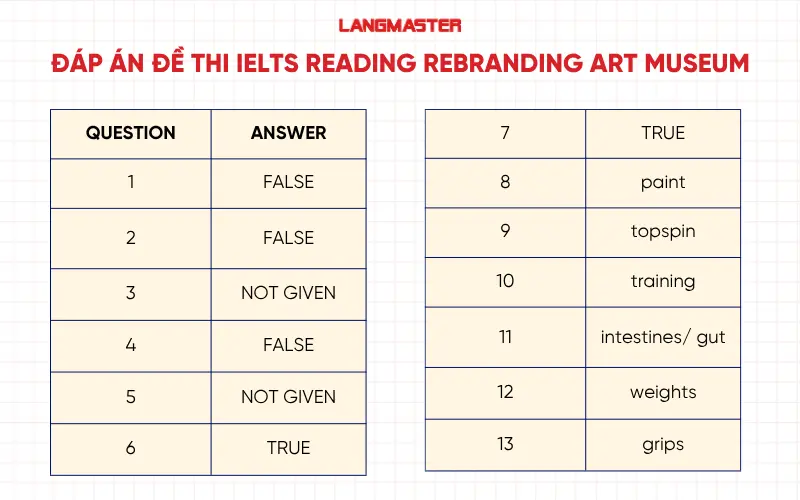
Questions 1-7
1. People had expected Andy Murray to become the world’s top tennis player for at least five years before 2016.
Thông tin đoạn 1: “Yet five years previously, he had been regarded as a talented outsider who entered but never won the major tournaments.”
Năm 2011 (năm năm trước khi Murray đạt hạng 1 thế giới), mọi người không kỳ vọng anh sẽ đứng đầu, mà xem anh chỉ là “a talented outsider”.
→ Vì vậy, nói rằng “people had expected him to become world’s top player” là trái ngược thông tin
=> Đáp án: FALSE
2. The change that Andy Murray made to his rackets attracted a lot of attention.
Thông tin đoạn 2: “Another change was so subtle as to pass more or less unnoticed.”
Thay đổi về dây vợt của Murray “so subtle” (rất tinh tế) và “unnoticed” (hầu như không ai để ý).
→ Nghĩa là không thu hút nhiều chú ý
=> Đáp án: FALSE
3. Most of the world’s top players take a professional racket stringer on tour with them.
Thông tin đoạn 3: “Touring professionals have their rackets customised to their specific needs,” says Colin Triplow, a UK-based professional racket stringer.
Tác giả không nói rằng đa số tay vợt hàng đầu mang theo người căng dây khi thi đấu, chỉ nói rằng họ có người căng dây chuyên nghiệp tùy chỉnh vợt cho họ. Không có thông tin về việc “take on tour”.
=> Đáp án: NOT GIVEN
4. Mike and Bob Bryan use rackets that are light in comparison to the majority of rackets.
Thông tin đoạn 3: “The rackets they use now weigh more than the average model and also have a denser string pattern.”
Racket của họ nặng hơn trung bình, không nhẹ hơn → phát biểu ngược nghĩa
=> Đáp án: FALSE
5. Werner Fischer played with a spaghetti-strung racket that he designed himself.
Thông tin đoạn 5: “Racket modifications mainly date back to the 1970s, when the amateur German tennis player Werner Fischer started playing with the so-called spaghetti-strung racket.”
Câu nói rõ ràng rằng chính Fischer bắt đầu chơi với loại vợt “spaghetti-strung”. Tuy nhiên, không có thông tin về việc Werner Fischer là người tự thiết kế cây vợt đó (“he designed himself”).
=> Đáp án: NOT GIVEN
6. The weather can affect how professional players adjust the strings on their rackets.
Thông tin đoạn 6: “They will continually change it depending on various factors including the court surface, climatic conditions, and game styles.”
“Climatic conditions” = điều kiện thời tiết → được nhắc trực tiếp
=> Đáp án: TRUE
7. It was believed that the change Pete Sampras made to his rackets contributed to his strong serve.
Thông tin đoạn 9: “Much of the serving power of US professional player Pete Sampras was attributed to the addition of four to five lead weights onto his rackets.”
Cụm “was attributed to” = được cho là nhờ vào → nghĩa là người ta tin rằng thay đổi vợt giúp cú giao bóng mạnh hơn
=> Đáp án: TRUE
Questions 8-13
8. Mike and Bob Bryan made changes to the types of_____________________used on their racket frames.
Từ loại cần điền: danh từ
Thông tin: “They explain how they have adjusted not only racket length, but even experimented with different kinds of paint.”
Hai tay vợt người Mỹ Mike và Bob Bryan mô tả rằng họ không chỉ điều chỉnh độ dài vợt mà còn thử nghiệm các loại sơn khác nhau trên khung vợt.
Câu hỏi hỏi “types of … used on their racket frames”
=> Đáp án: Paint
9. Players were not allowed to use the spaghetti-strung racket because of the amount of _____________________ it created.
Từ loại cần điền: Danh từ
Thông tin: “It created a string bed that generated so much topspin that it was quickly banned by the International Tennis Federation.”
Cây vợt “spaghetti-strung” của Werner Fischer tạo ra quá nhiều độ xoáy bóng (topspin), khiến nó bị cấm sử dụng.
→ Danh từ mô tả thứ “nó tạo ra” là topspin.
=> Đáp án: Topspin
10. Changes to rackets can be regarded as being as important as players’ diets or the _____________________ they do.
Từ loại cần điền: Danh từ
Thông tin: “Today it is, in many ways, an aspect of the game that is equal in significance to nutrition or training.”
Tác giả nói rằng việc tùy chỉnh vợt quan trọng ngang với chế độ dinh dưỡng hoặc luyện tập của vận động viên.
→ Từ cần điền là training – hành động luyện tập mà người chơi thực hiện.
=> Đáp án: Training
11. All rackets used to have natural strings made from the _____________________ of animals.
Từ loại cần điền: Danh từ số nhiều
Thông tin: “At one time, all tennis rackets were strung with natural gut made from the outer layer of sheep or cow intestines.”
Dây tự nhiên được làm từ lớp ngoài của ruột cừu hoặc bò. Trong câu hỏi có cụm “of animals”, nên danh từ cần điền phải là intestines (hoặc “gut” – cùng nghĩa).
=> Đáp án: Intestines/ gut
12. Pete Sampras had metal _____________________ put into the frames of his rackets.
Từ loại cần điền: Danh từ số nhiều
Thông tin: “Much of the serving power of US professional player Pete Sampras was attributed to the addition of four to five lead weights onto his rackets.”
Sampras gắn 4–5 miếng chì (lead weights) vào khung vợt để tăng lực giao bóng.
→ Danh từ cần điền là weights (các vật nặng bằng kim loại).
=> Đáp án: Weights
13. Gongalo Oliveira changed the _____________________ on his racket handles
Từ loại cần điền: Danh từ số nhiều
Thông tin: “The professional Portuguese player Gonçalo Oliveira replaced the original grips of his rackets with something thinner because they had previously felt uncomfortable to hold.”
Cầu thủ Bồ Đào Nha Gonçalo Oliveira thay lớp quấn tay cầm (grip) của vợt vì loại cũ cầm không thoải mái.
→ Từ cần điền là grips – lớp bọc quanh tay cầm vợt.
=> Đáp án: Grips
=> Xem thêm: Giải đề IELTS Reading: Love Stories (FULL ANSWERS)
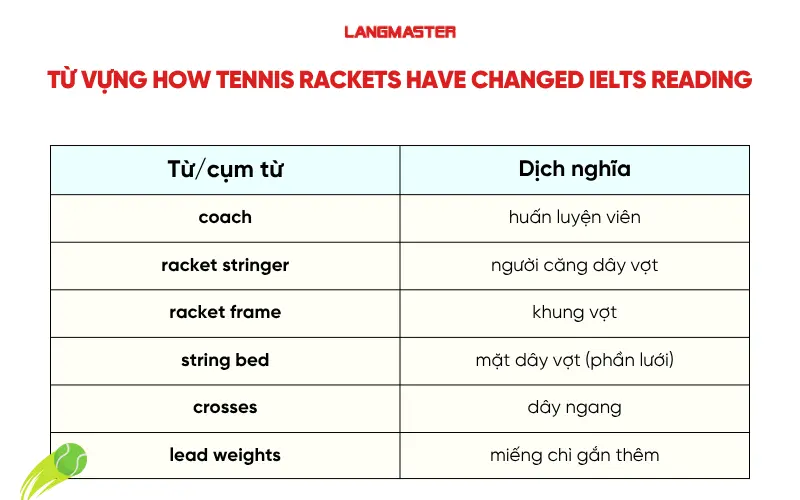
Với đề How tennis rackets have changed, bạn cần lưu ý một số từ vựng IELTS Reading cho đề này bao gồm:
>> Xem thêm: Bí quyết luyện IELTS Reading chinh phục mọi dạng bài
How tennis rackets have changed là dạng bài thường khiến nhiều thí sinh mất điểm vì thiếu chiến lược làm bài và kỹ năng phân tích chi tiết. Việc biết cách nhận diện lỗi sai và rút kinh nghiệm từ mỗi bài đọc là yếu tố then chốt giúp bạn cải thiện kỹ năng Reading nhanh chóng. Nếu chỉ luyện đề mà không có phương pháp đúng, bạn rất dễ “giậm chân tại chỗ” dù đã bỏ ra rất nhiều thời gian và công sức.
Để đạt band điểm mong muốn, bạn cần có người hướng dẫn giàu kinh nghiệm cùng một khóa học chất lượng, nơi không chỉ giúp bạn nắm vững kỹ thuật làm bài mà còn xây dựng nền tảng từ vựng và tư duy đọc hiểu một cách hệ thống.
Với hơn 16 năm kinh nghiệm đào tạo tiếng Anh, Langmaster mang đến khóa học IELTS online được thiết kế riêng theo mục tiêu và năng lực của từng học viên. Những điểm nổi bật khiến khóa học của Langmaster trở thành sự lựa chọn đáng tin cậy cho người học IELTS gồm:
Đặc biệt, bạn còn có thể tham gia lớp học thử miễn phí tại Langmaster. Với hình thức nhóm nhỏ, lớp học thử giúp bạn trải nghiệm trực tiếp phương pháp giảng dạy, kiểm tra trình độ hiện tại và đánh giá mức độ phù hợp của khóa học trước khi đăng ký chính thức.
Trên đây là toàn bộ đáp án và giải thích chi tiết cho đề thi IELTS How Tennis Rackets Have Changed IELTS Reading Answers. Việc luyện tập với đề thi thật không chỉ giúp bạn hiểu rõ cách ra đề mà còn rèn khả năng phân tích, suy luận và tích lũy thêm nhiều từ vựng học thuật quan trọng. Hy vọng tài liệu này sẽ là nguồn hỗ trợ hữu ích, giúp bạn tự tin hơn khi chinh phục kỹ năng Reading và tiến gần hơn tới band điểm mục tiêu trong kỳ thi IELTS.



![Giải đề thi European Heat Wave IELTS Reading [FULL ANSWER]](https://langmaster.edu.vn/storage/uploads/original/2025/11/20/european-heat-wave-ielts-reading-answers.png)
Tổng hợp đề thi European Heat Wave IELTS Reading Answers kèm phân tích chi tiết, từ vựng và đáp án giúp bạn tối ưu điểm Reading nhanh chóng.
![Đề thi IELTS Reading có đáp án mới nhất 2025-2026 [Cập nhật liên tục]](https://langmaster.edu.vn/storage/uploads/original/2025/12/25/de-thi-ielts-reading.png)
Đề thi IELTS Reading có đáp án mới nhất 2025/2026, cập nhật liên tục đề thi thật và Cambridge, kèm lời giải chi tiết giúp nâng band hiệu quả.

Bài viết tổng hợp chi tiết đề thi IELTS Reading Holidays with a difference, đáp án kèm giải thích chi tiết, từ vựng cần lưu ý khi làm bài giúp bạn luyện thi hiệu quả và nâng cao band điểm.

Bài viết tổng hợp chi tiết đề thi IELTS Reading on the trail of the honey badger, đáp án kèm giải thích chi tiết, từ vựng cần lưu ý khi làm bài giúp bạn luyện thi hiệu quả và nâng cao band điểm.
![Giải đề thi IELTS Reading: Listening to the Ocean [Full Answer]](https://langmaster.edu.vn/storage/uploads/original/2025/10/13/listening-to-the-ocean-ielts-reading-2.png)
Khám phá bài Listening to the Ocean trong IELTS Reading: tóm tắt, từ vựng quan trọng, đáp án chi tiết và mẹo làm bài hiệu quả để đạt band cao!




Hơn 16 năm kinh nghiệm, đào tạo thành công hàng trăm nghìn học viên
Phương pháp giảng dạy hiện đại, học viên tiến bộ rõ rệt
Lộ trình học chuẩn quốc tế, phù hợp với nhu cầu thực tiễn
Giáo viên đạt chuẩn Quốc tế với chất lượng top đầu thị trường, giàu kinh nghiệm
Học online linh hoạt, cam kết đầu ra bằng văn bản



![Giải đề IELTS Reading Actual Test Vol 6 Test 5: The Pearl [FULL ANSWER]](https://langmaster.edu.vn/storage/uploads/original/2025/10/08/the-pearl-ielts-reading.png)
![Giải đề IELTS Reading: Video Games and Violence [Full answers]](https://langmaster.edu.vn/storage/images/2025/10/02/giai-de-ielts-reading-video-games-and-violence-full-answers.webp)