
Khóa học
IELTS Online
IELTS Online
Giảm đến 18%
Đăng ký ngay
Mục lục [Ẩn]
Bài viết này, Langmaster sẽ giúp bạn giải trọn vẹn đề thi thật IELTS Reading “Rebranding Art Museums” với đầy đủ đề bài, câu hỏi, đáp án chi tiết kèm giải thích rõ ràng. Đây sẽ là tài liệu hữu ích để bạn ôn luyện và nâng cao kỹ năng Reading, sẵn sàng chinh phục band điểm mục tiêu trong kỳ thi IELTS.
Reading Passage
You should spend about 20 minutes on Questions 27-40, which are based on the following Reading Passage.
Rebranding Art Museums
A study of the reopened National Gallery of Victoria
As anyone with even a passing interest in cultural institutions will know, art museums are adapting to keep up with changes in society. Do any of these newly developed spaces indicate a fundamental shift in the ways we engage with art at the beginning of the twenty-first century? The answer is a qualified Yes—and also, it must be said, No. A clear sense of this can be gained by considering the 2003 redevelopment of the National Gallery of Victoria (NGV) in Melbourne, Australia's second-largest city, in the light of the aspirations embodied in the original building that served as its template.
The first building was considered a thoroughly modern museum when it opened to the public in 1968. We should not forget that it was not all bad; there were certainly innovative aspects that one must credit to the vision and insight of the architect, Roy Grounds. For one thing, the 1968 building signaled a strong sense of engagement both in its design and layout.
It was set apart from traditional notions of art museums, and over the years, this idea has been questioned and superseded by the growing impetus towards an alternative model of the museum—one that engages the public in more open-ended ways. The layout of its galleries was designed to facilitate the rapid and efficient circulation of visitors. It also contained a series of greatly expanded temporary exhibition galleries and a vast Great Hall, which represented an unprecedented emphasis on the ancillary roles of corporate functions and public performances in the contemporary museum.
This last feature might have seemed excessive to some, yet how wise it has proven over the years as museums have come to place increasing emphasis on corporate sponsorship and the need to generate additional funds via room hire. Furthermore, the Great Hall has, for forty years, provided an area for children to roam at large before being escorted through the much less spatially accommodating galleries themselves. As an unintimidating introduction to the lifelong rigors of visiting art museums, its impact on attendance cannot be overestimated.
At the same time, other aspects of the 1968 NGV have not withstood the test of time so well. Foremost among these are the huge expanse of the exterior's windowless wall and the surrounding moat, which creates a rather unwelcoming expression of the institution.
With these considerations in mind, Mario Bellini's redeveloped NGV opened in 2003, and his design reflects what the new, improved, twenty-first-century global museum feels it should be emphasizing to its visitors. Here, the institution's energies are focused not so much on the technical subtleties of how to design the galleries themselves, but rather on presenting to the public a spectacular image of the museum itself as a welcoming yet efficient facilitator of social interaction, popular entertainment, and public knowledge.
All of this is certainly impressive, but where has the art gone? We are not allowed to see the exhibitions until we have completed the necessary inductions. We are greeted by a hugely expanded cloakroom, screening off our vision to the right, followed by a large visitor information office leading to the ticket booths. Above us is the café, and to our left, we cannot escape the NGV shop, set alongside the exit.
And what of the redesigned galleries themselves? In fact, they represent a wonderfully elegant reframing of the permanent collections in ways that should offer first-time visitors and seasoned members alike many new avenues for engagement in the years to come. But herein lies the conundrum posed by the NGV renovation and by the global sweep of new museum projects more generally. The mainstay elements of a permanent collection can become all too easily lost in the increased prominence that these rebranding exercises tend to place on the more glamorously spectacular aspects of the institution itself.
At its most extreme, this results in the construction of new buildings that supplant the artworks inside them, becoming the major attractions themselves.
These challenges are most keenly felt in the area of the temporary exhibition. Entrance to the NGV permanent collection is now free, so the NGV needs something to keep the paying public coming back. The answer lies in the international 'blockbuster' exhibition.
For example, The Impressionists netted a total of 380,000 visitors, making it one of the most popular exhibitions in Australian history. There has also been, it needs to be said, a commendable attempt to leaven the international masterpieces with selected highlights from the permanent collection. Overall, though, the prevalence of these 'rental' blockbusters cannot help but introduce a certain 'off-the-rack' feeling to the institution's exhibition program.
More importantly, they narrow the options for other worthy but less glamorous projects, and they take energy away from the curators' potential to do further work on and around the permanent collection itself.
Yet the show must go on, and shows can't exist without the public. Even the most adroit organization, as the NGV assuredly is, needs to be able to juggle numerous, often conflicting priorities:
Nobody said it was going to be easy, and the effect of too much innovation in museums can be disastrous.
Questions 27-30
Choose the correct letter, A, B, C, or D.
Write the correct letter in boxes 27-30 on your answer sheet.
27. What is the writer doing in paragraph 1?
28. The writer criticises the old NGV because:
29. What does the writer notice about the new NGV?
30. The writer argues that rental "blockbuster" exhibitions:
Questions 31-35
Do the following statements agree with the claims of the writer in Reading Passage 3?
In boxes 31-35 on your answer sheet, write:
YES if the statement agrees with the claims of the writer
NO if the statement contradicts the claims of the writer
NOT GIVEN if it is impossible to say what the writer thinks about this
31. Roy Grounds’s design failed to recognise the importance of functions and performances in museums.
32. Mario Bellini’s new NGV rejects international museum design trends.
33. Mario Bellini’s work on subsequent museum projects has been less successful than that on the NGV.
34. The NGV monitors the number of first-time visitors to permanent collections.
35. Too much change may have negative impacts on museums.
Questions 36-40
Complete each sentence with the correct ending A-G, below.
Write the correct letter, A-G, in boxes 36-40 on your answer sheet.
36. If a large space is available in the museum,
37. If children are allowed to move freely in parts of the gallery,
38. If too much emphasis is placed on the museum building itself,
39. If there is an over-reliance on blockbuster exhibitions,
40. If the NGV wants to continue to be successful,
>> Xem thêm:
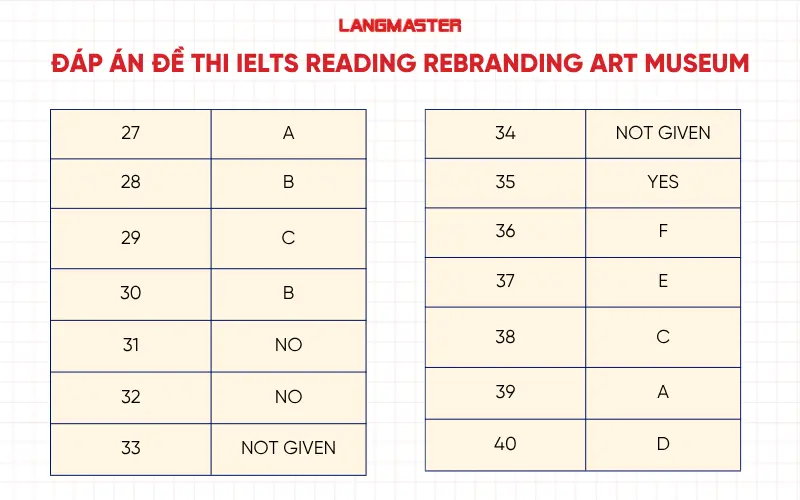
Questions 27-30
27. What is the writer doing in paragraph 1?
Thông tin đoạn 1: “art museums are adapting… indicate a fundamental shift in the ways we engage with art… considering the 2003 redevelopment of the NGV… in the light of the aspirations embodied in the original building.”
=> Đáp án: A
28. The writer criticises the old NGV because
Thông tin đoạn 6: “the huge expanse of the exterior’s windowless wall and the surrounding moat, which creates a rather unwelcoming expression of the institution.”
=> Đáp án: B
29. What does the writer notice about the new NGV?
Thông tin đoạn 8: “We are not allowed to see the exhibitions until we have completed the necessary inductions… a hugely expanded cloakroom… visitor information… ticket booths… café… shop.”
=> Đáp án: C
30. The writer argues that rental "blockbuster" exhibitions
Thông tin đoạn 13: “Entrance… is now free… NGV needs something to keep the paying public coming back. The answer lies in the international ‘blockbuster’ exhibition.”
=> Đáp án: B
Questions 31-35
31. Roy Grounds’s design failed to recognise the importance of functions and performances in museums.
Thông tin đoạn 5: “a vast Great Hall, which represented an unprecedented emphasis on the ancillary roles of corporate functions and public performances… how wise it has proven over the years…” => Kiến trúc của Roy Grounds nhấn mạnh vai trò sự kiện & biểu diễn, không “không công nhận”.
=> Đáp án: NO
32. Mario Bellini’s new NGV rejects international museum design trends.
Thông tin đoạn 7: “his design reflects what the … twenty-first-century global museum feels it should be emphasizing…” => Thiết kế của Mario Bellini đi theo/ phản ánh xu hướng bảo tàng toàn cầu thế kỷ 21, không bác bỏ.
=> Đáp án: NO
33. Mario Bellini’s work on subsequent museum projects has been less successful than that on the NGV.
Bài không nói về các dự án sau này của Bellini để so sánh mức độ thành công.
=> Đáp án: NOT GIVEN
34. The NGV monitors the number of first-time visitors to permanent collections.
Bài có nhắc “first-time visitors and seasoned members” và số khách của một triển lãm (“380,000 visitors”), nhưng không nói NGV theo dõi số lượng khách lần đầu xem bộ sưu tập thường trực.
=> Đáp án: NOT GIVEN
35. Too much change may have negative impacts on museums.
Thông tin đoạn 15: “the effect of too much innovation in museums can be disastrous.” => Tác giả khẳng định đổi mới quá mức có thể gây tác hại.
=> Đáp án: YES
Questions 36-40
36. If a large space is available in the museum,
Thông tin đoạn 5: “museums have come to place increasing emphasis on corporate sponsorship and the need to generate additional funds via room hire.”
=> Đáp án: F
37. If children are allowed to move freely in parts of the gallery,
Thông tin đoạn 5: “the Great Hall has… provided an area for children to roam at large… As an unintimidating introduction… its impact on attendance cannot be overestimated.”
=> Đáp án: E
38. If too much emphasis is placed on the museum building itself,
Thông tin đoạn 12: “At its most extreme… new buildings supplant the artworks inside them, becoming the major attractions themselves.”
=> Đáp án: C
39. If there is an over-reliance on blockbuster exhibitions,
Thông tin đoạn 14: “the prevalence of these ‘rental’ blockbusters… introduce an ‘off-the-rack’ feeling to the institution’s exhibition program.”
=> Đáp án: A
40. If the NGV wants to continue to be successful,
Thông tin đoạn 15: “needs to be able to juggle numerous, often conflicting priorities: The need to advance scholarship versus the imperative of access… new areas versus instant brand recognition.”
=> Đáp án: D
=> Xem thêm: Tổng hợp tài liệu luyện thi IELTS Reading miễn phí
|
Từ vựng/cụm từ |
Phiên âm (IPA) |
Dịch nghĩa |
Ví dụ trong bài đọc |
|
cultural institutions |
/ˈkʌltʃərəl ˌɪnstɪˈtjuːʃ(ə)nz/ |
các thiết chế văn hóa |
“As anyone with even a passing interest in cultural institutions will know…” |
|
adapt (are adapting) |
/əˈdæpt/ |
thích nghi, điều chỉnh |
“art museums are adapting to keep up with changes in society.” |
|
fundamental shift |
/ˌfʌndəˈmentl ʃɪft/ |
sự thay đổi căn bản |
“indicate a fundamental shift in the ways we engage with art” |
|
engage with (art) |
/ɪnˈɡeɪdʒ wɪð/ |
tương tác với |
“the ways we engage with art” |
|
a qualified yes |
/ə ˈkwɒlɪfaɪd jes/ |
có, nhưng với điều kiện/giới hạn |
“The answer is a qualified Yes—and also… No.” |
|
template |
/ˈtempleɪt/ |
khuôn mẫu, hình mẫu |
“that served as its template.” |
|
innovative |
/ˈɪnəvətɪv/ |
đổi mới, sáng tạo |
“there were certainly innovative aspects” |
|
emphasize |
/ˈemfəsaɪz/ |
nhấn mạnh |
“what the museum feels it should be emphasizing” |
|
cloakroom |
/ˈkləʊkruːm/ |
phòng để đồ |
“a hugely expanded cloakroom” |
|
rebranding |
/ˌriːˈbrændɪŋ/ |
tái định vị thương hiệu |
“these rebranding exercises” |
|
supplant |
/səˈplɑːnt/ |
lấn át, thay thế |
“buildings that supplant the artworks inside them” |
|
net (netted) |
/net/ |
thu hút/ đạt )(con số) |
“netted a total of 380,000 visitors” |
|
curator |
/kjʊəˈreɪtə/ |
người phụ trách (bảo tàng) |
“take energy away from the curators’ potential…” |
=> Xem thêm: Tổng hợp từ vựng IELTS Reading theo chủ đề phổ biến
Nếu bạn hay vướng mắc khi tự học IELTS, một khóa học tại trung tâm uy tín sẽ giúp bạn cân bằng giữa nền tảng học thuật và khả năng làm bài – giống như cách NGV phải cân bằng giữa bộ sưu tập cốt lõi và trải nghiệm công chúng.
Hiểu nhu cầu đó, Langmaster thiết kế khóa IELTS online cá nhân hóa giúp xây dựng nền tảng vững chắc. Với đội ngũ giảng viên giàu kinh nghiệm đồng hành sát sao, học viên được sửa lỗi trong vòng 24 giờ và định hướng phương pháp ôn tập hiệu quả – nhờ vậy tốc độ & độ chính xác khi đọc tăng rõ rệt, chinh phục mục tiêu IELTS bền vững.
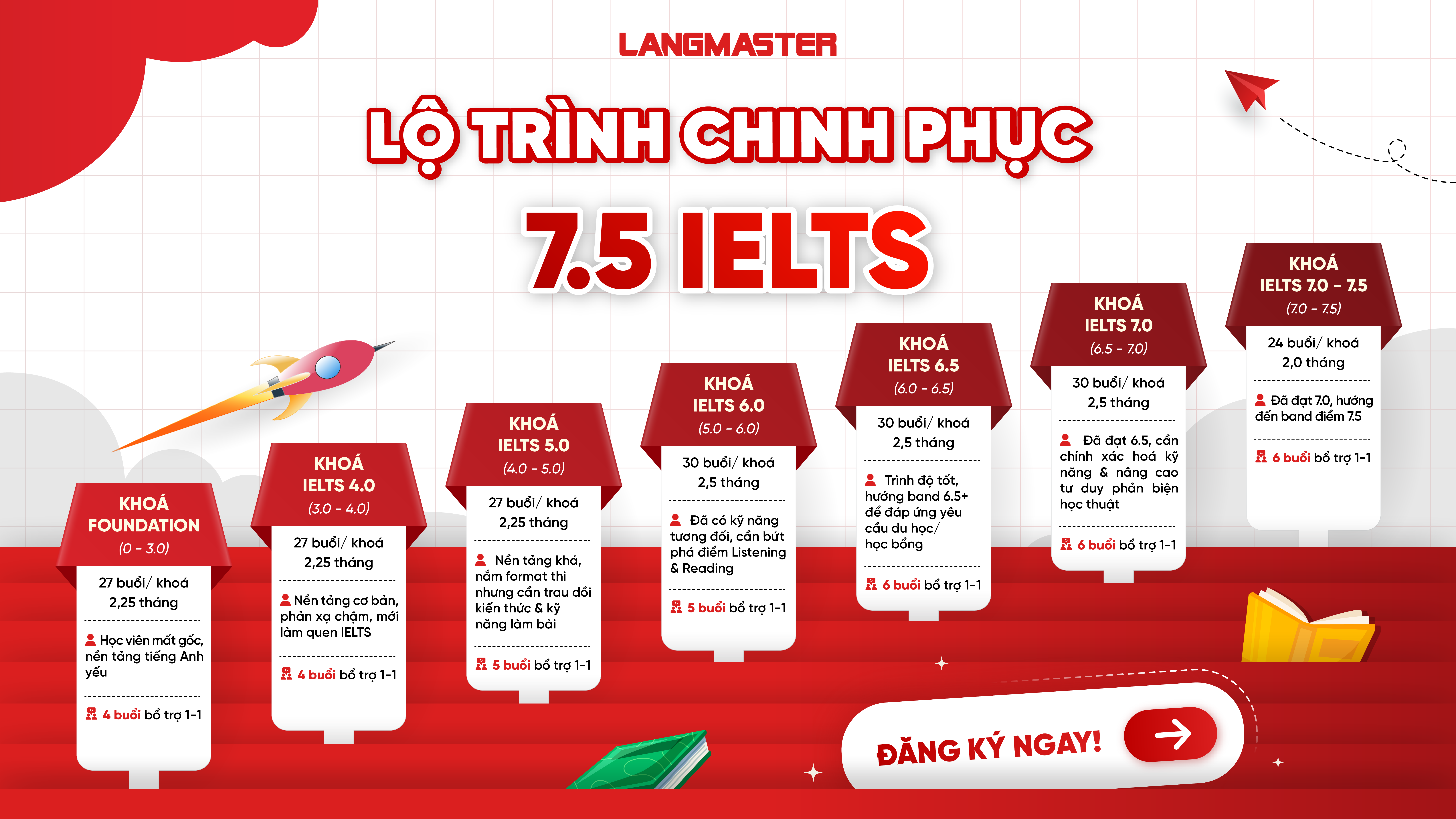
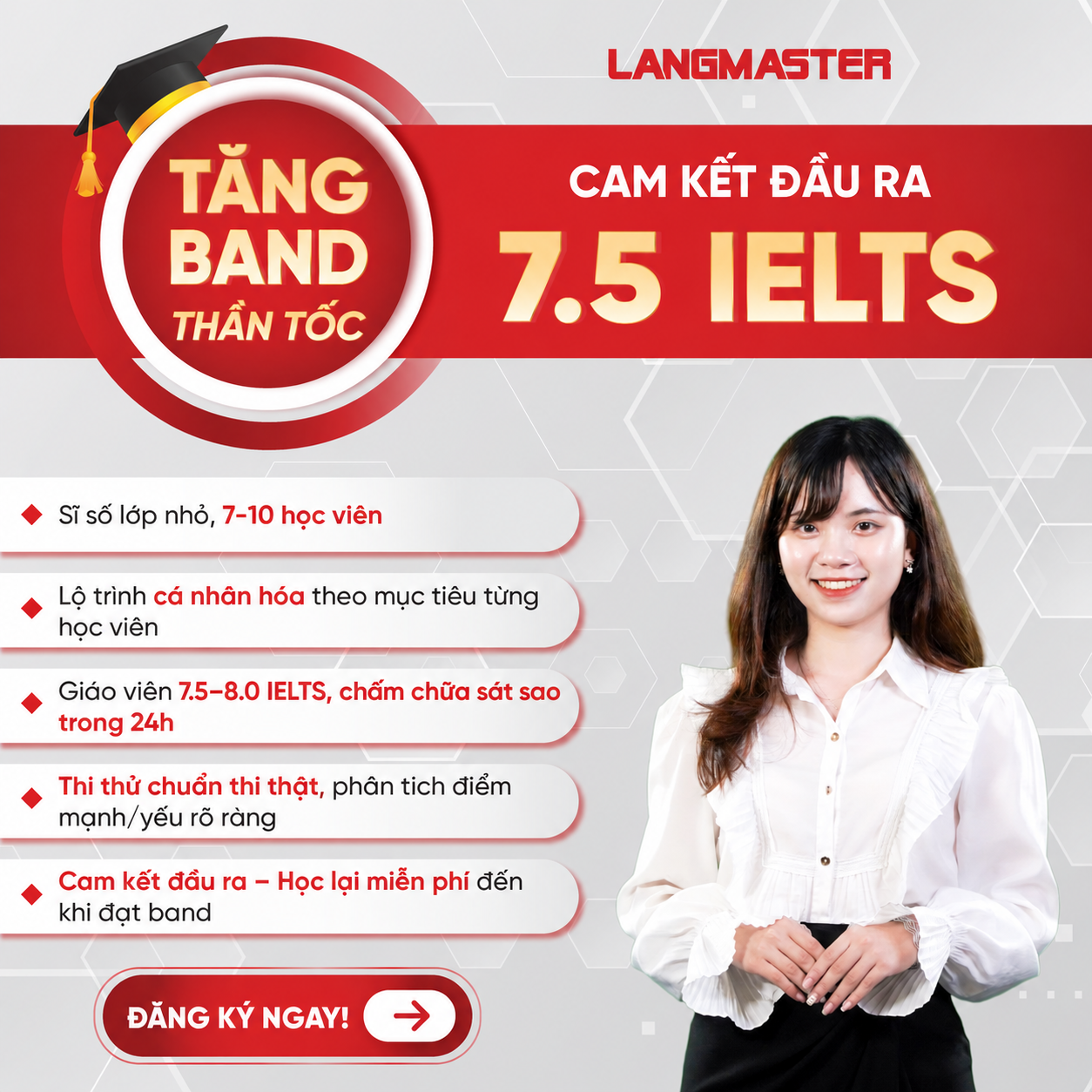
Tại Langmaster, học viên được:
Đăng ký học thử IELTS Online miễn phí ngay hôm nay để trải nghiệm lớp học thực tế, kiểm tra trình độ và nhận lộ trình học tập hiệu quả, giúp bạn thành thạo các kỹ năng và chinh phục mục tiêu IELTS!
Tóm lại, chủ đề rebranding art museum IELTS Reading giúp bạn luyện tư duy phân tích, nhận diện lập luận và từ vựng học thuật về văn hóa – kiến trúc. Đây chính là cơ hội để biến việc ôn tập Reading thành hành trình khám phá thú vị và hiệu quả. Nếu muốn bứt tốc, hãy đăng ký lớp IELTS Online tại Langmaster để có lộ trình cá nhân hóa và luyện đề IELTS sát chuẩn.


![Giải đề thi European Heat Wave IELTS Reading [FULL ANSWER]](https://langmaster.edu.vn/storage/uploads/original/2025/11/20/european-heat-wave-ielts-reading-answers.png)
Tổng hợp đề thi European Heat Wave IELTS Reading Answers kèm phân tích chi tiết, từ vựng và đáp án giúp bạn tối ưu điểm Reading nhanh chóng.
![Đề thi IELTS Reading có đáp án mới nhất 2025-2026 [Cập nhật liên tục]](https://langmaster.edu.vn/storage/uploads/original/2025/12/25/de-thi-ielts-reading.png)
Đề thi IELTS Reading có đáp án mới nhất 2025/2026, cập nhật liên tục đề thi thật và Cambridge, kèm lời giải chi tiết giúp nâng band hiệu quả.
Bài viết tổng hợp chi tiết đề thi IELTS Reading Holidays with a difference, đáp án kèm giải thích chi tiết, từ vựng cần lưu ý khi làm bài giúp bạn luyện thi hiệu quả và nâng cao band điểm.

Bài viết tổng hợp chi tiết đề thi IELTS Reading on the trail of the honey badger, đáp án kèm giải thích chi tiết, từ vựng cần lưu ý khi làm bài giúp bạn luyện thi hiệu quả và nâng cao band điểm.
![Giải đề IELTS Reading Growing more for less [FULL ANSWER]](https://langmaster.edu.vn/storage/uploads/original/2025/10/22/growing-more-for-less-ielts-reading-answers.png)
Khám phá bài đọc Growing more for less IELTS Reading: Tổng hợp đáp án, từ vựng quan trọng và phân tích chi tiết giúp bạn hiểu cách công nghệ vệ tinh hỗ trợ nông nghiệp hiện đại




Hơn 16 năm kinh nghiệm, đào tạo thành công hàng trăm nghìn học viên
Phương pháp giảng dạy hiện đại, học viên tiến bộ rõ rệt
Lộ trình học chuẩn quốc tế, phù hợp với nhu cầu thực tiễn
Giáo viên đạt chuẩn Quốc tế với chất lượng top đầu thị trường, giàu kinh nghiệm
Học online linh hoạt, cam kết đầu ra bằng văn bản


![Giải đề IELTS Reading Actual Test Vol 6 Test 5: The Pearl [FULL ANSWER]](https://langmaster.edu.vn/storage/uploads/original/2025/10/08/the-pearl-ielts-reading.png)
![Giải đề IELTS Reading: Video Games and Violence [Full answers]](https://langmaster.edu.vn/storage/images/2025/10/02/giai-de-ielts-reading-video-games-and-violence-full-answers.webp)
![[TỔNG HỢP] TỪ VỰNG IELTS READING THEO CHỦ ĐỀ THƯỜNG GẶP](https://langmaster.edu.vn/storage/images/2025/10/01/tong-hop-tu-vung-ielts-reading-theo-chu-de-thuong-gap.webp)