
Khóa học
IELTS Online
IELTS Online
Giảm đến 18%
Đăng ký ngay
Mục lục [Ẩn]
Đề thi IELTS Reading ngày 16.01.2026 gồm ba passage: Learning to Walk, Yawning, Endangered languages. Bài viết dưới đây cung cấp lời giải chi tiết từng câu hỏi và nội dung cụ thể của từng bài đọc trong đề thi thật, giúp bạn nắm rõ cấu trúc đề và chủ động hơn khi luyện tập với đề thi thật.
Learning to Walk
These days the feet of a typical city dweller rarely encounter terrain any more uneven than a crack in the pavement. While that may not seem like a problem, it turns out that by flattening our urban environment we have put ourselves at risk of a surprising number of chronic illnesses and disabilities. Fortunately, the commercial market has come to the rescue with a choice of products. Research into the idea that flat floors could be detrimental to our health was pioneered back in the late 1960s in Long Beach, California. Podiatrist Charles Brantingham and physiologist Bruce Beekman were concerned with the growing epidemic of high blood pressure, varicose veins and deep-vein thromboses and reckoned they might be linked to the uniformity of the surfaces that we tend to stand and walk on.
The trouble, they believed, was that walking continuously on flat floors, sidewalks and streets concentrates forces on just a few areas of the foot. As a result, these surfaces are likely to be far more conducive to chronic stress syndromes than natural surfaces, where the foot meets the ground in a wide variety of orientations. They understood that the anatomy of the foot parallels that of the human hand – each having 26 bones, 33 joints and more than 100 muscles, tendons and ligaments – and that modern lifestyles waste all this potential flexibility.
Brantingham and Beekman became convinced that the damage could be rectified by making people wobble. To test their ideas, they got 65 factory workers to try standing on a variable terrain floor – spongy mats with varying degrees of resistance across the surface. This modest irregularity allowed the soles of the volunteers’ feet to deviate slightly from the horizontal each time they shifted position. As the researchers hoped, this simple intervention made a huge difference, within a few weeks. Even if people were wobbling slightly, it activated a host of muscles in their legs, which in turn helped pump blood back to their hearts. The muscle action prevented the pooling of blood in their feet and legs, reducing the stress on the heart and circulation. Yet decades later, the flooring of the world’s largest workplaces remains relentlessly smooth.
Earlier this year, however, the idea was revived when other researchers in the US announced findings from a similar experiment with people over 60. John Fisher and colleagues at the Oregon Research Institute in Eugene designed a mat intended to replicate the effect of walking on cobblestones*. In tests funded by the National Institute of Aging, they got some 50 adults to walk on the toots in their bare feet for less than an hour, three times a week. After 16 weeks, these people showed marked improvements in mobility, and even a significant reduction in blood pressure. People in a control group who walked on ordinary floors also improved but not as dramatically. The mats are now available for purchase and production is being scaled up. Even so, demand could exceed supply if this foot-stimulating activity really is a ‘useful non-pharmacological approach for preventing or controlling hypertension of older adults, as the researchers believe.
They are not alone in recognising the benefits of cobblestones. Reflexologists have long advocated walking on textured surfaces to stimulate so-called ‘acupoints’ on the soles of the feet. They believe that pressure applied to particular spots on the foot connects directly to particular organs of the body and somehow enhances their function. In China, spas, apartment blocks and even factories promote their cobblestone paths as healthful amenities. Fisher admits he got the concept from regular visits to the country. Here, city dwellers take daily walks along cobbled paths for five or ten minutes, perhaps several times a day, to improve their health. The idea is now taking off in Europe too.
People in Germany, Austria and Switzerland can now visit ‘barefoot parks’ and walk along ‘paths of the senses – with mud, logs, stone and moss underfoot. And it is not difficult to construct your own path with simple everyday objects such as stones or bamboo poles. But if none of these solutions appeal, there is another option. A new shoe on the market claims to transform flat, hard, artificial surfaces into something like uneven ground. ‘These shoes have an unbelievable effect,’ says Benno Nigg, an exercise scientist at Calgary University in Canada.
Known as the Masai Barefoot Technology, the shoes have rounded soles that cause you to rock slightly when you stand still, exercising the small muscles around the ankle that are responsible for stability. Forces in the joint are reduced, putting less strain on the system, Nigg claims.
Some of these options may not appeal to all consumers and there is a far simpler alternative. If the urban environment is detrimental to our health, then it is obvious where we should turn. A weekend or even a few hours spent in the countryside could help alleviate a sufferer’s aches and pains, and would require only the spending of time.
However, for many modern citizens, the countryside is not as accessible as it once was and is in fact a dwindling resource. Our concrete cities are growing at a terrifying rate – perhaps at the same rate as our health problems.

Questions 1 – 5
Do the following statements agree with the information given in Reading Passage? Write:
TRUE if the statement agrees with the information
FALSE if the statement contradicts the information
NOT GIVEN if there is no information on this
1. Brantingham and Beekman were the first researchers to investigate the relationship between health problems and flat floors.
2. The subjects in Fisher’s control group experienced a decline in their physical condition.
3. The manufacturers are increasing the number of cobblestone mats they are making.
4. Fisher based his ideas on what he saw during an overseas trip.
5. The Masai Barefoot Technology shoes are made to fit people of all ages.
Questions 6 – 8
Choose the correct letter, A, B, C or D.
Write the correct letter in boxes 6 – 8 on your answer sheet.
6. The writer suggests that Brantingham and Beekman’s findings were
A. ignored by big companies.
B. doubted by other researchers.
C. applicable to a narrow range of people.
D. surprising to them.
7. What claim is made by the designers of the cobblestone mats?
A. They need to be used continuously in order to have a lasting effect.
B. They would be as beneficial to younger people as to older people.
C. They could be an effective alternative to medical intervention.
D. Their effects may vary depending on individual users.
8. Which of the following points does the writer make in the final paragraph?
A. People should question new theories that scientists put forward.
B. High prices do not necessarily equate to a quality product.
C. People are setting up home in the country for health reasons.
D. The natural environment is fast disappearing.
Questions 9 – 14
Complete the summary below.
Choose ONE WORD ONLY from the passage for each answer.
Write your answers in boxes 9-14 on your answer sheet.
In their research, Brantingham and Beekman looked at the complex physical 9.______ of the foot and noted that the surfaces of modem environments restrict its movement. They invented a mat which they tried out on factory workers. Whenever the workers walked on it, the different levels of 10.______ in the mat would encourage greater muscle action. In turn, this lessened the effect of 11.______ on the cardiovascular system. Similar research was undertaken by John Fisher and colleagues in Oregon. As a result of their findings, they decided to market cobblestone mats to the elderly as a means of dealing with 12.______ . Reflexologists claim that by manipulating specific parts of the feet, the performance of certain 13.______ will also improve. Finally, Benno Nigg at Calgary University believes that specially shaped 14.______ on shoes should give health benefits.
>>> XEM THÊM:
Đề thi IELTS Reading có đáp án mới nhất 2025-2026 [Cập nhật liên tục]
Giải đề thi thật IELTS Reading ngày 04.01.2026 [Full Answers]
Dưới đây là bảng đáp án đề IELTS Reading Passage 1 ngày 16.01.2026
|
1. TRUE |
8. D |
|
2. FALSE |
9. anatomy |
|
3. TRUE |
10. resistance |
|
4. TRUE |
11. stress |
|
5. NOT GIVEN |
12. hypertension |
|
6. A |
13. organs |
|
7. C |
14. soles |
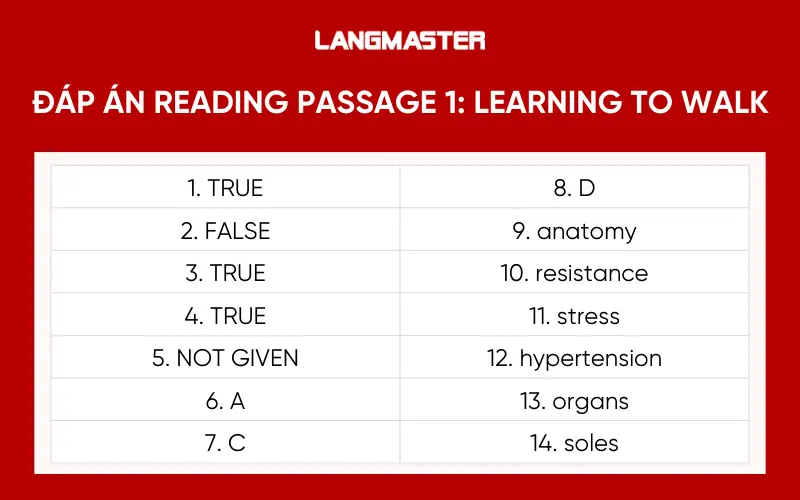
Đáp án chi tiết 1 - 5
Câu 1. TRUE
Đoạn 1 có câu: “Research into the idea that flat floors could be detrimental to our health was pioneered…” Từ “pioneered” nghĩa là tiên phong, cho thấy Brantingham và Beekman là những người đầu tiên nghiên cứu mối liên hệ giữa sàn phẳng và vấn đề sức khỏe.
Câu 2. FALSE
Đoạn 4 viết: “People in a control group… also improved but not as dramatically.” Nhóm đối chứng vẫn cải thiện, chỉ không nhiều bằng nhóm thử nghiệm. Đề bài nói họ bị suy giảm thể trạng (decline) → trái ngược thông tin.
Câu 3. TRUE
Đoạn 4 có câu: “production is being scaled up.” “Scaled up” nghĩa là tăng quy mô sản xuất → các nhà sản xuất đang tăng số lượng thảm đá cuội.
Câu 4. TRUE
Đoạn 5 viết: “Fisher admits he got the concept from regular visits to the country.” Ông thừa nhận ý tưởng xuất phát từ những chuyến thăm nước ngoài (Trung Quốc).
Câu 5. NOT GIVEN
Bài chỉ nói về loại giày mới trên thị trường, không có thông tin nào nói nó phù hợp với mọi lứa tuổi.
Đáp án chi tiết 6 - 8
Câu 6. A – ignored by big companies
Đoạn 3 viết: “the flooring of the world’s largest workplaces remains relentlessly smooth.” Dù nghiên cứu cho thấy lợi ích, các nơi làm việc lớn vẫn dùng sàn phẳng → phát hiện bị phớt lờ.
Câu 7. C – They could be an effective alternative to medical intervention
Đoạn 4: “a useful non-pharmacological approach for preventing or controlling hypertension.” “Non-pharmacological” nghĩa là không dùng thuốc → giải pháp thay thế điều trị bằng thuốc.
Câu 8. D – The natural environment is fast disappearing
Đoạn cuối có cụm “a dwindling resource” và “cities are growing at a terrifying rate.” Cho thấy môi trường tự nhiên đang dần thu hẹp.
Đáp án chi tiết 9 - 14
Câu 9. anatomy
Câu tóm tắt: “In their research, Brantingham and Beekman looked at the complex physical ______ of the foot…”
Ta cần một danh từ mô tả “cấu trúc vật lý phức tạp” của bàn chân.
Trong đoạn 2 có câu: “They understood that the anatomy of the foot parallels that of the human hand…”
“Anatomy” nghĩa là cấu trúc giải phẫu.
Cụm “complex physical structure” trong summary chính là cách diễn đạt lại của “anatomy”.
→ Đáp án: anatomy
Câu 10. resistance
Câu tóm tắt: “…the different levels of ______ in the mat would encourage greater muscle action.”
Ta cần từ mô tả “mức độ khác nhau” của cái gì đó trong tấm thảm.
Trong đoạn 3: “spongy mats with varying degrees of resistance…”
“Varying degrees” = different levels → khớp hoàn toàn với summary.
“Resistance” nghĩa là lực cản/độ đàn hồi khác nhau của thảm.
→ Đáp án: resistance
Câu 11. stress
Câu tóm tắt: “In turn, this lessened the effect of ______ on the cardiovascular system.”
Ta cần từ liên quan đến tác động xấu lên tim mạch.
Đoạn 3 viết: “reducing the stress on the heart and circulation.”
“Heart and circulation” = cardiovascular system
“Stress” được giữ nguyên ý nghĩa trong summary.
→ Đáp án: stress
Câu 12. hypertension
Câu tóm tắt: “…a means of dealing with ______.”
Ta cần 1 vấn đề sức khỏe mà thảm đá cuội giúp cải thiện.
Đoạn 4 viết: “preventing or controlling hypertension of older adults.”
Hypertension = high blood pressure (cao huyết áp).
Summary paraphrase “preventing or controlling” thành “dealing with”.
→ Đáp án: hypertension
Câu 13. organs
Câu tóm tắt: “…the performance of certain ______ will also improve.”
Ta cần danh từ số nhiều, liên quan đến bộ phận cơ thể.
Đoạn 5 viết: “pressure applied to particular spots on the foot connects directly to particular organs…”
Reflexologists tin rằng kích thích bàn chân sẽ cải thiện chức năng của “organs”.
→ Đáp án: organs
Câu 14. soles
Câu tóm tắt: “…specially shaped ______ on shoes should give health benefits.”
Ta cần một bộ phận của giày.
Đoạn 6 viết: “the shoes have rounded soles…”
“Soles” = đế giày.
Summary dùng “specially shaped” để paraphrase “rounded”.
→ Đáp án: soles

>>> XEM THÊM:
Yawning
How and why we yarn still presents problems for researchers in an area which has only recently been opened up to study
When Robert R Provine began studying yawning in the 1960s, it was difficult for him to convince research students of the merits of ‘yawning science1. Although it may appear quirky to some, Provine’s decision to study yawning was a logical extension of his research in developmental neuroscience.
The verb ‘to yawn’ is derived from the Old English ganien or ginian, meaning to gape or open wide. But in addition to gaping jaws, yawning has significant features that are easy to observe and analyse. Provine ‘collected’ yawns to study by using a variation of the contagion response*. He asked people to ‘think about yawning’ and, once they began to yawn to depress a button and that would record from the start of the yawn to the exhalation at its end.
Provine’s early discoveries can be summanized as follows: the yawn is highly stereotyped but not invariant in its duration and form. It is an excellent example of the instinctive ‘fixed action pattern’ of classical animal-behavior study, or ethology. It is not a reflex (short-duration, rapid, proportional response to a simple stimulus), but, once started, a yawn progresses with the inevitability of a sneeze. The standard yawn runs its course over about six seconds on average, but its duration can range from about three seconds to much longer than the average. There are no half-yawns: this is an example of the typical intensity of fixed action patterns and a reason why you cannot stifle yawns. Just like a cough, yawns can come in bouts with a highly variable inter-yawn interval, which is generally about 68 seconds but rarely more than 70. There is no relation between yawn frequency and duration: producers of short or long yawns do not compensate by yawning more or less often. Furthermore, Provine’s hypotheses about the form and function of yawning can be tested by three informative yawn variants which can be used to look at the roles of the nose, the mouth and the jaws.
i) The closed nose yawn
Subjects are asked to pinch their nose closed when they feel themselves start to yawn. Most subjects report being able to perform perfectly normal closed nose yawns. This indicates that the inhalation at the onset of a yawn, and the exhalation at its end, need not involve the nostrils – the mouth provides a sufficient airway.
ii) The clenched teeth yawn
Subjects are asked to clench their teeth when they feel themselves start to yawn but allow themselves to inhale normally through their open lips and clenched teeth. This variant gives one the sensation of being stuck midyawn. This shows that gaping of the jaws is an essential component of the fixed action pattern of the yawn, and unless it is accomplished, the program (or pattern) will not run to completion. The yawn is also shown to be more than a deep breath, because, unlike normal breathing, inhalation and exhalation cannot be performed so well through the clenched teeth as through the nose.
iii) The nose yawn
This variant tests the adequacy of the nasal airway to sustain a yawn. Unlike normal breathing, which can be performed equally well through mouth or nose, yawning is impossible via nasal inhalation alone. As with the clenched teeth yawn, the nose yawn provides the unfulfilling sensation of being stuck in mid-yawn. Exhalation, on the other hand, can be accomplished equally well through nose or mouth. Through thin methodology Provine demonstrated that inhalation through the oral airway and the gaping of jaws are necessary for normal yawns. The motor program for yawning will not run to completion without feedback that these parts of the program have been accomplished.
But yawning is a powerful, generalized movement that involves much more than airway maneuvres and jaw-gaping. When yawning you also stretch your facial muscles, tilt your head back, narrow or close your eyes, produce tears, salivate, open the Eustachian tubes of your middle ear and perform many other, yet unspecified, cardiovascular and respiratory acts. Perhaps the yawn shares components with other behaviour. For example, in the yawn a kind of ‘slow sneeze1 or is the sneeze a ‘fast yawn’? Both share common respiratory and other features including jaw gaping, eye closing and head tilting.
Yawning and stretching share properties and may be performed together as parts of a global motor complex. Studies by J I p deVries et al. in the early 1980s, charting movement in the developing foet US using ultrasound, observed a link between yawning and stretching. The most extraordinary demonstration of the yawn-stretch linkage occurs in many people paralyzed on one side of their body because of brain damage caused by a stroke, the prominent British neurologist Sir Francis Walshe noted in 1923 that when these people yawn, they are startled and mystified to observe that their otherwise paralyzed arm rises and flexes automatically in what neurologists term an ‘associated response’. Yawning apparently activates undamaged, unconsciously controlled connections between the brain and the motor system, causing the paralyzed limb to move. It is not known whether the associated response is a positive prognosis for recovery, nor whether yawning is therapeutic for prevention of muscular deterioration.
Provine speculated that, in general, yawning may have many functions, and selecting a single function from the available options may be an unrealistic goal. Yawning appears to be associated with a change of behavioral state, switching from one activity to another. Yawning is also a reminder that ancient and unconscious behavior linking US to the animal world lurks beneath the veneer of culture, rationality and language

Questions 15 – 20
Complete the summary below using the list of words, A-K, below
Write the correct letter, A-K, in boxes 15-20 on your answer sheet.
Provine’s early findings on yawns
Through his observation of yawns, Province was able to confirm that 1.______ do not exist.
Just like a 2._______, yawns cannot be interrupted after they have begun. This is because yawns occur as a 3.______ rather than a stimulus response as was previously thought.
In measuring the time taken to yawn, provive found that a typical yawn lasts about 4.______. He also found that it is a common for people to yawn a number of times in quick succession with the yawns usually being around 5._____ apart. When studying whether length and rate were connected. Province concluded that people who yawn less do not necessarily produce 6._____ to make up for this.
A. form and function
B. long yawns
C. 3 seconds
D. fixed action pattern
E. 68 seconds
F. short yawns
G. reflex
H. sneeze
I. short duration
J. 6 seconds
K. half-yawns
Questions 20 – 24
Choose the correct letter, A, B, C or D.
Write the correct letter in boxes 20 – 24 on your answer sheet.
20. What did Provine conclude from his ‘closed nose yawn1 experiment?
A Ending a yawn requires use of the nostrils.
B You can yawn without breathing through your nose
C Breathing through the nose produces a silent yawn.
D The role of the nose in yawning needs further investigation.
21. Provine’s clenched teeth yawn’s experiment shows that
A yawning is unconnected with fatigue.
B a yawn is the equivalent of a deep intake of breath.
C you have to be able to open your mouth wide to yawn.
D breathing with the teeth together is as efficient as through the nose.
22. The nose yawn experiment was used to test weather yawning
A can be stopped after it has stated
B is the result of motor programing
C involves both inhalation and exhalation.
D can be accomplished only through the nose.
23. In people paralyzed on one side because of brain damage
A yawning may involve only one side of the face.
B the yawing response indicates that recovery is likely
C movement in paralysed arm is stimulated by yawming
D yawning can be used as an example to prevent muscle wasting.
24. In the last paragraph, the writer concludes that
A yawning is a sign of boredom.
B we yawn is spite of the development of our species
C yawning is a more passive activity than we Imagine
D we are stimulated to yawn when our brain activity is low.
Questions 25 – 27
Do the following statements agree with the claims of the writer in Reading Passage?
In boxes 25-27 on your answer sheet, write
YES if the statement agrees with the views of the writer
NO if the statement contradicts the views of the writer
NOT GIVEN if it is impossible to say what the writer thinks about this
25. Research students were initially reluctant to appreciate the value of Provine’s studies.
26. When foetuses yawn and stretch they are learning how to control movement.
27. According to Provine, referring to only one function is probably inadequate to explain why people yawn.
>>> XEM THÊM:
Cách làm Multiple Choice trong IELTS Reading ẵm trọn điểm tối đa
Cách làm Matching Information trong IELTS Reading “ẵm trọn” điểm cao
Dưới đây là bảng đáp án đề IELTS Reading Passage 2 ngày 16.01.2026
|
15. K |
21. C |
|
16. H |
22. B |
|
17. D |
23. C |
|
18. J |
24. B |
|
19. E |
25. YES |
|
20. B |
26. NOT GIVEN |
|
21. B |
27. YES |
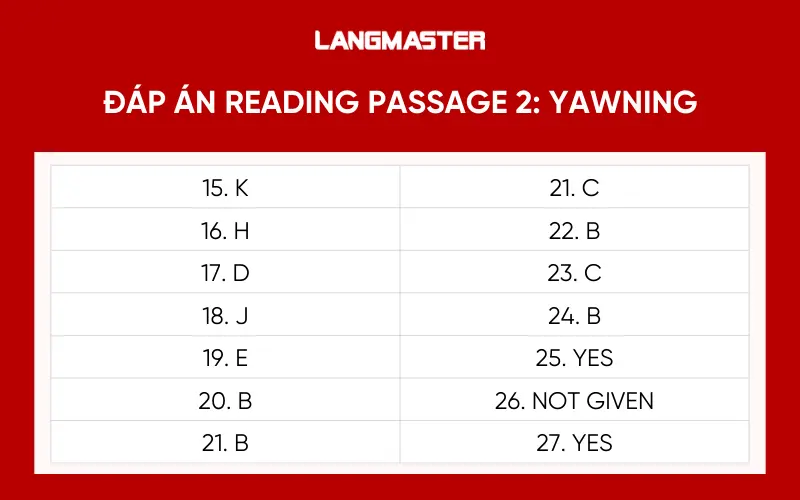
Đáp án chi tiết 15 - 19
Câu 15. K – half-yawns
Summary: “Through his observation of yawns, Provine was able to confirm that ______ do not exist.”
Trong bài có câu: “There are no half-yawns.”
→ Không tồn tại “ngáp nửa chừng”.
→ Đáp án: half-yawns.
Câu 16. H – sneeze
Summary: “Just like a ______, yawns cannot be interrupted after they have begun.”
Trong bài: “once started, a yawn progresses with the inevitability of a sneeze.”
Ngáp giống như hắt hơi – đã bắt đầu thì không dừng lại được.
→ Đáp án: sneeze.
Câu 17. D – fixed action pattern
Summary: “yawns occur as a ______ rather than a stimulus response…”
Trong bài: “It is an excellent example of the instinctive ‘fixed action pattern’… It is not a reflex.”
→ Ngáp không phải reflex (phản xạ) → Mà là fixed action pattern (một chương trình vận động cố định).
→ Đáp án: fixed action pattern.
Câu 18. J – 6 seconds
Summary: “a typical yawn lasts about ______.”
Trong bài: “The standard yawn runs its course over about six seconds on average.”
→ Đáp án: 6 seconds.
Câu 19. E – 68 seconds
Summary:
“yawns usually being around ______ apart.”
Trong bài: “inter-yawn interval… generally about 68 seconds.” Khoảng cách giữa hai lần ngáp ≈ 68 giây.
→ Đáp án: 68 seconds.
Đáp án chi tiết 20 - 24
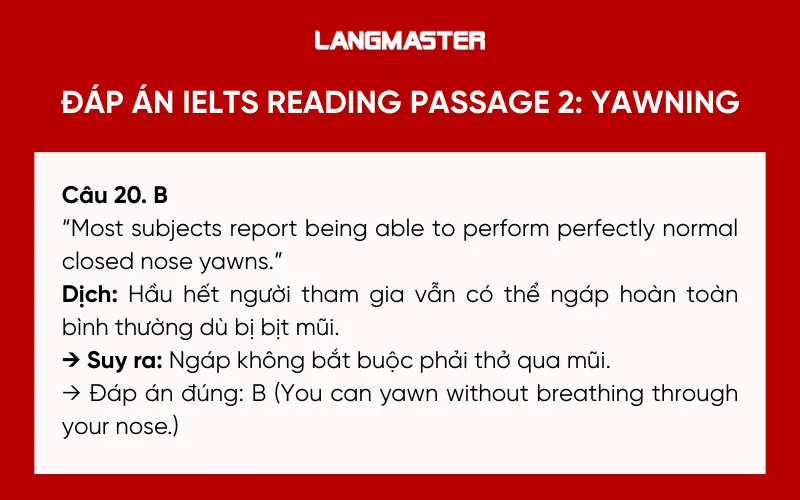
Câu 20. B
“Most subjects report being able to perform perfectly normal closed nose yawns.”
Dịch: Hầu hết người tham gia vẫn có thể ngáp hoàn toàn bình thường dù bị bịt mũi.
→ Suy ra: Ngáp không bắt buộc phải thở qua mũi.
→ Đáp án đúng: B (You can yawn without breathing through your nose.)
Câu 21. C
Trong bài viết: “This shows that gaping of the jaws is an essential component of the fixed action pattern of the yawn, and unless it is accomplished, the program will not run to completion.”
Dịch: Điều này cho thấy việc há rộng hàm là thành phần thiết yếu của hành động ngáp, và nếu không thực hiện được thì cái ngáp sẽ không hoàn thành.
→ Suy ra: Phải mở miệng rộng mới ngáp hoàn chỉnh. → Đáp án đúng: C.
Câu 22. B
Trong bài viết:“The motor program for yawning will not run to completion without feedback that these parts of the program have been accomplished.”
Dịch: Chương trình vận động của hành động ngáp sẽ không hoàn thành nếu các bước cần thiết chưa được thực hiện.
→ Suy ra: Ngáp là một “motor program” (chương trình vận động có trình tự). → Đáp án đúng: B.
Câu 23. C
Trong bài viết: “their otherwise paralyzed arm rises and flexes automatically…”
Dịch: Cánh tay vốn bị liệt của họ tự động nâng lên và co lại khi ngáp.
→ Suy ra: Ngáp kích thích cánh tay bị liệt cử động. → Đáp án đúng: C.
Câu 24. B
Trong bài viết: “Yawning is also a reminder that ancient and unconscious behavior linking us to the animal world lurks beneath the veneer of culture…”
Dịch: Ngáp nhắc nhở rằng đây là hành vi cổ xưa và vô thức, liên kết con người với thế giới động vật.
→ Suy ra: Dù con người đã phát triển văn minh, hành vi này vẫn tồn tại. → Đáp án đúng: B.
Đáp án chi tiết 25 - 27
Câu 25. YES
Trong bài viết: “it was difficult for him to convince research students of the merits of ‘yawning science’.”
Dịch: Ông gặp khó khăn khi thuyết phục sinh viên nghiên cứu rằng lĩnh vực này có giá trị.
→ Đồng ý với nhận định. → YES.
Câu 26. NOT GIVEN
Trong bài viết chỉ nói: “observed a link between yawning and stretching.”
Dịch: Quan sát thấy có mối liên hệ giữa ngáp và vươn người ở thai nhi.
→ Không có thông tin nói thai nhi đang “học cách điều khiển cơ thể”. → NOT GIVEN.
Câu 27. YES
Trong bài viết: “selecting a single function from the available options may be an unrealistic goal.”
Dịch: Việc chọn một chức năng duy nhất để giải thích ngáp có thể là mục tiêu không thực tế.
→ Tác giả đồng ý rằng không thể giải thích ngáp chỉ bằng một lý do. → YES.
>>> XEM THÊM:
Endangered languages
‘Nevermind whales, save the languages’, says Peter Monaghan, graduate of the Australian National University
Worried about the loss of rain forests and the ozone layer? Well, neither of those is doing any worse than a large majority of the 6,000 to 7,000 languages that remain in use on Earth. One half of the survivors will growing evidence that not all approaches to the almost certainly be gone by 2050, while 40% more preservation of languages will be particularly will probably be well on their way out. In their place, almost all humans will speak one of a handful of megalanguages – Mandarin, English, Spanish.
Linguists know what causes languages to disappear, but less often remarked is what happens on the way to disappearance: languages’ vocabularies, grammars and expressive potential all diminish as one language is replaced by another. ‘Say a community goes over from speaking a traditional Aboriginal language to speaking a creole*,’ says Australian Nick Evans, a leading authority on Aboriginal languages, ‘you leave behind a language where there’s very fine vocabulary for the landscape. All that is gone in a creole. You’ve just got a few words like ‘gum tree’ or whatever. As speakers become less able to express the wealth of knowledge that has filled ancestors’ lives with meaning over millennia, it’s no wonder that communities tend to become demoralised.’
If the losses are so huge, why are relatively few linguists combating the situation? Australian linguists, at least, have achieved a great deal in terms of preserving traditional languages. Australian governments began in the 1970s to support an initiative that has resulted in good documentation of most of the 130 remaining Aboriginal languages. In England, another Australian, Peter Austin, has directed one of the world’s most active efforts to limit language loss, at the University of London. Austin heads a programme that has trained many documentary linguists in England as well as in language-loss hotspots such as West Africa and South America.
At linguistics meetings in the US, where the endangered-language issue has of late been something of a flavour of the month, there is growing evidence that not all approaches to the preservation of languages will be particularly helpful. Some linguists are boasting, for example, of more and more sophisticated means of capturing languages: digital recording and storage, and internet and mobile phone technologies. But these are encouraging the ‘quick dash’ style of recording trip: fly in, switch on digital recorder, fly home, download to hard drive, and store gathered material for future research. That’s not quite what some endangered-language specialists have been seeking for more than 30 years. Most loud and untiring has been Michael Krauss, of the University of Alaska. He has often complained that linguists are playing with non-essentials while most of their raw data is disappearing.
Who is to blame? That prominent linguist Noam Chomsky, say Krauss and many others. Or, more precisely, they blame those linguists who have been obsessed with his approaches. Linguists who go out into communities to study, document and describe languages, argue that theoretical linguists, who draw conclusions about how languages work, have had so much influence that linguistics has largely ignored the continuing disappearance of languages. Chomsky, from his post at the Massachusetts Institute of Technology, has been the great man of theoretical linguistics for far longer than he has been known as a political commentator. His landmark work of 1957 argues that all languages exhibit certain universal grammatical features, encoded in the human mind. American linguists, in particular, have focused largely on theoretical concerns ever since, even while doubts have mounted about Chomsky’s universals.
Austin and Co. are in no doubt that because languages are unique, even if they do tend to have common underlying features, creating dictionaries and grammars requires prolonged and dedicated work. This requires that documentary linguists observe not only languages’ structural subtleties, but also related social, historical and political factors. Such work calls for persistent funding of field scientists who may sometimes have to venture into harsh and even hazardous places. Once there, they may face difficulties such as community suspicion. As Nick Evans says, a community who speak an endangered language may have reasons to doubt or even oppose efforts to preserve it. They may have seen support and funding for such work come and go. They may have given up using the language with their children, believing they will benefit from speaking a more widely understood one.
Plenty of students continue to be drawn to the intellectual thrill of linguistics field work. That’s all the more reason to clear away barriers, contend Evans, Austin and others. The highest barrier, they agree, is that the linguistics profession’s emphasis on theory gradually wears down the enthusiasm of linguists who work in communities. Chomsky disagrees. He has recently begun to speak in support of language preservation. But his linguistic, as opposed to humanitarian, argument is, let’s say, unsentimental: the loss of a language, he states, ‘is much more of a tragedy for linguists whose interests are mostly theoretical, like me, than for linguists who focus on describing specific languages, since it means the permanent loss of the most relevant data for general theoretical work’. At the moment, few institutions award doctorates for such work, and that’s the way it should be, he reasons. In linguistics, as in every other discipline, he believes that good descriptive work requires thorough theoretical understanding and should also contribute to building new theory. But that’s precisely what documentation does, objects Evans. The process of immersion in a language, to extract, analyse and sum it up, deserves a PhD because it is ‘the most demanding intellectual task a linguist can engage in’.

Questions 27-32
Do the following statements agree with the views of the author in the Reading Passage? Write in boxes 27-32 on your answer sheet
YES if the statement matches the information
NO if the statement does not match with the information
NOT GIVEN if no information is available
27. By 2050 only a small number of languages will be flourishing.
28. Australian academics’ efforts to record existing Aboriginal languages have been too limited.
29. The use of technology In language research is proving unsatisfactory in some respects.
30. Chomsky’s political views have overshadowed his academic work.
31. Documentary linguistics studies require long-term financial support.
32. Chomsky’s attitude to disappearing languages is too emotional.
Question 33-36
Choose appropriate options A, B, C or D.
33. The writer mentions rainforests and the ozone layer.
A. because he believes anxiety about environmental issues is unfounded.
B. to demonstrate that academics in different disciplines share the same problems.
C. because they exemplify what is wrong with the attitudes of some academics.
D. to make the point that the public should be equally concerned about languages.
34. What does Nick Evans say about speakers of a creole?
A. They lose the ability to express ideas which are part of their culture.
B. Older and younger members of the community have difficulty communicating.
C. They express their ideas more clearly and concisely than most people.
D. Accessing practical information causes problems for them.
35. What is similar about West Africa and South America, from the linguist’s point of view?
A. The English language is widely used by academics and teachers.
B. The documentary linguists who work there were trained by Australians.
C. Local languages are disappearing rapidly in both places.
D. There are now only a few undocumented languages there.
36. Michael Krauss has frequently pointed out that
A. linguists are failing to record languages before they die out.
B. linguists have made poor use of improvements in technology.
C. linguistics has declined in popularity as an academic subject.
D. linguistics departments are underfunded in most universities.
Question 37-40
Complete each sentence with the correct ending A-G below.
Write the correct letter A-G.
List of Endings
A. even though it is in danger of disappearing.
B. provided that it has a strong basis in theory.
C. although it may share certain universal characteristics
D. because there is a practical advantage to it
E. so long as the drawbacks are clearly understood.
F. in spite of the prevalence of theoretical linguistics.
G. until they realize what is involved
37. Linguists like Peter Austin believe that every language is unique
38. Nick Evans suggests a community may resist attempts to save its language
39. Many young researchers are interested in doing practical research
40. Chomsky supports work in descriptive linguistics
>>> XEM THÊM:
Dưới đây là bảng đáp án đề IELTS Reading Passage 3 ngày 16.01.2026
|
27. YES |
34. A |
|
28. NO |
35. C |
|
29. YES |
36. A |
|
30. NOT GIVEN |
37. C |
|
31. YES |
38. A |
|
32. NO |
39. F |
|
33. D |
40. B |
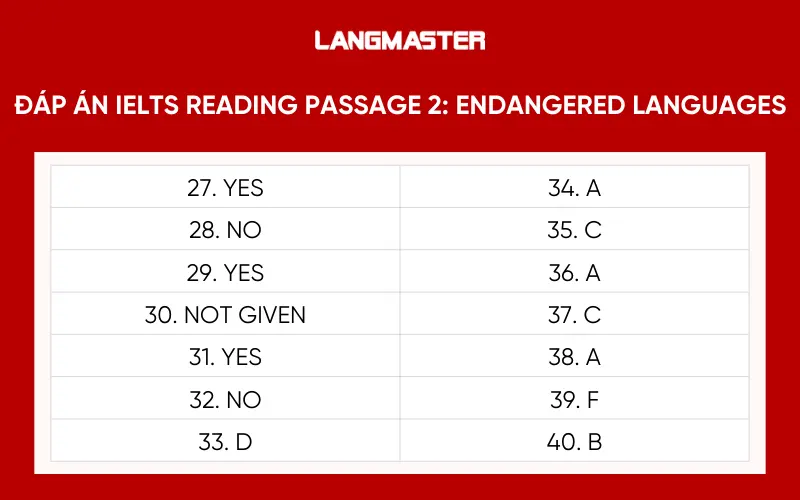
Đáp án chi tiết 27 - 31
Câu 27. YES
Bài viết: “One half of the survivors will almost certainly be gone by 2050, while 40% more will probably be well on their way out.”
→ Đến năm 2050, một nửa số ngôn ngữ còn lại gần như chắc chắn sẽ biến mất, và 40% nữa cũng đang trên đường biến mất.
→ Nghĩa là: chỉ còn rất ít ngôn ngữ phát triển tốt. → YES.
Câu 28. NO
Bài viết: “Australian linguists… have achieved a great deal in terms of preserving traditional languages.”
“…good documentation of most of the 130 remaining Aboriginal languages.”
→ Các nhà ngôn ngữ học Úc đã đạt được nhiều thành tựu và ghi chép tốt hầu hết 130 ngôn ngữ còn lại.
“achieved a great deal” = đạt được rất nhiều thành tựu → Nhấn mạnh họ làm được nhiều
→ Không hề nói là “quá hạn chế”→ NO.
Câu 29. YES
Bài viết: “there is growing evidence that not all approaches… will be particularly helpful.”
“But these are encouraging the ‘quick dash’ style of recording trip…”
→ Có bằng chứng rằng không phải mọi cách bảo tồn đều hiệu quả. Công nghệ khiến người ta chỉ thu âm nhanh rồi về.
→ Công nghệ đang có vấn đề trong một số khía cạnh. → YES.
Câu 30. NOT GIVEN
Bài chỉ nói: “Chomsky… has been the great man of theoretical linguistics…” Không nói quan điểm chính trị của ông làm lu mờ học thuật.
→ Không có thông tin. → NOT GIVEN.
Câu 31. YES
Bài viết: “Such work calls for persistent funding of field scientists…”
Dịch: Công việc này đòi hỏi tài trợ lâu dài cho các nhà nghiên cứu thực địa.
→ Phù hợp với nhận định. → YES.
Câu 32. NO
Bài viết: Chomsky nói: “the loss of a language… is much more of a tragedy for linguists…”
Ông nhìn vấn đề theo góc độ học thuật, không phải cảm xúc.
→ Đề nói ông quá cảm tính → NO.
Đáp án chi tiết 33 - 36
Câu 33. D
Bài mở đầu so sánh việc mất ngôn ngữ với mất rừng và tầng ozone.
→ Tác giả muốn nói: công chúng cũng nên lo lắng về ngôn ngữ như lo môi trường. → D.
Câu 34. A
Bài viết: “You leave behind a language where there’s very fine vocabulary for the landscape… All that is gone in a creole.”
Dịch: Khi chuyển sang creole, người ta mất vốn từ phong phú về môi trường sống.
→ Họ mất khả năng diễn đạt kiến thức văn hóa. → A.
Câu 35. C
Bài viết: “language-loss hotspots such as West Africa and South America.”
Dịch: Đây là những điểm nóng về mất ngôn ngữ.
→ Ngôn ngữ địa phương đang biến mất nhanh. → C.
Câu 36. A
Bài viết: “He has often complained that linguists are playing with non-essentials while most of their raw data is disappearing.”
Dịch: Ông phàn nàn rằng các nhà ngôn ngữ đang làm việc không quan trọng trong khi dữ liệu ngôn ngữ đang biến mất.
→ Họ không kịp ghi chép trước khi ngôn ngữ chết. → A.
Đáp án chi tiết 37 - 40
Câu 37. C
Bài viết: “Austin… because languages are unique, even if they do tend to have common underlying features…”
→ Ngôn ngữ là độc nhất dù có vài đặc điểm chung. → C.
Câu 38. A
Bài viết: “a community… may have reasons to doubt or even oppose efforts to preserve it.”
→ Cộng đồng có thể chống lại việc bảo tồn.→ A (even though it is in danger of disappearing).
Câu 39. F
Bài viết: “Plenty of students continue to be drawn to the intellectual thrill of linguistics field work.”
→ Nhiều sinh viên vẫn hứng thú làm thực địa, dù ngành đang thiên về lý thuyết. → F.
Câu 40. B
Bài viết: “good descriptive work requires thorough theoretical understanding…”
→ Công trình mô tả phải dựa trên nền tảng lý thuyết vững.→ B.
>>> XEM THÊM:
Khi luyện đề IELTS Reading ngày 16.01.2026 nhiều học viên thường gặp khó khăn trong việc xác định dạng câu hỏi và áp dụng từ vựng học thuật một cách chính xác. Để đạt hiệu quả cao, cần có một kế hoạch ôn tập logic, kết hợp với chiến lược làm bài rõ ràng và sự hỗ trợ từ giáo viên nhiều kinh nghiệm. Để đáp ứng nhu cầu, Langmaster xây dựng các khóa học IELTS online với lộ trình cá nhân hóa. Học viên sẽ được giáo viên theo sát, chỉ ra lỗi sai ngay lập tức trong vòng 24 giờ và hướng dẫn phương pháp học tập tối ưu để tiến bộ nhanh chóng hơn.

Tại Langmaster học viên được:
Coaching 1 - 1 với chuyên gia: Học viên được kèm riêng để khắc phục điểm yếu, phân bổ thời gian thi chi tiết, tập trung rèn kỹ năng chưa vững và rút ngắn lộ trình nâng band.
Sĩ số lớp nhỏ, 7 - 10 học viên: Giáo viên theo sát từng bạn, nhiều cơ hội trao đổi và nhận phản hồi chi tiết.
Hệ sinh thái học tập toàn diện: Tài liệu chuẩn, bài tập online, cộng đồng học viên và cố vấn luôn đồng hành.
Lộ trình học cá nhân hóa: Thiết kế dựa trên trình độ đầu vào và mục tiêu điểm số, kèm báo cáo tiến bộ hàng tháng.
Giáo viên 7.5+ IELTS: Chấm chữa bài trong 24 giờ, giúp bạn cải thiện nhanh chóng và rõ rệt.
Thi thử định kỳ: Mô phỏng áp lực thi thật, phân tích điểm mạnh - yếu để điều chỉnh chiến lược học.
Cam kết đầu ra, học lại miễn phí: Đảm bảo kết quả, giảm thiểu rủi ro “học xong vẫn chưa đạt mục tiêu”.
Học online tiện lợi, chất lượng như offline: Có bản ghi để xem lại, linh hoạt, tiết kiệm thời gian, chi phí.
Đăng ký học thử IELTS Online miễn phí ngay hôm nay để trải nghiệm lớp học thực tế, kiểm tra trình độ và nhận lộ trình học tập hiệu quả, giúp bạn thành thạo kỹ năng IELTS Reading và chinh phục mục tiêu IELTS!
Khi ôn luyện đề IELTS Reading ngày 16.01.2026 học viên không chỉ nắm vững đáp án đúng mà còn phát triển khả năng phân tích theo từng dạng câu hỏi một cách logic. Việc kết hợp từ vựng học thuật trong ngữ cảnh thực tế giúp ghi nhớ hiệu quả, đồng thời mở rộng vốn từ cần thiết cho kỹ năng đọc học thuật




![Giải đề thi European Heat Wave IELTS Reading [FULL ANSWER]](https://langmaster.edu.vn/storage/uploads/original/2025/11/20/european-heat-wave-ielts-reading-answers.png)
Tổng hợp đề thi European Heat Wave IELTS Reading Answers kèm phân tích chi tiết, từ vựng và đáp án giúp bạn tối ưu điểm Reading nhanh chóng.
![Đề thi IELTS Reading có đáp án mới nhất 2025-2026 [Cập nhật liên tục]](https://langmaster.edu.vn/storage/uploads/original/2025/12/25/de-thi-ielts-reading.png)
Đề thi IELTS Reading có đáp án mới nhất 2025/2026, cập nhật liên tục đề thi thật và Cambridge, kèm lời giải chi tiết giúp nâng band hiệu quả.

Bài viết tổng hợp chi tiết đề thi IELTS Reading Holidays with a difference, đáp án kèm giải thích chi tiết, từ vựng cần lưu ý khi làm bài giúp bạn luyện thi hiệu quả và nâng cao band điểm.

Bài viết tổng hợp chi tiết đề thi IELTS Reading on the trail of the honey badger, đáp án kèm giải thích chi tiết, từ vựng cần lưu ý khi làm bài giúp bạn luyện thi hiệu quả và nâng cao band điểm.
![Giải đề IELTS Reading Growing more for less [FULL ANSWER]](https://langmaster.edu.vn/storage/uploads/original/2025/10/22/growing-more-for-less-ielts-reading-answers.png)
Khám phá bài đọc Growing more for less IELTS Reading: Tổng hợp đáp án, từ vựng quan trọng và phân tích chi tiết giúp bạn hiểu cách công nghệ vệ tinh hỗ trợ nông nghiệp hiện đại




Hơn 16 năm kinh nghiệm, đào tạo thành công hàng trăm nghìn học viên
Phương pháp giảng dạy hiện đại, học viên tiến bộ rõ rệt
Lộ trình học chuẩn quốc tế, phù hợp với nhu cầu thực tiễn
Giáo viên đạt chuẩn Quốc tế với chất lượng top đầu thị trường, giàu kinh nghiệm
Học online linh hoạt, cam kết đầu ra bằng văn bản




![Giải đề thi thật IELTS Reading ngày 04.01.2026 [Full Answers]](https://langmaster.edu.vn/storage/uploads/original/2026/02/22/ielts-reading-04-01-2026.png)