Khóa học
IELTS Online
IELTS Online
Giảm đến 18%
Đăng ký ngay
Mục lục [Ẩn]
Đề thi IELTS Reading ngày 04.01.2026 gồm ba passage: The Ant and the Mandarin, Multitasks và What Are the 1,000 Foods to Eat Before You Die?. Bài viết dưới đây cung cấp lời giải chi tiết từng câu hỏi và nội dung cụ thể của từng bài đọc trong đề thi thật, giúp bạn nắm rõ cấu trúc đề và chủ động hơn khi luyện tập với đề thi thật.
The Ant and the Mandarin
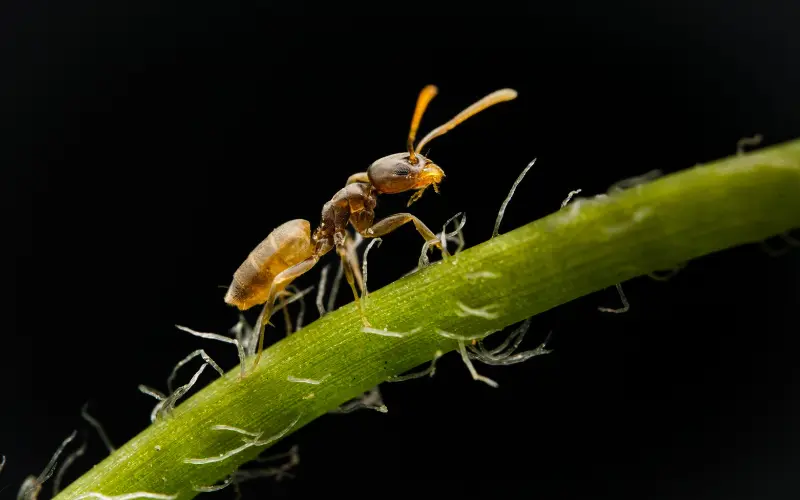
In 1476, the farmers of Berne in Switzerland decided there was only one way to rid their fields of the cutworms attacking their crops. They took the pests to court. The worms were tried, found guilty and excommunicated by the archbishop. In China, farmers had a more practical approach to pest control. Rather than relying on divine intervention, they put their faith in frogs, ducks and ants. Frogs and ducks were encouraged to snap up the pests in the paddies and the occasional plague of locusts. But the notion of biological control began with an ant. More specifically, it started with the predatory yellow citrus ant Oeco-phylla smaragdina, which has been polishing off pests in the orange groves of southern China for at least 1,700 years. The yellow citrus ant is a type of weaver ant, which binds leaves and twigs with silk to form a neat, tent-like nest. In the beginning, farmers made do with the odd ants’ nests here and there. But it wasn’t long before growing demand led to the development of a thriving trade in nests and a new type of agriculture – ant farming.
For an insect that bites, the yellow citrus ant is remarkably popular. Even by ant standards, Oecophylla smaragdina is a fearsome predator. It’s big, runs fast and has a powerful nip – painful to humans but lethal to many of the insects that plague the orange groves of Guangdong and Guangxi in southern China. And for at least 17 centuries, Chinese orange growers have harnessed these six-legged killing machines to keep their fruit groves healthy and productive.
Citrus fruits evolved in the Far East and the Chinese discovered the delights of their flesh early on. As the ancestral home of oranges, lemons and pomelos, China also has the greatest diversity of citrus pests. And the trees that produce the sweetest fruits, the mandarins – or kan – attract a host of plant-eating insects, from black ants and sap-sucking mealy bugs to leaf-devouring caterpillars. With so many enemies, fruit growers clearly had to have some way of protecting their orchards.
The West did not discover the Chinese orange growers’ secret weapon until 1 the early 20th century. At the time, Florida was suffering an epidemic of citrus canker and in 1915 Walter Swingle, a plant physiologist working for the US Department of Agriculture, was sent to China in search of varieties of orange that were resistant to the disease. Swingle spent some time studying the citrus orchards around Guangzhou, and there he came across the story of the cultivated ant. These ants, he was told, were “grown” by the people of a small village nearby who sold them to the orange growers by the nestful.
The earliest report of citrus ants at work among the orange trees appeared in a book on tropical and subtropical botany written by Hsi Han in AD 304. “The people of Chiao-Chih sell in their markets ants in bags of rush matting. The nests are like silk. The bags are all attached to twigs and leaves which, with the i ants inside the nests, are for sale. The ants are reddish-yellow in colour, bigger than ordinary ants. In the south, if the kan trees do not have this kind of ant, the fruits will all be damaged by many harmful insects, and not a single fruit will be perfect.”
Initially, farmers relied on nests which they collected from the wild or bought in the market where trade in nests was brisk. “It is said that in the south orange trees which are free of ants will have wormy fruits. Therefore, people race to buy nests for their orange trees,” wrote Liu Hsun in Strange Things Noted in the South in about 890.
The business guickly became more sophisticated. From the 10th century, country people began to trap ants in artificial nests baited with fat. “Fruit-growing families buy these ants from vendors who make a business of collecting and selling such creatures,” wrote Chuang Chi-Yu in 1130. “They trap them by filling hogs’ or sheep’s bladders with fat and placing them with the cavities open next to the ants’ nests. They wait until the ants have migrated into the bladders and take them away. This is known as ‘rearing orange ants’.” Farmers attached k the bladders to their trees, and in time the ants spread to other trees and built new nests.
By the 17th century, growers were building bamboo walkways between their trees to speed the colonisation of their orchards. The ants ran along these narrow bridges from one tree to another and established nests “by the hundreds of thousands”.
Did it work? The orange growers clearly thought so. One authority, Chhii Ta-Chun, writing in 1700, stressed how important it was to keep the fruit trees free of insect pests, especially caterpillars. “It is essential to eliminate them so that the trees are not injured. But hand labour is not nearly as efficient as ant power…”
Swingle was just as impressed. Yet despite his reports, many Western biologists were sceptical. In the West, the idea of using one insect to destroy another was new and highly controversial. The first breakthrough had come in 1888, when the infant orange industry in California had been saved from extinction by the Australian vedalia beetle. This beetle was the only thing that had made any in- T roads into the explosion of cottony cushion scale that was threatening to destroy the state’s citrus crops. But, as Swingle now knew, California’s “first” was nothing of the sort. The Chinese had been expert in biocontrol for many centuries.
The long tradition of ants in the Chinese orchards only began to waver in the 1950s and 1960s with the introduction of powerful organic insecticides. Although most fruit growers switched to chemicals, a few hung onto their ants. Those who abandoned ants in favour of chemicals quickly became disillusioned. As costs soared and pests began to develop resistance to the chemicals, growers began to revive the old ant patrols in the late 1960s. They had good reason to have faith in their insect workforce.
Research in the early 1960s showed that as long as there were enough ants in the trees, they did an excellent job of dispatching some pests – mainly the larger insects – and had modest success against others. Trees with yellow ants produced almost 20 per cent more healthy leaves than those without. More recent trials have shown that these trees yield just as big a crop as those protected by expensive chemical sprays.
One apparent drawback of using ants – and one of the main reasons for the early scepticism by Western scientists – was that citrus ants do nothing to control mealy bugs, waxy-coated scale insects which can do considerable damage to fruit trees. In fact, the ants protect mealy bugs in exchange for the sweet honey-dew they secrete. The orange growers always denied this was a problem but Western scientists thought they knew better.
Research in the 1980s suggests that the growers were right all along. Where X mealy bugs proliferate under the ants’ protection, they are usually heavily parasitised and this limits the harm they can do.
Orange growers who rely on carnivorous ants rather than poisonous chemicals maintain a better balance of species in their orchards. While the ants deal with the bigger insect pests, other predatory species keep down the numbers of smaller pests such as scale insects and aphids. In the long run, ants do a lot less damage than chemicals – and they’re certainly more effective than excommunication.
Questions 1-5
Look at the following events (Questions 1-5) and the list of dates below.
Match each event with the correct time A-G.
Write the correct letter A-G in boxes 1-5 on your answer sheet.
1 The first description of citrus ants is traded in the marketplace.
2 Swingle came to Asia for research.
3 The first record of one insect is used to tackle other insects in the western world.
4 Chinese fruit growers started to use pesticides in place of citrus ants.
5 Some Chinese farmers returned to the traditional bio-method.
List of Dates
A 1888
B AD 890
C AD 304
D 1950s
E 1960s
F 1915
G 1130
Questions 6-13
Do the following statements agree with the information given in Reading Passage?
In boxes 6-13 on your answer sheet write
TRUE if the statement agrees with the information
FALSE if the statement contradicts the information
NOT GIVEN if there is no information on this
6 China has more citrus pests than any other country in the world.
7 Swingle came to China to search for an insect to bring back to the US.
8 Many people were very impressed by Swingle’s discovery.
9 Chinese farmers found that pesticides became increasingly expensive.
10 Some Chinese farmers abandoned the use of pesticide.
11 Trees with ants had more leaves fall than those without.
12 Fields using ants yield as large a crop as fields using chemical pesticides.
13 Citrus ants often cause considerable damage to the bio-environment of the orchards.
>>> XEM THÊM:
Đề thi IELTS Reading có đáp án mới nhất 2025-2026 [Cập nhật liên tục]
|
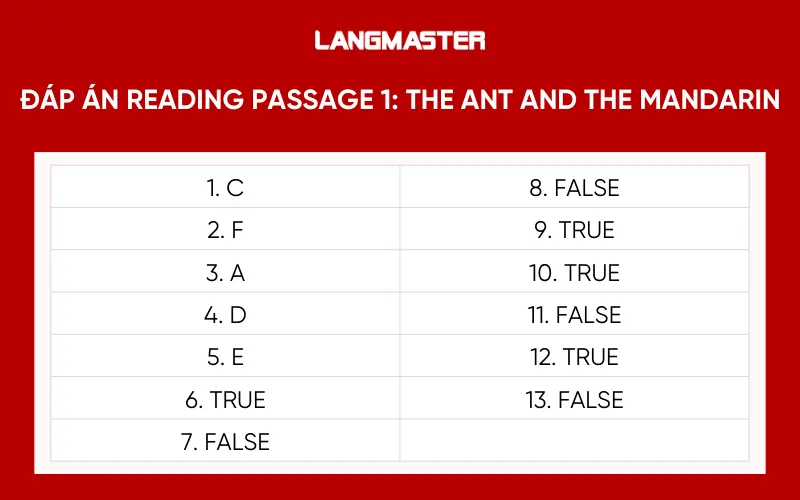
1. C |
8. FALSE |
|
2. F |
9. TRUE |
|
3. A |
10. TRUE |
|
4. D |
11. FALSE |
|
5. E |
12. TRUE |
|
6. TRUE |
13. FALSE |
|
7. FALSE |
Đáp án chi tiết 1-5
Câu 1. The first description of citrus ants is traded in the marketplace. → Đáp án: C
Giải thích:
Đoạn văn nói: “The earliest report of citrus ants at work… appeared in a book… written by Hsi Han in AD 304… The people… sell in their markets ants in bags…”
“earliest report” = mô tả đầu tiên
Có chi tiết ants được bán ở chợ (traded in marketplace)
Mốc thời gian AD 304 xuất hiện trực tiếp trong đoạn này
Câu 2. Swingle came to Asia for research. → Đáp án: F
Giải thích:
Đoạn văn ghi: “In 1915 Walter Swingle… was sent to China in search of varieties of orange that were resistant to the disease.”
Swingle đến Trung Quốc để nghiên cứu giống cam chống bệnh
Mốc thời gian rõ ràng là 1915
Câu 3. The first record of one insect is used to tackle other insects in the western world. → Đáp án: A (1888)
Giải thích:
Đoạn văn nêu: “The first breakthrough had come in 1888… California’s orange industry had been saved… by the Australian vedalia beetle.”
Đây là lần đầu phương Tây dùng côn trùng để diệt côn trùng khác
Từ khóa: “first breakthrough” → Khớp với năm 1888.
Câu 4. Chinese fruit growers started to use pesticides in place of citrus ants. → Đáp án: D (1950s)
Giải thích:
Đoạn văn: “The long tradition… began to waver in the 1950s and 1960s with the introduction of powerful organic insecticides.”
“began to waver” nghĩa là bắt đầu thay đổi
Thời điểm bắt đầu chuyển sang dùng thuốc trừ sâu là những năm 1950s
Câu 5. Some Chinese farmers returned to the traditional bio-method. → Đáp án: E
Giải thích:
Đoạn văn nói: “Growers began to revive the old ant patrols in the late 1960s.”
“revive” = quay trở lại sử dụng phương pháp cũ
Mốc thời gian là cuối thập niên 1960s
Đáp án chi tiết 6-13
Câu 6. China has more citrus pests than any other country in the world. → Đáp án: TRUE
Đoạn văn viết: “China also has the greatest diversity of citrus pests.”
“greatest diversity” nghĩa là đa dạng và nhiều nhất → Nội dung trùng khớp với câu hỏi.
Câu 7. Swingle came to China to search for an insect to bring back to the US. → Đáp án: FALSE
Bài đọc nêu rõ: Swingle đến Trung Quốc để tìm giống cam kháng bệnh, không phải tìm côn trùng.
Mục đích thực: tìm giống cây
Câu hỏi nói: tìm côn trùng
→ Thông tin trái ngược.
Câu 8. Many people were very impressed by Swingle’s discovery. → Đáp án: FALSE
Đoạn văn ghi: “Many Western biologists were sceptical.”
“sceptical” nghĩa là hoài nghi
Câu hỏi nói nhiều người ấn tượng
→ Ý nghĩa ngược lại.
Câu 9. Chinese farmers found that pesticides became increasingly expensive. → Đáp án: TRUE
Đoạn văn: “As costs soared and pests began to develop resistance…”
“costs soared” = chi phí tăng mạnh → Khớp với nội dung câu hỏi.
Câu 10. Some Chinese farmers abandoned the use of pesticide. → Đáp án: TRUE
Đoạn văn nói: “Most fruit growers switched to chemicals, a few hung onto their ants.”
Một số nông dân vẫn giữ cách dùng kiến, tức là không dùng thuốc trừ sâu → Nội dung đồng nghĩa với việc từ bỏ thuốc trừ sâu.
Câu 11. Trees with ants had more leaves fall than those without. → Đáp án: FALSE
Bài đọc ghi: “Trees with yellow ants produced almost 20 per cent more healthy leaves.”
Cây có kiến có nhiều lá khỏe hơn
Câu hỏi nói lá rụng nhiều hơn
→ Nội dung trái ngược.
Câu 12. Fields using ants yield as large a crop as fields using chemical pesticides. → Đáp án: TRUE
Đoạn văn: “These trees yield just as big a crop as those protected by expensive chemical sprays.”
“just as big” = năng suất tương đương → Khớp hoàn toàn.
Câu 13. Citrus ants often cause considerable damage to the bio-environment of the orchards. → Đáp án: FALSE
Đoạn văn nói: “Orange growers who rely on ants maintain a better balance of species…”
Kiến giúp cân bằng hệ sinh thái
Câu hỏi nói gây tổn hại môi trường
→ Nội dung trái ngược.
>>> XEM THÊM:
Multitasks
A. Do you read while listening to music? Do you like to watch TV while finishing your homework? People who have these kinds of habits are called multi-taskers. Multitasks are able to complete two tasks at the same time by dividing their focus. However, Thomas Lehman, a researcher in Psychology, believes people never really do multiple things simultaneously. Maybe a person is reading while listening to music, but in reality, the brain can only focus on one task. Reading the words in a book will cause you to ignore some of the words of the music. When people think they are accomplishing two different tasks efficiently, what they are really doing is dividing their focus. While listening to music, people become less able to focus on their surroundings. For example, we all have experience of times when we talk with friends and they are not responding properly. Maybe they are listening to someone else talk, or maybe they are reading a text on their smart phone and don’t hear what you are saying. Lehman called this phenomenon “email voice”.
B. The world has been changed by computers and its spin offs like smart-phones or cellphones. Now that most individuals have a personal device, like a smart-phone or a laptop, they are frequently reading, watching or listening to virtual information. This raises the occurrence of multitasking in our day to day life. Now when you work, you work with your typewriter, your cellphone, and some colleagues who may drop by at any time to speak with you. In professional meetings, when one normally focuses and listens to one another, people are more likely to have a cell phone in their lap, reading or communicating silently with more people than ever, even inventions such as the cordless phone have increased multitasking. In the old days, a traditional wall phone would ring, and then the housewife would have to stop her activities to answer it. When it rang, the housewife will sit down with her legs up, and chat, with no laundry or sweeping or answering the door. In the modern era, our technology is convenient enough to not interrupt our daily tasks.
C. Earl Miller, an expert at the Massachusetts Institute of Technology, studied the prefrontal cortex, which controls the brain while a person is multitasking. According to his studies, the size of this cortex varies between species, He found that for humans, the size of this part constitutes one third of the brain, while it is only 4 to 5 percent in dogs, and about 15% in monkeys. Given that this cortex is larger on a human, it allows a human to be more flexible and accurate in his or her multitasking. However, Miller wanted to look further into whether the cortex was truly processing information about two different tasks simultaneously. He designed an experiment where he presents visual stimulants to his subjects in a wax that mimics multi-tasking. Miller then attached sensors to the patients’ heads to pick up the electric patterns of the brain. This sensor would show if the brain particles, called neurons, were truly processing two different tasks. What he found is that the brain neurons only lit up in singular areas one at a time, and never simultaneously.
D. Davis Meyer, a professor of University of Michigan, studied the young adults in a similar experiment. He instructed them to simultaneously do math problems and classify simple words into different categories. For this experiment, Meyer found that when you think you are doing several jobs at the same time, you are actually switching between jobs. Even though the people tried to do the tasks at the same time, and both tasks were eventually accomplished, overall, the task took more time than if the person focused on a single task one at a time.
E. People sacrifice efficiency when multitasking, Gloria Mark set office workers as his subjects. He found that they were constantly multitasking. He observed that nearly every 11 minutes people at work were disrupted. He found that doing different jobs at the same time may actually save time. However, despite the fact that they are faster, it does not mean they are more efficient. And we are equally likely to self-interrupt as be interrupted by outside sources. He found that in office nearly every 12 minutes an employee would stop and with no reason at all, check a website on their computer, call someone or write an email. If they concentrated for more than 20 minutes, they would feel distressed. He suggested that the average person may suffer from a short concentration span. This short attention span might be natural, but others suggest that new technology may be the problem. With cellphones and computers at our sides at all times, people will never run out of distractions. The format of media, such as advertisements, music, news articles and TV shows are also shortening, so people are used to paying attention to information for a very short time.
F. So even though focusing on one single task is the most efficient way for our brains to work, it is not practical to use this method in real life. According to human nature, people feel more comfortable and efficient in environments with a variety of tasks, Edward Hallowell said that people are losing a lot of efficiency in the workplace due to multitasking, outside distractions and self-distractions. As it matters of fact, the changes made to the workplace do not have to be dramatic. No one is suggesting we ban e-mail or make employees focus on only one task. However, certain common workplace tasks, such as group meetings, would be more efficient if we banned cell-phones, a common distraction. A person can also apply these tips to prevent self-distraction. Instead of arriving to your office and checking all of your e-mails for new tasks, a common workplace ritual, a person could dedicate an hour to a single task first thing in the morning. Self-timing is a great way to reduce distraction and efficiently finish tasks one by one, instead of slowing ourselves down with multi-tasking.

Questions 14-18
Reading Passage 2 has six paragraphs, A-F.
Which paragraph contains the following information?
Write the correct letter, A-F, in boxes 14-18 on your answer sheet.
14. A reference to a domestic situation that does not require multitasking
15. A possible explanation of why we always do multitask together
16. A practical solution to multitask in work environment
17. Relating multitasking to the size of prefrontal cortex
18. Longer time spent doing two tasks at the same time than one at a time
Questions 19-23
Look at the following statements (Questions 6-10) and the list of scientists below.
Match each statement with the correct scientist, A-E.
Write the correct letter, A-E, in boxes 6-10 on your answer sheet. NB You may use any letter more than once.
A. Thomas Lehman
B. Earl Miller
C. David Meyer
D. Gloria Mark
E. Edward Hallowell
19. When faced multiple visual stimulants, one can only concentrate on one of them.
20. Doing two things together may be faster but not better.
21. People never really do two things together even if you think you do.
22. The causes of multitask lie in the environment.
23. Even minor changes in the workplace will improve work efficiency.
Questions 24-26
Complete the sentences below.
Choose NO MORE THAN TWO WORDS from the passage for each answer. Write your answers in boxes 24-26 on your answer sheet.
A term used to refer to a situation when you are reading a text and cannot focus on your surroundings is 24.______.
The 25.______ part of the brain controls multitasking.
The practical solution of multitask in work is not to allow use of cellphone in 26._____.
>>> XEM THÊM:
Cách làm Multiple Choice trong IELTS Reading ẵm trọn điểm tối đa
Cách làm Matching Information trong IELTS Reading “ẵm trọn” điểm cao
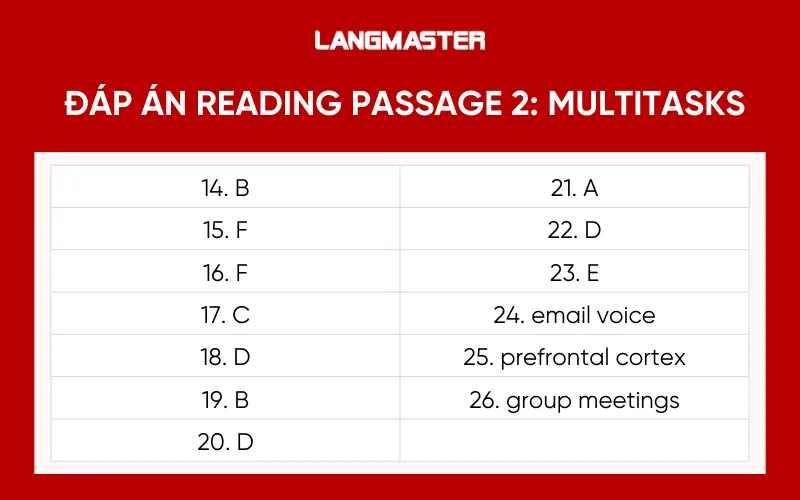
|
14. B |
21. A |
|
15. F |
22. D |
|
16. F |
23. E |
|
17. C |
24. email voice |
|
18. D |
25. prefrontal cortex |
|
19. B |
26. group meetings |
|
20. D |
Đáp án chi tiết 14 -18
Câu 14. A reference to a domestic situation that does not require multitasking → Đáp án: B
Giải thích: Đoạn B nói về tình huống trong quá khứ khi điện thoại bàn reo: “In the old days, a traditional wall phone would ring… the housewife would have to stop her activities to answer it… sit down… and chat, with no laundry or sweeping…”
→ Người nội trợ phải dừng mọi việc để nghe điện thoại.
→ Đây là tình huống gia đình (domestic situation).
→ Không có làm nhiều việc cùng lúc (does not require multitasking).
Câu 15. A possible explanation of why we always do multitask together → Đáp án: F
Đoạn F nói: “According to human nature, people feel more comfortable and efficient in environments with a variety of tasks…”
→ Giải thích rằng do bản chất con người (human nature) thích môi trường có nhiều nhiệm vụ.
→ Đây chính là lời giải thích vì sao chúng ta hay multitask.
Câu 16. A practical solution to multitask in work environment → Đáp án: F
Giải thích: Đoạn F đề xuất giải pháp: “group meetings would be more efficient if we banned cell-phones”
→ Cấm điện thoại trong họp nhóm.
→ Đây là giải pháp thực tế (practical solution) trong môi trường làm việc.
Câu 17. Relating multitasking to the size of prefrontal cortex → Đáp án: C
Giải thích: Đoạn C nói: “studied the prefrontal cortex… the size of this cortex varies between species…”
→ So sánh kích thước vùng prefrontal cortex ở người, chó, khỉ.
→ Liên hệ trực tiếp giữa multitasking và kích thước vùng não này.
Câu 18. Longer time spent doing two tasks at the same time than one at a time → Đáp án: D
Giải thích: Đoạn D viết: “overall, the task took more time than if the person focused on a single task”
→ Làm hai việc cùng lúc mất nhiều thời gian hơn so với tập trung từng việc một.
Đáp án chi tiết 19 - 23
Câu 19. When faced multiple visual stimulants, one can only concentrate on one of them. → Đáp án: B (Earl Miller)
Giải thích: “He designed an experiment where he presents visual stimulants to his subjects in a way that mimics multi-tasking. Miller then attached sensors to the patients’ heads to pick up the electric patterns of the brain… What he found is that the brain neurons only lit up in singular areas one at a time, and never simultaneously.”
“visual stimulants” = nhiều kích thích thị giác
“only lit up… one at a time” = chỉ hoạt động từng cái một
“never simultaneously” = không bao giờ cùng lúc
→ Nghĩa là khi có nhiều thứ xuất hiện cùng lúc, não chỉ xử lý từng thứ một.
Câu 20. Doing two things together may be faster but not better. → Đáp án: D (Gloria Mark)
Giải thích: “He found that doing different jobs at the same time may actually save time. However, despite the fact that they are faster, it does not mean they are more efficient.”
“may actually save time” = có thể nhanh hơn
“does not mean they are more efficient” = không có nghĩa là hiệu quả hơn
→ Làm hai việc cùng lúc có thể nhanh hơn, nhưng không tốt hơn về hiệu quả.
Câu 21. People never really do two things together even if you think you do. → Đáp án: A (Thomas Lehman)
Giải thích: “However, Thomas Lehman… believes people never really do multiple things simultaneously… When people think they are accomplishing two different tasks efficiently, what they are really doing is dividing their focus.”
“never really do multiple things simultaneously” = không thực sự làm nhiều việc cùng lúc
“dividing their focus” = chỉ đang chia sự tập trung
→ Con người nghĩ mình đang làm hai việc cùng lúc, nhưng thực ra chỉ chuyển sự chú ý qua lại.
Câu 22. The causes of multitask lie in the environment. → Đáp án: D (Gloria Mark)
Giải thích: “With cellphones and computers at our sides at all times, people will never run out of distractions. The format of media, such as advertisements, music, news articles and TV shows are also shortening…”
Điện thoại, máy tính luôn ở bên cạnh
Quảng cáo, TV, tin tức đều ngắn và gây phân tâm
→ Nguyên nhân multitask đến từ môi trường công nghệ và truyền thông xung quanh chúng ta.
Câu 23. Even minor changes in the workplace will improve work efficiency. → Đáp án: E (Edward Hallowell)
Giải thích: “As a matter of fact, the changes made to the workplace do not have to be dramatic… group meetings would be more efficient if we banned cell-phones…”
“do not have to be dramatic” = không cần thay đổi lớn
Chỉ cần cấm điện thoại trong họp nhóm
→ Nghĩa là chỉ cần thay đổi nhỏ cũng cải thiện hiệu quả làm việc.
Đáp án chi tiết 24 - 26
Câu 24. A term used to refer to a situation when you are reading a text and cannot focus on your surroundings is ______. → Đáp án: email voice
Giải thích: “For example, we all have experience of times when we talk with friends and they are not responding properly. Maybe they are listening to someone else talk, or maybe they are reading a text on their smart phone and don’t hear what you are saying. Lehman called this phenomenon ‘email voice’.”
→ Người đang đọc tin nhắn nên không nghe người khác nói
→ Lehman đặt tên hiện tượng này là “email voice”
Câu 25. The ______ part of the brain controls multitasking. → Đáp án: prefrontal cortex
Giải thích: “Earl Miller, an expert at the Massachusetts Institute of Technology, studied the prefrontal cortex, which controls the brain while a person is multitasking.”
“which controls the brain while a person is multitasking” → Vùng não điều khiển khi con người multitask
Câu 26. The practical solution of multitask in work is not to allow use of cellphone in ______. → Đáp án: group meetings
Giải thích: “However, certain common workplace tasks, such as group meetings, would be more efficient if we banned cell-phones, a common distraction.”
“Một số hoạt động phổ biến ở nơi làm việc, chẳng hạn như các cuộc họp nhóm, sẽ hiệu quả hơn nếu chúng ta cấm điện thoại, vì điện thoại là một yếu tố gây xao nhãng phổ biến.”
Câu hỏi nói: “not to allow use of cellphone in ______” → không cho phép dùng điện thoại ở đâu? → cấm điện thoại trong group meetings (các cuộc họp nhóm).
>>> XEM THÊM:
What Are the 1,000 Foods to Eat Before You Die?
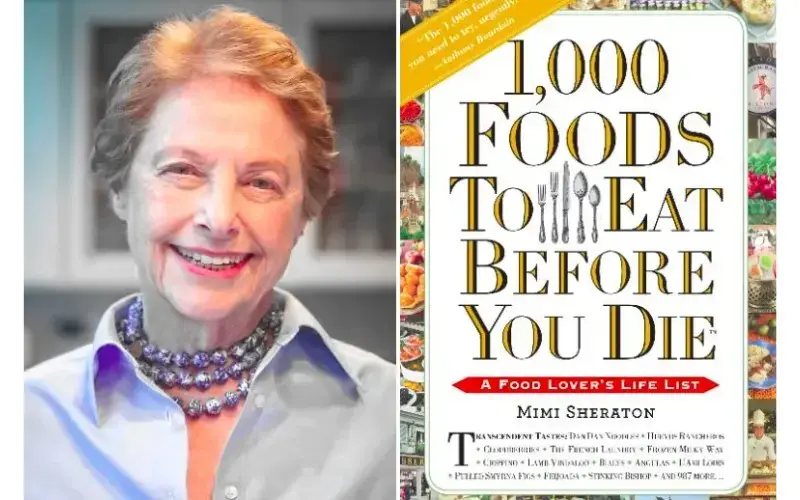
Written by a former New York Times restaurant critic, this tome will keep your appetite satisfied for a lifetime.
When was the last time you sat down to a meal of harnam meshwi, a.k.a. grilled pigeon, which is most likely found on a menu in Egypt? Or traveled to Oslo, Norway, for a breakfast of freshly caught shrimp? Chances are probably never. However, thanks to former New York Times restaurant critic, Smithsonian contribution and author Mimi Sheraton’s latest book, 1,000 Foods to Eat Before You Die, your foodie life is about to get a whole lot more interesting.
Inspired by Patricia Schultz’s best-selling 1,000 Places to See Before You Die (also published by Workman Publishing), Sheraton has rounded up 1,000 must-try dishes, restaurants, markets, cultural feasts, and even some relatively universal foods (such as bananas, olive oil, and whipped cream) that transcend regional categorization. Curated from cuisines around the globe, Sheraton has put them together in one large volume, along with details on historic and cultural context, tips on how to prepare or where to try a particular dish, and even several dozen recipes. It’s a project that’s been 10 years in the making - one that’s as much a wonderful display of Sheraton’s vast food knowledge (she’s been writing about food for 60 years) as it is an ode to the world’s sheer culinary diversity.
The ultimate gift for the food lover. In the same way that 1,000 Places to See Before You Die reinvented the travel book, 1,000 Foods to Eat Before You Die is a joyous, informative, dazzling, mouthwatering life list of the world’s best food. The book is organized not by country or type of food, but rather by the experience of eating itself. Sections guide the reader through “Street Food & Snacks,” “Comfort Food,” and “Sweets & Treats,” among others. This structure encourages serendipitous discovery, where a reader looking for a classic French pastry might stumble upon a traditional Indonesian dessert and become captivated. Sheraton’s entries are more than just lists; they are miniature stories. She explains why a specific cheese from a remote village in Greece is worth seeking out, or how a particular noodle dish embodies the history of trade routes in Southeast Asia. This narrative approach transforms the book from a mere checklist into a compelling read about culture, history, and human connection through food.
Of course, a list of 1,000 items is bound to include some controversies. Some critics question the inclusion of ubiquitous items like the banana, arguing that it diminishes the exclusivity of the list. Others have noted a possible bias towards European and North American cuisines, though Sheraton defends her selections by pointing to the extensive research and personal travels that informed her choices. She emphasizes that the book is a personal, albeit expert, guide rather than a definitive, objective ranking. The goal, she states, is to inspire curiosity and appreciation, not to end debate.
Ultimately, 1,000 Foods to Eat Before You Die serves as a passport to gastronomic adventure. It challenges the reader to look beyond their culinary comfort zone, whether that means seeking out a rare ingredient, attempting a complex recipe at home, or simply ordering something unfamiliar at a local restaurant. For Sheraton, the book is a culmination of a lifetime’s passion for food, an invitation to savor the incredible diversity of flavors the world has to offer, one unforgettable bite at a time.
Questions 27-31
Do the following statements agree with the information given in Reading Passage 3?
In boxes 27-31 on your answer sheet, write
TRUE – if the statement agrees with the information
FALSE – if the statement contradicts the information
NOT GIVEN – if there is no information on this
27. Mimi Sheraton is currently working as a restaurant critic for the New York Times.
28. The book 1,000 Foods to Eat Before You Die was directly inspired by a popular travel guide.
29. Sheraton’s book includes recipes for every one of the 1,000 foods mentioned.
30. The book is organized according to the geographic origin of the foods.
31. Sheraton has been a food writer for six decades.
Questions 32 – 35
Choose the correct letter, A, B, C or D.
Write the correct letter in boxes 32-35 on your answer sheet.
32. The main purpose of the first paragraph is to
A. criticize people’s boring eating habits.
B. provide specific examples of exotic foods.
C. explain the health benefits of a global diet.
D. introduce the book by highlighting its adventurous nature.
33. According to the passage, the book includes all of the following EXCEPT
A. historical background for certain dishes.
B. recommendations on where to find specific foods.
C. nutritional information for each food item.
D. a small number of full recipes.
34. How is the book’s structure described?
A. It is organized by country to make it easy for travelers.
B. It categorizes foods by their main ingredient.
C. It groups foods by the type of eating experience.
D. It is presented in a simple alphabetical list.
35. What is the author’s stated goal for the book?
A. To create an objective and definitive ranking of world foods.
B. To settle debates about the best cuisines.
C. To inspire curiosity and appreciation for diverse foods.
D. To promote European and North American restaurants.
Questions 36 – 40
Complete the summary below.
Choose NO MORE THAN TWO WORDS from the passage for each answer.
Write your answers in boxes 36-40 on your answer sheet.
Mimi Sheraton’s book has been described as a 36._____ for anyone who loves food. It is noted for its narrative approach, where each entry is like a mini 37._____ , explaining the cultural significance of a dish. While the book has faced some 38._____ , particularly over the inclusion of common items and a potential regional bias, Sheraton clarifies that the selections are based on her own 39._____ and expert opinion. The ultimate aim of the book is to encourage readers to expand their 40._____ and embark on a gastronomic adventure.
>>> XEM THÊM:
Top Website luyện IELTS Reading miễn phí tốt nhất, đạt band mục tiêu
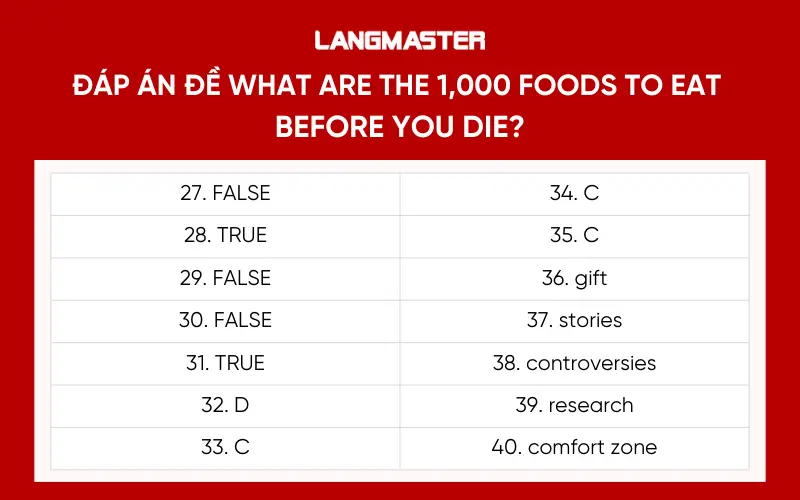
|
27. FALSE |
34. C |
|
28. TRUE |
35. C |
|
29. FALSE |
36. gift |
|
30. FALSE |
37. stories |
|
31. TRUE |
38. controversies |
|
32. D |
39. research |
|
33. C |
40. comfort zone |
Đáp án chi tiết 27 - 31
Câu 27 Mimi Sheraton is currently working as a restaurant critic for the New York Times. → Đáp án: FALSE
Trích đoạn: “Written by a former New York Times restaurant critic…”
Dịch: “Được viết bởi một cựu nhà phê bình nhà hàng của New York Times…”
Giải thích:
“Former” nghĩa là “cựu”, tức là đã từng làm trong quá khứ.
Câu hỏi nói “currently working” (hiện đang làm).
Thông tin trái ngược nhau → FALSE.
Câu 28: The book was directly inspired by a popular travel guide. → Đáp án: TRUE
Trích đoạn: “Inspired by Patricia Schultz’s best-selling 1,000 Places to See Before You Die…”
Dịch: “Được truyền cảm hứng từ cuốn sách bán chạy 1,000 Places to See Before You Die…”
Giải thích:
“Inspired by” nghĩa là “được truyền cảm hứng từ”.
“Best-selling” nghĩa là bán chạy, nổi tiếng.
Thông tin trùng khớp hoàn toàn → TRUE.
Câu 29: The book includes recipes for every one of the 1,000 foods mentioned. → Đáp án: FALSE
Trích đoạn: “…and even several dozen recipes.”
Dịch: “…và thậm chí có vài chục công thức nấu ăn.”
Giải thích:
“Several dozen” nghĩa là vài chục, không phải 1.000.
Câu hỏi nói có công thức cho tất cả 1.000 món → sai → FALSE.
Câu 30: The book is organized according to the geographic origin of the foods. → Đáp án: FALSE
Trích đoạn: “The book is organized not by country or type of food, but rather by the experience of eating itself.”
Dịch: “Cuốn sách không được sắp xếp theo quốc gia hay loại món ăn, mà theo trải nghiệm ăn uống.”
Giải thích:
“Not by country” nghĩa là không theo quốc gia.
Câu hỏi nói theo nguồn gốc địa lý → trái thông tin → FALSE.
Câu 31: Sheraton has been a food writer for six decades. → Đáp án: TRUE
Trích đoạn: “She’s been writing about food for 60 years.”
Dịch: “Bà ấy đã viết về ẩm thực trong 60 năm.”
Giải thích:
60 years = 6 thập kỷ.
Thông tin khớp → TRUE.
Đáp án chi tiết 32 - 35
Câu 32: The main purpose of the first paragraph is to… → Đáp án: D
Trích đoạn: “Chances are probably never. However… your foodie life is about to get a whole lot more interesting.”
Dịch: “Có lẽ bạn chưa từng thử những món đó. Tuy nhiên… cuộc sống ẩm thực của bạn sắp trở nên thú vị hơn rất nhiều.”
Giải thích:
Đoạn 1 đưa ra ví dụ món lạ, khơi gợi tò mò và giới thiệu cuốn sách.
Mục đích chính là giới thiệu cuốn sách như một hành trình khám phá ẩm thực → D.
Câu 33: The book includes all of the following EXCEPT… → Đáp án: C (nutritional information for each food item)
Trích đoạn: “Curated from cuisines around the globe, Sheraton has put them together in one large volume, along with details on historic and cultural context, tips on how to prepare or where to try a particular dish, and even several dozen recipes.”
Dịch nghĩa: “Được tuyển chọn từ các nền ẩm thực khắp thế giới, Sheraton đã tập hợp chúng trong một cuốn sách lớn, kèm theo các thông tin về bối cảnh lịch sử và văn hóa, mẹo cách chế biến hoặc nơi có thể thử một món cụ thể, và thậm chí còn có vài chục công thức nấu ăn.”
Giải thích:
Trong đoạn này có:
“details on historic and cultural context” → thông tin về lịch sử và văn hóa
“tips on how to prepare or where to try” → hướng dẫn cách chế biến hoặc nơi thử món ăn
“several dozen recipes” → vài chục công thức
Nhưng trong đoạn không hề nhắc đến “nutritional information” (thông tin dinh dưỡng).
Câu hỏi hỏi mục nào KHÔNG có trong sách.
Vì bài không đề cập đến thông tin dinh dưỡng cho từng món ăn → đáp án đúng là C.
Câu 34: How is the book’s structure described? → Đáp án: C
Trích đoạn: “The book is organized not by country or type of food, but rather by the experience of eating itself. Sections guide the reader through ‘Street Food & Snacks,’ ‘Comfort Food,’ and ‘Sweets & Treats,’ among others.”
Dịch nghĩa: “Cuốn sách không được sắp xếp theo quốc gia hay loại thực phẩm, mà theo chính trải nghiệm ăn uống. Các phần hướng dẫn người đọc qua những mục như ‘Đồ ăn đường phố & Ăn vặt’, ‘Món ăn tạo cảm giác thoải mái’, và ‘Đồ ngọt’, cùng nhiều mục khác.”
Giải thích:
Không tổ chức theo quốc gia → loại A sai
Không theo nguyên liệu chính → B sai
Không theo thứ tự bảng chữ cái → D sai
Tổ chức theo trải nghiệm ăn uống → đúng với C
Câu 35: What is the author’s stated goal for the book? → Đáp án: C
Trích đoạn: “She emphasizes that the book is a personal, albeit expert, guide rather than a definitive, objective ranking. The goal, she states, is to inspire curiosity and appreciation, not to end debate.”
Dịch nghĩa: “Bà nhấn mạnh rằng cuốn sách là một hướng dẫn mang tính cá nhân, dù dựa trên chuyên môn, chứ không phải một bảng xếp hạng khách quan, tuyệt đối. Mục tiêu, theo bà, là truyền cảm hứng về sự tò mò và sự trân trọng, chứ không phải chấm dứt tranh luận.”
Giải thích:
Không phải bảng xếp hạng khách quan → A sai
Không nhằm chấm dứt tranh luận → B sai
Mục tiêu là truyền cảm hứng về sự tò mò và trân trọng → đúng với C
Không nhằm quảng bá nhà hàng châu Âu và Bắc Mỹ → D sai
Đáp án chi tiết 36 - 40
Câu 36: Đáp án: gift
Trích trong bài: “The ultimate gift for the food lover.”
Giải thích: Tóm tắt viết: “has been described as a _____ for anyone who loves food.”
Trong bài có cụm “The ultimate gift for the food lover.” → Điền: gift.
Câu 37: Đáp án: stories
Trích trong bài: “Sheraton’s entries are more than just lists; they are miniature stories.”
Giải thích: Tóm tắt viết: “each entry is like a mini _____.”
Trong bài có “miniature stories.” → Điền: stories.
Câu 38: Đáp án: controversies
Trích trong bài: “Of course, a list of 1,000 items is bound to include some controversies.”
Giải thích: Tóm tắt viết: “the book has faced some _____.” (đối mặt với một số …). → Điền: controversies (tranh cãi)
Câu 39: Đáp án: research
Trích trong bài: “Sheraton defends her selections by pointing to the extensive research and personal travels that informed her choices.”
Giải thích: Tóm tắt viết: “the selections are based on her own _____ and expert opinion.”
Bà bảo vệ lựa chọn của mình bằng việc nói rằng bà đã nghiên cứu kỹ và đi nhiều nơi. → điền “research” (nghiên cứu).
Câu 40: Đáp án: comfort zone
Trích trong bài: “It challenges the reader to look beyond their culinary comfort zone…”
Giải thích: Tóm tắt viết: “encourage readers to expand their _____ and embark on a gastronomic adventure.”
“Mục tiêu cuối cùng là khuyến khích người đọc mở rộng _____ và bắt đầu hành trình ẩm thực.”
“Expand their _____” = mở rộng vùng gì đó.
Trong bài nói rõ là “comfort zone.” → Điền: comfort zone.
>>> XEM THÊM:
Khi luyện đề IELTS Reading ngày 4/1/2026 nhiều học viên thường gặp khó khăn trong việc xác định dạng câu hỏi và áp dụng từ vựng học thuật một cách chính xác. Để đạt hiệu quả cao, cần có một kế hoạch ôn tập logic, kết hợp với chiến lược làm bài rõ ràng và sự hỗ trợ từ giáo viên nhiều kinh nghiệm. Để đáp ứng nhu cầu, Langmaster xây dựng các khóa học IELTS online với lộ trình cá nhân hóa. Học viên sẽ được giáo viên theo sát, chỉ ra lỗi sai ngay lập tức trong vòng 24 giờ và hướng dẫn phương pháp học tập tối ưu để tiến bộ nhanh chóng hơn.
Tại Langmaster học viên được:
Coaching 1 - 1 với chuyên gia: Học viên được kèm riêng để khắc phục điểm yếu, phân bổ thời gian thi chi tiết, tập trung rèn kỹ năng chưa vững và rút ngắn lộ trình nâng band.
Sĩ số lớp nhỏ, 7 - 10 học viên: Giáo viên theo sát từng bạn, nhiều cơ hội trao đổi và nhận phản hồi chi tiết.
Hệ sinh thái học tập toàn diện: Tài liệu chuẩn, bài tập online, cộng đồng học viên và cố vấn luôn đồng hành.
Lộ trình học cá nhân hóa: Thiết kế dựa trên trình độ đầu vào và mục tiêu điểm số, kèm báo cáo tiến bộ hàng tháng.
Giáo viên 7.5+ IELTS: Chấm chữa bài trong 24 giờ, giúp bạn cải thiện nhanh chóng và rõ rệt.
Thi thử định kỳ: Mô phỏng áp lực thi thật, phân tích điểm mạnh - yếu để điều chỉnh chiến lược học.
Cam kết đầu ra, học lại miễn phí: Đảm bảo kết quả, giảm thiểu rủi ro “học xong vẫn chưa đạt mục tiêu”.
Học online tiện lợi, chất lượng như offline: Có bản ghi để xem lại, linh hoạt, tiết kiệm thời gian, chi phí.
Đăng ký học thử IELTS Online miễn phí ngay hôm nay để trải nghiệm lớp học thực tế, kiểm tra trình độ và nhận lộ trình học tập hiệu quả, giúp bạn thành thạo kỹ năng IELTS Reading và chinh phục mục tiêu IELTS!
Khi ôn luyện đề IELTS Reading học viên không chỉ nắm vững đáp án đúng mà còn phát triển khả năng phân tích theo từng dạng câu hỏi một cách logic. Việc kết hợp từ vựng học thuật trong ngữ cảnh thực tế giúp ghi nhớ hiệu quả, đồng thời mở rộng vốn từ cần thiết cho kỹ năng đọc học thuật.

![Giải đề thi European Heat Wave IELTS Reading [FULL ANSWER]](https://langmaster.edu.vn/storage/uploads/original/2025/11/20/european-heat-wave-ielts-reading-answers.png)
Tổng hợp đề thi European Heat Wave IELTS Reading Answers kèm phân tích chi tiết, từ vựng và đáp án giúp bạn tối ưu điểm Reading nhanh chóng.
![Đề thi IELTS Reading có đáp án mới nhất 2025-2026 [Cập nhật liên tục]](https://langmaster.edu.vn/storage/uploads/original/2025/12/25/de-thi-ielts-reading.png)
Đề thi IELTS Reading có đáp án mới nhất 2025/2026, cập nhật liên tục đề thi thật và Cambridge, kèm lời giải chi tiết giúp nâng band hiệu quả.
Bài viết tổng hợp chi tiết đề thi IELTS Reading Holidays with a difference, đáp án kèm giải thích chi tiết, từ vựng cần lưu ý khi làm bài giúp bạn luyện thi hiệu quả và nâng cao band điểm.
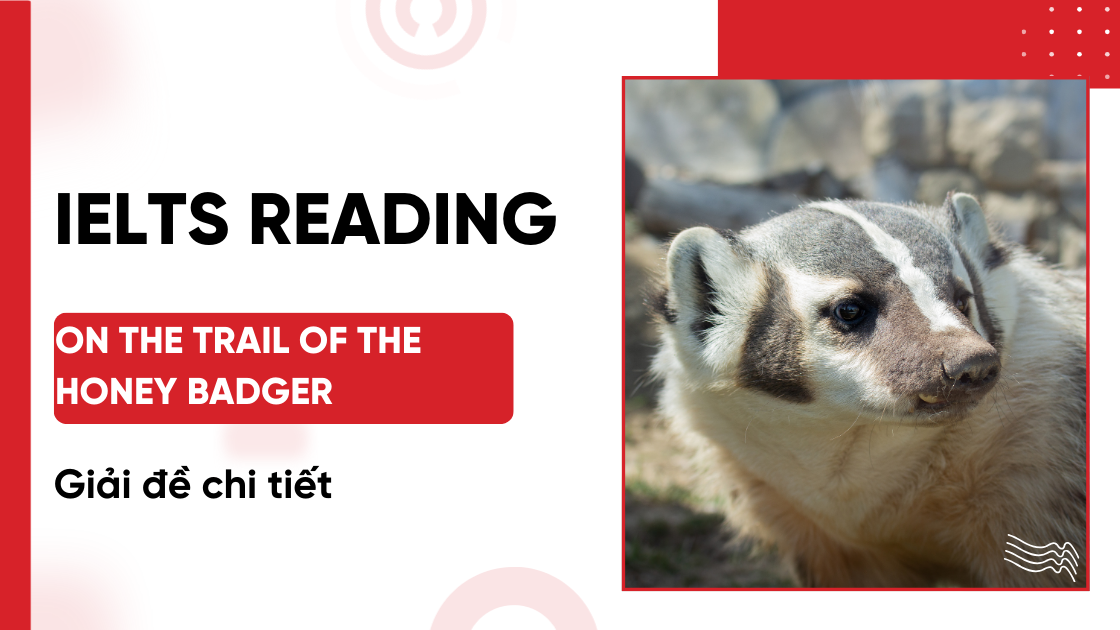
Bài viết tổng hợp chi tiết đề thi IELTS Reading on the trail of the honey badger, đáp án kèm giải thích chi tiết, từ vựng cần lưu ý khi làm bài giúp bạn luyện thi hiệu quả và nâng cao band điểm.
![Giải đề IELTS Reading Growing more for less [FULL ANSWER]](https://langmaster.edu.vn/storage/uploads/original/2025/10/22/growing-more-for-less-ielts-reading-answers.png)
Khám phá bài đọc Growing more for less IELTS Reading: Tổng hợp đáp án, từ vựng quan trọng và phân tích chi tiết giúp bạn hiểu cách công nghệ vệ tinh hỗ trợ nông nghiệp hiện đại



Hơn 16 năm kinh nghiệm, đào tạo thành công hàng trăm nghìn học viên
Phương pháp giảng dạy hiện đại, học viên tiến bộ rõ rệt
Lộ trình học chuẩn quốc tế, phù hợp với nhu cầu thực tiễn
Giáo viên đạt chuẩn Quốc tế với chất lượng top đầu thị trường, giàu kinh nghiệm
Học online linh hoạt, cam kết đầu ra bằng văn bản


.png)