Khóa học
IELTS Online
IELTS Online
Giảm đến 18%
Đăng ký ngay
Mục lục [Ẩn]
Đề thi IELTS Reading ngày 05.12.2025 gồm ba passage:, . Bài viết dưới đây cung cấp lời giải chi tiết từng câu hỏi và nội dung cụ thể của từng bài đọc trong đề thi thật, giúp bạn nắm rõ cấu trúc đề và chủ động hơn khi luyện tập với đề thi thật.
Katherine Mansfield
Katherine Mansfield was a modernist writer of short fiction who was born and brought up in New Zealand
A.
Katherine Mansfield Beauchamp Murry was born in 1888, into a prominent family in Wellington, New Zealand. She became one of New Zealand’s best-known writers, using the pen name of Katherine Mansfield. The daughter of a banker, and born into a middle-class family, she was also a first cousin of Countess Elizabeth von Arnim, a distinguished novelist in her time. Mansfield had two older sisters and a younger brother. Her father, Harold Beauchamp, went on to become the chairman of the Bank of New Zealand. In 1893, the Mansfield family moved to Karori, a suburb of Wellington, where Mansfield would spend the happiest years of her childhood; she later used her memories of this time as an inspiration for her Prelude story.
B.
Her first published stories appeared in the High School Reporter and the Wellington Girls 7 High School magazine in 1898 and 1899. In 1902, she developed strong feelings for a musician who played the cello, Arnold Trowell, although her feelings were not, for the most past, returned. Mansfield herself was an accomplished cellist, having received lesion from Trowell’s father. Mansfied wrote in her journals of feeling isolated to some extent in New Zealand, and, in general terms of her interest in the Maori people ( New Zealand’s native people), who were often portrayed in a sympathetic light in her later stories, such as How Pearl Button was Kidnapped
C.
She moved to London in 1903, where she attended Queen’s college, along with her two sisters. Manfield recommenced playing the cello, an occupation that she believed, during her time at Queen’s, she would take up professionally. She also began contributing to the college newspaper, with such a dedication to it that she eventually became its editor. She was particularly interested in the works of the French writers of this period and on the 19th- century British writer, Oscar Wilde, and she was appreciated amongst fellow students at Queen’s for her lively and charismatic approach to life and work. She met fellow writer Ida Baker, a South African, at the college, and the pair became lifelong friends. Mansfield did not actively support the suffragette movement in the UK. Women in New Zeland had gained the right to vote in 1893.
D.
Mansfield first began journeying into the other parts of Europe in the period 1903-1906, mainly to Belgium and Germany. After finishing her schooling in England, she returned to her New Zealand home in 1906, only then beginning to write short stories in a serious way. She had several works published in Australia in a magazine called Native Comparison, which was her first paid writing work, and by this time she had her mind set on becoming a professional writer. It was also the first occasion on which she used the pseudonym “k.Mansfied”.
E.
Mansfield rapidly grew discontented with the provincial New Zealand lifestyle, and with her family. Two years later she headed again in London. Her father sent her an annual subsidy of €100 for the rest of her life. In later years, she would express both admiration and disdain for New Zealand in her journals.
F.
In 1911, Mansfield met John Middleton Murry, the Oxford scholar and editor of the literary magazine Rhythm. They were later to marry in 1918. Mansfield became a co-editor of Rhythm, which was subsequently called The Blue Review, in which more of her works were published. She and Murry lived in various houses in England and briefly in Paris. The Blue Review failed to gain enough readers and was no longer published. Their attempt to set up as writers in Paris was cut short by Murry’s bankruptcy, which resulted from the failure of this and other journals. Life back in England meant frequently changed addresses and very limited funds.
G.
Between 1915 and 1918, Mansfield moved between England and Bandoi, France. She and Murry developed close contact with other well-known writers of the time such as DH Lawrence, Bertrand Russell and Aldous Huxley. By October 1918 Mansfield had become seriously ill; she had been diagnosed with tuberculosis and was advised to enter a sanatorium. She could no longer spend time with writers in London. In the autumn of 1918 she was so ill that she decided to go to Ospedale in Italy. It was the publication of Bliss and Other Stories in 1920 that was to solidify Mansfield’s reputation as a writer.
H.
Mansfied also spent time in Menton, France, as the tenant of her father’s cousin at ” The Villa Isola Bella”. There she wrote she pronounced to be “…the only story that satisfies me to any extent”.
I.
Mansfield produced a great deal of work in the final years of her life, and much of her prose and poetry remained unpublished at her death in 1923. After her death, her husband, Murry, took on the task of editing and publishing her works. His efforts resulted in two additional volumes of short stories. The Doves’ Nest and Something Childish, published in 1923 and 1924 respectively, the publication of her Poems as well as a collection of critical writings (Novels and Novelist) and a number of editions of Mansfield’s previously unpublished letters and journals.

Questions 1-6
Do the following statements agree with the information given in Reading Passage 1?
In boxes 1 – 6 on your answer sheet, write
TRUE if the statement agrees with the information
FALSE if the statement contradicts the information
NOT GIVEN if there is no information on this
The name Katherine Mansfield, that appears on the writer’s book, was exactly the same as her origin name
Mansfield won a prize for a story she wrote for the High School Reporter.
How Pearl Button Was Kidnapped portrayed Maori people in a favorable way.
When Mansfield was at Queen’s college, she planned to be a professional writer.
Mansfield was unpopular with the other students at Queen’s college
In London, Mansfield showed little interest in politics.
Questions 7-13
Complete the notes below
Choose ONE WORD AND/OR A NUMBER from the passage for each answer
Write your answers in boxes 7-13 on your answer sheet
Katherine Mansfield’s adult years
(7) …
Moved from England back to New Zealand
First paid writing work was in a publication based in
(8) … her
(9) … and the New Zealand way of life made her feel dissatisfied
1908: returned to London
1911-1919:
Met John Middleton Murry in 1911
(10) … perverted…. Mansfield and Murry from staying together in Paris spent time with distinguished
(11) …from 1916, tuberculosis restricted the time she spent in London 1920 her
(12) … was consolidated when Bliss and Other Stories was published wrote several stories at “Villa Isola Bella 1923-1924 Mansfield’s
(13) … published more of her works after her death
>>> XEM THÊM:
Đề thi IELTS Reading có đáp án mới nhất 2025-2026 [Cập nhật liên tục]
Giải đề thi thật IELTS Reading ngày 04.01.2026 [Full Answers]
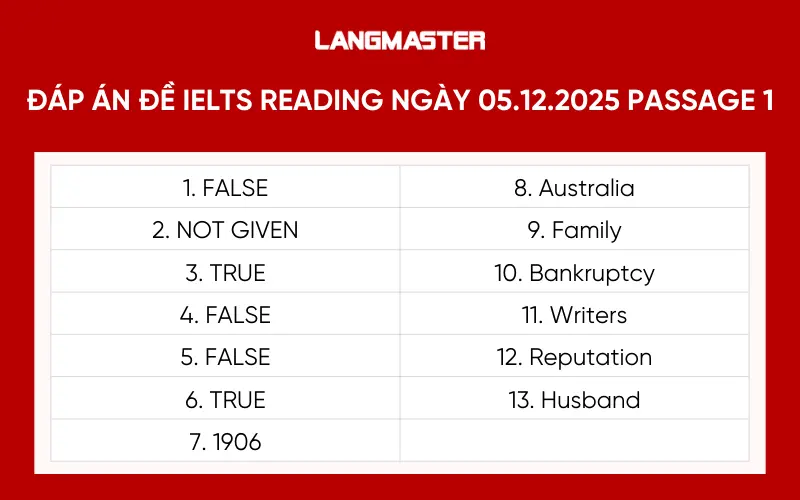
Bảng đáp án đề IELTS READING ngày 05.12.2025 PASSAGE 1
|
1. FALSE |
8. Australia |
|
2. NOT GIVEN |
9. Family |
|
3. TRUE |
10. Bankruptcy |
|
4. FALSE |
11. Writers |
|
5. FALSE |
12. Reputation |
|
6. TRUE |
13. Husband |
|
7. 1906 |
XEM ĐÁP ÁN CHI TIẾT TẠI ĐÂY: Giải đề IELTS Reading: Katherine Mansfield [Full answers]
Growing more for less
Satellite technology is helping farmers boost crop yields
A. For farmers, working out the optimal amount of seed, fertiliser, pesticide and water to scatter on a field can be a matter of luck, despite several harvests. Regular laboratory analyses of soil and plant samples from various sections of a field can help — but such expertise is costly, and often unavailable. However, a new and cheaper method of doing this analysis is now on offer. Precise prescriptions for growing crops can be obtained quickly, and less expensively, by calculating the amount of electromagnetic radiation reflected from agricultural land. The data is collected by orbiting satellites.
B. Examining the wavelength of radiation that is reflected can reveal, with surprising precision, the properties of the soil, the quality of crop being grown, and the levels in those crops of chlorophyll, various minerals, moisture and other indicators of their quality. If recent and forecast weather data is added, detailed maps can be produced indicating exactly how, where and when crops should be grown. The service usually costs less than US $15 per hectare for a handful of readings a year, and can increase yields by as much as 10%.
C. Such precision farming using satellite-based intelligence is a relatively new technique. Even so, it is catching on quickly. Five years ago, for example, a French cereal-growers' co-operative called Sevepi purchased a satellite and makes it available to its members in the form of maps of their fields, divided into three or four colour-coded zones per hectare. For each zone, the exact and best fertiliser formula is recommended. On top of this, if the amount of rain in the field has already grown quite high early in the season, and heavy showers are expected, an appropriate dose of growth regulator is recommended for each zone (as fragile stems break more easily in downpours). Then, farm vehicles equipped with global-positioning system locators automatically mix and apply the prescribed dose to each area.
D. France is the pioneer in this sort of surveillance. More farmland is analysed by satellite there than in any other country, according to Infoterra (a subsidiary of EADS Astrium), the firm that is France’s largest provider of such information, supplying data to companies such as Sevepi. Moreover, Henri Douche, head of Infoterra's agriculture sales in Toulouse, reckons the amount of monitored farmland will increase as weather patterns change and farmers can no longer rely on the past as a guide to the future. When confounded by the yield variations that these new weather patterns will bring, even farmers who are afraid of new technology will sign up, he says.
E. Inexpensive data on the productivity of land is advantageous to governments too. Areas where fertilisers and pesticides are being applied excessively can be pinpointed, enabling a reduction in environmental and land-use damage. Says Guy Lafond, an agronomist with Agriculture and Agri-Food Canada, a government agency, says the satellite data it purchases is proving useful for the study of fields with declining productivity in the province of Saskatchewan. Over-application of nitrate fertilisers (which are also a source of greenhouse gases) appears partly responsible. And according to RapidEye, a German satellite operator, some companies are also studying satellite data with a view to selling insurance policies to governments of famine-prone countries that might be threatened by crop failure.
F. In March, RapidEye began selling data that helps forecast harvests. "Too often, farmers limit productivity by managing fields wrongly," says Fredrick Jung-Rothenhäuser, head of product development at the firm's headquarters in Brandenburg an der Havel. "Our satellites are the first commercial satellites to include the Red-Edge band of the light spectrum, which is sensitive to changes in chlorophyll content. More research will be necessary to realise the full benefits of the Red-Edge band. However, this band can assist in monitoring vegetation health, improving species separation and also help in measuring protein and nitrogen content in biomass." The company's data, which comes from both Europe and the Americas, breaks field productivity down into patches just five metres square.
G. The advantages that satellite technology provides in terms of precision farming do not have to be restricted to rich countries. In Africa, where many areas have become badly depleted of nutrients, better fertiliser management would help reverse this situation. As a consequence, the charitable trust World Agroforestry Centre, in the city of Nairobi, in Kenya, has begun to build up a collection of radiation patterns derived from around 100,000 samples of African soils. The aim of this work is to help by understanding the potential of these soils to be more agriculturally productive. Once passed on to the International Centre for Tropical Agriculture, based in Colombia, South America, it is intended that the information be used to build a database called the 'Digital Soil Map'. When complete, this will provide farmers with free forecasts, developed with regularly updated satellite imagery, across farmland in the poorest countries in Africa. This is information which will almost certainly assist in improving crop yields. For a hunger-ravaged continent, that is good news indeed.
Questions 14–20
Reading Passage 2 has seven paragraphs, A–G.
Which paragraph contains the following information?
Write the correct letter, A–G, in boxes 14–20 on your answer sheet.
You may use any letter more than once.
14. an example of how farmers in one country are now using satellite data to determine fertiliser use
15. a reference to climate change and its effects
16. a reference to the effect on the soil of using too much fertiliser
17. an example of information that will be shared between different countries
18. mention of the country which is the leader in agricultural technology
19. a description of an innovation in satellite imaging which requires further study
20. evidence of the cost-effectiveness of using satellite technology in agriculture
Questions 21 and 22
Choose TWO letters, A–E.
Write the correct letters in boxes 21 and 22 on your answer sheet.
Which TWO companies obtain information directly from satellites?
A. Sevepi
B. Infoterra
C. Agriculture and AgriFood Canada
D. RapidEye
E. World Agroforestry Centre
Questions 23–26
Complete the sentences below.
Choose NO MORE THAN TWO WORDS from the passage for each answer.
Write your answers in boxes 23–26 on your answer sheet.
23. Initially, orbiting satellites are used to measure ............... coming from farmland.
24. Fredrick Jung-Rothenhäuser says that additional irregular weather will raise the ............... of satellite technology.
25. As a result of satellite technology, it may become possible to insure against the threat of ............... in some countries.
26. In Africa, much of the soil suffers from the loss of ............... .
>>> XEM THÊM:
Cách làm Multiple Choice trong IELTS Reading ẵm trọn điểm tối đa
Cách làm Matching Information trong IELTS Reading “ẵm trọn” điểm cao
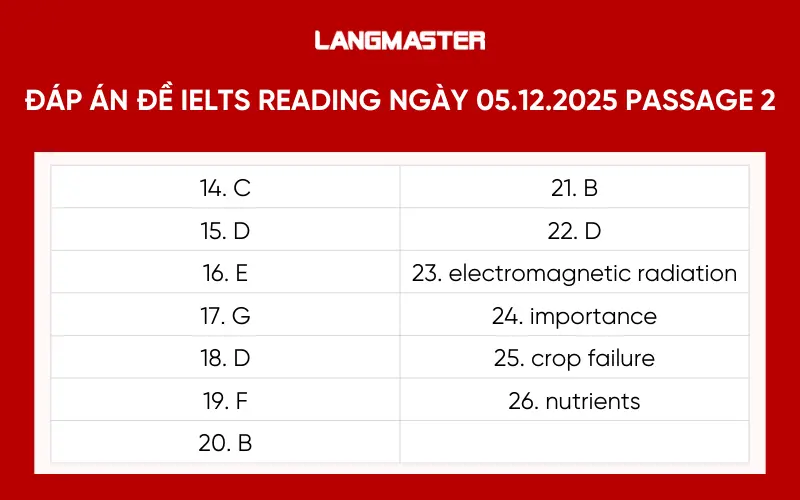
Bảng đáp án đề IELTS READING ngày 05.12.2025 PASSAGE 2
|
14. C |
21. B |
|
15. D |
22. D |
|
16. E |
23. electromagnetic radiation |
|
17. G |
24. importance |
|
18. D |
25. crop failure |
|
19. F |
26. nutrients |
|
20. B |
XEM ĐÁP ÁN CHI TIẾT TẠI ĐÂY: Giải đề IELTS Reading Growing more for less [FULL ANSWER]
>>> XEM THÊM:
Satellite Technology
The space-age began with the launch of the Russian artificial satellite Sputnik in 1957 and developed further with the race to the moon between the United States and Russia. This rivalry was characterized by advanced technology and huge budgets. In this process, there were spectacular successes, some failures, but also many spin-offs.
Europe, Japan, China, and India quickly joined this space club of the superpowers. With the advent of relatively low-cost high-performance mini-satellites and launchers, the acquisition of indigenous space capabilities by smaller nations in Asia has become possible. How, in what manner, and for what purpose will these capabilities be realized?
A. Rocket technology has progressed considerably since the days of ‘fire arrows’ (bamboo poles filled with gunpowder) first used in China around 500 BC, and, during the Sung Dynasty, to repel Mongol invaders at the battle of Kaifeng (Kai-fung fu) in AD 1232. These ancient rockets stand in stark contrast to the present-day Chinese rocket launch vehicles, called the ‘Long March’, intended to place a Chinese astronaut in space by 2005 and, perhaps, to achieve a Chinese moon-landing by the end of the decade.
B. In the last decade, there has been a dramatic growth in space activities in Asia both in the utilization of space-based services and the production of satellites and launchers. This rapid expansion has led many commentators and analysts to predict that Asia will become a world space power. The space-age has had dramatic effects worldwide with direct developments in space technology influencing telecommunications, meteorological forecasting, earth resource and environmental monitoring, and disaster mitigation (flood, forest fires, and oil spills). Asian nations have been particularly eager to embrace these developments.
C. New and innovative uses for satellites are constantly being explored with potential revolutionary effects, such as in the field of health and telemedicine, distance education, crime prevention (piracy on the high seas), food and agricultural planning and production (rice crop monitoring). Space in Asia is very much influenced by the competitive commercial space sector, the emergence of low-cost mini-satellites, and the globalization of industrial and financial markets. It is not evident how Asian space will develop in the coming decades in the face of these trends. It is, however, important to understand and assess the factors and forces that shape Asian space activities and development in determining its possible consequences for the region.
D. At present, three Asian nations, Japan, China, and India, have comprehensive end-to-end space capabilities and possess a complete space infrastructure: space technology, satellite manufacturing, rockets, and spaceports. Already self-sufficient in terms of satellite design and manufacturing, South Korea is currently attempting to join their ranks with its plans to develop a launch site and spaceport. Additionally, nations in Southeast Asia as well as those bordering the Indian subcontinent (Nepal, Pakistan, and Bangladesh), have, or are starting to develop indigenous space programmes. The Association of Southeast Asian Nations (ASEAN) has, in varying degrees, embraced space applications using foreign technology and over the past five years or so its space activities have been expanding. Southeast Asia is predicted to become the largest and fastest-growing market for commercial space products and applications, driven by telecommunications (mobile and fixed services), the Internet, and remote sensing applications. In the development of this technology, many non-technical factors, such as economics, politics, culture, and history, interact and play important roles, which in turn affect Asian technology.
E. Asia and Southeast Asia, in particular, suffers from a long list of recurrent large-scale environmental problems including storms and flooding, forest fires and deforestation, and crop failures. Thus the space application that has attracted the most attention in this region is remote sensing. Remote sensing satellites equipped with instruments to take photographs of the ground at different wavelengths provide essential information for natural resource accounting, environmental management, disaster prevention and monitoring, land-use mapping, and sustainable development planning. Progress in these applications has been rapid and impressive. ASEAN members, unlike Japan, China, and India, do not have their own remote sensing satellites, however, most of its member nations have facilities to receive, process, and interpret such data from American and European satellites. In particular, Thailand, Malaysia, and Singapore have world-class remote sensing processing facilities and research programmes. ASEAN has plans to develop (and launch) its own satellites and in particular remote sensing satellites. Japan is regarded as the dominant space power in Asia and its record of successes and quality of technologies are equal to those of the West. In view of the technological challenges and high risks involved in space activities, a very long, and expensive, the learning curve has been followed to obtain those successes achieved. Japan’s satellite manufacturing was based on the old and traditional defense and military procurement methodologies as practiced in the US and Europe.
F. In recent years there have been fundamental changes in the way satellites are designed and built to drastically reduce costs. The emergence of ‘small satellites’ and their quick adoption by Asian countries as a way to develop low-cost satellite technology and rapidly establish a space capability has given these countries the possibility to shorten their learning curve by a decade or more. The global increase of technology transfer mechanisms and use of readily available commercial technology to replace costly space and military-standard components may very well result in a highly competitive Asian satellite manufacturing industry.
G. The laws of physics are the same in Tokyo as in Toulouse, and the principles of electronics and mechanics know no political or cultural boundaries. However, no such immutability applies to engineer practices and management; they are very much influenced by education, culture, and history. These factors, in turn, have an effect on costs, lead times, product designs and, eventually, international sales. Many Asian nations are sending their engineers to be trained in the West. Highly experienced, they return to work in the growing Asian space industry. Will this acquisition of technical expertise, coupled perhaps with the world-renowned Japanese manufacturing and management techniques, be applied to build world-class satellites and reduce costs?
Questions 28-32
The reading passage has seven paragraphs, A-G. Choose the correct heading for paragraphs A-G from the list below. Write the correct number, i-ix, in boxes 27-31 on your answer sheet.
i. Western countries provide essential assistance
ii. Unbalanced development for an essential space technology
iii. Innovative application compelled by competition
iv. An ancient invention which is related to the future
v. Military purpose of the satellite
vi. Rockets for application in ancient China
vii. Space development in Asia in the past
viii. Non-technology factors counts
ix. competitive edge gained by more economically feasible satellite
Paragraph D Example: Current space technology development in Asia
28. Paragraph A………………..
29. Paragraph B………………..
30. Paragraph C………………..
31. Paragraph E………………..
32. Paragraph F………………..
Questions 33-36
Match the following reasons for each question according to the information given in the passage. Write the correct letter A-F, in boxes 33-36 on your answer sheet.
A. Because it helps administrate the crops.
B. Because there are some unapproachable areas.
C. Because the economic level in that area is low.
D. Because there are influences from some other social factors.
E. Because it can be used in non-peaceful purpose.
F. Because disasters such as bush fires happened in Southeast Asia.
33. Why is remote-photographic technology used to resolve environmental problems?………………..
34. Why is satellite technology used in the medicine area?………………..
3.5 Why Asian countries’ satellite technology is limited for development?………………..
36. Why is satellite technology deployed in an agricultural area?………………..
Questions 37-40
Do the following statements agree with the information given in the Reading Passage? In boxes 37-40 on your answer sheet, write:
TRUE if the statement is true
FALSE if the statement is false
NOT GIVEN if the information is not given in the passage
37. Ancient China had already deployed rockets as a military purpose as early as 500 years ago.
38. Space technology has enhanced the literacy of Asia.
39. Photos taken by satellites with certain technology help predict some natural catastrophes prevention and surveillance.
40. Commercial competition constitutes a boosting factor to Asian technology.
>>> XEM THÊM:
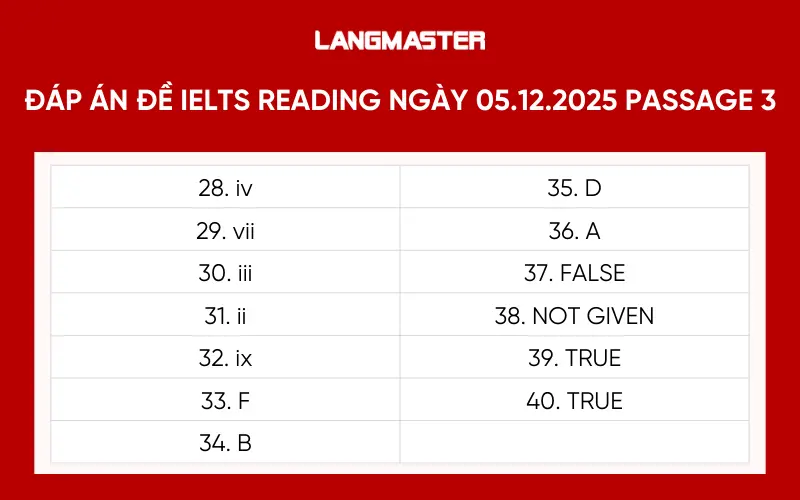
Bảng đáp án đề IELTS READING ngày 05.12.2025 PASSAGE 3
|
28. iv |
35. D |
|
29. vii |
36. A |
|
30. iii |
37. FALSE |
|
31. ii |
38. NOT GIVEN |
|
32. ix |
39. TRUE |
|
33. F |
40. TRUE |
|
34. B |
Questions 28-32: Matching Headings
28. Paragraph A – iv (An ancient invention which is related to the future)
Đoạn A mở đầu bằng việc nhắc đến “fire arrows” – tiền thân của tên lửa – xuất hiện ở Trung Quốc khoảng năm 500 TCN. Tác giả đặt chi tiết này trong sự tương phản với các tên lửa hiện đại như Long March, được sử dụng cho các chương trình không gian và kế hoạch đưa phi hành gia lên vũ trụ. Như vậy, đoạn văn cho thấy sự liên hệ rõ ràng giữa một phát minh cổ đại và tham vọng chinh phục không gian trong tương lai.
29. Paragraph B – vii (Space development in Asia in the past)
Đoạn B đề cập đến sự tăng trưởng mạnh mẽ của các hoạt động không gian tại châu Á trong thập kỷ gần đây. Sự phát triển này làm dấy lên nhiều dự đoán về vị thế ngày càng quan trọng của khu vực trong ngành công nghiệp vũ trụ toàn cầu.
30. Paragraph C – iii (Innovative application compelled by competition)
Đoạn C trình bày nhiều ứng dụng mới và sáng tạo của vệ tinh như y tế từ xa, giáo dục từ xa và giám sát nông nghiệp. Bên cạnh đó, tác giả nhấn mạnh vai trò của môi trường thương mại cạnh tranh trong việc thúc đẩy những đổi mới này.
31. Paragraph E – ii (Unbalanced development for an essential space technology)
Đoạn E tập trung vào công nghệ viễn thám – một công cụ quan trọng trong việc giải quyết các vấn đề môi trường. Tuy nhiên, sự phát triển không đồng đều thể hiện ở việc chỉ một số quốc gia như Nhật Bản, Trung Quốc và Ấn Độ sở hữu vệ tinh riêng, trong khi nhiều nước ASEAN vẫn phải phụ thuộc vào dữ liệu từ bên ngoài.
32. Paragraph F – ix (Competitive edge gained by more economically feasible satellite)
Đoạn F nói về xu hướng phát triển vệ tinh nhỏ và sử dụng linh kiện thương mại thay thế cho thiết bị tiêu chuẩn quân sự đắt đỏ. Điều này giúp giảm đáng kể chi phí và tăng tính cạnh tranh của ngành công nghiệp vệ tinh tại châu Á.
Questions 33-36: Matching Information
33. Why is remote-photographic technology used to resolve environmental problems? → F (Because disasters such as bush fires happened in Southeast Asia.)
Giải thích: “Remote-photographic technology” thực chất đề cập đến công nghệ “remote sensing” (viễn thám). Ở đoạn E, tác giả nhấn mạnh rằng khu vực này thường xuyên phải đối mặt với hàng loạt vấn đề môi trường quy mô lớn như bão, lũ lụt và đặc biệt là cháy rừng. Chính vì những thảm họa lặp đi lặp lại này mà công nghệ chụp ảnh từ xa được ứng dụng để theo dõi và xử lý.
Vị trí và trích dẫn: Đoạn E: “…suffers from a long list of recurrent large-scale environmental problems including… forest fires…”
34. Why is satellite technology used in the medicine area? → B (Because there are some unapproachable areas.)
Giải thích: Đoạn C đề cập đến việc ứng dụng vệ tinh trong lĩnh vực “health and telemedicine” cùng với “distance education”. Dù bài không trực tiếp nhắc đến cụm “unapproachable areas”, bản chất của “telemedicine” là cung cấp dịch vụ y tế từ xa cho những khu vực khó tiếp cận hoặc nơi bệnh nhân không thể gặp bác sĩ trực tiếp. Do đó, đây là suy luận hợp lý nhất.
Vị trí và trích dẫn: Đoạn C: “…such as in the field of health and telemedicine, distance education…”
35. Why Asian countries’ satellite technology is limited for development? → D (Because there are influences from some other social factors.)
Giải thích: Ở đoạn D, tác giả chỉ ra rằng quá trình phát triển công nghệ không chỉ phụ thuộc vào yếu tố kỹ thuật mà còn chịu tác động từ nhiều yếu tố phi kỹ thuật như kinh tế, chính trị, văn hóa và lịch sử. Những yếu tố này tương tác lẫn nhau và ảnh hưởng trực tiếp đến sự tiến bộ công nghệ của châu Á.
Vị trí và trích dẫn: Đoạn D (câu cuối): “…many non-technical factors, such as economics, politics, culture, and history, interact and play important roles, which in turn affect Asian technology.”
36. Why is satellite technology deployed in an agricultural area? → A (Because it helps administrate the crops.)
Giải thích: Đoạn C đề cập đến ứng dụng vệ tinh trong “agricultural planning and production”, cụ thể là “rice crop monitoring”. Việc giám sát và lập kế hoạch sản xuất lúa gạo chính là quá trình quản lý và điều hành mùa màng, tương đương với ý “administrate the crops”.
Vị trí và trích dẫn: Đoạn C: “…food and agricultural planning and production (rice crop monitoring).”
Questions 37-40: TRUE / FALSE / NOT GIVEN
37. Ancient China had already deployed rockets as a military purpose as early as 500 years ago. Đáp án: FALSE
Giải thích: Bài đọc cho biết “fire arrows” được sử dụng tại Trung Quốc từ khoảng năm 500 BC và từng được dùng để chống quân Mông Cổ vào năm 1232 AD. Tuy nhiên, câu hỏi lại đề cập mốc “500 years ago” (khoảng năm 1500 AD), điều này không trùng khớp với dữ liệu trong bài nên thông tin là sai.
Vị trí và trích dẫn: Đoạn A: “…first used in China around 500 BC, and… to repel Mongol invaders at the battle of Kaifeng (Kai-fung fu) in AD 1232.”
38. Space technology has enhanced the literacy of Asia. Đáp án: NOT GIVEN
Giải thích: Mặc dù đoạn C có nhắc đến “distance education” như một ứng dụng tiềm năng của công nghệ vệ tinh, bài đọc không cung cấp bằng chứng nào khẳng định rằng công nghệ này đã thực sự nâng cao tỷ lệ biết chữ tại châu Á. Vì không có thông tin xác nhận hay phủ định, đáp án là NOT GIVEN.
39. Photos taken by satellites with certain technology help predict some natural catastrophes prevention and surveillance. Đáp án: TRUE
Giải thích: Đoạn E mô tả rõ ràng rằng vệ tinh viễn thám được trang bị thiết bị chụp ảnh mặt đất nhằm cung cấp thông tin cần thiết cho việc phòng ngừa và giám sát thảm họa. Nội dung này hoàn toàn trùng khớp với phát biểu trong câu hỏi.
Vị trí và trích dẫn: Đoạn E: “Remote sensing satellites equipped with instruments to take photographs of the ground… provide essential information for… disaster prevention and monitoring…”
40. Commercial competition constitutes a boosting factor to Asian technology. Đáp án: TRUE
Giải thích: Đoạn C khẳng định hoạt động không gian tại châu Á chịu ảnh hưởng mạnh mẽ từ khu vực thương mại cạnh tranh. Đồng thời, đoạn F cho thấy việc áp dụng công nghệ thương mại giúp rút ngắn quá trình học hỏi và tạo ra ngành công nghiệp sản xuất vệ tinh mang tính cạnh tranh cao. Điều này chứng minh cạnh tranh thương mại là động lực thúc đẩy phát triển công nghệ.
Vị trí và trích dẫn:
Đoạn C: “Space in Asia is very much influenced by the competitive commercial space sector…”
Đoạn F: “…result in a highly competitive Asian satellite manufacturing industry.”
>>> XEM THÊM:
Khi luyện đề IELTS Reading ngày 05.12.2025 nhiều học viên thường gặp khó khăn trong việc xác định dạng câu hỏi và áp dụng từ vựng học thuật một cách chính xác. Để đạt hiệu quả cao, cần có một kế hoạch ôn tập logic, kết hợp với chiến lược làm bài rõ ràng và sự hỗ trợ từ giáo viên nhiều kinh nghiệm. Để đáp ứng nhu cầu, Langmaster xây dựng các khóa học IELTS online với lộ trình cá nhân hóa. Học viên sẽ được giảng viên theo sát, chỉ ra lỗi sai ngay lập tức trong vòng 24 giờ và hướng dẫn phương pháp học tập tối ưu để tiến bộ nhanh chóng hơn.
Tại Langmaster học viên được:
Coaching 1 - 1 với chuyên gia: Học viên được kèm riêng để khắc phục điểm yếu, phân bổ thời gian thi chi tiết, tập trung rèn kỹ năng chưa vững và rút ngắn lộ trình nâng band.
Sĩ số lớp nhỏ, 7 - 10 học viên: Giáo viên theo sát từng bạn, nhiều cơ hội trao đổi và nhận phản hồi chi tiết.
Hệ sinh thái học tập toàn diện: Tài liệu chuẩn, bài tập online, cộng đồng học viên và cố vấn luôn đồng hành.
Lộ trình học cá nhân hóa: Thiết kế dựa trên trình độ đầu vào và mục tiêu điểm số, kèm báo cáo tiến bộ hàng tháng.
Giáo viên 7.5+ IELTS: Chấm chữa bài trong 24 giờ, giúp bạn cải thiện nhanh chóng và rõ rệt.
Thi thử định kỳ: Mô phỏng áp lực thi thật, phân tích điểm mạnh - yếu để điều chỉnh chiến lược học.
Cam kết đầu ra, học lại miễn phí: Đảm bảo kết quả, giảm thiểu rủi ro “học xong vẫn chưa đạt mục tiêu”.
Học online tiện lợi, chất lượng như offline: Có bản ghi để xem lại, linh hoạt, tiết kiệm thời gian, chi phí.
Đăng ký học thử IELTS Online miễn phí ngay hôm nay để trải nghiệm lớp học thực tế, kiểm tra trình độ và nhận lộ trình học tập hiệu quả, giúp bạn thành thạo kỹ năng IELTS Reading và chinh phục mục tiêu IELTS!
Khi ôn luyện đề IELTS Reading ngày 05.12.2025 học viên không chỉ nắm vững đáp án đúng mà còn phát triển khả năng phân tích theo từng dạng câu hỏi một cách logic. Việc kết hợp từ vựng học thuật trong ngữ cảnh thực tế giúp ghi nhớ hiệu quả, đồng thời mở rộng vốn từ cần thiết cho kỹ năng đọc học thuật.



![Giải đề thi European Heat Wave IELTS Reading [FULL ANSWER]](https://langmaster.edu.vn/storage/uploads/original/2025/11/20/european-heat-wave-ielts-reading-answers.png)
Tổng hợp đề thi European Heat Wave IELTS Reading Answers kèm phân tích chi tiết, từ vựng và đáp án giúp bạn tối ưu điểm Reading nhanh chóng.
![Đề thi IELTS Reading có đáp án mới nhất 2025-2026 [Cập nhật liên tục]](https://langmaster.edu.vn/storage/uploads/original/2025/12/25/de-thi-ielts-reading.png)
Đề thi IELTS Reading có đáp án mới nhất 2025/2026, cập nhật liên tục đề thi thật và Cambridge, kèm lời giải chi tiết giúp nâng band hiệu quả.

Bài viết tổng hợp chi tiết đề thi IELTS Reading Holidays with a difference, đáp án kèm giải thích chi tiết, từ vựng cần lưu ý khi làm bài giúp bạn luyện thi hiệu quả và nâng cao band điểm.
Bài viết tổng hợp chi tiết đề thi IELTS Reading on the trail of the honey badger, đáp án kèm giải thích chi tiết, từ vựng cần lưu ý khi làm bài giúp bạn luyện thi hiệu quả và nâng cao band điểm.
![Giải đề IELTS Reading Growing more for less [FULL ANSWER]](https://langmaster.edu.vn/storage/uploads/original/2025/10/22/growing-more-for-less-ielts-reading-answers.png)
Khám phá bài đọc Growing more for less IELTS Reading: Tổng hợp đáp án, từ vựng quan trọng và phân tích chi tiết giúp bạn hiểu cách công nghệ vệ tinh hỗ trợ nông nghiệp hiện đại




Hơn 16 năm kinh nghiệm, đào tạo thành công hàng trăm nghìn học viên
Phương pháp giảng dạy hiện đại, học viên tiến bộ rõ rệt
Lộ trình học chuẩn quốc tế, phù hợp với nhu cầu thực tiễn
Giáo viên đạt chuẩn Quốc tế với chất lượng top đầu thị trường, giàu kinh nghiệm
Học online linh hoạt, cam kết đầu ra bằng văn bản


![Giải đề thi thật IELTS Reading ngày 13.01.2026 [Full Answers]](https://langmaster.edu.vn/storage/uploads/original/2026/02/25/ielts-reading-13-01-2025.png)
![Giải đề thi thật IELTS Reading ngày 23.01.2026 [Full Answers]](https://langmaster.edu.vn/storage/uploads/original/2026/02/25/ielts-reading-23-01-2026.png)

![Giải đề thi thật IELTS Reading ngày 16.01.2026 [Full Answers]](https://langmaster.edu.vn/storage/uploads/original/2026/02/24/ielts-reading-16-01-2026.png)
