Khóa học
IELTS Online
IELTS Online
Giảm đến 18%
Đăng ký ngay
Mục lục [Ẩn]
Dạng bài multiple choice trong IELTS Reading luôn khiến nhiều thí sinh “mất điểm oan” vì dễ nhầm lẫn và bẫy thông tin. Vậy làm thế nào để làm đúng và nhanh dạng bài này? Trong bài viết dưới đây, bạn sẽ được hướng dẫn chi tiết cách làm cùng với các bài tập multiple choice IELTS Reading kèm đáp án giúp luyện tập hiệu quả và nâng band nhanh chóng.
| Bạn đang ở band IELTS bao nhiêu? Làm bài test miễn phí và nhận ngay lộ trình học cá nhân hóa. 👉 Đăng ký test IELTS miễn phí ngay |
Multiple Choice là dạng bài trắc nghiệm phổ biến trong IELTS Reading, yêu cầu bạn chọn đáp án đúng nhất trong các phương án A, B, C hoặc D dựa trên nội dung bài đọc.
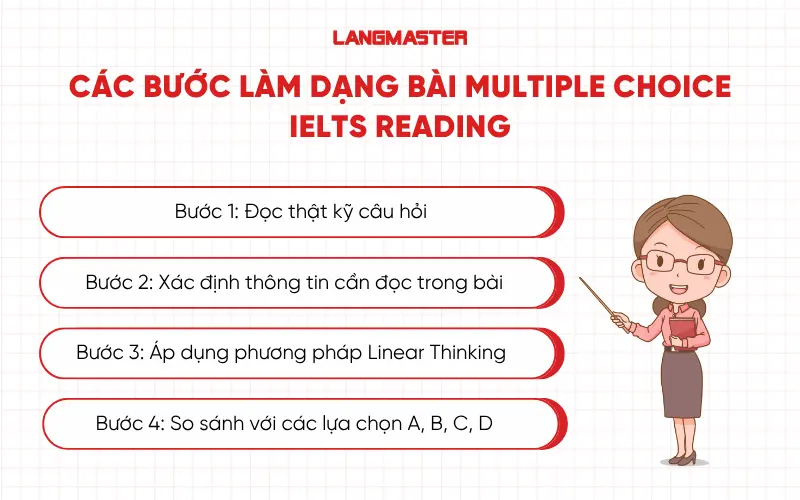
Bước 1: Đọc thật kỹ câu hỏi
Trước khi đọc bài, bạn cần đọc kỹ câu hỏi để hiểu rõ yêu cầu và xác định từ khóa chính. Hãy chú ý các từ như NOT, EXCEPT, TRUE vì đây thường là “bẫy” khiến bạn chọn sai nếu đọc lướt.
Bước 2: Xác định thông tin cần đọc trong bài
Dựa vào từ khóa trong câu hỏi, bạn xác định vị trí thông tin trong bài đọc bằng cách scanning. Việc này giúp bạn tiết kiệm thời gian và tập trung vào đúng đoạn chứa đáp án thay vì đọc toàn bộ bài.
Bước 3: Áp dụng phương pháp Linear Thinking
Trong IELTS Reading, câu hỏi thường xuất hiện theo thứ tự thông tin trong bài. Vì vậy, bạn nên làm lần lượt từng câu theo trình tự, tránh nhảy qua lại khiến bị rối và mất dấu thông tin.
Bước 4: So sánh với các lựa chọn A, B, C, D
Sau khi tìm được đoạn chứa đáp án, hãy so sánh kỹ từng lựa chọn với nội dung bài. Đáp án đúng thường được paraphrase, không giống y nguyên. Đồng thời, bạn cần loại bỏ các phương án sai do thông tin thiếu, sai lệch hoặc gây nhiễu.
ENERGY PROFILE OF THE CZECH REPUBLIC
The Czech Republic's dependence on energy imports has been quite favourable to date (32% of energy demand is met by imports); however, it is structurally unbalanced. The country's dependence on oil is about 95%, and in the case of natural gas, it is about 98%. The Czech Republic also imports nuclear power, but the primary resource, uranium ore, is available and produced domestically. In 2006, some 260,000 tomes of oil and 150 mcm* of natural gas came from indigenous resources. However, the country's dependence on energy imports is expected to grow (to almost 50% by 2020). A number of direct and indirect measures must be adopted to slow the rate at which the Czech Republic’s dependence on energy imports is increasing. Key measures include those geared towards promoting energy efficiency, supporting renewable energy resources in areas where they are effective (in accordance with the government's energy policy: 8% by 2010 and 16.9% by 2030), supporting nuclear energy (zero-emission energy sources) and improving the availability and extending the life span of the hidden potential of indigenous solid fuels, mainly brown coal.
*mcm = million cubic metres
adapted from www.euracoauorg
Which of these statements best describes energy use in the Czech Republic?
A. The country imports almost all of its energy
B. The country’s need for imported energy is likely to decrease through energy efficiency
C. The country considers nuclear power as one of the potential solutions to the problem of imported energy
D. The country aims to double its energy efficiency between 2010 and 2030.
Đáp án: C
>> Xem thêm:
Chiến lược làm Matching Headings trong IELTS Reading ẵm trọn điểm
Cách làm dạng bài Diagram Labelling IELTS Reading đạt band cao
THE POMPIDOU CENTRE
More than three decades after it was built, the Pompidou Centre in Paris has survived its moment at the edge of architectural fashion and proved itself to be one of the most remarkable buildings of the 20th century.
It was the most outstanding now building constructed in Paris for two generations. It looked like an explosion of brightly coloured service pipes in the calm of the city centre. However, when in 1977 the architects Richard Rogers and Renzo Piano stood among a large crowd of 5,000 at the opening of the Centre Culturel d'Art Georges Pompidou (known as the Pompidou), no one was really aware of the significance of this unusual building.
Rogers was only 38 when he and Piano won the competition to design a new cultural centre for Paris in the old market site. Young, unknown architects, they had been chosen from a field of nearly 700 to design one of the most prestigious buildings of its day. After six difficult years, with 25,000 drawings, seven lawsuits, battles over budgets, and a desperate last-minute scramble to finish the building, it had finally been done.
Yet the opening was a downbeat moment. The Pompidou Centre had been rubbished by the critics while it was being built, there was no more work in prospect for the architects, and their partnership had effectively broken down. But this was just a passing crisis. The Centre, which combined the national museum of modern art, exhibition space, a public library and a centre for modern music, proved an enormous success. It attracted six million visitors in its first year, and with its success, the critics swiftly changed their tune.
The architects had been driven by the desire for ultimate flexibility, for a building that would not limit the movement of its users. All the different parts were approached through the same enormous entrance hall and served by the same escalator, which was free to anyone to ride, whether they wanted to visit an exhibition or just admire the view. With all the services at one end of the building, escalators and lifts at the other, and the floors hung on giant steel beams providing uninterrupted space the size of two football pitches, their dream had become a reality.
The image of the Pompidou pervaded popular culture in the 1970s, making appearances everywhere - on record-album covers and a table lamp, and even acting as the set for a James Bond 1 film. This did much to overcome the secretive nature of the architectural culture of its time, as it enabled wider audience to appreciate the style and content of the building and so moved away from the strictly professional view.
The following year, Rogers was commissioned to design a new headquarters for Lloyd's Bank in London and went on to create one of Britain's most dynamic architectural practices. Piano is now among the world's most respected architects. But what of their shared creation?
It was certainly like no previous museum, with its plans for a flexible interior that not only had movable walls but floors that could also be adjusted up or down. This second feature did not in the end survive when the competition drawings were turned into a real building. In other ways, however, the finished building demonstrated a remarkable degree of refinement - of craftsmanship even - in the way the original diagram was transformed into a superbly detailed structure. It was this quality which, according to some critics, suggested that the Pompidou should be seen as closer to the 19th-century engineering tradition than the space age.
Nevertheless, as a model for urban planning, it has proved immensely influential. The Guggenheim in Bilbao* and the many other major landmark projects that were built in the belief that innovatively designed cultural buildings can bring about urban renewal are all following the lead of the Pompidou Centre.
Other buildings may now challenge it for the title of Europe s most outlandish work of architecture. However, more than a quarter of a century later, this construction - it is hard to call it a building when there is no façade, just a lattice of steel beams and pipes and a long external escalator snaking up the outside - still seems extreme.
Today, the Pompidou Centre itself still looks much as it did when it opened. The shock value of its colour-coded plumbing and its structure has not faded with the years. But while traditionalists regarded it as an ugly attack on Paris when it was built, they now see it for what it is - an enormous achievement, technically and conceptually.
Questions 1-4
Choose the correct letter, A, B, C or D.
What does the writer say in the first paragraph about the opening of the Pompidou Centre?
A. The elderly did not like it.
B. The architects were not present.
C. The atmosphere was very noisy.
D. The people did not realise its importance.
What does the writer say in the second paragraph about the construction of the Pompidou?
A. There was a hurry to complete it.
B. It cost less than expected.
C. Other experts helped draw the plans.
D. The market location was criticised.
What is the writer’s main purpose in the third paragraph?
A. to explain the multi-functional role of the centre
B. to praise the architects for their design ideas
C. to say why some people’s opinions quickly altered
D. to show how the media benefited from its success
What was the architects’ ‘dream’, referred to in the fourth paragraph?
A. to become famous
B. to provide entertainment
C. to allow visitors to use it freely
D. to build the biggest museum in the world
Đáp án
D
A
C
C
>> Xem thêm: Giải đề thi thật IELTS Reading ngày 23.01.2026 [Full Answers]
The growth of bike sharing schemes around the world
How Dutch engineer Luud Schimmelpennink helped to devise urban bike-sharing schemes.
A – The original idea for an urban bike-sharing scheme dates back to a summer’s day in 1965. Provo, the organisation that came up with the idea, was a group of Dutch activists who wanted to change society. They believed the scheme, which was known as the Witte Fietsenplan, was an answer to the perceived threats of air pollution and consumerism. In the centre of Amsterdam, they painted a small number of used bikes white. They also distributed leaflets describing the dangers of cars and inviting people to use the white bikes. The bikes were then left unlocked at various locations around the city, to be used by anyone in need of transport.B – Luud Schimmelpennink, a Dutch industrial engineer who still lives and cycles in Amsterdam, was heavily involved in the original scheme. He recalls how the scheme succeeded in attracting a great deal of attention – particularly when it came to publicising Provo’s aims – but struggled to get off the ground. The police were opposed to Provo’s initiatives and almost as soon as the white bikes were distributed around the city, they removed them. However, for Schimmelpennink and for bike-sharing schemes in general, this was just the beginning. ‘The first Witte Fietsenplan was just a symbolic thing,’ he says. ‘We painted a few bikes white, that was all. Things got more serious when | became a member of the Amsterdam city council two years later.’
C – Schimmelpennink seized this opportunity to present a more elaborate Witte Fietsenplan to the city council. ‘My idea was that the municipality of Amsterdam would distribute 10,000 white bikes over the city, for everyone to use,’ he explains. ‘| made serious calculations. It turned out that a white bicycle – per person, per kilometre – would cost the municipality only 10% of what it contributed to public transport per person per kilometre.’ Nevertheless, the council unanimously rejected the plan. ‘They said that the bicycle belongs to the past. They saw a glorious future for the car,’ says Schimmelpennink. But he was not in the least discouraged.
D – Schimmelpennink never stopped believing in bike-sharing, and in the mid-90s, two Danes asked for his help to set up a system in Copenhagen. The result was the world’s first large-scale bike-share programme. It worked on a deposit: ‘You dropped a coin in the bike and when you returned it, you got your money back.’ After setting up the Danish system, Schimmelpennink decided to try his luck again in the Netherlands and this time he succeeded in arousing the interest of the Dutch Ministry of Transport. ‘Times had changed,’ he recalls. ‘People had become more environmentally conscious, and the Danish experiment had proved that bike-sharing was a real possibility.’ A new Witte Fietsenplan was launched in 1999 in Amsterdam. However, riding a white bike was no longer free; it cost one guilder per trip and payment was made with a chip card developed by the Dutch bank Postbank. Schimmelpennink designed conspicuous, sturdy white bikes locked in special racks which could be opened with the chip card – the plan started with 250 bikes, distributed over five stations.
E – Theo Molenaar, who was a system designer for the project, worked alongside Schimmelpennink. ‘ I remember when we were testing the bike racks, he announced that he had already designed better ones. But of course, we had to go through with the ones we had.’ The system, however, was prone to vandalism and theft. ‘After every weekend there would always be a couple of bikes missing,’ Molenaar says.‘ I really have no idea what people did with them, because they could instantly be recognised as white bikes.’ But the biggest blow came when Postbank decided to abolish the chip card, because it wasn’t profitable. ‘That chip card was pivotal to the system,’ Molenaar says. ‘To continue the project we would have needed to set up another system, but the business partner had lost interest.’
F – Schimmelpennink was disappointed, but - characteristically - not for long. In 2002 he got a call from the French advertising corporation JC Decaux, who wanted to set up his bike-sharing scheme in Vienna. ‘That went really well. After Vienna, they set up a system in Lyon. Then in 2007, Paris followed. That was a decisive moment in the history of bike-sharing.’ The huge and unexpected success of the Parisian bike-sharing programme, which now boasts more than 20,000 bicycles, inspired cities all over the world to set up their own schemes, all modelled on Schimmelpennink. ‘It’s wonderful that this happened,’ he says. ‘But financially | didn’t really benefit from it, because | never filed for a patent.’
G – In Amsterdam today, 38% of all trips are made by bike and, along with Copenhagen, it is regarded as one of the two most cycle-friendly capitals in the world - but the city never got another Witte Fietsenplan. Molenaar believes this may be because everybody in Amsterdam already has a bike. Schimmelpennink, however, cannot see that this changes Amsterdam’s need for a bike-sharing scheme. ‘People who travel on the underground don’t carry their bikes around. But often they need additional transport to reach their final destination.’ Although he thinks it is strange that a city like Amsterdam does not have a successful bike-sharing scheme, he is optimistic about the future. ‘In the 60s we didn’t stand a chance because people were prepared to give their lives to keep cars in the city. But that mentality has totally changed.
Choose TWO letters, A–E. Write the correct letters in boxes 19 and 20 on your answer sheet.
Which TWO of the following statements are made in the text about the Amsterdam bike-sharing scheme of 1999?
A. It was initially opposed by a government department.
B. It failed when a partner in the scheme withdrew support.
C. It aimed to be more successful than the Copenhagen scheme.
D. It was made possible by a change in people’s attitudes.
E. It attracted interest from a range of bike designers.
Đáp án: D - B
| Học mãi mà IELTS không lên band? Học thử IELTS miễn phí cùng giáo viên 7.5+, chấm chữa lỗi sai ngay lập tức. 👉 Đăng ký học thử miễn phí ngay |
>> Xem thêm:
WHY DON'T BABIES TALK LIKE ADULTS?
Kids go from 'goo-goo' to talkative one step at a time.
By Joshua Hartshorne
A recent e-trade advertisement shows a baby speaking directly to the camera: 'Look at this,’ he says, I'm a free man. I go anywhere I want now.’ He describes his stock-buying activities, and then his phone rings. This advertisement proves what comedians have known for years: few things are as funny as a baby who talks like an adult. But it also raises an important question: Why don’t young children express themselves clearly like adults?
Many people assume children learn to talk by copying what they hear. In other words, they listen to the words adults use and the situations in which they use them and imitate accordingly. Behaviourism, the scientific approach that dominated American cognitive science for the first half of the 20th century, made exactly this argument.
However, this ’copycat’ theory can’t explain why toddlers aren’t as conversational as adults. After all, you never hear literate adults express themselves in one-word sentences like ‘bottle’ or ‘doggie’. In fact, it's easy for scientists to show that a copycat theory of language acquisition can’t explain children’s first words. What is hard for them to do is to explain these first words, and how they fit into the language acquisition pattern.
Over the past half-century, scientists have settled on two reasonable possibilities. The first of these is called the ‘mental-developmental hypothesis’. It states that one-year-olds speak in baby talk because their immature brains can’t handle adult speech. Children don't learn to walk until their bodies are ready. Likewise, they don't speak multi-word sentences or use word endings and function words (‘Mummy opened the boxes') before their brains are ready.
The second is called the ‘stages-of-language hypothesis’, which states that the stages of progress in child speech are necessary stages in language development.
A basketball player can't perfect his or her jump shot before learning to (1) jump and (2) shoot. Similarly, children learn to multiply after they have learned to add. This is the order in which children are taught - not the reverse. There's evidence, for instance, that children don't usually begin speaking in two-word sentences until they’ve learned a certain number of single words. In other words, until they’ve crossed that linguistic threshold, the word-combination process doesn't get going.
The difference between these theories is this: under the mental-development hypothesis, language learning should depend on the child’s age and level of mental development when he or she starts learning a language. Linder the stages-of-language hypothesis, however, it shouldn’t depend on such patterns, but only on the completion of previous stages.
In 2007, researchers at Harvard University, who were studying the two theories, found a clever way to test them. More than 20,000 internationally adopted children enter the US each year. Many of them no longer hear their birth language after they arrive, and they must learn English more or less the same way infants do - that is, by listening and by trial and error. International adoptees don’t take classes or use a dictionary when they are learning their new tongue and most of them don’t have a well-developed first language. All of these factors make them an ideal population in which to test these competing hypotheses about how language is learned.
Neuroscientists Jesse Snedeker, Joy Geren and Carissa Shafto studied the language development of 27 children adopted from China between the ages of two and five years. These children began learning English at an older age than US natives and had more mature brains with which to tackle the task. Even so, just as with American-born infants, their first English sentences consisted of single words and were largely bereft of function words, word endings and verbs. The adoptees then went through the same stages as typical American- born children, albeit at a faster clip. The adoptees and native children started combining words in sentences when their vocabulary reached the same sizes, further suggesting that what matters is not how old you are or how mature your brain is, but the number of words you know.
This finding - that having more mature brains did not help the adoptees avoid the toddler-talk stage - suggests that babies speak in babytalk not because they have baby brains, but because they have only just started learning and need time to gain enough vocabulary to be able to expand their conversations. Before long, the one-word stage will give way to the two-word stage and so on. Learning how to chat like an adult is a gradual process.
But this potential answer also raises an even older and more difficult question. Adult immigrants who learn a second language rarely achieve the same proficiency in a foreign language as the average child raised as a native speaker. Researchers have long suspected there is a ‘critical period’ for language development, after which it cannot proceed with full success to fluency. Yet we still do not understand this critical period or know why it ends.
Adapted from Scientific American: Mind Matters
Choose the correct letter A, B, C or D.
10. What is the writer’s main purpose in the seventh paragraph?
A. to give reasons why adopted children were used in the study
B. to reject the view that adopted children need two languages
C. to argue that culture affects the way children learn a language
D. to justify a particular approach to language learning
11. Snedeker, Geren and Shafto based their study on children who
A. were finding it difficult to learn English.
B. had come from a number of language backgrounds.
C. were learning English at a later age than US children.
D. had taken English lessons in China.
12. What aspect of the adopted children's language development differed from that of US-born children?
A. their first words
B. the way they learnt English
C. the rate at which they acquired language
D. the point at which they started producing sentences
13. What did the Harvard finding show?
A. Not all toddlers use babytalk.
B. Language learning takes place in ordered steps.
C. Some children need more conversation than others.
D. Not all brains work in the same way.
14. When the writer says ‘critical period’, he means a period when.
A. studies produce useful results.
B. adults need to be taught like children.
C. immigrants want to learn another language.
D. language learning takes place effectively.
Đáp án:
10. A
11. C
12. C
13. B
14. D
>> Xem thêm: Giải đề thi IELTS Reading ngày 01.02.2026 [FULL ANSWERS]
Dưới đây là một số mẹo khi làm dạng bài Multiple Choice IELTS Reading:
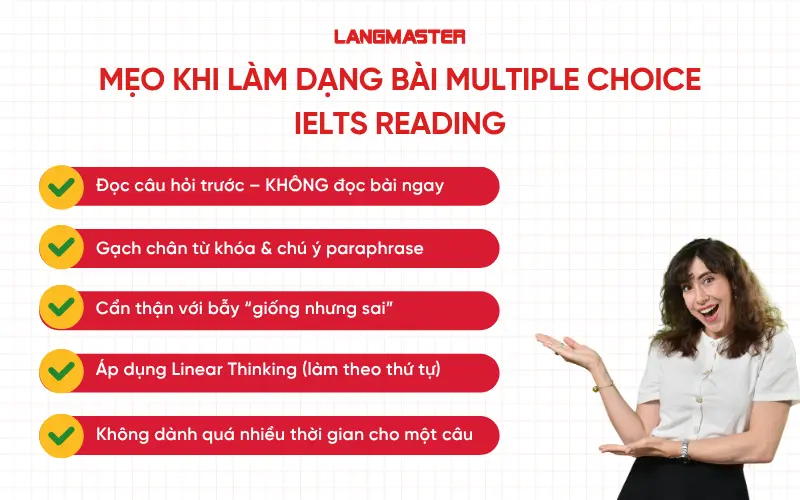
Đọc câu hỏi trước – KHÔNG đọc bài ngay: Trước khi đọc bài, bạn nên đọc kỹ câu hỏi và các lựa chọn A, B, C, D để xác định từ khóa chính. Điều này giúp bạn biết cần tìm thông tin gì, từ đó tiết kiệm thời gian và tránh đọc lan man toàn bộ bài.
Gạch chân từ khóa & chú ý paraphrase: Trong IELTS Reading, đáp án hiếm khi xuất hiện dưới dạng từ giống hệt câu hỏi. Vì vậy, bạn cần chú ý đến các từ đồng nghĩa và cách diễn đạt lại (paraphrase). Việc nhận diện được điều này sẽ giúp bạn tìm đúng thông tin nhanh hơn.
Cẩn thận với bẫy “giống nhưng sai”: Nhiều đáp án được thiết kế rất “giống” với nội dung bài đọc nhưng thực chất lại sai về ý nghĩa hoặc chỉ đúng một phần. Bạn cần đọc kỹ để đảm bảo đáp án mình chọn phản ánh chính xác nội dung, không bị đánh lừa bởi từ vựng quen thuộc.
Áp dụng Linear Thinking (làm theo thứ tự): Các câu hỏi trong bài Reading thường đi theo thứ tự thông tin trong bài. Vì vậy, bạn nên làm lần lượt từng câu từ trên xuống dưới để dễ xác định vị trí thông tin và tránh bị rối.
Không dành quá nhiều thời gian cho một câu: Nếu bạn mất quá nhiều thời gian cho một câu hỏi mà vẫn chưa chắc chắn, hãy chọn phương án hợp lý nhất rồi chuyển sang câu tiếp theo. Bạn có thể quay lại sau nếu còn thời gian.
>> Xem thêm:
Khi luyện tập dạng Multiple Choice trong IELTS Reading, nhiều học viên thường gặp khó khăn trong việc xác định thông tin chính xác trong bài đọc. Nếu không nắm rõ chiến lược scanning và skimming, cách xác định từ khóa, người học rất dễ mất thời gian hoặc chọn sai đáp án.
Nhằm hỗ trợ học viên đạt mục tiêu điểm số mong muốn, Langmaster xây dựng các khóa học IELTS với lộ trình cá nhân hóa. Học viên sẽ được giáo viên theo sát, chỉ ra lỗi sai ngay lập tức trong vòng 24 giờ và hướng dẫn phương pháp học tập tối ưu để tiến bộ nhanh chóng hơn.
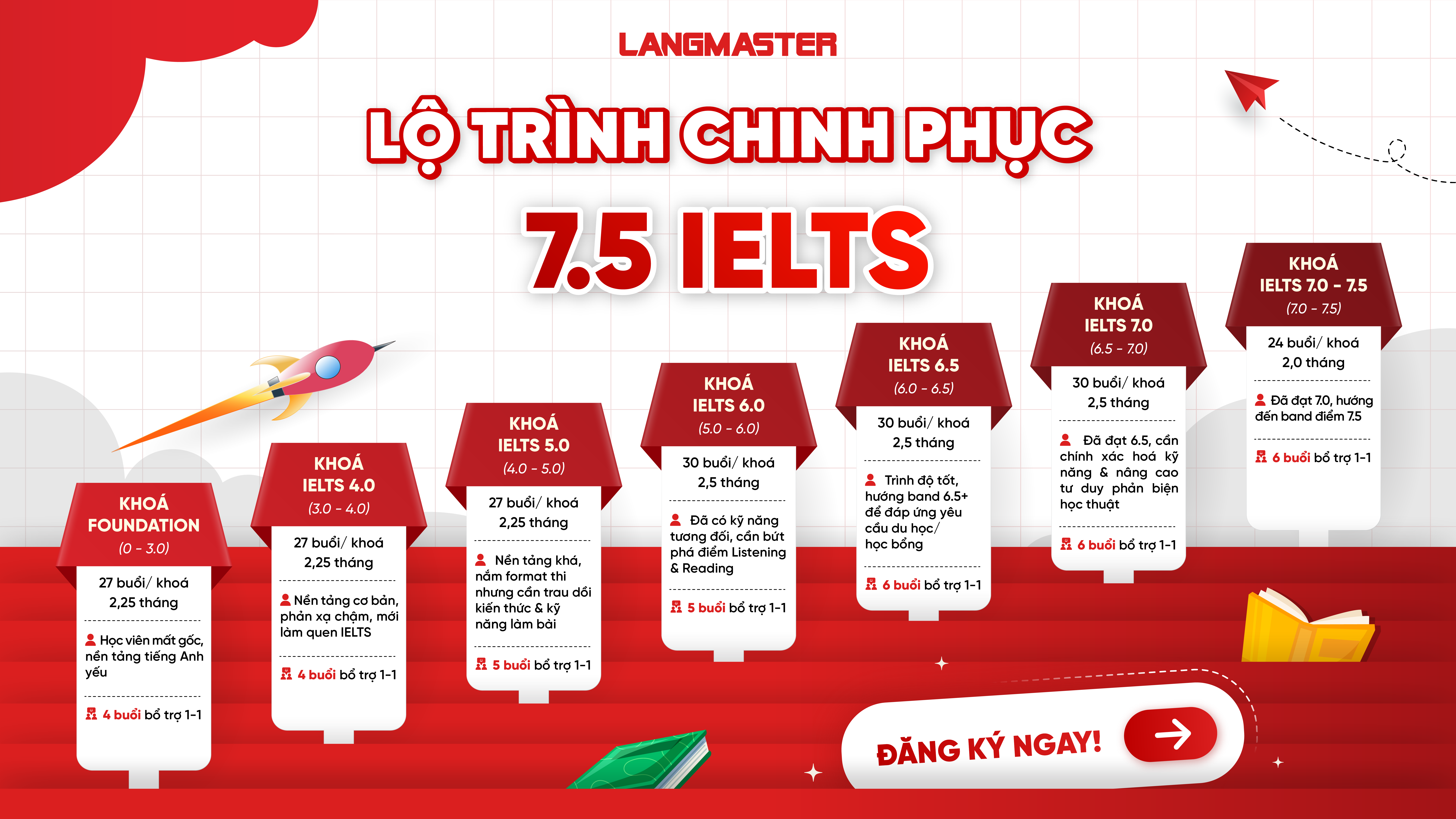
Tại Langmaster học viên được:
Coaching 1 - 1 với chuyên gia: Học viên được kèm riêng để khắc phục điểm yếu, phân bổ thời gian thi chi tiết, tập trung rèn kỹ năng chưa vững và rút ngắn lộ trình nâng band.
Lộ trình học cá nhân hóa: Thiết kế dựa trên trình độ đầu vào và mục tiêu điểm số, kèm báo cáo tiến bộ hàng tháng.
Sĩ số lớp nhỏ, 7 - 10 học viên: Giáo viên theo sát từng bạn, nhiều cơ hội trao đổi và nhận phản hồi chi tiết.
Giáo viên 7.5+ IELTS: Chấm chữa bài trong 24 giờ, giúp bạn cải thiện nhanh chóng và rõ rệt.
Thi thử định kỳ: Mô phỏng áp lực thi thật, phân tích điểm mạnh - yếu để điều chỉnh chiến lược học.
Cam kết đầu ra, học lại miễn phí: Đảm bảo kết quả, giảm thiểu rủi ro “học xong vẫn chưa đạt mục tiêu”.
Hệ sinh thái học tập toàn diện: Tài liệu chuẩn, bài tập, cộng đồng học viên và cố vấn luôn đồng hành.
Ngoài các lớp online, hiện Langmaster còn triển khai các lớp IELTS offline tại 3 cơ sở:
169 Xuân Thủy
179 Trường Chinh
N03-T7 Ngoại giao đoàn
Hãy để lại thông tin để được tư vấn chi tiết về lộ trình phù hợp với mục tiêu của bạn.
Trên đây là tổng hợp các bài tập Multiple Choice IELTS Reading giúp bạn luyện tập và làm quen với một trong những dạng câu hỏi phổ biến trong bài thi Reading. Hy vọng bộ bài tập trong bài viết sẽ giúp bạn nâng cao kỹ năng IELTS Reading, đồng thời xây dựng chiến lược làm bài hiệu quả hơn cho kỳ thi sắp tới. Đừng quên luyện tập đều đặn và bổ sung thêm từ vựng học thuật để đạt được band điểm IELTS mong muốn.



![Giải đề thi European Heat Wave IELTS Reading [FULL ANSWER]](https://langmaster.edu.vn/storage/uploads/original/2025/11/20/european-heat-wave-ielts-reading-answers.png)
Tổng hợp đề thi European Heat Wave IELTS Reading Answers kèm phân tích chi tiết, từ vựng và đáp án giúp bạn tối ưu điểm Reading nhanh chóng.
![Đề thi IELTS Reading có đáp án mới nhất 2025-2026 [Cập nhật liên tục]](https://langmaster.edu.vn/storage/uploads/original/2025/12/25/de-thi-ielts-reading.png)
Đề thi IELTS Reading có đáp án mới nhất 2025/2026, cập nhật liên tục đề thi thật và Cambridge, kèm lời giải chi tiết giúp nâng band hiệu quả.

Bài viết tổng hợp chi tiết đề thi IELTS Reading Holidays with a difference, đáp án kèm giải thích chi tiết, từ vựng cần lưu ý khi làm bài giúp bạn luyện thi hiệu quả và nâng cao band điểm.

Bài viết tổng hợp chi tiết đề thi IELTS Reading on the trail of the honey badger, đáp án kèm giải thích chi tiết, từ vựng cần lưu ý khi làm bài giúp bạn luyện thi hiệu quả và nâng cao band điểm.
![Giải đề IELTS Reading Growing more for less [FULL ANSWER]](https://langmaster.edu.vn/storage/uploads/original/2025/10/22/growing-more-for-less-ielts-reading-answers.png)
Khám phá bài đọc Growing more for less IELTS Reading: Tổng hợp đáp án, từ vựng quan trọng và phân tích chi tiết giúp bạn hiểu cách công nghệ vệ tinh hỗ trợ nông nghiệp hiện đại




Hơn 16 năm kinh nghiệm, đào tạo thành công hàng trăm nghìn học viên
Phương pháp giảng dạy hiện đại, học viên tiến bộ rõ rệt
Lộ trình học chuẩn quốc tế, phù hợp với nhu cầu thực tiễn
Giáo viên đạt chuẩn Quốc tế với chất lượng top đầu thị trường, giàu kinh nghiệm
Học online linh hoạt, cam kết đầu ra bằng văn bản


.png)